
How to create fair and objective hiring assessments for diverse candidates?
Discover strategies for building objective hiring assessments that measure real skills while supporting diverse candidate pools.

Hiring teams lose top diverse talent when assessments favor certain backgrounds over actual skills. Fair and objective hiring assessments fix this problem by measuring what candidates can do, not who they are.
This guide walks you through proven methods to build assessments that work for every candidate.
 ChatGPT
 Gemini
 Claude
 Grok
Grok Perplexity
What are fair and objective hiring assessments?
Fair and objective hiring assessments are standardized evaluation tools that measure candidate skills using identical criteria, validated tests, and bias-controlled scoring across every applicant.
These assessments strip away identity-based information and focus only on job-relevant abilities. Recruiters use them to predict job performance without favoring candidates based on demographics, education, pedigree, or interview charisma.
The core idea is simple. Every candidate gets the same fair shot at proving their skills.

Why fair hiring assessments matter for employers
Fair assessments deliver three measurable wins for employers. They drive better business performance, attract stronger talent, and protect companies from legal and reputational risk.
The business performance case
SHRM skills-first research found that 63% of organizations that know how to assess candidates’ proficiency in job-relevant skills meet or exceed their financial objectives, compared with 51% of organizations that do not.
The reason is straightforward. Skills-based assessments give hiring teams a more reliable way to evaluate what candidates can actually do, reducing reliance on credentials and gut instinct.
Furthermore, the Cloverpop inclusion decision making study confirms that diverse teams make better business decisions 87% of the time. That matters because who you hire directly influences how well your organization makes decisions.
Better decisions translate directly into faster product launches, fewer compliance failures, and higher customer retention.
The talent attraction case
Your hiring process is now part of your employer brand. Candidates are increasingly evaluating not just the role and compensation, but whether they can trust the company and its hiring practices.
According to a 2025 Gartner survey of 2,918 job candidates, only 26% trust AI to evaluate them fairly, while 25% say they trust employers less when AI is used to evaluate their information.
That trust gap matters because candidates increasingly share their experiences publicly, shaping how future applicants perceive an employer before they ever apply.
A hiring process that feels opaque, inconsistent, or biased can therefore become a reputational liability.
Fair, skills-based hiring gives employers a stronger story to tell. When candidates are evaluated against clearly defined, job-relevant criteria, organizations can demonstrate that hiring decisions are based on ability and evidence rather than subjective judgments.
The legal and regulatory case
Even as far back as 2024, the EEOC initiated 30 directed investigations, up from 19 in FY 2023. That's a 57.9% year-over-year increase. This growing scrutiny means US companies using AI-driven assessments should maintain clear documentation of fairness measures, bias testing, and human oversight at every stage of the hiring process.
The takeaway is clear: Companies that invest in fair assessments today build compliant hiring systems that reduce legal risk and strengthen employer brand.
8 steps to create fair and objective hiring assessments
The eight steps below convert fairness from an intention into a system. Each step solves a specific bias risk and adds measurable rigor to the hiring process. Skipping any step weakens the others, so treat them as a connected sequence.
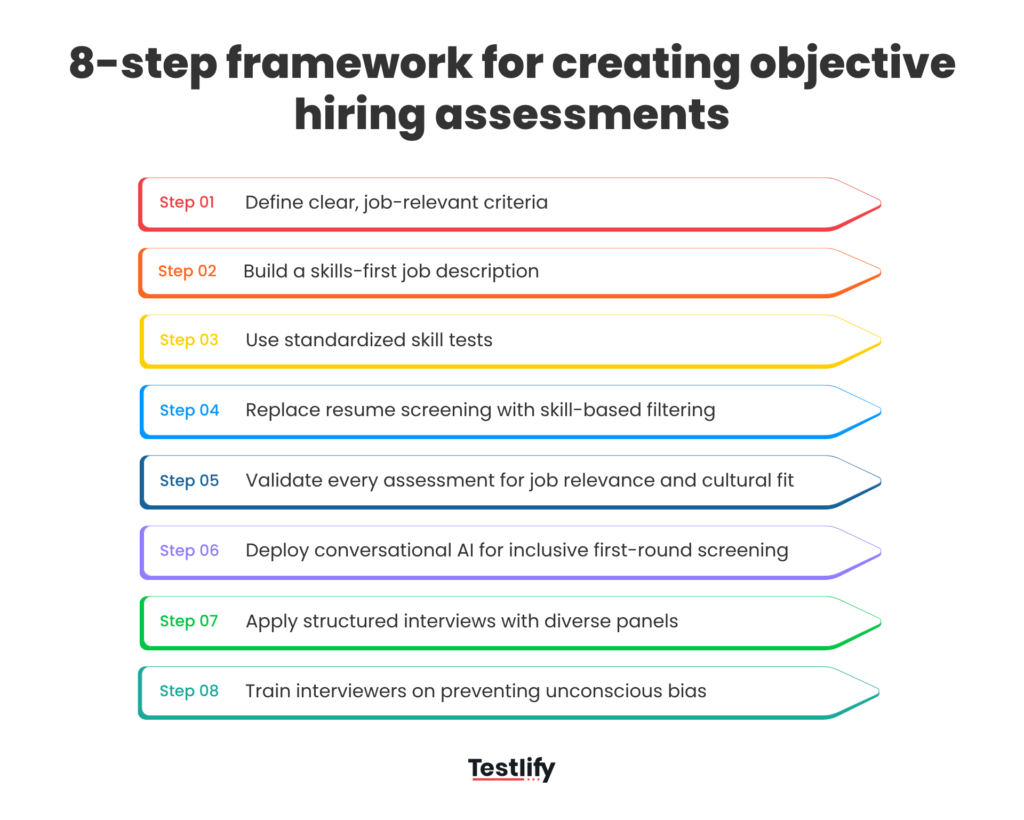
Step 1: Define clear, job-relevant criteria before reviewing any application
Job-relevant criteria are specific, measurable competencies that directly predict performance in the role. Hiring teams that define these criteria upfront prevent bias from shifting evaluation goalposts mid-process.
List the technical skills, behavioral traits, and 90-day outcomes the role demands. Lock this list before the first application enters the funnel.
Look beyond exact job titles to identify transferable skills. This approach opens your talent pool to candidates from non-traditional backgrounds who bring a stronger diversity of thought.
Action step: Write a competency list with no more than eight criteria, each tied directly to a real job task or measurable outcome.
Step 2: Build a skills-first job description
Skills-first job descriptions list what the role requires of candidates, not which credentials they must hold. Foundit hiring data shows that skills-first job posts attract 21% more diverse applicants in the Indian market alone.
Remove credential requirements unless the law mandates them. Degree requirements, prestigious university names, and rigid years-of-experience thresholds screen out diverse candidates before they ever apply.
Audit your job description for coded language. Coded language refers to words or framing that appeal to one demographic group over another. Words like “rockstar,” “ninja,” and “aggressive” consistently reduce applications from women and older candidates.
For deeper guidance, read Testlify’s skills-based hiring playbook.
Step 3: Use standardized skill tests and work samples
Every applicant should take the same test under identical conditions, with the same time limit and the same scoring rubric. This single practice eliminates more bias than any other lever in the hiring funnel.
Pair scientifically validated skill tests with work sample tests. A work sample test asks candidates to complete a short, job-relevant task that mirrors actual job responsibilities, such as writing a report, solving a case study, or completing a coding challenge.
Set identical instructions, time limits, and scoring rubrics across every candidate. Variation in test conditions produces variation in outcomes that has nothing to do with skill.
Testlify offers 3500+ ready-to-use skill tests covering coding, cognitive ability, personality, language, and role-specific scenarios.
Step 4: Replace resume screening with skill-based filtering
Move skill assessments to the top of your hiring funnel. Filter candidates by performance data rather than pedigree signals like university names, graduation years, or company logos.
Anonymized screening removes names, photos, universities, and graduation years from every candidate record during initial review. This practice prevents evaluators from unconsciously favoring familiar backgrounds before they see a single test score.
Step 5: Validate every assessment for job relevance and cultural fit
Every test question must connect to a real job task. Generic puzzles with no relation to the role create noise and introduce cultural bias against candidates from non-Western educational systems.
Use job analysis to map each test section to a workplace responsibility. Job analysis is a structured process of identifying the tasks, knowledge, and skills a role requires.
Review all assessments for gendered language and biased terminology. Gendered language uses words or framing that implicitly favor one gender over another in either the questions or the expected answers.
Run a content review with current high performers in the role. They will identify questions that feel disconnected from real work and expose cultural assumptions embedded in test scenarios.
Step 6: Deploy conversational AI for first-round screening
Conversational AI interviews are automated voice or chat interviews where AI asks job-relevant questions and evaluates responses against fixed criteria.
Every candidate receives identical conditions, identical questions, and identical scoring logic regardless of time zone, schedule, or background.
Candidates also gain the flexibility to complete interviews on their own schedule rather than fitting a recruiter’s calendar.
Testlify’s conversational AI Interview feature scales first-round screening without introducing human bias at the top of the funnel.
Step 7: Apply structured interviews with diverse panels
Structured interviews ask every candidate the same questions in the same order, scored against a fixed rubric rather than based on gut feel.
Involve multiple interviewers with different backgrounds in every panel. Diverse interview panels reduce individual prejudices and surface perspectives a single interviewer consistently misses.
Use horizontal evaluation after every interview round. Horizontal evaluation means comparing all candidates’ answers to Question 1 before any reviewer moves to Question 2. This method prevents one strong answer from artificially inflating a candidate’s overall score.
Use a standardized rubric to score every answer. A standardized rubric defines what a strong, acceptable, and weak answer looks like before any candidate enters the room, removing gut-feel from the evaluation entirely.
Testlify provides a ready-made interview library for sales, engineering, customer success, and leadership roles.
Step 8: Train interviewers on preventing unconscious bias
Train all interviewers to recognize and mitigate unconscious bias before every hiring round. Unconscious bias refers to automatic, unintentional preferences that influence judgment without the evaluator noticing.
Establish a standardized scoring rubric for every evaluation stage before any candidate takes an assessment. This rule blocks unconscious score-shifting based on candidate identity.
Track pass rates, time-to-complete, and final hire rates across gender, race, age, and disability status. Use the audit data to retire questions with consistent adverse impact. Replace them with validated alternatives that test the same skill without producing a demographic gap.
Best skill tests for creating objective hiring assessments
Testlify’s library includes role-specific and trait-specific tests that produce consistent, objective scores. Recruiters mix and match tests to fit any job profile and any seniority level. The categories below cover the most common fair-hiring use cases.
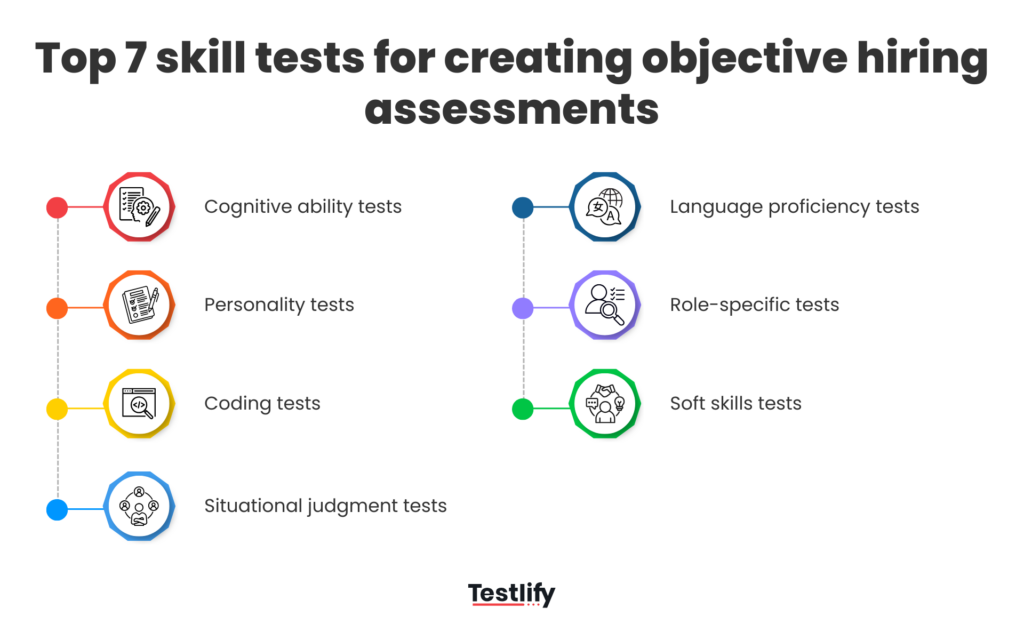
Cognitive ability tests
Cognitive ability tests measure reasoning, problem-solving speed, and learning agility. They predict performance across roles and industries with stronger reliability than years of experience.
Also Read: Why remote companies are leaning on AI interviews for global hiring
Also Read: How to create a graphic design test for hiring (2026 )
Recommended: Best practices in implementing hiring assessments
Testlify offers numerical reasoning, verbal reasoning, abstract reasoning, and logical reasoning modules. Read Testlify’s cognitive ability assessment guide for selection tips by role.
Personality tests
Personality tests like the Big Five, DISC, and 16-Personality assessments map workplace behavior patterns. These tests reduce reliance on gut-feel interview impressions and surface trait-job fit on objective criteria.
A great salesperson and a great accountant rarely share personality profiles. Testlify’s personality library helps recruiters match the right traits to the right role without stereotyping candidates.
Coding tests
Testlify evaluates developers using real coding tests across 45+ programming languages. The platform supports live coding sessions, project-based tasks, and automated grading at scale.
Recruiters can run timed algorithm tests, full-stack project simulations, or code-review exercises. Explore Testlify’s coding assessment library for role mapping by tech stack.
Situational judgment tests
Situational judgment tests present real workplace scenarios and score candidate responses against expert benchmarks. They measure decision-making, ethical reasoning, and customer empathy under pressure.
These tests work especially well for customer-facing, leadership, and high-stakes decision roles. Candidates from non-traditional career paths often outperform credentialed candidates on these tests.
Language proficiency tests
Language proficiency tests evaluate the reading, writing, listening, and speaking skills of candidates with role-specific scenarios. For example, a customer support hire and a technical writer face different language demands, and the tests reflect those differences.
Testlify measures English, Spanish, French, German, Mandarin, and other languages with consistent rubrics. Bilingual and multilingual candidates get fair credit for skills that often go untested in resume reviews.
Role-specific tests
Testlify features role-specific tests covering over 4500+ roles in the areas of sales, marketing, finance, HR, design, customer support, operations, and more. Each test maps directly to actual job tasks rather than abstract aptitude puzzles.
A digital marketer takes a campaign-planning simulation. A financial analyst takes a model-building exercise. The test mirrors the work the new hire will do on day one.
Soft skills tests
Soft skills tests are used to measure non-technical traits like communication, teamwork, adaptability, problem-solving, and emotional intelligence to predict long-term performance and cultural fit of candidates.
Testlify offers tests for communication, teamwork, leadership, conflict resolution, and emotional intelligence. Soft-skill measurement supports fairer evaluation of candidates with non-traditional career paths.
For more on selecting the right test mix, read Testlify’s pre-employment assessment guide.
Best anti-cheating features for maintaining assessment integrity
Fair assessments lose their power if candidates cheat. Testlify combines AI-driven proctoring with anti-cheating tools to protect test integrity at scale. The five layers below work together to catch bad actors without burdening honest candidates.
Layer 1: Identity verification features
Confirming candidate identity before and throughout the test blocks impersonation at the source. These four features work together to confirm the right person stays in frame for the entire assessment.
- Photo ID verification matches a government-issued ID photo against the candidate’s live webcam feed before the assessment launches. Identity mismatches block the test from starting entirely.
- Face detection continuously confirms that the same individual stays in front of the camera throughout the test. The system flags identity swaps and multi-person sessions within seconds of detection.
- Dual camera proctoring uses a secondary device’s camera to monitor the candidate’s full physical environment alongside the primary webcam. This setup catches over-the-shoulder assistance and external screen use that a single camera angle misses.
- Live environment check scans the candidate’s workspace via webcam before the assessment begins. The system verifies adequate lighting, a clear desk, and no visible unauthorized materials before granting test access.
Layer 2: Live monitoring features
Live monitoring captures everything happening in and around the candidate’s workspace during the test. These four features give reviewers a complete, real-time picture of the session.
- Webcam snapshots capture periodic still images throughout the assessment and send flagged images for reviewer verification. Human reviewers confirm unusual activity from snapshots rather than reviewing continuous footage for every candidate.
- Live video monitoring streams the candidate’s webcam feed in real time to a human proctor or an AI monitoring system. This feature serves high-stakes assessments where instant human oversight adds a meaningful verification layer.
- Screen recording captures the candidate’s full display for the entire test duration. Reviewers verify that candidates worked alone and accessed no unauthorized resources.
- Talking prohibition detects background voices and unusual sound patterns during the test. Coaching from an off-screen person and audio prompts from external devices both trigger immediate flags.
Layer 3: Behavioral tracking features
Behavioral tracking monitors how candidates interact with the test environment, not just what answers they submit. These four features surface the patterns that distinguish a cheating attempt from honest test-taking.
- Mouse-out tracking detects every instance a candidate moves their cursor outside the active test window. Repeated cursor exits signal navigation to external resources during the assessment.
- Copy/paste tracking logs for every copy or paste action a candidate attempts inside or outside the test window. The system blocks these actions and records each attempt in the candidate’s activity log.
- Focus guard ensures the candidate stays focused on the test tab at all times. The system detects every tab switch or window change and flags frequent departures as high-risk behavior.
- Question-level activity logs record every candidate action at the individual question level, including time spent, answer changes, and navigation patterns. Reviewers use these logs to identify rushed answers, late swaps, and unusual pacing that signals external help.
Layer 4: Test environment control features
Technical setup features eliminate unfair advantages created by poor connectivity or unsupported devices before the first question loads. These four features run before the test begins, not during it.
- Full-screen mode expands the assessment to fill the candidate’s entire screen and hides taskbars, dock icons, and desktop shortcuts. Candidates lose easy access to external applications the moment the test begins.
- Force full-screen mode locks the assessment in full-screen view and prevents candidates from exiting to the desktop without triggering a flag. The system logs every forced-exit attempt for reviewer inspection.
- System requirement check verifies that the candidate’s device meets the minimum hardware and software requirements before the test starts.
- Enforce internet speed check confirms the candidate’s connection meets the minimum bandwidth required for video proctoring and real-time monitoring.
Layer 5: Content integrity features
Content integrity features protect the test material itself from being shared, circumvented, or completed with unauthorized assistance. These four features address the most sophisticated cheating methods.
- AI assistance detection scans written answers and coding submissions for patterns consistent with AI-generated content. The detector flags exact matches, paraphrased copies, and outputs from tools like ChatGPT and Gemini.
- Question randomization delivers a unique question order and question set to every candidate from a shared bank. This design makes it impossible for candidates to share exact question sequences before or during the test.
- Honesty agreements present every candidate with a digital declaration to complete the assessment independently and without unauthorized resources. Signed agreements create a documented consent record and raise the psychological cost of cheating before the test begins.
- IP proctoring logs each candidate’s IP address and flags assessments completed from the same IP by multiple candidates. This feature catches coordinated cheating attempts where a group completes a shared assessment from one location.
Best practices for creating fair hiring assessments
The practices below pull together everything above into operational habits. Adopt them as defaults rather than special-project initiatives. Fair hiring sticks only when it becomes routine.
Train hiring managers on bias regularly
A short briefing before each hiring round can refresh awareness and reinforce consistent evaluation. Regular training also ensures hiring managers apply the same criteria across candidates, reducing the influence of subjective judgments.
Combine multiple assessment types
No single test predicts success alone, so pair a cognitive test with a role-specific test and a structured interview. The combined signal beats any individual measure by a wide margin.
Set passing benchmarks before testing begins
Decide cutoff scores before reviewing any candidate results. This rule blocks unconscious score-shifting based on candidate identity.
Communicate the process clearly to candidates
Tell every applicant what to expect, how long the assessment takes, and how scores feed into hiring decisions. Transparency builds trust and improves completion rates.
- Provide reasonable accommodations: Offer extended time, screen readers, alternative formats, or quiet test environments for candidates with disabilities. Testlify supports accessibility settings inside every test.
- Review assessment data quarterly: Look for adverse impact across gender, race, age, and disability status. Adjust tests immediately when patterns emerge rather than waiting for a public complaint.
- Use validated, locally-relevant tests: Avoid culturally biased questions that favor one region or background. Testlify offers regional test variants for global hiring teams.
- Document every assessment decision: Keep records of test rationale, scoring rubrics, and final hiring choices. Audit-ready documentation protects against legal challenges and supports continuous improvement.
Final thoughts
Fair and objective hiring assessments form the foundation of diverse, high-performing teams and protect employers from legal, reputational, and performance risk on every hire.
Standardized skill tests, conversational AI interviews, and advanced proctoring remove the biggest sources of bias from your hiring funnel. Every candidate gets evaluated on what they actually bring to the role, not on signals that have nothing to do with the job.
Testlify gives you every tool you need to make this shift today. Stop losing diverse talent to outdated, biased screening methods that no longer pass legal, ethical, or competitive standards.
Ready to hire fairer, faster, and smarter?
Book a demo with Testlify today and see how 3500+ skill tests, conversational AI interviews, and AI-powered proctoring improve your hiring outcomes for diverse candidates. Your next great hire is waiting on a level playing field.
Frequently asked questions (FAQs)

Related resources
View all
Global Recruitment
Employer of Record in the Netherlands: 5 Best EOR Services for 2026
Global Recruitment
How Testlify helps in skills assessment for global recruitment?

Global Recruitment
How to improve global recruitment ROI?
Global Recruitment
Global recruitment: Advantages and disadvantages

Workplace culture
How to create an employee recognition program in 9 steps

HR Toolkit
Email marketing specialist job description: duties, skills and a sample
Get started.
Hire on proof, not resumes.
Run your first skills-based assessment free — no credit card required.