
How to improve global recruitment ROI?
Learn how to calculate and improve global recruitment ROI with simple tactics and 5 monthly metrics to track.

With the global jobs gap expected to reach 408 million dollars this year, every open role represents a direct loss in productivity and revenue. This makes global recruitment ROI one of the most important metrics for your business.
Recruitment ROI is a metric that measures the financial profit or value your company gains from a new hire compared to the total amount of money spent to find, interview, and hire them.
Defining your ROI is just the beginning; the real goal is to improve these results by removing friction from your hiring process. Let’s dive into specific ways you can optimize recruitment efforts so your international hires contribute measurable business value.
Also read: What is global recruitment? Pros, importance, best practices
 ChatGPT
 Gemini
 Claude
 Grok
Grok Perplexity
TL;DR – Key takeaways
- Global recruitment ROI compares the value a hire brings to what you spend to source, assess, and hire them across countries.
- Calculate ROI by listing all hiring costs first, then estimating returns like faster role coverage, better performance, and lower early turnover.
- The biggest ROI gains usually come from reducing time-to-fill, improving shortlist quality with skills screening, and cutting offer drop-offs with early pay clarity.
- Decide the hiring model upfront and keep interviews structured to avoid rework, delays, and inconsistent decisions.
- Review five metrics monthly (cost per hire, time to fill, offer acceptance, quality of hire, 90-day retention) and fix one leak at a time.

How to calculate global recruitment ROI (The formula)
The global recruitment ROI formula
The most straightforward way to calculate this is by using the standard ROI percentage formula:
ROI = {Total benefit of hire} – {Total cost of hire} / {Total cost of hire} x 100
- Positive ROI: You are gaining more value than you spent.
- Negative ROI: The hiring process is costing more than the value the employee provides.
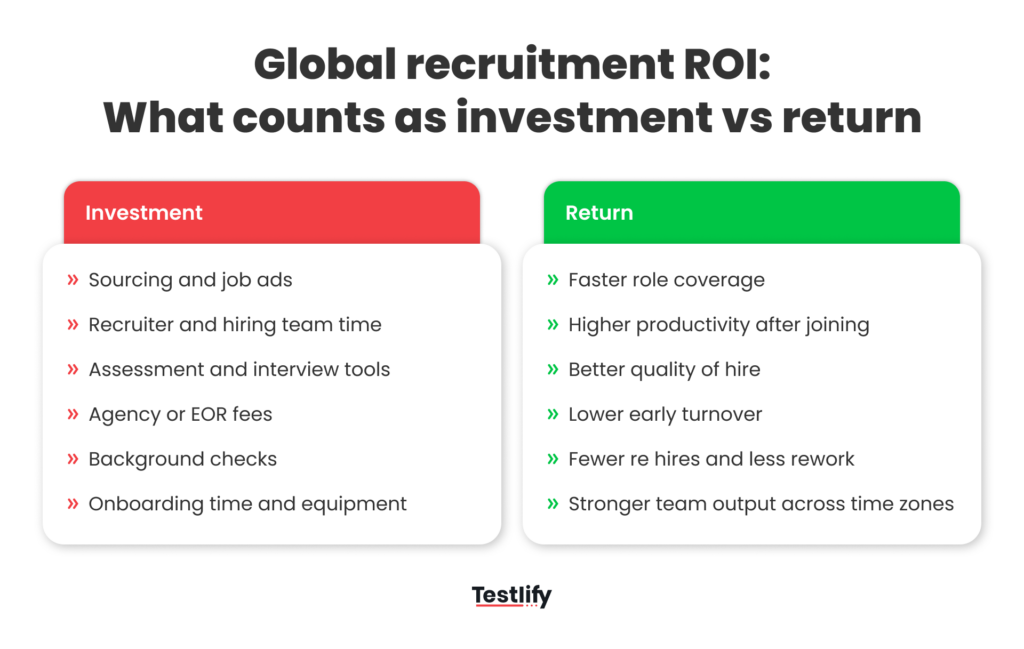
Breaking down the investment (your costs)
In a global setting, hiring costs go beyond just a job advertisement. You must include both direct and hidden expenses:
- Sourcing and advertising: Money spent on international job boards, social media ads, and LinkedIn Recruiter seats.
- Third-party fees: If you use a Global Staffing Agency or an Employer of Record (EOR), include their placement fees or monthly service charges.
- Internal staff time: The cost of the hours your recruiters and hiring managers spend reviewing resumes and conducting interviews.
- Technology stack: Subscriptions for an ATS (Applicant Tracking System) and skills-based screening tools like Testlify that help filter candidates.
- Compliance and legal: Costs for background checks, identity verification, and local legal advice to avoid “misclassification” fines.
Breaking down the return
The “Return” is the total financial benefit the hire brings to the company. For global teams, this includes:
- Geographic salary savings: The difference between what you would pay a local hire versus a global hire in a different region with a lower cost of living.
- Increased productivity: Highly skilled international talent can often fill niche roles faster, reducing the cost of vacancy where projects sit idle.
- Reduced operational overhead: Remote global teams save an average of $11,000 per employee every year in office space, utilities, and equipment costs.
- Innovation revenue: Teams with higher diversity are proven to generate significantly more revenue (up to 45% of their total) from new products and innovation compared to less diverse teams.
- 24/7 business continuity: Using a follow-the-sun model where teams in different time zones work on the same project can double the speed of delivery without increasing headcount.
Strategies to improve your global recruitment ROI
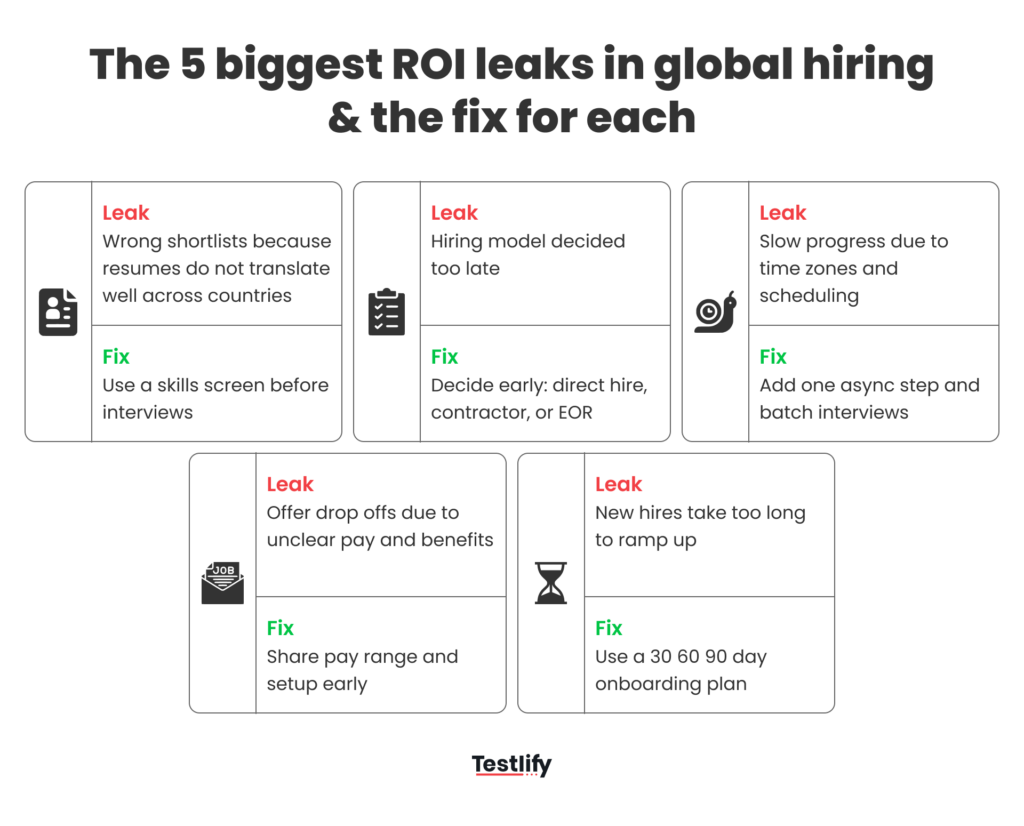
Improving ROI requires a two-pronged approach: reducing the total cost of hire and maximizing the long-term value the hire brings to the company.
Implement skills-first screening early
Resumes and job titles vary significantly across countries and can be unreliable. Using a brief skills-based assessment at the very start of your hiring process provides immediate evidence of a candidate’s ability.
Standardized screening can reduce your time-to-hire by 30%-75%. By only interviewing top performers, you save hundreds of hours of manager time and drastically reduce the risk of a “bad hire”.
Decide the hiring model upfront
Many companies lose ROI by starting a search before locking in how they will legally engage the talent (e.g., Direct Hire, Contractor, or Employer of Record).
Choosing the model early prevents late-stage legal reviews and offers delays that cause top candidates to drop out . If you don’t have a local entity, using an EOR is the fastest way to stay compliant with local labor laws.
Shift to asynchronous communication
In international hiring, time zone differences often create a “lag” in decisions and daily work. In this scenario, shift to asynchronous communication (recorded video answers or documented hand-offs) prevents meeting fatigue and burnout.
Pay transparency
Global candidates often drop out late in the process if compensation, currency, or tax implications are unclear. Sharing a realistic pay range and engagement structure early increases your offer acceptance rate and attracts higher-quality applicants.
Use structured interviews to predict performance
Conversational interviews are prone to bias and inconsistent decisions. Using the same scorecard and rubric for every candidate ensures you are hiring for skill, not just cultural similarity. Data consistently shows that structured interviews are far better at predicting job success.
90-Day onboarding plan
ROI isn’t achieved at the “offer accepted” stage; it begins when the hire is fully productive. A structured 30-60-90 day onboarding plan ensures a faster “ramp-up” time. Also, Faster productivity means a quicker return on your initial investment.
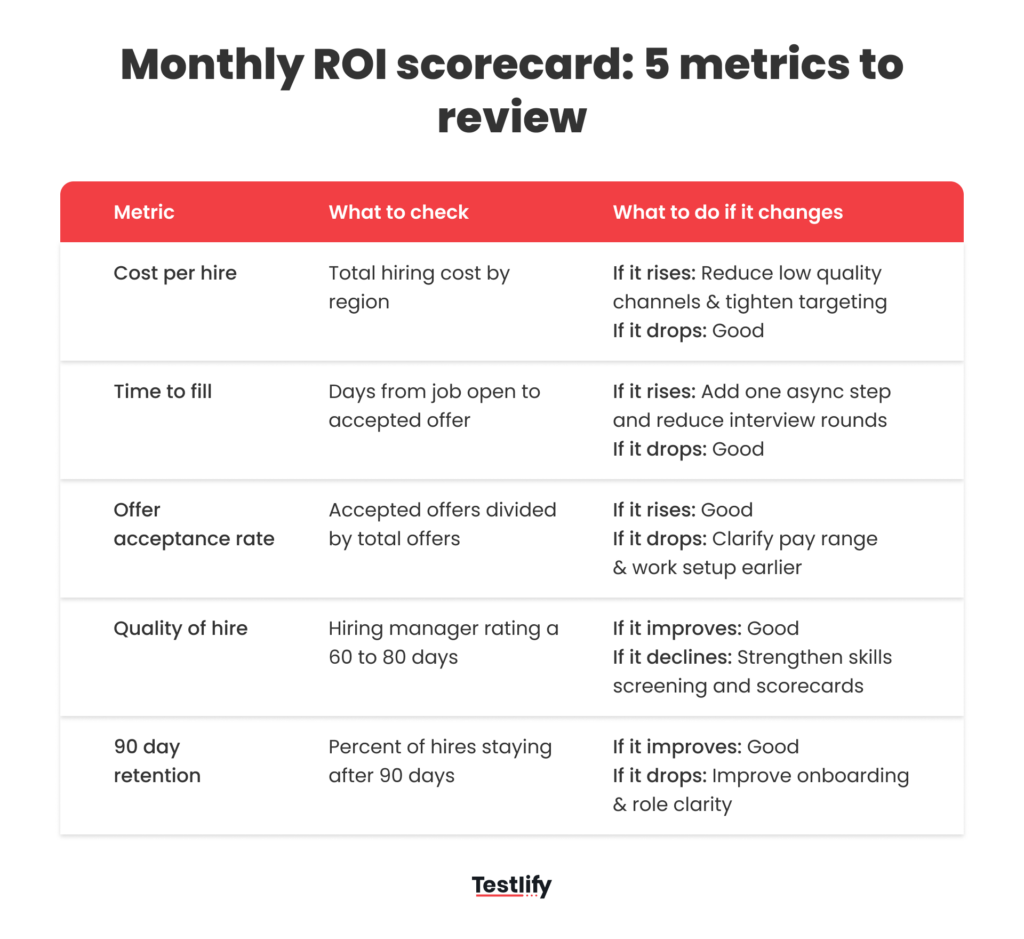
Review these 5 metrics every month
To keep your global recruitment ROI on track, you cannot wait until the end of the year to see what worked. You need to review these five tactical metrics every month.
Cost per hire
Cost-per-hire is the total money spent to fill a role. For international hiring, you must look beyond just job board fees. Include recruiter salaries, software costs (like your ATS or Testlify), and “hidden” global costs like Employer of Record (EOR) fees and bank transfer markups.
Try out: Cost per hire (CPH) calculator
Time to fill
This measures how many days it takes from posting a job description to having a candidate sign the offer. Watch for delays caused by time zones or slow feedback loops between global managers.
Offer acceptance rate
This is the percentage of candidates who say “yes” to your job offer. If candidates are dropping out at the end, look at your pay range and benefits transparency. Low acceptance rates mean you are wasting weeks of recruitment efforts only to start over, which doubles your sourcing costs.
Quality of hire
This tracks how well a new hire performs once they join the team. Measure how quickly a new hire reaches full productivity (ramp-up time) and their scores on skills-first screening during the interview.
A high-quality hire brings in more revenue and innovation, while a “bad hire” can cost your company 30% of their annual salary in lost time.
Retention rate (90-day turnover)
This measures how many team members stay with your company after the first three months. Look for early departures caused by time-zone burnout or a poor onboarding boarding process.
Early attrition is the biggest ROI killer because you lose your entire investment before the employee has time to provide any value.
Also read: Employee onboarding process: A complete guide
Why should you track these metrics?
Tracking matters because it tells you exactly where ROI is leaking in global hiring. If time-to-fill goes up, vacancy time increases and work gets delayed. If funnel conversion drops, you are wasting spend on candidates who never reach the offer stage. If offer acceptance falls, you are losing strong candidates late, which forces you to restart and pay the same costs again.
And if quality-of-hire or 90-day retention is weak, the biggest ROI loss is already locked in because re-hiring costs more than getting the process right the first time. These metrics give you early signals so you can fix the process quickly instead of doing a full reset after a few bad outcomes.
Conclusion
Global recruitment ROI isn’t about chasing the lowest-cost hire. It’s about building a process that gets you the right people faster, keeps them longer, and avoids expensive rework around time zones, offers, and compliance.
If you want to see how Testlify can help you screen global candidates consistently and reduce wasted interview time, book a demo.
Frequently asked questions (FAQs)

B2B SaaS Content Writer
Rishav Kumar is a B2B SaaS content writer with 4 years of experience. He loves crafting engaging content. Always exploring fresh ideas, he's passionate about helping businesses grow through impactful writing.
LinkedInRelated resources
View all
Global Recruitment
Global recruitment: Advantages and disadvantages

Global Recruitment
How to create fair and objective hiring assessments for diverse candidates?

Global Recruitment
Employer of Record in the Netherlands: 5 Best EOR Services for 2026

Global Recruitment
How Testlify helps in skills assessment for global recruitment?

Talent Acquisition
Hiring military veterans: a practical guide for employers in 2026

HR Statistics
Employer concerns survey 2026: What the data means for hiring
Get started.
Hire on proof, not resumes.
Run your first skills-based assessment free — no credit card required.