
Global recruitment: benefits, models, and best practices
Discover the benefits, importance, and best practices of global recruitment to help your business attract top talent worldwide.

Global recruitment is the practice of sourcing, screening, and hiring people from international talent pools instead of limiting your search to one country. Companies use it to reach skills that are scarce or expensive at home, to build teams across time zones, and to hire faster for roles that sit empty locally.
This guide explains what global recruitment is, the hiring models to choose from, the benefits and risks, and a practical process to run it well.
TL;DR
- Global recruitment means hiring beyond your borders so you can reach skills that are not available or affordable locally.
- Pick the hiring model early. Direct employment, an Employer of Record, a contractor arrangement, and a staffing agency each fit a different stage and budget.
- The upside is a wider talent pool, faster hiring for niche roles, and more diverse teams that tend to perform better.
- The risks are compliance, worker misclassification, time-zone drag, and inconsistent pay, so you need a clear process and a set pay range.
- Screen with skills-based assessments before the first call. It keeps the bar even across countries where degrees and job titles do not compare cleanly.
 ChatGPT
 Gemini
 Claude
 Grok
Grok Perplexity
What is global recruitment?
Global recruitment is the process of finding, evaluating, and hiring candidates who live and work outside your home country. Instead of posting a role and waiting for local applicants, you decide which markets to hire in, choose a legal way to employ people there, and set consistent standards for pay, screening, and onboarding across borders.
The reason it has moved from a nice-to-have to a core hiring strategy is supply. Roughly three in four employers worldwide (75%) report trouble finding the skilled talent they need, up from 36% a decade ago, according to ManpowerGroup’s talent shortage research. When the skills are not in your city, the fastest route is often to widen the map.
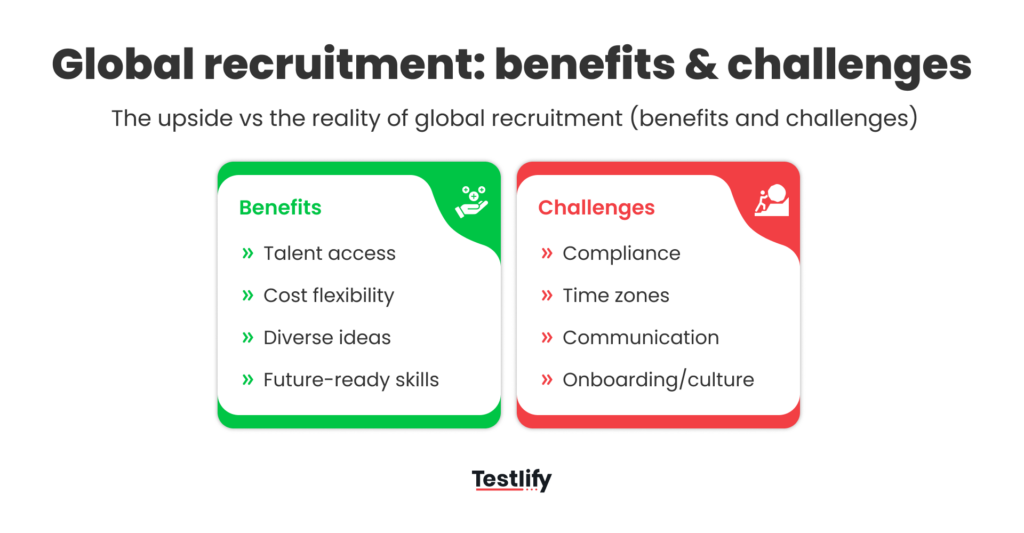

Global recruitment vs local hiring: what changes?
Local hiring draws from one labor market under one set of rules. Global recruitment draws from many, which widens the talent pool but adds legal, payroll, and coordination work. The table below shows where the two differ and what that means for how you run the process.
Factor | Local hiring | Global recruitment |
|---|---|---|
Talent pool | One city or country | Many countries and skill markets |
Employment setup | Your existing entity | Local entity, EOR, or contractor per country |
Compliance load | One legal framework | Tax, labor, and data rules per country |
Pay setup | One currency and market rate | Multiple currencies and cost-of-living bands |
Collaboration | Shared working hours | Async work across time zones |
Screening | Familiar degrees and titles | Skills-based tests to compare fairly |
What are the main global hiring models?
Most companies hire abroad through one of four models. The right one depends on how long you plan to keep the role, how much control you need, and whether you already have a legal presence in the country.
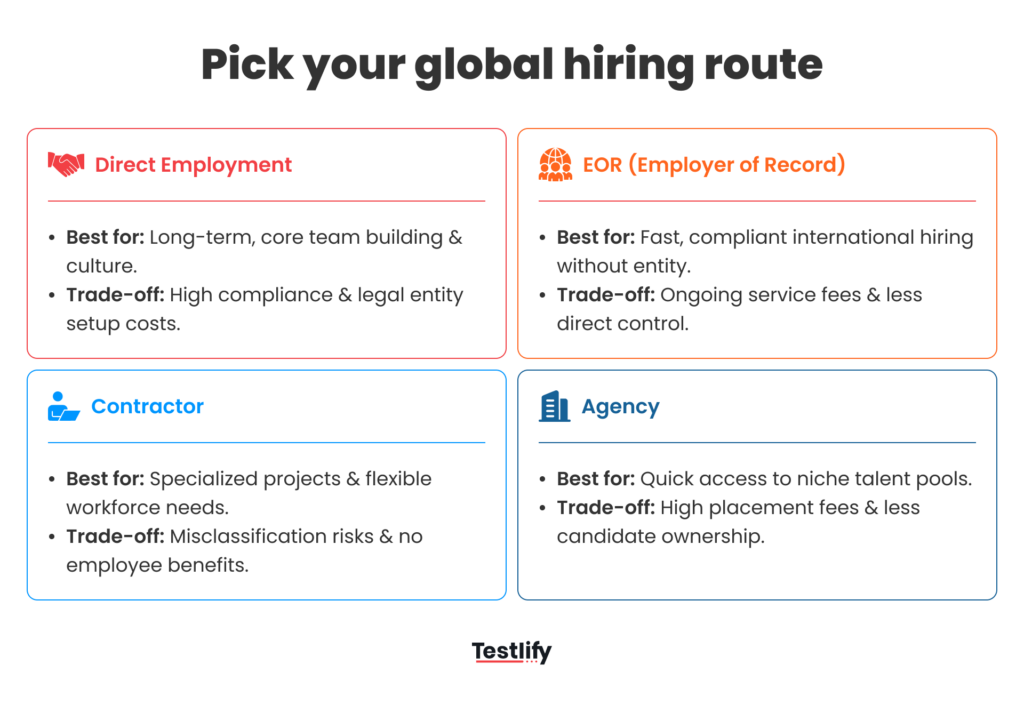
Direct employment
Direct employment is the traditional global hiring model where your company establishes a legal entity in the country and hires employees directly. It offers the highest level of control over culture, performance, and employee experience, making it the preferred option for long term international expansion.
Pros
- Full control over hiring, compensation, and HR policies.
- Builds a stronger company culture and employee loyalty.
- Best suited for long-term workforce planning.
- Gives direct oversight of performance and career development.
Considerations
- Requires establishing and maintaining a local legal entity.
- Higher costs for payroll, taxes, benefits, and compliance.
- Takes longer to enter new international markets.
- Ongoing legal and administrative responsibilities.
Employer of Record (EOR)
An Employer of Record (EOR) hires employees through its local legal entity while your company manages their day to day work. This allows you to hire internationally without setting up your own entity.
Pros
- Hire employees quickly in new countries.
- Local payroll, taxes, benefits, and compliance are handled for you.
- Reduces legal and employment risks.
- Ideal for testing new markets before expanding permanently.
Considerations
- Ongoing service fees can add up over time.
- Less flexibility over certain employment policies.
- May become more expensive than direct employment as your workforce grows.
- Some HR processes remain dependent on the EOR provider.
Contractor
Hiring independent contractors provides flexibility without creating a traditional employment relationship. Contractors usually manage their own taxes and benefits while working on defined projects or short-term assignments.
Pros
- Fast onboarding and flexible engagement.
- Lower fixed employment costs.
- Easy to scale your workforce up or down.
- Access to specialized skills for short-term needs.
Considerations
- Risk of worker misclassification if employment rules are not followed.
- Contractors are generally not eligible for employee benefits.
- Less control over work schedules and processes.
- May not be suitable for long-term core business roles.
Recruitment agency
Recruitment agencies source, screen, and recommend candidates on your behalf. They help companies fill difficult roles faster by leveraging established talent networks and recruitment expertise.
Pros
- Faster access to qualified candidates.
- Reduces the workload for internal recruiting teams.
- Useful for executive, specialist, or high-volume hiring.
- Provides market insights and salary benchmarking.
Considerations
- Placement fees can be significant.
- Less control over the initial candidate experience.
- Candidate quality depends on the agency’s recruitment process.
- Long-term hiring costs may be higher than building an internal recruiting function.
How to choose the right hiring model
The best hiring model depends on your growth plans, hiring timeline, budget, and how much operational control you need in each country.
- Choose Direct Employment if you’re building a long-term team, have or plan to establish a local legal entity, and want full control over hiring, culture, and employee experience.
- Choose an Employer of Record (EOR) if you need to hire quickly in a new market without setting up a local entity while staying compliant with local employment laws.
- Choose Contractors if you need specialized expertise, short-term project support, or the flexibility to scale your workforce up or down without long-term employment commitments.
- Choose a Recruitment Agency if you’re hiring for hard-to-fill roles, need access to niche talent pools, or want to accelerate hiring without expanding your internal recruiting team.
Why does global recruitment matter in 2026?
Two forces make global recruitment a mainstream strategy rather than an edge case: a widening skills gap and the normalisation of distributed work. Skills gaps are now the single biggest barrier to business transformation, cited by 63% of employers in the World Economic Forum’s Future of Jobs Report 2025.
The same research projects 78 million net new jobs by 2030, with close to 40% of core skills expected to change over the same period and 59 of every 100 workers needing reskilling or upskilling. When the skills you need are shifting this fast, one local market rarely keeps up.
Talent is also moving. Permanent migration to OECD countries hit a record 6.5 million people in 2023, a 10% rise on the prior year and 28% above 2019 levels, per the OECD International Migration Outlook 2024. More cross-border movement plus stable remote work means the pool of people open to working for a foreign employer is larger than it has ever been.
Benefits of global recruitment
Hiring globally gives companies access to talent, skills, and markets that may not exist locally. Beyond filling vacancies faster, it helps businesses build stronger teams, improve resilience, and support international growth.
Access to a larger talent pool
Expanding your search beyond one city or country dramatically increases the number of qualified candidates. This is especially valuable for hard-to-fill roles in technology, engineering, healthcare, and other specialist fields where local talent may be limited.
Hiring globally also reduces dependence on a single labor market, making it easier to continue recruiting even when local hiring conditions are competitive.
Build diverse, high-performing teams
Global recruitment brings together employees with different experiences, perspectives, and problem solving approaches. Diverse teams are often better equipped to innovate, understand international customers, and make balanced business decisions.
For organizations expanding into new markets, hiring local talent also provides valuable cultural knowledge and market expertise that can improve customer relationships and business performance.
Improve cost efficiency
Compensation levels vary significantly between countries. Hiring internationally allows companies to build skilled teams while aligning salaries with local market rates rather than paying a single global benchmark.
The goal is not to underpay employees, but to pay competitively within each market. This approach can lower overall hiring costs while remaining fair to employees and sustainable for the business.
Scale your business faster
Global hiring enables companies to expand into new regions without waiting to relocate employees or build local teams from scratch. Whether entering a new market or supporting international customers, hiring talent where the work happens helps businesses grow more quickly.
It also provides greater flexibility to scale teams up or down based on changing business needs.
Increase business resilience
Relying on talent from a single location creates risk during labor shortages, economic shifts, or regional disruptions. A geographically distributed workforce spreads that risk across multiple markets and improves business continuity.
Companies with global teams are often better positioned to respond to changing customer demands and operate across multiple time zones.
Pro tip: Treat cost as a byproduct of a good hire, not the goal. Teams that lead with the lowest rate tend to churn and re-hire within a year. Lead with the skills match, set a fair local range, and the cost math still works in your favor.
Challenges of global recruitment
Hiring talent across borders creates opportunities, but it also introduces legal, operational, and cultural complexities. Understanding these challenges early helps companies build a compliant and scalable global hiring strategy.
Compliance and worker classification
Every country has its own employment laws covering contracts, taxes, benefits, notice periods, and worker protections. Misclassifying an employee as an independent contractor can result in fines, back taxes, and legal disputes.
Companies hiring internationally need a clear understanding of local regulations or support from local legal experts or an Employer of Record (EOR).
Key challenges
- Different labor laws in every country.
- Risk of employee misclassification.
- Complex tax and social security requirements.
- Country-specific employment contracts and compliance obligations.
Payroll and pay equity
Managing payroll across multiple countries means dealing with different currencies, tax systems, payment schedules, and statutory benefits. At the same time, companies must ensure compensation remains fair and competitive within each local market.
A well-defined global compensation framework helps maintain consistency while respecting regional salary differences.
Key challenges
- Managing multiple payroll providers and currencies.
- Maintaining pay equity across global teams.
- Complying with local tax and payroll regulations.
- Balancing global consistency with local market rates.
Time zones and communication
Distributed teams often work across several time zones, making collaboration more challenging. Without clear processes, projects can slow down as employees wait for responses or struggle to coordinate meetings.
Successful global teams rely on asynchronous communication, documented workflows, and overlapping working hours where possible.
Key challenges
- Limited overlap in working hours.
- Slower decision-making and project coordination.
- Increased reliance on documentation and asynchronous communication.
- Greater risk of communication gaps across regions.
Fair and consistent candidate evaluation
Education systems, job titles, certifications, and work experience vary significantly between countries. Relying solely on resumes can introduce bias and make it difficult to compare candidates fairly.
Skills-based assessments, structured interviews, and standardized scorecards provide a more objective way to evaluate international talent.
Key challenges
- Different qualifications are difficult to compare.
- Resume-based screening can introduce unconscious bias.
- Varying interview standards across hiring teams.
- Maintaining a consistent hiring process across countries.
How does the global recruitment process work?
A successful global hiring process starts with careful planning, not just posting a job. Following a structured workflow helps you stay compliant, attract qualified candidates, and make consistent hiring decisions across different countries.
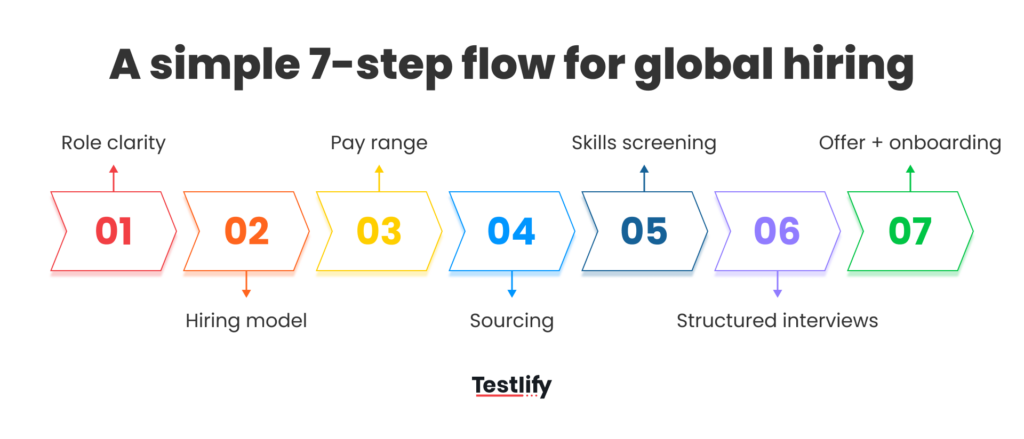
Step 1: Define the role
Start by identifying the skills, responsibilities, and outcomes the role requires. Decide whether the position needs local market knowledge, specific language skills, or the ability to work across multiple time zones.
A clear job description also makes it easier to compare candidates fairly and attract the right applicants.
Step 2: Choose the right hiring model
Select the hiring model that best fits your business goals, budget, and timeline. You may hire directly through a local entity, use an Employer of Record (EOR), engage independent contractors, or partner with a recruitment agency.
Making this decision early helps avoid compliance issues later in the hiring process.
Step 3: Set a competitive pay range
Research salary benchmarks, statutory benefits, and employment costs in the target country. Compensation should reflect local market conditions while remaining internally consistent across your global workforce.
A transparent salary range also improves candidate trust and offer acceptance rates.
Step 4: Source candidates
Use multiple sourcing channels to reach qualified talent. Job boards, LinkedIn, employee referrals, recruitment agencies, and local talent communities all play an important role in building a diverse candidate pipeline.
Tailor your sourcing strategy to each country’s hiring market rather than relying on a single approach.
Step 5: Screen candidates for skills
Evaluate candidates using structured skills assessments, work samples, and standardized scorecards before interviews. Skills-based screening provides a more objective comparison than resumes alone, especially when candidates come from different education systems and job markets.
This approach helps identify candidates who can perform the work regardless of where they are located.
Step 6: Conduct structured interviews
Ask every shortlisted candidate the same core questions and score responses against predefined criteria. Structured interviews reduce bias and make hiring decisions more consistent across countries and hiring managers.
Include both technical and behavioral questions that reflect the role’s requirements.
Step 7: Make the offer and onboard
Prepare a compliant employment contract that meets local labor laws, then guide the new hire through onboarding. A structured onboarding process helps international employees understand company expectations, connect with their team, and become productive more quickly.
Provide clear documentation, communication channels, and support during the first few weeks to improve long term retention.
Best practices for global recruitment
A successful global hiring strategy depends on consistency, transparency, and flexibility. These best practices help companies hire across borders while maintaining compliance, delivering a strong candidate experience, and building high-performing international teams.
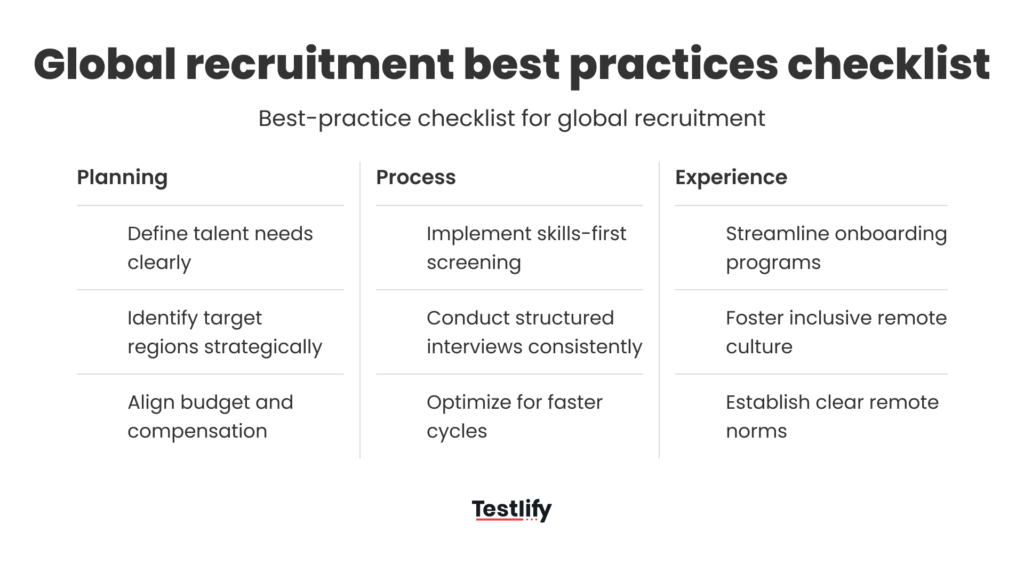
Standardize the hiring process, then localize where needed
Create one core hiring process that every recruiter and hiring manager follows. Use the same interview framework, scorecards, and evaluation criteria across countries, then adapt only the elements required by local laws or cultural expectations.
This approach improves hiring consistency without forcing every market into the same process.
Best practices
- Use standardized interview questions and scorecards.
- Apply the same skills-based evaluation criteria globally.
- Adapt contracts, benefits, and compliance for each country.
- Train hiring managers on local hiring practices.
Build a transparent compensation strategy
Develop a clear compensation philosophy before hiring internationally. Define salary ranges for each market based on local benchmarks and communicate them openly with candidates.
Transparency reduces negotiation delays, improves trust, and helps ensure fair and competitive offers.
Best practices
- Benchmark salaries against local market data.
- Define salary bands for every location.
- Explain how compensation decisions are made.
- Review pay equity regularly across regions.
Design workflows for asynchronous collaboration
Global teams rarely work in the same time zone. Document decisions, establish clear ownership, and use asynchronous communication so work continues without waiting for real-time meetings.
A well-documented workflow improves productivity and reduces delays across distributed teams.
Best practices
- Document decisions and project updates.
- Set overlapping working hours where possible.
- Use shared knowledge bases and project management tools.
- Record important meetings for team members in other time zones.
Prioritize the candidate experience
Top international candidates often receive multiple offers. A simple application process, timely communication, and structured assessments help create a positive hiring experience and reduce candidate drop-off.
Fast, transparent hiring also strengthens your employer brand in new markets.
Best practices
- Keep applications short and mobile-friendly.
- Use relevant skills assessments instead of lengthy screening.
- Communicate consistently throughout the hiring process.
- Provide timely interview feedback and decisions.
For a deeper look at the obstacles teams hit at scale, see our guide to global hiring challenges and how enterprises solve them, and the rules that govern paying international staff in our overview of global employment laws and costs.
To broaden where you look for candidates, review our blog on the best sources of recruitment for hiring top talent.
Screen global candidates on skills, not resumes
Testlify lets you assess candidates in any country on the same skills-based evidence, from coding and cognitive ability to role-specific tasks, before the first interview. See how it fits your global hiring workflow.
Key takeaways
- Global recruitment is a supply answer, not a trend. With 75% of employers reporting talent shortages, widening the search is often the only way to fill scarce roles, so treat it as a core hiring channel rather than a fallback.
- The hiring model is the first real decision. Direct employment, EOR, contractor, and agency carry different cost, control, and compliance profiles, so choosing before you advertise prevents expensive rework and misclassification risk.
- Diversity is a performance lever. The 39% outperformance edge for the most ethnically diverse leadership teams means cross-border hiring can improve results, not just optics, when you hire for skill and integrate people well.
- Compliance is where global hiring breaks. Misclassification, payroll, and pay-equity errors cause the most damage, so build the legal and pay setup before the offer, not after the hire starts.
- Skills-based screening keeps the bar even. Degrees and titles do not compare across countries, so structured assessments give you one fair standard and a shortlist you can defend to any hiring manager.
- Process beats improvisation. A standard scorecard, async habits, and a repeatable seven-step flow let you hire in five countries as calmly as in one, which is what makes global recruitment scale.
Frequently asked questions

Related resources
View all
HR & recruitment
7 types of HR reporting and steps to implement

HR & recruitment
What is job profiling? Everything you need to know

HR & recruitment
What is text recruiting and how to start using it to hire

HR & recruitment
Career Pathing: How to Build Paths That Retain Talent

HR & recruitment
Pros and cons of cross-training employees in 2026

HR & recruitment
How to use reverse mentoring to make it work?
Get started.
Hire on proof, not resumes.
Run your first skills-based assessment free — no credit card required.