
Delaware employment & labor laws 2026: Employer compliance guide
Understand Delaware’s 2025 labor laws on wages, discrimination, and HR compliance to protect businesses and employees.
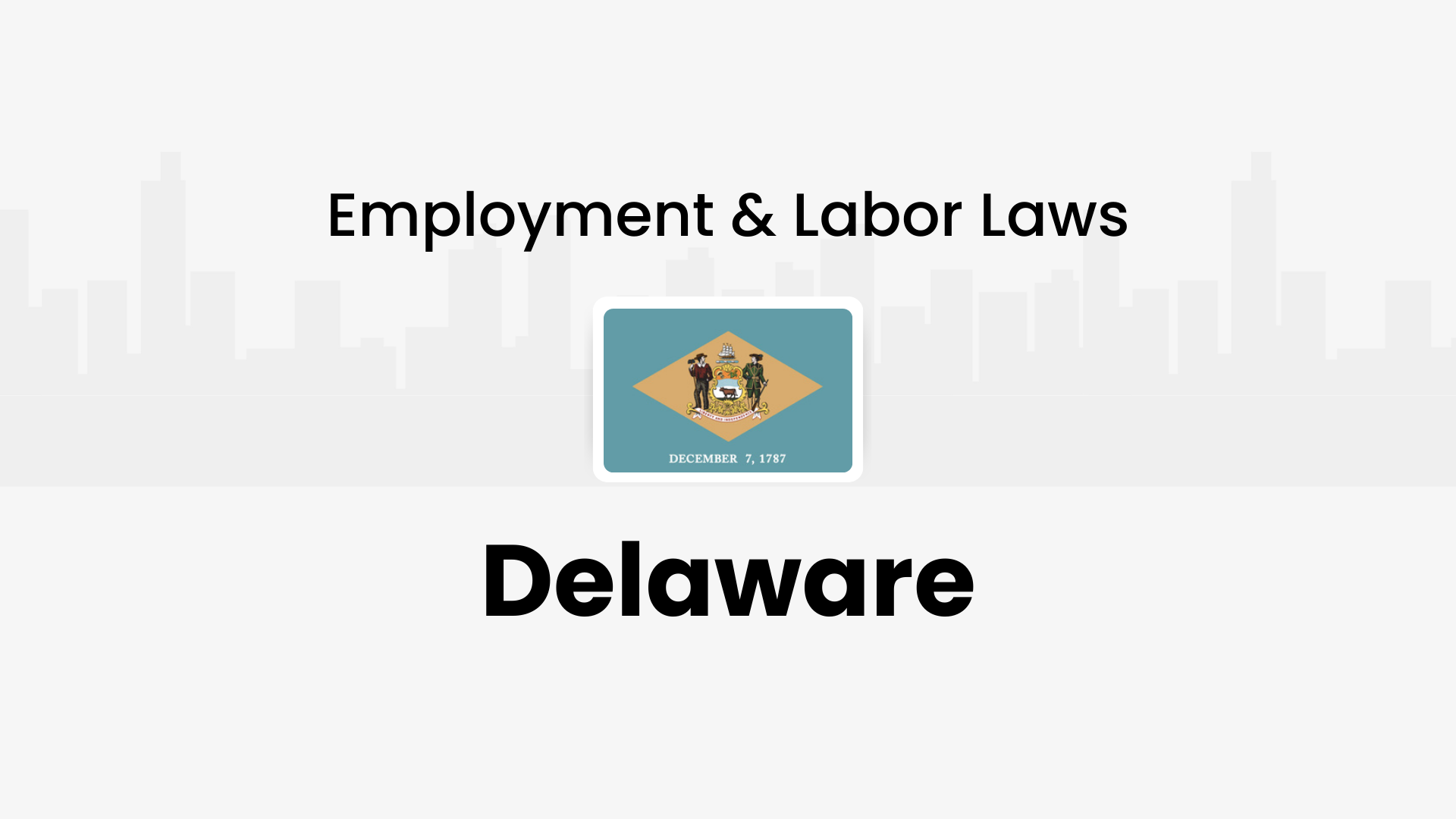
Delaware may be a small state, but its employment and labor laws carry big weight for HR professionals and employers.
With a growing workforce and a reputation as a corporate hub, Delaware combines federal standards with unique state-level rules that shape wages, leave, discrimination protections, and workplace compliance.
This guide breaks down the essentials of Delaware employment law, enforcement bodies, and HR compliance strategies so you can stay aligned, avoid costly penalties, and build a fair, resilient workplace.
 ChatGPT
 Gemini
 Claude
 Grok
Grok Perplexity
Delaware employment legal framework & enforcement bodies
Delaware employment laws combine federal standards with state-specific rules. Enforcement is overseen by agencies like the Delaware Department of Labor to ensure compliance.
Primary legal sources
- Delaware Code Title 19 – Labor: Governs wages, hours, workplace safety, and employer-employee relations.
- Delaware Discrimination in Employment Act (DDEA): Protects workers from discrimination, harassment, and retaliation.
- Delaware Family and Medical Leave policies: Provides specific leave protections beyond federal law in some cases.
- Federal Frameworks: The Fair Labor Standards Act (FLSA), Family and Medical Leave Act (FMLA), and OSHA apply, but Delaware often adds state-specific layers.
Delaware employment laws: Key enforcement agencies
- Delaware Department of Labor (DDOL) – Oversees wage claims, unemployment, and employment discrimination.
- Delaware Office of Anti-Discrimination – Investigates workplace discrimination complaints under state and federal law.
- OSHA (federal) – Since Delaware does not have its own state OSHA program, federal OSHA enforces workplace safety standards.

Employee wages and hours in Delaware
Wage and hour laws in Delaware regulate minimum pay, overtime, and working hours, ensuring fair compensation and protecting workers’ rights across industries.
In 2023, the Delaware Department of Labor collected over $1.2 million in unpaid wages for workers through enforcement actions.
Delaware minimum wage 2025
- As of January 1, 2025, Delaware’s minimum wage is $15/hour (part of a phased increase that began in 2022).
- Federal minimum wage remains $7.25/hour, but Delaware employers must follow the higher state standard.
- Tipped employees: Employers may pay a lower tipped minimum wage ($2.23/hour) as long as tips bring earnings to at least $15/hour.
Category | Rate (2025) | Notes |
|---|---|---|
Statewide Minimum Wage | $15.00/hour | Effective Jan 1, 2025 |
Tipped Employees | $2.23/hour + tips | Must meet $15/hour with tips |
Youth/Training Wage | $8.75/hour | For workers under 18 during first 90 days |
Delaware employee overtime rules
Delaware follows federal FLSA overtime rules:
- 1.5x pay for hours worked over 40 in a workweek.
- No daily overtime requirement.
- Exemptions: Executive, administrative, and professional employees may be exempt if salary and duties tests are met.
Exceptions to the minimum wage in Delaware
While most Delaware workers are entitled to the full state minimum wage of $15/hour (2025), there are important exceptions:
- Tipped Employees: Can be paid a cash wage of $2.23/hour, provided tips bring them up to $15/hour total.
- Youth/Training Wage: Workers under 18, or new employees in their first 90 days, may be paid $8.75/hour.
- Certain Agricultural & Domestic Workers: Some categories may not be covered under state wage laws.
- Federal Law Supremacy: If federal contracts apply (under the Service Contract Act or Davis-Bacon Act), federal prevailing wages may override state standards.
Note: Even if a lower wage is allowed, employers must carefully document pay structures and ensure workers still meet total compensation requirements.
Delaware break laws
Delaware does not mandate meal or rest breaks for workers 18 years or older. However, many employers voluntarily provide breaks to support productivity and reduce legal risks under federal guidelines.
Exceptions to break laws in Delaware
Break requirements only apply to minors under 18 years old:
- Workers under 18 must receive a 30-minute uninterrupted break if scheduled to work more than 5 consecutive hours.
- Breaks must be scheduled during the first half of the shift.
Adults are not guaranteed breaks under state law, but if employers do offer them:
- Breaks of 20 minutes or less must be paid.
- Breaks of 30 minutes or more may be unpaid if the employee is fully relieved of duties.
Worker classification in Delaware
Correctly classifying workers is critical:
- Employees vs Independent Contractors: Delaware applies IRS guidelines and common law tests.
- Misclassification can lead to back pay, taxes, and penalties.
- The Delaware Department of Labor actively audits businesses for compliance.
Non-compete agreements in Delaware
Non-compete agreements are enforceable in Delaware under certain conditions. Courts generally uphold them if they are:
- Limited in time, geography, and scope of work.
- Necessary to protect legitimate business interests (trade secrets, customer relationships).
- Not overly restrictive to prevent someone from earning a livelihood.
Pro tip: Always have legal review for non-competes, especially for senior roles or sales positions.
Workplace protections and discrimination in Delaware
Delaware provides strong protections against workplace discrimination and retaliation, aligning with federal laws while adding state-level safeguards for employees.
Delaware Discrimination in Employment Act (DDEA)
The Delaware Discrimination in Employment Act (DDEA) prohibits discrimination based on:
- Race, color, religion, sex (including pregnancy), sexual orientation, gender identity, national origin, age (40+), marital status, genetic information, or disability.
- Applies to employers with 4 or more employees.
- Also protects against harassment and retaliation.
Sexual harassment training requirement
- Employers with 50+ employees must provide interactive sexual harassment training every two years.
- Supervisors require additional training on handling complaints.
At-Will employment in Delaware
Like most states, Delaware follows the at-will employment doctrine: employers can terminate employees for any reason, at any time. Exceptions include:
- Discrimination or retaliation.
- Violations of employment contracts or collective bargaining agreements.
- Whistleblower protections.
Leave laws and benefits in Delaware
Delaware workers are protected by a mix of federal and state leave laws. While not as expansive as some states, Delaware leave laws give employees important rights to manage family, civic, and military responsibilities. Here’s a breakdown:
Family and Medical Leave Act (FMLA)
The Family and Medical Leave Act (FMLA) is a federal law that applies in Delaware to employers with 50 or more employees. It provides up to 12 weeks of unpaid, job-protected leave in a 12-month period. Eligible employees can use this time for:
- Personal or family medical conditions.
- Bonding with a new child through birth, adoption, or foster care.
- Certain needs arising from a family member’s military service.
Delaware paid parental leave (State employees)
Delaware goes further for its public sector workforce. State employees are entitled to up to 12 weeks of paid parental leave following the birth or adoption of a child.
- Applies to full-time state employees who have at least one year of service.
- Leave must be taken within one year of the child’s birth or adoption.
This benefit does not apply to private sector employees, but many Delaware companies voluntarily offer parental leave to stay competitive in talent retention.
Jury duty leave
All Delaware employers must allow employees time off for jury service. Key points:
- Leave is unpaid, unless the employer chooses to provide compensation.
- Retaliation or termination for serving on a jury is prohibited.
- Employers cannot require employees to use vacation or sick time to cover jury duty.
Voting leave
Unlike some states, Delaware does not have a law mandating paid or unpaid time off for voting. However:
- Many employers provide voting leave voluntarily as a best practice.
- Federal law requires employers to allow time off if voting is connected to certain federal elections (rare cases).
Military leave
Delaware follows the federal Uniformed Services Employment and Reemployment Rights Act (USERRA). This means:
- Employees called to active duty, training, or service in the armed forces must be granted unpaid leave.
- Employers must reinstate returning service members to their previous job or an equivalent role with the same pay and benefits.
- Retaliation for military service or obligations is strictly prohibited.
Labor laws for minors in Delaware
Nationwide, the U.S. Department of Labor reported a 44% increase in child labor violations since 2019, making compliance checks critical for Delaware employers. Delaware’s child labor laws are designed to balance work opportunities with education and safety:
Work permits for minors to work in Delaware
- Required for all workers under 18 before starting employment.
- Permits are issued through the Delaware Department of Labor, often coordinated with schools.
Hours and restrictions for minors working in Delaware
Ages 14–15
- Maximum 4 hours on school days, 8 hours on non-school days.
- No more than 18 hours per week when school is in session.
- Can work between 7 AM and 7 PM (extended to 9 PM during summer, June–Labor Day).
Ages 16–17
- Can work up to 8 hours/day, 40 hours/week.
- Night and hazardous job restrictions apply.
- No work in especially dangerous industries (mining, manufacturing explosives, certain construction jobs).
HR compliance checklist for Delaware employers
Area of compliance | Key HR action | Frequency |
|---|---|---|
Wages & hours | Verify Delaware minimum wage, check overtime rules, and review exempt classifications. | Quarterly |
Leave policies | Update FMLA, parental leave, jury duty, voting, and military leave policies. | Annually + as laws change |
Workplace protections | Train managers on anti-discrimination and harassment laws; align with Delaware & federal standards. | Bi-Annually |
Youth employment | Confirm permits for minors, track hours worked, and ensure no hazardous roles. | Ongoing |
Delaware DOL compliance | Monitor Delaware DOL updates, review complaint procedures, and maintain records. | Ongoing / Quarterly |
Delaware employment law updates 2025
Key developments shaping HR compliance in 2025:
- Final phase of minimum wage increase ($15/hour effective Jan 1, 2025).
- Growing emphasis on harassment training compliance audits.
- Rising attention to non-compete reform at the federal level (may impact Delaware enforcement in the future).
Conclusion
Delaware may not have the volume of employment laws as in states like California or New York, but its unique combination of wage laws, discrimination protections, and training requirements means HR must stay proactive.
By monitoring updates, ensuring fair pay, providing required training, and documenting compliance, Delaware employers can reduce legal risks and build a more inclusive workplace.
Key takeaways
- Delaware’s minimum wage rises to $15/hour in 2025, one of the highest on the East Coast.
- Overtime follows federal FLSA rules, but misclassification audits are common.
- Non-compete agreements are enforceable if reasonable in scope and duration.
- Employers with 50+ staff must provide harassment training every two years.
- Youth employment requires permits and strict adherence to hour limits.
- HR compliance means balancing state-specific rules with federal standards.
FAQs

Content Writer
Yashika Khandelwal is a Content Writer with 3+ years of experience creating research-backed content on hiring, talent assessment, and HR technology. She is a registered Organizational Psychologist and subject matter expert who combines behavioral science with practical recruitment insights to produce accurate, evidence-based content.
LinkedInRelated resources
View all
Employment and labor laws
California employment & labor laws 2026: Employer compliance guide
Employment and labor laws
Utah employment and labor laws
Employment and labor laws
South Carolina employment and labor laws
Employment and labor laws
Maryland employment and labor laws

Employment and labor laws
Indiana employment and labor laws 2026
Employment and labor laws
Virginia employment and labor laws 2026
Get started.
Hire on proof, not resumes.
Run your first skills-based assessment free — no credit card required.