
Testlify vs Brillium: A detailed comparison
Discover the perfect solution for evaluating your candidates’ skills with Testlify. Dive into our comprehensive Testlify vs Brillium 2024…
Testlify and Brillium both let you score people on what they can actually do, but they were built for different jobs. Brillium is an assessment authoring tool, strongest when you need to write your own exams and certification tests. Testlify is a pre-hire assessment platform with a ready-made library, strongest when you need to screen candidates this week.
That distinction decides most of these evaluations. If your team is building a certification program, a blank canvas is a feature. If your team is trying to shortlist 200 applicants for a support role by Friday, a blank canvas is a project nobody has time for.
TL;DR
- Brillium is built for authoring: you write the questions, set the logic, and deliver exams, certifications, and surveys, often tied to a learning platform.
- Testlify is built for hiring: 3,500+ ready-made assessments covering 5,000+ roles, plus proctoring and reviewer scoring, so screening starts without a content project first.
- Pick Brillium if the content is yours and the use case is training or certification. Pick Testlify if the goal is a scored shortlist before the first interview.
- Neither replaces your applicant tracking system. Both sit next to it.
- Judge either one on evidence quality, not feature counts: standardized scoring is what predicts on-the-job performance, and that is a measurable property, not a marketing claim.
Testlify is used by 1,500+ talent teams, and the comparison below sticks to what each platform is genuinely designed to do.
 ChatGPT
 Gemini
 Claude
 Grok
Grok Perplexity
What are Brillium exams?
Brillium exams are online assessments you build yourself in Brillium's assessment builder. You write the questions, group them into sections, set scoring and feedback rules, then deliver the exam through a browser. They are commonly used for certification programs, course exams, knowledge checks, and surveys rather than for pre-hire screening.
The important word there is "build". Brillium does not hand you a finished exam for a job role. It hands you the tooling to write one, which is the right trade when the subject matter is yours and nobody else's off-the-shelf content would be accurate.
What a Brillium test covers
A Brillium test is defined by whatever you put in it. The platform supports a wide spread of question formats, section-level and topic-level scoring, customized feedback based on how someone answered, and reporting that breaks results down by question and by category. It also connects to learning management systems, which is why so much of its use sits inside training programs.
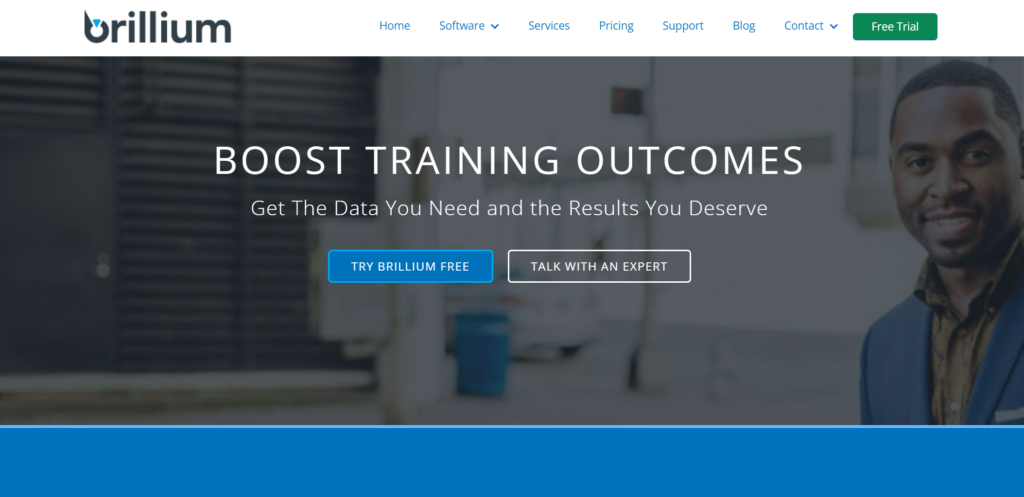
Practical consequence: your first Brillium project is a content project. Someone has to write the items, decide what a passing score means, and defend that cut score if a candidate or an auditor ever questions it. Teams that already employ instructional designers or subject-matter experts handle this well. Teams that do not tend to stall at question 40.

How does Testlify approach skills assessment?
Testlify starts from the opposite end. Instead of an empty builder, you get a library of 3,500+ validated assessments mapped to 5,000+ roles, covering role skills, coding, cognitive ability, personality, language, and software proficiency. You assemble an assessment from existing tests, invite candidates, and get scored, comparable results back.
You can still write custom questions, and there are 25+ question formats to do it with. But custom content is an option rather than the entry fee. The platform also carries the parts hiring teams need that a general exam tool usually does not: proctoring controls for remote assessment, multi-reviewer scoring so more than one person rates a candidate, candidate reports built for a hiring conversation, and 100+ integrations so results land in the system your recruiters already live in. The interface runs in 11 languages.
Testlify is a pre-hire assessment platform. It is not an applicant tracking system, a sourcing tool, or an HR information system, and it does not try to be. It plugs into those.
Feature comparison: Testlify vs Brillium
The table below compares the two on the dimensions that actually change a buying decision. It replaces the comparison table that was previously broken on this page.
Dimension | Testlify | Brillium |
|---|---|---|
Primary job | Pre-hire candidate screening and selection | Authoring and delivering your own exams, certifications, and surveys |
Ready-made content | 3,500+ assessments across 5,000+ roles | None by design, you author the content |
Custom authoring | Yes, 25+ question formats | Yes, this is the core strength |
Time to first assessment | Same day, assemble from the library | As long as writing the items takes |
Proctoring and integrity | Identity checks, environment and browser controls, AI-assistance signals | Delivery controls oriented to exams and certification |
Reviewer workflow | Multi-reviewer scoring and candidate comparison | Reporting and analytics on results |
Integrations | 100+, including ATS two-way sync | Learning management systems, plus partner integrations |
Interface languages | 11 | Configurable per assessment |
Best fit | Talent acquisition teams screening candidates | Training, certification, and education teams |
How do Testlify and Brillium price their plans?
Both sell subscriptions rather than one-off licences, and both publish plan tiers that change often enough that any figure printed in an article goes stale fast. So here is the shape of each model rather than a price that will be wrong by the time you read it.
What Brillium's pricing looks like
Annual, quarterly, and partner plans
Brillium sells tiered plans on annual and quarterly billing, with a separate partner plan for customers who run assessments inside a connected learning platform. Tiers step up mainly on integration depth and customization rather than on assessment volume. Check the vendor's current pricing before you budget, because the tier names have outlived several price changes.
What Testlify's pricing looks like
Testlify sells monthly and annual plans that step up on features and usage, with a free trial so a team can run a real assessment before committing. Current figures live on the Testlify plan pricing page.
Pro tip: when you compare these two on cost, count the content. A cheaper authoring licence plus 60 hours of a subject-matter expert's time writing items is not cheaper than a library subscription. Price the work, not just the software.
Which platform fits which hiring job?
Three situations cover most of the decisions teams actually face.
You are screening candidates at volume. A 400-person company hiring 25 support agents a quarter needs scored results before the first phone call, not an item-writing project. Testlify fits. Assemble a role assessment, send it with the application, and interview the top of a ranked list instead of the top of an inbox.
You are certifying people on your own material. A training team issuing a compliance certificate on internal policy has content nobody else can supply. Brillium fits. The exam has to be yours, and the platform's job is to deliver and score it reliably.
You are doing both. Plenty of organizations hire with one tool and certify with another, and that is a reasonable answer rather than a failure to consolidate. The two jobs have different owners, different audiences, and different legal exposure.
Where teams get this wrong is stretching an authoring tool across hiring because it was already paid for. Whoever has spare time ends up writing the exam, the cut score gets picked by feel, and six months later nobody can explain why 62% was the line. That is the expensive version of saving money.
How should you choose an assessment platform?
Judge the evidence, not the feature grid. An assessment is worth what its scores predict, and that question has real research behind it.
The strongest modern reanalysis of selection-method validity, published in the Journal of Applied Psychology in 2022, revised many long-standing estimates downward but kept the shape intact: structured methods outrank unstructured ones, while years of education and general years of experience sit among the weaker predictors. Resume screening is the thing being replaced, and the research is unusually clear about that.
Scoring discipline matters just as much as the test. A meta-analysis of mechanical versus clinical data combination found that combining assessment information by a consistent rule predicts outcomes at least as well as experts re-weighing the same information by judgment. Translation: the value leaks out the moment a panel overrides the scores because someone interviewed well.
Content freshness is the third test, and it is where a library and a blank builder diverge. Employers expect 39% of workers' core skills to change by 2030, per the World Economic Forum's Future of Jobs Report 2025, down from 44% in its 2023 edition. Whoever owns the content owns that maintenance. With a library, the vendor does. With an authoring tool, you do.
Volume is the fourth. U.S. employers made 5.3 million hires in June 2026 against 7.4 million open roles, per the Bureau of Labor Statistics. At that scale, screening consistency is not a nicety. It is the only way two recruiters reach the same conclusion about the same candidate.
This is what the Testlify Multi-Signal Talent Evaluation Model is built around: no single signal carries a hiring decision on its own. A skills assessment, a structured interview, a work sample, and reviewer feedback each cover a blind spot the others leave open, and a candidate moves forward when several independent signals agree. AI helps summarize and structure that evidence. People still make the call.
Run any platform, either of these two or a third, through four questions. What does a score here predict, and how would you know? Who keeps the content current as roles change? Can two reviewers score the same candidate the same way? And could you explain the pass mark to a candidate who challenges it? A tool that answers all four is worth buying. A tool that answers none is a quiz engine with a sales team.
Hire on proof, not resumes
If a scored shortlist before the first interview is what you are after, start a free trial and build a role assessment from the library in an afternoon, or book a demo and have someone walk your team through it. If you want to see how Testlify stacks up more broadly first, the roundup of other Brillium alternatives covers the wider field, and the test library shows what is available off the shelf.
Key takeaways
- The two tools solve different problems. Brillium authors assessments, Testlify supplies and scores them for hiring. Most comparison confusion comes from treating them as rivals for one job when they are specialists in two, so decide which job you have before you compare a single feature.
- Content ownership is the real cost line. An authoring tool moves the work of writing, validating, and maintaining questions onto your team. That labour is invisible in a price comparison and dominant in a budget, so cost every evaluation with a content estimate attached.
- Standardized scoring is what makes assessment worth doing. Structured methods outrank unstructured ones in the selection research, and combining scores by rule beats re-weighing them by gut. If your process ends with a panel overriding the numbers, you have paid for evidence and then thrown it away.
- Skills drift faster than assessment content does. With 39% of core skills expected to change by 2030, content maintenance is a recurring job. A library shifts that burden to the vendor. Own the content and you own the upkeep, permanently.
- Volume makes consistency non-negotiable. With 5.3 million hires a month in the United States alone, unstructured screening does not merely slow teams down, it produces different answers for identical candidates. Standardize before you scale, not after.
- Neither tool replaces your ATS. Both sit alongside it, which means integration depth belongs in the evaluation. A score trapped in a second system that recruiters never open changes no decisions at all.
FAQs
Related resources
View all
Competitor Comparisons
Testlify vs Priority Bridge: A detailed comparison
Competitor Comparisons
Testlify vs Talent Science: A detailed comparison
Competitor Comparisons
Testlify vs XBInsight: A detailed comparison
Competitor Comparisons
Testlify vs Weirdly: A detailed comparison
Competitor Comparisons
Testlify vs Toggl Hire: A detailed comparison
Competitor Comparisons
Testlify vs Searchlight: A detailed comparison
Get started.
Hire on proof, not resumes.
Run your first skills-based assessment free — no credit card required.