
4 simple ways to measure training effectiveness
Discover how to measure and improve training effectiveness to boost employee performance, engagement, and ROI.

Training is one of the most powerful tools organizations can use to enhance employee performance, boost engagement, and foster a culture of continuous learning.
According to SHRM, 68% of employees prefer to learn and train at work, emphasizing the need for accessible training programs.
But as an HR professional, how can you measure the effectiveness of your training programs? How do you know if they are achieving the desired results or if they need to be fine-tuned?
In this blog, we’ll cover everything from why training effectiveness matters, to strategies for improving it, and even how to assess its success. Let’s dive in!
 ChatGPT
 Gemini
 Claude
 Grok
Grok Perplexity
What is training effectiveness?
Training effectiveness refers to the degree to which a training program achieves its intended goals like knowledge, skills, and performance.
This could mean improved employee skills, enhanced knowledge, better job performance, or a higher return on investment (ROI) for the organization. It’s about ensuring that the resources put into training deliver measurable and meaningful outcomes.
As an HR professional, it’s crucial to go beyond just offering training sessions and build a training framework that aligns with organizational goals and drives real business impact.

What is training effectiveness vs. efficiency?
Now, you might have heard the term training efficiency thrown around as well. While the two concepts are related, they’re not the same. Let’s break it down:
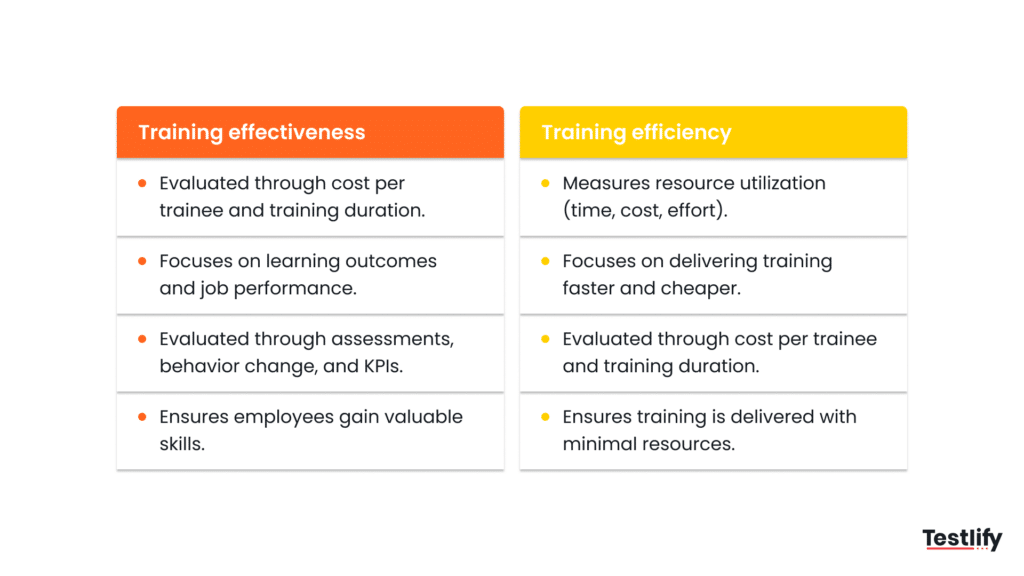
Training effectiveness: Focuses on the outcomes of the training. Did the training achieve its goals? Did it lead to improved performance?
Training efficiency: Focuses on the process of delivering the training. Was the training delivered on time? Was it cost-effective? Did it use resources optimally?
For example, if you conducted a training program that was completed on time and under budget, it was efficient. But if the employees didn’t learn anything useful or apply it to their jobs, it wasn’t effective.
Why is training effectiveness important to measure?
Training isn’t just about checking boxes or offering employees something to do on a Friday afternoon. It is the key to:
1. To check and improve employee performance
Training helps employees gain the skills and knowledge they need to succeed in their roles. But when that training is ineffective, employees may not perform to their full potential. Measuring the effectiveness of your training ensures employees are acquiring what they need to improve performance.
2. Increasing employee retention and engagement
Training that’s relevant and valuable boosts employee satisfaction and engagement. Engaged employees are more likely to stay with the organization. Providing a solid training program is one of the best ways to demonstrate that you’re invested in your employees’ growth.
3. Enhancing organizational performance
The goal of training is to improve overall organizational performance. Whether you’re teaching technical skills, leadership qualities, or communication abilities, effective training can help drive business success.
4. Maximizing return on investment (ROI)
Training can be costly in terms of time, money, and resources. Measuring training effectiveness allows you to evaluate whether these investments pay off and deliver the expected results. Without assessing ROI, you risk wasting valuable resources on ineffective programs.
How much training effectiveness measurement makes sense?
Now that you understand the difference between training effectiveness and efficiency, you might wonder how much measurement is truly necessary. Do you need to track every detail of the training program, or is there a better way to focus your efforts?
Measuring training effectiveness helps you answer critical questions about your programs, such as:
- Did the training meet its objectives?
- Are employees applying what they learned?
- Is the training contributing to organizational goals?
- What areas of training need improvement?
Without proper measurement, you may never know whether the resources you invest in training are being used wisely. However, measuring effectiveness doesn’t always mean collecting massive amounts of data or conducting extensive surveys. The key is to identify the most relevant metrics that align with your organizational goals.
Key elements of training effectiveness
To assess the effectiveness of your training programs, it’s important to understand the components that contribute to training success. Let’s break it down into several key elements.
1. Learning objectives
Imagine setting off on a road trip without a destination in mind. You might enjoy the ride, but you’ll likely end up somewhere random with no sense of accomplishment. The same goes for training programs.
Without clear, measurable learning objectives, your training lacks direction and purpose. Learning objectives act as a roadmap, guiding both the trainer and the participants toward a shared goal. They help answer the question: What should employees be able to do after this training?
To assess the effectiveness of your training programs, it’s essential to understand the components that contribute to their success. These elements are like the gears in a well-oiled machine each one plays a critical role in ensuring the training delivers the desired outcomes.
2. Delivery method
The way training is delivered can make or break its effectiveness. Even the best content can fall flat if it’s delivered in a way that doesn’t resonate with the audience. The delivery method determines how well the information is absorbed, retained, and applied. It’s not just about what you teach but how you teach it.
3. Employee motivation
You can have the best training program in the world, but if employees aren’t motivated to engage with it, the results Will be disappointing. Motivation is the fuel that drives learning. Without it, even the most well-designed training program Will fall flat. Motivated employees are more likely to pay attention, participate actively, and apply what they’ve learned to their jobs.
4. Content quality
High-quality content is the backbone of any effective training program. If the content is outdated, irrelevant, or poorly designed, employees won’t retain the information or apply it to their jobs. On the other hand, well-crafted content that addresses real-world challenges can transform the way employees work.
5. Post-training support
Learning doesn’t end when the training session is over. In fact, that’s when the real work begins. Employees need opportunities to practice what they’ve learned and apply it to their jobs. Without post-training support, the knowledge and skills gained during the training can quickly fade away.
How to measure training effectiveness
Now that you understand what contributes to training effectiveness, it’s time to dive into how to measure it. Measuring training effectiveness is essential for understanding whether your investment is paying off and what areas need improvement.
Here are a few strategies you can implement:
1. Kirkpatrick’s four-level training evaluation model
One of the most widely recognized models for evaluating training effectiveness is Kirkpatrick’s Four-Level Training Evaluation Model. This framework allows HR professionals to assess training programs in a structured way.
Level 1: Reaction
At this level, you measure how participants felt about the training. Did they find it engaging? Was it relevant to their job? This can be gauged through surveys or feedback forms.
Level 2: Learning
Here, you evaluate whether participants have acquired the knowledge or skills intended by the training. This can be measured through tests, quizzes, or assignments.
Level 3: Behavior
At this stage, you assess whether the employees apply the knowledge and skills learned in the training to their job. Are they exhibiting better performance or making fewer mistakes?
Level 4: Results
Finally, you measure the broader impact of the training on business outcomes. This could include increased sales, improved customer satisfaction, or reduced error rates.
2. Pre-and post-training assessments
One effective way to measure learning outcomes is to conduct assessments before and after the training. Pre-training assessments establish a baseline of employee knowledge or skills, while post-training assessments show how much improvement has been made.
3. Employee surveys
Surveys can provide valuable insights into how participants perceive the training. Did they find it valuable? Did they feel more confident after completing it? Surveys can help HR professionals gather qualitative feedback that complements quantitative data from tests or assessments.
4. ROI analysis
Conducting an ROI analysis helps HR determine whether the training program was worth the investment. To do this, calculate the costs of the training program (including time, materials, and employee involvement) and compare it to the benefits (such as increased productivity, sales, or reduced turnover). If the benefits outweigh the costs, the training can be considered effective.
When to use training effectiveness?
When it comes to training, measurement should be done at different stages:
- Before the training: Understanding baseline knowledge and skills will help you measure improvements after training.
- During the training: Collect feedback from participants in real-time (through surveys, polls, or observation) to identify if the training is engaging and effective.
- After the training: Measure outcomes like knowledge retention, behavior change, and performance improvements.
Strategies for improving training effectiveness
Now that you have a solid understanding of how to measure training effectiveness let’s explore a few strategies to improve it.
1. Align training with organizational goals
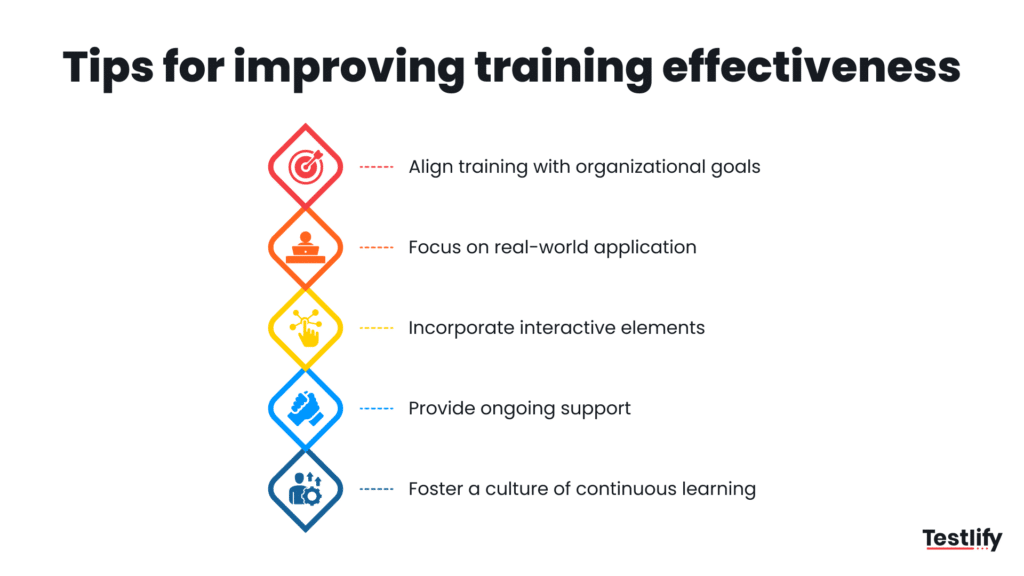
For training to be effective, it must be aligned with the broader goals of the organization. Whether the goal is to improve customer service, enhance technical skills, or develop leadership capabilities, make sure the training content and objectives support these overarching goals.
2. Focus on real-world application
Employees are more likely to retain what they’ve learned if the training is practical and applies to daily tasks. Make sure the content is relevant to the challenges employees face and includes hands-on opportunities to practice new skills.
3. Incorporate interactive elements
Engagement is key to effective training. Interactive elements such as discussions, group activities, and role-playing can make the training more enjoyable and impactful. Employees are more likely to retain information if they’re actively involved.
4. Provide ongoing support
Training shouldn’t be a one-time event. Offer ongoing support through follow-up sessions, mentoring, or refresher courses. This helps employees reinforce their learning and apply it more effectively.
5. Foster a culture of continuous learning
Training should be viewed as part of a broader culture of continuous learning. Encourage employees to keep learning and developing new skills through various resources such as webinars, books, or online courses. This ensures that employees stay up to date with industry trends and developments.
Common challenges in measuring training effectiveness
While measuring and improving training effectiveness is critical, HR professionals often face a few common challenges. Let’s explore some of these challenges and how to address them.
1. Lack of resources
Training programs can be resource-intensive. If your organization has limited time, budget, or personnel, it may be difficult to design and deliver effective training programs. One solution is to use digital tools such as e-learning platforms, which can deliver high-quality training at a lower cost.
2. Employee resistance to training
Some employees may resist training due to a lack of motivation or a belief that training wastes time. According to LinkedIn 15% of employees feel that training content isn’t relevant to their roles, leading to disengagement.
To overcome this, communicate the value of training clearly and show how it aligns with employees’ personal and professional development goals.
3. Inadequate evaluation methods
Without proper evaluation, it’s difficult to measure training effectiveness accurately. Ensure that you have a solid plan in place to assess learning, behavior change, and business outcomes. Use multiple evaluation methods to gather a comprehensive picture of training success.
Conclusion
Training effectiveness is crucial for ensuring that your investment in learning and development pays off. By setting clear objectives, aligning training with business goals, and using robust evaluation methods, you can improve employee performance, engagement, and organizational success. With continuous improvement and support, your training programs will create a more skilled, motivated, and productive workforce.
As HR professionals, your role in facilitating and evaluating training programs is key to helping employees thrive and ensuring the success of the organization as a whole. Keep exploring new ways to enhance training effectiveness, and your efforts will undoubtedly pay off!
Frequently asked questions (FAQs)

Content Writer
Yashika Khandelwal is a Content Writer with 3+ years of experience creating research-backed content on hiring, talent assessment, and HR technology. She is a registered Organizational Psychologist and subject matter expert who combines behavioral science with practical recruitment insights to produce accurate, evidence-based content.
LinkedInRelated resources
View all
HR & recruitment
Employee Pulse Surveys: What They Are, How They Work, and Why They Matter in 2026

HR & recruitment
The science behind picOCEAN: How image personality test work

HR & recruitment
Why visual personality tests are the future of hiring

HR & recruitment
What Is Quiet Quitting? Causes, Signs, and How to Prevent It in 2026

HR & recruitment
Hiring without borders: how HR and fintech empower global talent acquisition

HR & recruitment
Best practices for collaborating with recruitment agencies
Get started.
Hire on proof, not resumes.
Run your first skills-based assessment free — no credit card required.