Skip to content
Demo Demo Call Support +1 (844) 755 8378 Contact Contact Login
Testlify
  • ProductExpand
    • Testlify AI
    • AI resume screener
    • Features
    • Video interviewing
    • Science behind tests
    • Live product demo
    • Customer success stories
    • Roadmap
    • ATS integrations
  • Test library
  • Interviews
  • Pricing
  • SolutionsExpand
    • By industry typeExpand
      • Information & technology
      • Logistics & supply chain
      • Retail
      • Recruitment
      • Financial
      • SaaS
      • Energy
      • Hospitality
      • Health care
      • BPO
      • Edtech
      • Real estate
      • Media
    • By use caseExpand
      • Lateral hiring
      • Diversity and inclusion
      • Volume hiring
      • Remote hiring
      • Blue collar hiring
      • Freelance hiring
      • Campus hiring
    • By test typeExpand
      • Role specific
      • Language
      • Programming
      • Software skills
      • Personality & culture
      • Cognitive ability
      • Situational judgment
      • CEFR
      • Typing
      • Coding
      • Engineering
    • By company typeExpand
      • For startups 
      • SMB’s
      • Enterprises
      • Non-profits
      • Public sector
  • ResourcesExpand
    • Blogs
    • HR toolsExpand
      • AI Interview question generator
      • AI Job description generator
      • Cost per hire calculator
      • Attrition rate calculator
      • Employee NPS calculator
      • Applicant funnel calculator
      • Average Time to Hire
      • Employee turnover
      • Sourcing channel efficiency
      • Remote work cost savings
      • Quality of hire calculator
      • Interview-to-hire offer
      • Recruiting conversion rate
      • Job offer acceptance rate
      • Hiring manager satisfaction
    • Hiring guides
    • HR glossary
    • Customer success stories
    • Job description templates
    • Ebooks
    • Podcasts
    • Referral program
    • Partnership program
    • Integration program
    • Competitors
    • Sitemap
  • AboutExpand
    • Our story
    • Contact us
    • Trust center
    • Clients
    • Partners
    • Job openings
    • Write for us
Try for Free
Book demo Login
Testlify

Zero Based Budgeting

Back to HR Glossary
Table of Contents
  • What is zero based budgeting?
  • Features of zero based budgeting
  • What are the disadvantages of zero based budgeting

What is zero based budgeting?

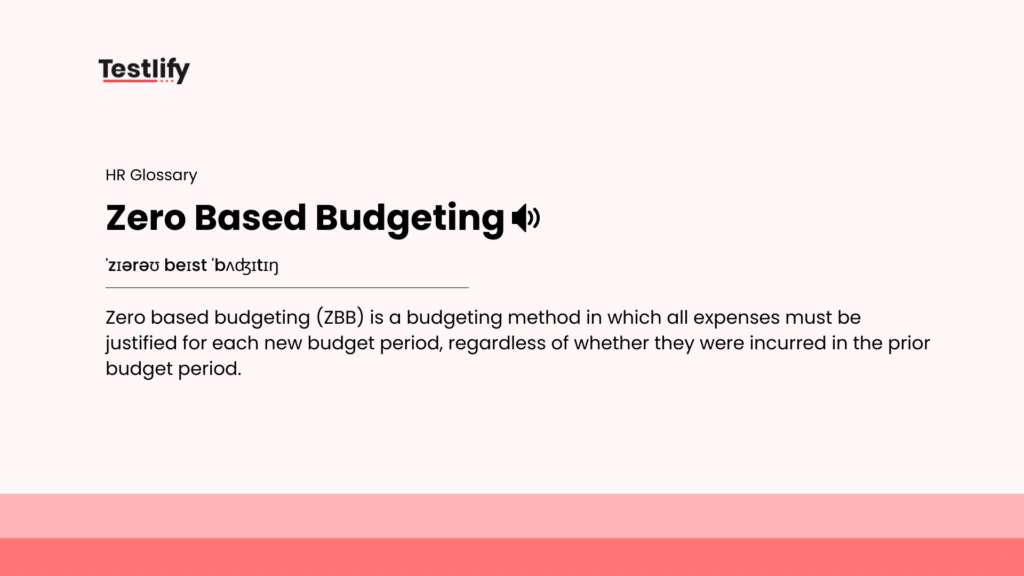
Zero based budgeting (ZBB) is a budgeting method in which all expenses must be justified for each new budget period, regardless of whether they were incurred in the prior budget period. This approach starts from a “zero base” and looks at each budget line item individually, rather than using a previous budget as a starting point. The goal of zero based budgeting is to ensure that all spending is necessary and productive and to minimize waste and inefficiency.

Summarise this post with:

chatgptChatgpt perplexityPerplexity geminiGemini grokGrok claudeClaude
Image showing the meaning of zero based budgeting

In ZBB, all expenses must be evaluated and justified based on current business needs and priorities. This includes both recurring expenses and one-time expenditures. The process of zero based budgeting typically involves identifying all expenses, evaluating their necessity, and making decisions about whether to continue, reduce, or eliminate each expense. The end result is a budget that is optimized for the current period, rather than being based on historical spending patterns.

Zero based budgeting has been adopted by many organizations, including corporations, government agencies, and non-profits, as a way to reduce costs, increase efficiency, and improve decision-making. By forcing managers to evaluate each expense and justify its need, ZBB can help organizations identify areas where they can reduce spending and improve the allocation of resources.

Features of zero based budgeting

The main features of zero based budgeting (ZBB) include:

  1. Fresh start: ZBB starts from a “zero base” and does not assume that previous spending levels are valid. Instead, all expenses must be justified for each new budget period.
  2. Expense evaluation: In ZBB, all expenses are evaluated and justified based on current business needs and priorities. This includes both recurring expenses and one-time expenditures.
  3. Cost control: The goal of ZBB is to minimize waste and inefficiency by ensuring that all spending is necessary and productive. By forcing managers to evaluate each expense, ZBB can help organizations identify areas where they can reduce spending.
  4. Decentralized decision-making: ZBB places responsibility for budget decisions with managers at the operational level, who are closest to the activities being funded. This can help ensure that budgets reflect the needs and priorities of each business unit.
  5. Improved information: ZBB requires managers to provide detailed information about the costs associated with each activity, which can improve the quality of financial information and decision-making.
  6. Increased accountability: By forcing managers to justify each expense, ZBB increases accountability for budget decisions. This can help reduce the risk of waste and inefficiency and improve the allocation of resources.
  7. More accurate forecasting: By starting from a “zero base” and evaluating all expenses, ZBB can provide a more accurate picture of future costs and help organizations make better decisions about resource allocation.

What are the disadvantages of zero based budgeting

  1. Time consuming: Zero-based budgeting requires significant time and effort to design and implement.
  2. Resource intensive: It requires a lot of resources to implement, including staff time and resources for data analysis and decision-making.
  3. Resistance to change: Implementing zero-based budgeting may face resistance from departments and employees who are used to traditional budgeting methods.
  4. Complexity: The process of zero-based budgeting can be complex, particularly for organizations with large budgets and multiple departments.
  5. Potential misalignment: Zero-based budgeting can lead to misalignment between departments, as each one may prioritize its own budget, rather than working towards common goals.
  6. Short term focus: Zero-based budgeting can be focused on short-term cost savings, rather than long-term strategic planning and investment.

Table of Contents
  • What is zero based budgeting?
  • Features of zero based budgeting
  • What are the disadvantages of zero based budgeting

Cut through the Noise, Hire with Clarity

Resumes don’t tell you everything! Testlify gives you the insights you need to hire the right people with skills assessments that are accurate, automated, and unbiased.

Try for Free Book a Demo

Product

Testlify AI

Test library

ATS integrations

Science

Analytics

API

Reseller plan

Features

What’s new

White label

Video interviewing

Product roadmap

Test type

Role specific tests

Language tests

Programming tests

Software skills tests

Cognitive ability tests

Situational judgment tests

CEFR test

Typing test

Coding tests

Psychometric tests

Engineering tests

Process knowledge tests New

Resources

Blog

Join Testlify SME

Integration program

Sitemap

Knowledge base

Podcast

Referral program

Partnership program

Success stories

Competitors

Hiring guides

HR glossary

HR tools

Terms

Privacy policy

Terms & conditions

Refund policy

GDPR compliance

Cookie policy

Security practices

Security

Data processing agreement

Data privacy framework

CCPA

Trust center

Company

About us

Careers We are hiring

For subject matter experts

Clients

Our partners

Press room

Investors

Write for us

Contact us

Support

Help center

Backed by

NVIDIA
GDPR
SOC 2 Type 2
CCPA
ISO

[email protected]

[email protected]

+1 (844) 755 8378

  • LinkedIn
  • Facebook
  • testlify youtube channel
  • Instagram
  • X

[email protected]

[email protected]

+1 (844) 755 8378

  • LinkedIn
  • Facebook
  • testlify youtube channel
  • Instagram
  • X

©2025 Testlify All Rights Reserved

Try for free
Book a demo

Before you go. Want to see how top teams assess talent?

Get a quick walkthrough to improve shortlist quality and speed.

Please enable JavaScript in your browser to complete this form.
Loading

No credit card required. 7-day free trial. Used by 1,500+ teams.

This website uses cookies to enhance your experience. By continuing, you consent to our use of cookies. Read our Privacy Policy

Got it
Scroll to top
  • Product
    • Testlify AI
    • AI resume screener
    • Features
    • Video interviewing
    • Science behind tests
    • Live product demo
    • Customer success stories
    • Roadmap
    • ATS integrations
  • Test library
  • Interviews
  • Pricing
  • Solutions
    • By industry type
      • Information & technology
      • Logistics & supply chain
      • Retail
      • Recruitment
      • Financial
      • SaaS
      • Energy
      • Hospitality
      • Health care
      • BPO
      • Edtech
      • Real estate
      • Media
    • By use case
      • Lateral hiring
      • Diversity and inclusion
      • Volume hiring
      • Remote hiring
      • Blue collar hiring
      • Freelance hiring
      • Campus hiring
    • By test type
      • Role specific
      • Language
      • Programming
      • Software skills
      • Personality & culture
      • Cognitive ability
      • Situational judgment
      • CEFR
      • Typing
      • Coding
      • Engineering
    • By company type
      • For startups 
      • SMB’s
      • Enterprises
      • Non-profits
      • Public sector
  • Resources
    • Blogs
    • HR tools
      • AI Interview question generator
      • AI Job description generator
      • Cost per hire calculator
      • Attrition rate calculator
      • Employee NPS calculator
      • Applicant funnel calculator
      • Average Time to Hire
      • Employee turnover
      • Sourcing channel efficiency
      • Remote work cost savings
      • Quality of hire calculator
      • Interview-to-hire offer
      • Recruiting conversion rate
      • Job offer acceptance rate
      • Hiring manager satisfaction
    • Hiring guides
    • HR glossary
    • Customer success stories
    • Job description templates
    • Ebooks
    • Podcasts
    • Referral program
    • Partnership program
    • Integration program
    • Competitors
    • Sitemap
  • About
    • Our story
    • Contact us
    • Trust center
    • Clients
    • Partners
    • Job openings
    • Write for us
Book demo