
De Minimis Rule
Learn about the de minimis rule: its meaning, benefits, and drawbacks. Understand how ignoring small sums can impact transparency, tax purposes, and overall performance.
 ChatGPT
 Gemini
 Claude
 Grok
Grok Perplexity
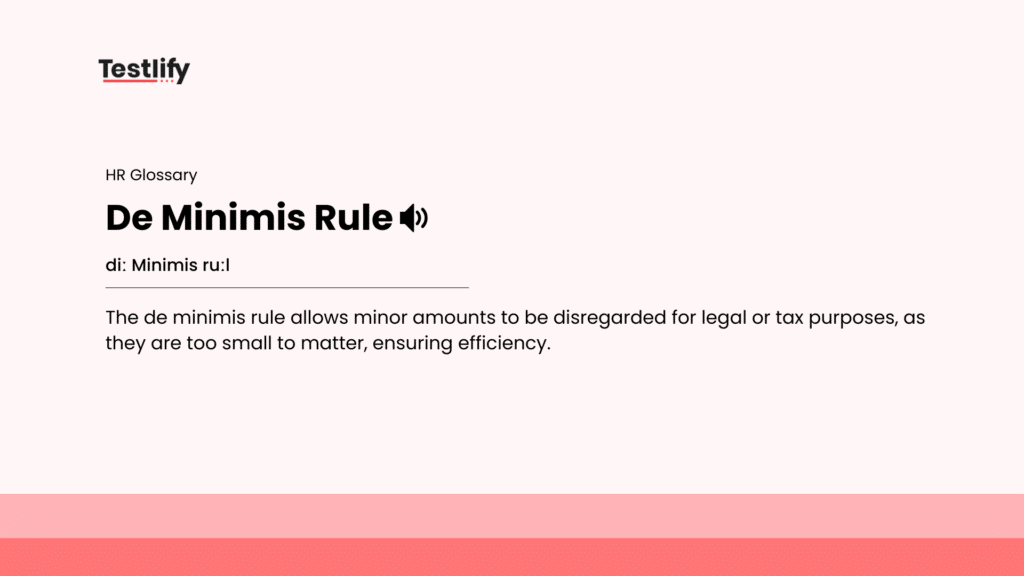
What is the de minimis rule?
De Minimis Rule is a risk of missing key details.
In HR and payroll contexts, these benefits are often excluded from taxation, helping employers simplify compliance without burdening employees with minor tax obligations.
The De Minimis Tax Rule is especially relevant when organizations offer occasional perks like snacks, holiday gifts (of low value), small personal use of office equipment, etc. These perks do not have to be reported as taxable income under specific regulatory guidelines. According to HBR’s compensation research, de minimis benefit policies form part of a broader total rewards strategy that improves employee satisfaction without significant tax complexity.
What are the benefits of using the de minimis rule?
The de minimis rule offers several benefits that help make processes simpler and more efficient.
- Simplified record keeping: By ignoring small or insignificant amounts, the de minimis rule reduces the need for extensive record-keeping. It helps in focusing only on the significant figures, making compliance easier.
- Focus on significant issues: With the de minimis threshold in place, organizations can concentrate on larger issues instead of small sums of money. This keeps attention on what matters most.
- Reduced administrative burden: This rule cuts down on the time and resources needed to handle small or negligible amounts. Less paperwork means a lighter administrative load.
- Avoiding disputes: The de minimis rule helps avoid arguments over tiny amounts that might otherwise become costly disputes. It’s better to focus resources on big matters than on trivial ones.
- Lower costs: Ignoring small amounts also means cost savings. For instance, accounting for every small error or transaction is time-consuming and costly. De minimis exemptions, like those in tax purposes, reduce these costs.
- Better efficiency: By disregarding minor sums of money, organizations can speed up decision-making. Fewer details to consider lead to faster processes.
Remember, the “de minimis” threshold depends on the context. In tax regulations, like those outlined in the Internal Revenue Code, a small de minimis tax exemption could simplify the process for many tax-exempt entities. The interest rate or specific minimis rule may vary for different purposes, including sales tax or credit card policies.
The application of the rule may differ, but it ultimately aims to keep things simple and efficient. It’s all about making sure the focus stays where it should:on the big picture.
Are there any drawbacks to the de minimis rule?
The de minimis rule has some drawbacks that are worth noting:
Overlooking important details
By ignoring small amounts, there is a risk of missing key details. These small sums of money could add up over time. When combined, they may have a significant impact.
Potential for abuse
Without oversight, the rule can be abused. For instance, an employee could report a few extra minutes worked each day. While each instance seems small, these minutes accumulate and turn into a large sum of money over time.
Lack of transparency
The de minimis rule might reduce transparency. This is because small details are ignored. When these are for tax purposes, such as sales tax or a de minimis amount, it can be difficult to fully understand an organization’s financial performance.
Inability to detect patterns
Ignoring small amounts also makes it harder to detect patterns. These patterns may indicate issues or areas for improvement, such as fluctuations in interest rates or other sums of money that seem insignificant at first.
The rule has its benefits, but it’s crucial to stay aware of these challenges. The opinions expressed here are compiled from online sources to illustrate the potential effects of the de minimis rule. Send us feedback if you have other insights or opinions.
How to calculate de minimis
Calculating whether something qualifies under the De Minimis Tax Rule is less about complex math and more about judgment based on certain factors. Here’s how to assess it:
- Frequency: It should be occasional or infrequent (not regular or predictable).
- Value: The fair market value must be minimal, typically considered insignificant. (IRS has no fixed dollar amount, but generally items under $100 annually are treated as de minimis.)
- Administrative Burden: Tracking the item or benefit should be impractical or too costly compared to its value.
Key Points to Remember While Calculating:
- Regular cash or cash equivalents like gift cards are not de minimis, regardless of the amount.
- Occasional tickets to sporting events or infrequent personal use of a copier might qualify.
- Ongoing meals, transport benefits, or significant perks do not fall under this rule.
Thus, while calculating, ask yourself: Is it occasional, low in value, and would tracking it create unnecessary complexity?
Example of the de minimis rule
Here are some practical examples where the De Minimis Tax Rule applies:
- Occasional coffee, snacks, or meals provided at the workplace.
- Holiday or birthday gifts like a fruit basket, box of chocolates, or similar small items.
- Minimal use of company resources (e.g., photocopying a few pages for personal use).
- Occasional event tickets given as a reward without expectation or pattern.
- Flowers or small tokens given for a special life event (e.g., birth of a child).
Non-examples (i.e., not covered under De Minimis Rule):
- Cash bonuses, no matter how small.
- Regular use of a company car for personal needs.
- Monthly gym memberships paid by the employer.
These examples help organizations ensure they are offering perks correctly without unintentionally creating taxable income events.
Who benefits from the de minimis tax exemption?
Both employers and employees benefit significantly from the De Minimis Tax Rule:
- Benefits for Employers
- Simplified administration: No need to track every small employee benefit.
- Employee goodwill: Offering small perks improves employee morale without tax complications.
- Cost efficiency: Saves resources by avoiding detailed accounting for minor benefits.
- Benefits for Employees
- No tax burden: Employees don’t pay taxes on small, occasional perks.
- Enhanced workplace experience: Occasional free lunches, snacks, or small rewards make the work environment more enjoyable.
Ultimately, the De Minimis Rule encourages a positive and generous workplace culture without creating complex compliance hurdles for HR and payroll teams. SHRM’s total rewards framework provides detailed guidance on which benefits qualify as de minimis and how to document them for payroll compliance.
Understanding de minimis rules is essential for compliant total compensation design. Organizations using pre-employment assessments ensure every hire is grounded in verified skills. A data-driven hiring plan reduces mis-hire risk, while strong talent acquisition practices focused on skills-based hiring help organizations attract and retain top talent.
Frequently asked questions
The de minimis rule states that certain minor, low-value employee benefits are so small that accounting for them would be administratively impractical. The IRS allows these benefits to be excluded from an employee’s taxable income. Examples include occasional free meals, small gifts for birthdays, or access to the company’s copy machine for personal use.
Cite this page
Copy a ready-made citation for this page in your preferred style.
- APA
Testlify. (2023). De Minimis Rule. https://testlify.com/hr-glossary/de-minimis-rule/
- MLA
"De Minimis Rule." Testlify, 11 January 2023, https://testlify.com/hr-glossary/de-minimis-rule/.
- Chicago
Testlify. "De Minimis Rule." Testlify. Last modified September 15, 2026. https://testlify.com/hr-glossary/de-minimis-rule/.
- HTML link
<a href="https://testlify.com/hr-glossary/de-minimis-rule/">De Minimis Rule</a>, Testlify (2023)
Related terms
Dead end Job
A dead-end job is a position with little potential for career advancement or growth.
Deep learning
Deep learning is a type of machine learning that uses neural networks to learn from data, improve automatically and make decisions.
Deferred Compensation
Deferred compensation is an employment benefit where salary is received later with tax deferral advantage.
Defined Benefit Plan
A defined-benefit plan is a type of retirement plan in which employer guarantees a certain benefit to employee at retirement, based on factors such as salary and length of service.
Defined Contribution
Defined contribution is a retirement plan where employer or employee contribute to individual account, employee bears investment risk, benefit based on contributions and returns.
Delayering
Delayering is the process of reducing the number of layers in an organizational hierarchy, for the purpose of improving communication, reducing costs, increasing flexibility, and improving employee motivation.
Get started.
Hire on proof, not resumes.
Run your first skills-based assessment free — no credit card required.