
How to stop cheating in online tests?
Learn practical ways to stop cheating in online tests while keeping it fair and secure.
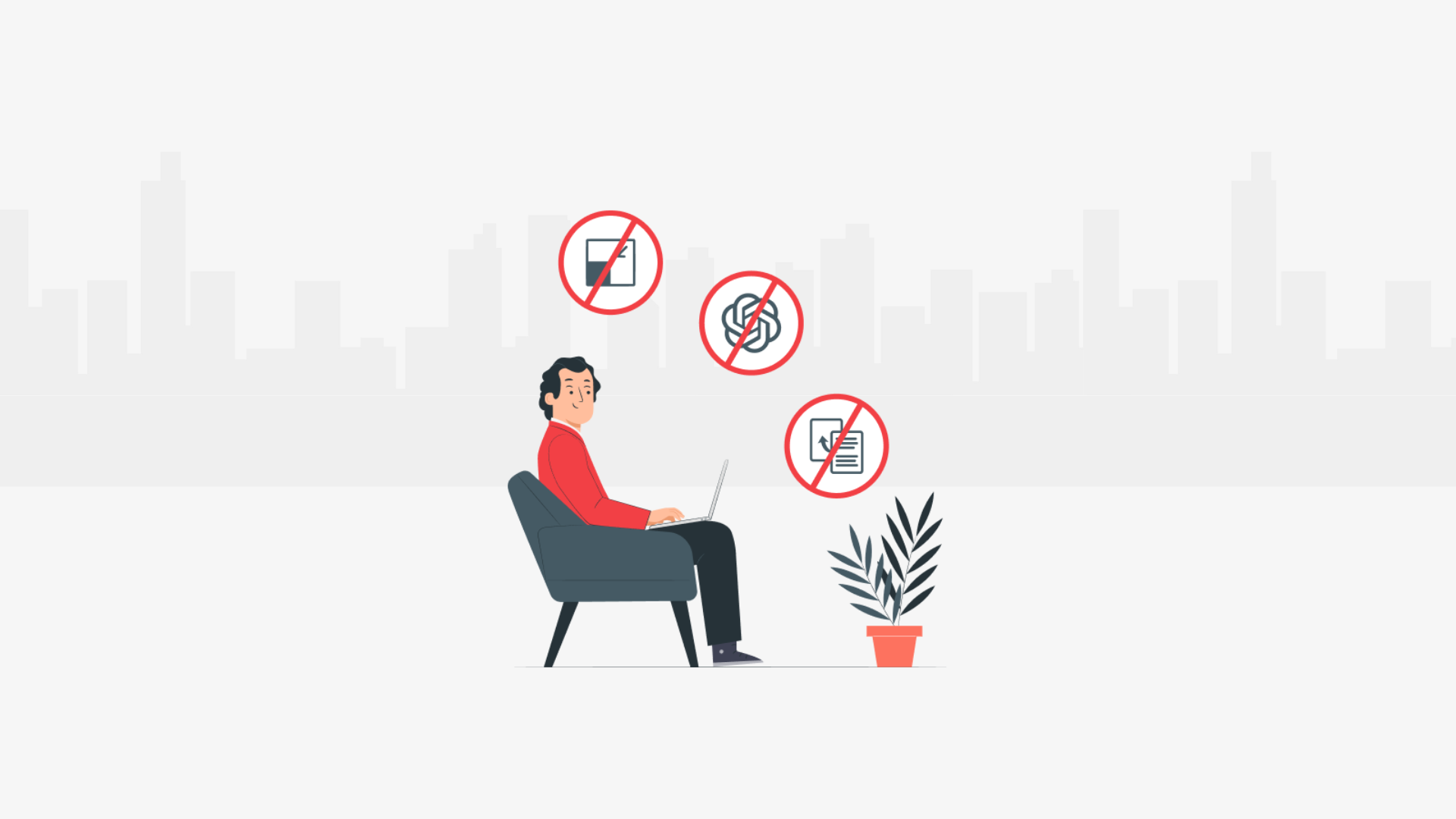
More than half of students admit to cheating in an online test (ICAI, 2023). Phones, VPNs, leaked questions, and now AI tools give candidates shortcuts that put exam integrity at risk. These tricks make it easier for the candidates to break the rules.
If you conduct remote exams or hiring assessments, you need to understand how to stop cheating in online tests. But before you can prevent cheating, you need to know how it happens.
 ChatGPT
 Gemini
 Claude
 Grok
Grok Perplexity
What are the most common ways people cheat online?
Cheating online ranges from phones to impersonation, AI answers, and leaked questions. Here’s how candidates usually try to cheat online.
Using secondary devices
The easiest way for candidates to cheat is to use a second device. A candidate keeps the test open on one primary device screen while searching for answers on a phone, tablet, or smartwatch.
Even sending a quick text message to a friend during the exam can give them an unfair advantage if the test isn’t being monitored closely.
IP masking and VPNs
VPNs and IP masking are simple for candidates to use. A VPN (Virtual Private Network) or IP masking tool allows a candidate to pretend they’re logging in from somewhere else, possibly even another country.
Without location checks or IP logging, it’s hard to know if the real person, or someone else, is taking the test.
Impersonation (Someone else taking the test)
Sometimes a candidate gets a friend to log in and take the test for them. If you don’t verify identity (ID checks, facial match, or camera), it’s nearly impossible to catch. A single impersonation attempt can undermine exam fairness.
Using AI tools mid-test
This method of cheating has become one of the fastest-growing forms of cheating in online assessments. Candidates simply copy and paste the exam question into the AI tools like ChatGPT, and within seconds, the AI generates a ready-made answer.
For example, if the question asks “Write a short essay on the impact of remote work”, the AI can draft a 200-word essay in less than five seconds. If it’s a math or coding problem, the AI can solve it step by step.
Even for multiple-choice questions, candidates can paste the question and get the right option almost instantly.
If AI tools are being used by candidates to cheat on remote online tests, then recruiters may end up hiring someone who can’t actually code, write, or problem-solve without outside help. That’s why AI-assisted cheating is a direct threat to exam integrity.
Contract help
Some candidates pay others to help them during the exam. This is called contract cheating.
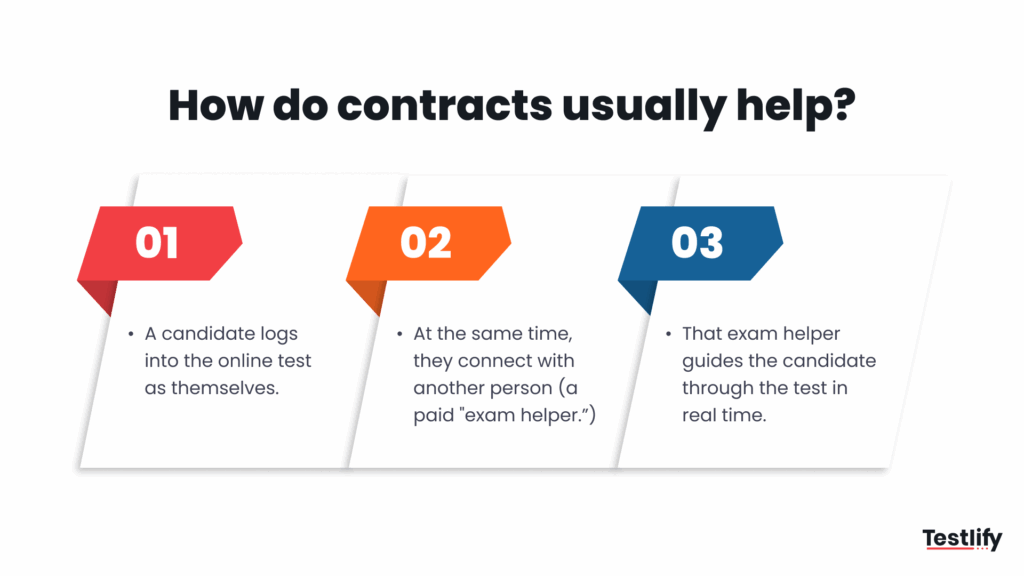
The helper might give answers over a video or phone call. In some cases, they use screen-sharing apps so the helper can see every question as it appears.
In more advanced cases, the candidate gives the helper full remote access to their computer through a tool like TeamViewer or AnyDesk, so the helper can actually control the test on their behalf.
This method completely breaks exam integrity because the score no longer reflects the candidate’s own ability.
Leaked test questions
Leaked questions are one of the hardest forms of cheating to control. Once out, they spread quickly online. Sites like Chegg and private forums often host entire banks of leaked questions.
An audit at Queensland University of Technology in Australia found that over half of the exam questions across 41 subjects were being posted on Chegg. In other words, more than half of the modules examined had answers available on the platform.
Together, these methods show why cheating online is easy if exams aren’t created and monitored properly.

How to create tests that reduce cheating?
Cheating in online tests has become common, and in most cases, it happens because tests are designed in ways that are easy to exploit.
If multiple-choice questions are too straightforward, they can often be searched online within seconds.
Similarly, if the same set of questions is reused every term or exam cycle, candidates quickly identify patterns and exploit them. Designing more resilient question formats helps reduce these risks and strengthens exam integrity.
There is also evidence to support this. Research has shown that even introducing just two different versions of the same problem can significantly lower cheating rates in online assessments.
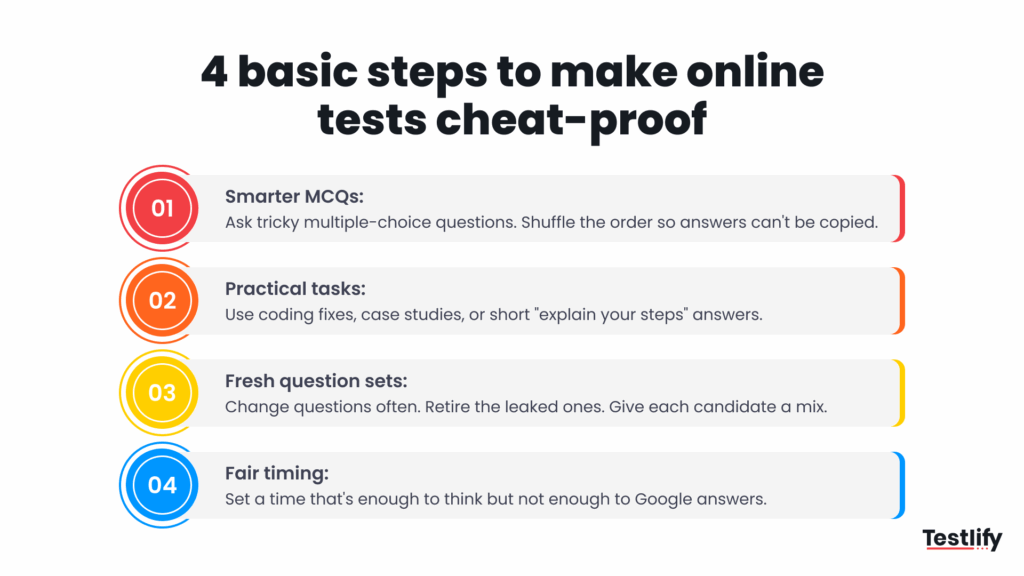
Write better multiple-choice questions
Weak MCQs are easy to guess or look up. To improve it.
- Write answer options that all look believable.
- Remove giveaways (like one option being much longer than the others).
Ask practical, real-world tasks
Questions that check recall are the easiest to cheat on. Instead, test application:
- Coding questions where candidates fix broken code.
- Business case studies that need a decision and explanation.
- Short answers that ask for reasoning, not just a fact.
Set fair but strict timing
Timing prevents candidates from having long windows to search for answers.
- Match time to task: more for essays, less for recall questions.
- Use “one-question-at-a-time” mode in high-stakes exams.
- Limit backtracking where honesty is critical.
Example: If a math problem normally takes 2 minutes to solve, give 3 minutes, not 10. Enough for honest candidates, but not enough to Google it.
Designing smarter questions is only the first step. The next layer involves conducting the online examination.
Simple rules to stop cheating in online exams
Good questions alone don’t keep exams fair. The way you set up the test matters just as much.
Measures such as tracking candidate login locations, establishing rules against backtracking, and providing clear practice runs all contribute to reducing cheating and protecting exam integrity.
Track login locations
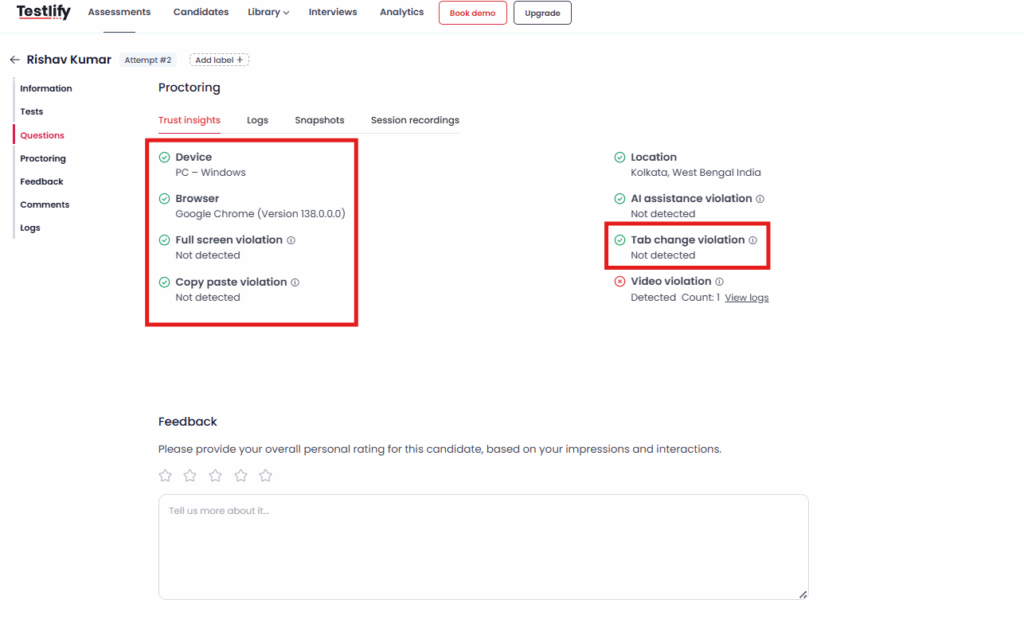
Location matters. If a candidate registers from one city but logs in from another country during the test, that’s a clear red flag. Monitoring IP addresses helps catch impersonation and collusion.
Recommended: How to prevent cheating in online interviews (2026)
Testlify has worked on this problem and built a solution that highlights IP violations for recruiters or admins running the test. This way, if someone logs in from a suspicious location, it’s flagged instantly.
Limit going back to old questions
In many online exams, candidates can move back and forth between questions. This sounds fair, but it also creates a loophole. For example, a candidate might skip a tough question, quickly search for the answer on another device, and then return later to fill it in.
To stop this, some online assessment platforms limit navigation so candidates can’t go back once they’ve answered and moved ahead. This makes it harder to cheat by pausing and searching.
In high-stakes exams (like certifications or hiring assessments), this rule helps protect exam integrity.
In low-stakes tests (like practice quizzes or classroom learning), allowing candidates to go back can reduce stress. The key is to match the rule with the purpose of the exam.
Together, these delivery rules close common gaps that question design alone can’t cover. Next, we’ll explore proctoring measures, the real-time features that keep exams secure.
Proctoring controls that stop cheating in online tests
Even with strong questions and fair exam rules, some candidates will still try to cheat in an online test.
That’s where proctoring has the upper hand. Proctoring is the process of monitoring candidates during an exam, either by a human, AI tools, or both, to keep the test fair and secure.
“There are unquestionable benefits of online proctoring.” – Caspar Matthews, Director of electcomm.com
Combine human and AI proctoring
Cheating in online tests can be subtle. A candidate may whisper answers with someone off-screen, glance at hidden notes, or use another device just out of the camera’s view.
Human proctors are good at catching these small signs in real time. They can judge tone, hesitation, or unusual behavior that software might miss.
On the other hand, relying solely on human proctors is challenging when hundreds of candidates are taking the test simultaneously. That’s where AI-powered proctoring helps.
It can track behaviors automatically, such as frequent tab switching, copy-paste attempts, or logins from different devices. It works at scale and gives quick alerts when something looks unusual.
The best approach is to combine both (Hybrid proctoring). AI keeps a close watch and flags possible issues instantly.
Then a human proctor or admin reviews those flags and decides whether the behavior is normal or dishonest. This balance reduces false alarms and ensures that honest candidates aren’t unfairly penalized.
Also read: Types of online exam proctoring: Which one’s right for you?
This layered approach is what Testlify’s AI proctoring solution is built around: automated checks to cover the scale, with human review to keep judgments fair.
Verify candidate identity
One of the simplest tricks is impersonation (someone else taking the test). To stop this:
- Verify photo ID before the exam starts.
- Match the ID to a live camera snapshot.
- Use periodic face recognition during the test.
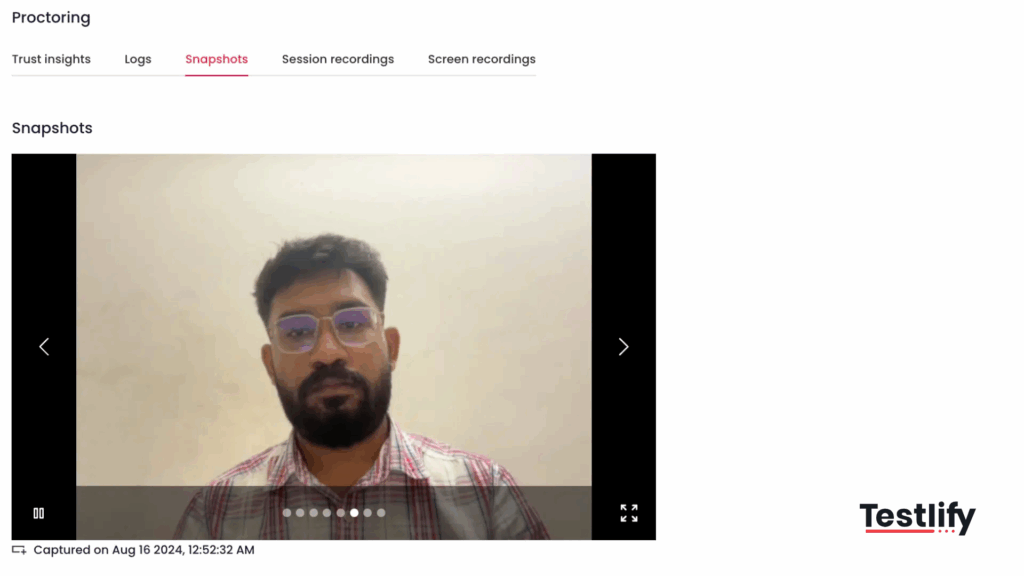
These steps ensure that the person who logs in is the same person completing the assessment. This is exactly how Testlify’s proctoring features are applied in practice.
Explore more: How proctored exams work and the best proctoring features
How to handle AI tools and leaked exam questions?
AI tools are changing how people cheat. A candidate no longer has to search for answers one by one. Now they can paste the whole question into a chatbot and get a neat reply in seconds.
The truth is, banning AI completely isn’t realistic. What works better is designing questions where AI isn’t much help. Instead of asking, “What’s the formula?” you ask, “Here’s a scenario, use the formula and explain how you got the result.”
The answer isn’t just the number. It’s the steps, the logic, and the reasoning that are harder for an AI tool to fake.
Detection is also becoming important. Cheating with AI can be tricky to catch, but you don’t have to guess blindly. Testlify has a feature that checks if a candidate’s answer looks like it was written by an AI tool.
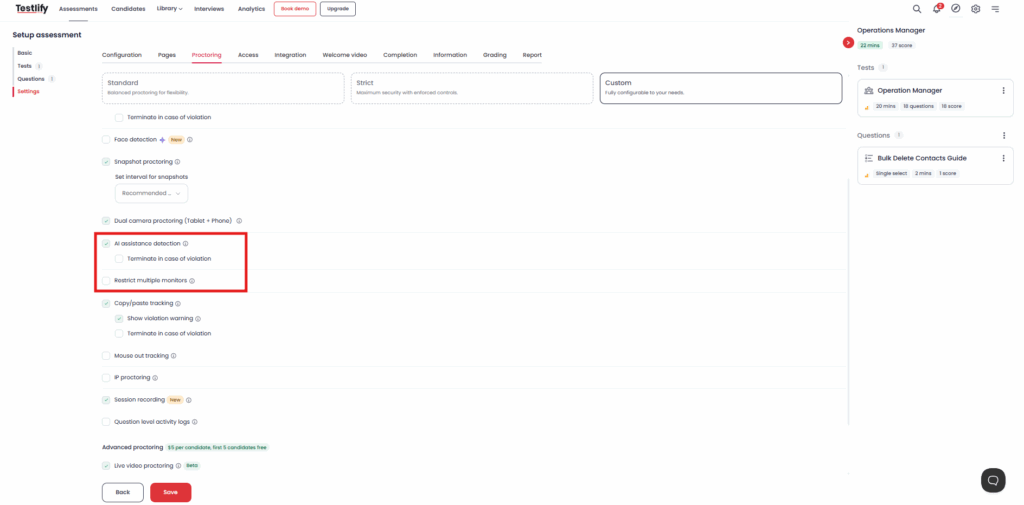
For example, if someone pastes a question into ChatGPT and copies the response, the system can flag that answer as suspicious.
Then there’s the old problem of leaked questions. Once a test gets out, it spreads like wildfire through WhatsApp groups, Chegg, and private forums.
The fix is speed. Retire those questions quickly, rotate fresh ones, and watermark items so you know where leaks start. Testlify’s regularly refreshed test library of over 3000 tests helps recruiters save time by eliminating the need to rewrite tests from scratch.
Cheating will never disappear, but with the right steps, you can make it harder than it’s worth. For candidates who want to cheat, it becomes more effort than it’s worth. For those who want to play fair, it stays simple and transparent.
Wrap-up
Cheating techniques will always evolve, but so can your strategies to stop cheating in online tests. By combining smart question design, layered proctoring, and clear rules, you can make shortcuts or trickery less rewarding without punishing genuine candidates during the hiring process.
Testlify brings these pieces together in one place: fresh test libraries, flexible proctoring, AI detection, and compliance settings you can trust. If you’re ready to see how this balance works in practice, try a demo now.
Frequently asked questions (FAQs)

B2B SaaS Content Writer
Rishav Kumar is a B2B SaaS content writer with 4 years of experience. He loves crafting engaging content. Always exploring fresh ideas, he's passionate about helping businesses grow through impactful writing.
LinkedInRelated resources
View all
Hiring Risks & Safeguards
How do platforms handle GDPR compliance for candidate data?

Hiring Risks & Safeguards
The real cost of a slow hiring process
Hiring Risks & Safeguards
Are traditional background checks enough for HR compliance?

Hiring Risks & Safeguards
Post-hire employee monitoring and behavioral analysis
Hiring Risks & Safeguards
How to prevent qualification fraud in hiring?

Hiring Risks & Safeguards
Candidate ghosting in recruitment: Solutions
Get started.
Hire on proof, not resumes.
Run your first skills-based assessment free — no credit card required.