
How do platforms handle GDPR compliance for candidate data?
Learn how recruitment platforms handle GDPR compliance through secure data processing, consent management, and compliant hiring practices.
Recruitment platforms handle GDPR compliance for candidate data through four core mechanisms. They encrypt candidate data, capture explicit consent, enforce role-based access controls, and automatically delete records when retention periods end.
This protects candidates while shielding employers from fines that can reach 4% of global annual turnover. According to the European Data Protection Board, GDPR penalties surpassed €5.88 billion by early 2025, so platform-level compliance now drives every modern hiring stack.
 ChatGPT
 Gemini
 Claude
 Grok
Grok Perplexity
What is GDPR compliance, and why does it matter for hiring?
GDPR compliance means an organization meets every requirement of the General Data Protection Regulation, the European Union law that controls how companies process personal data.
The regulation took effect on May 25, 2018, and applies to any business that handles EU resident data anywhere in the world.
For recruiters and hiring teams, GDPR carries importance because recruitment processes involve large volumes of sensitive candidate information. This includes resumes, identification documents, salary history, interview feedback, and assessment scores.
Mishandling this data can expose organizations to significant legal and reputational risk.
The regulation defines two roles that matter for hiring teams. The data controller decides why and how the company processes candidate data, while the data processor handles that data on the controller’s behalf.
GDPR matters for hiring because non-compliance carries severe financial and reputational costs. The regulation allows fines up to €20 million or 4% of global annual turnover.

How do platforms handle GDPR compliance for candidate data?
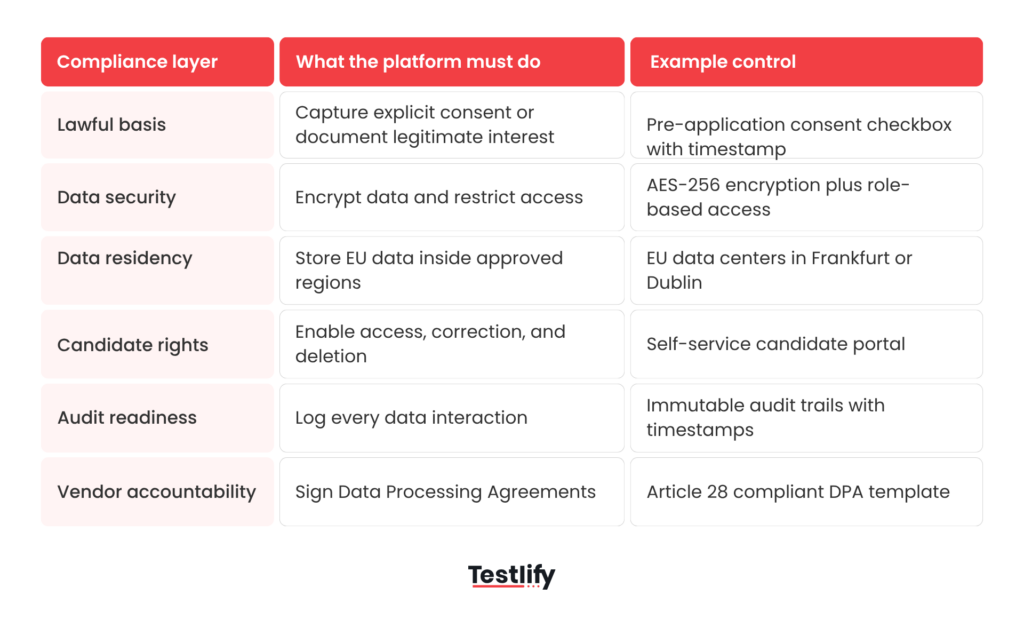
Modern recruitment platforms build GDPR compliance directly into their product architecture rather than treating it as a checkbox feature. They combine technical controls, contractual safeguards, and operational processes to protect candidate data across its full lifecycle.
The table below summarizes the core compliance layers a credible platform must operate.
How do platforms protect candidate data at rest and in transit?
Compliant platforms encrypt candidate data using AES-256 at rest and TLS 1.3 in transit. They also segment customer data inside isolated tenant environments to prevent cross-account exposure during a breach.
Leading vendors layer additional controls on top of encryption. Testlify, for example, runs enterprise-grade security controls that include quarterly penetration tests, annual ISO 27001 audits, and continuous SOC 2 monitoring through independent assessors.
What consent mechanisms do compliant platforms use?
Platforms capture consent through granular, time-stamped opt-in flows that record exactly what each candidate agreed to. They also store the consent version, the policy text the candidate accepted, and the IP address from which the candidate submitted the form.
Candidates can withdraw consent at any time through a self-service portal. The platform must then automatically purge or anonymize the data within the timeframe specified in the privacy policy.
What are the key GDPR rights and obligations for candidates?
GDPR creates eight fundamental rights for candidates and matching obligations for recruiters who process their data. Recruitment teams must operationalize each right inside their hiring workflow, not just publish it inside a privacy notice.
What rights do candidates hold under GDPR?
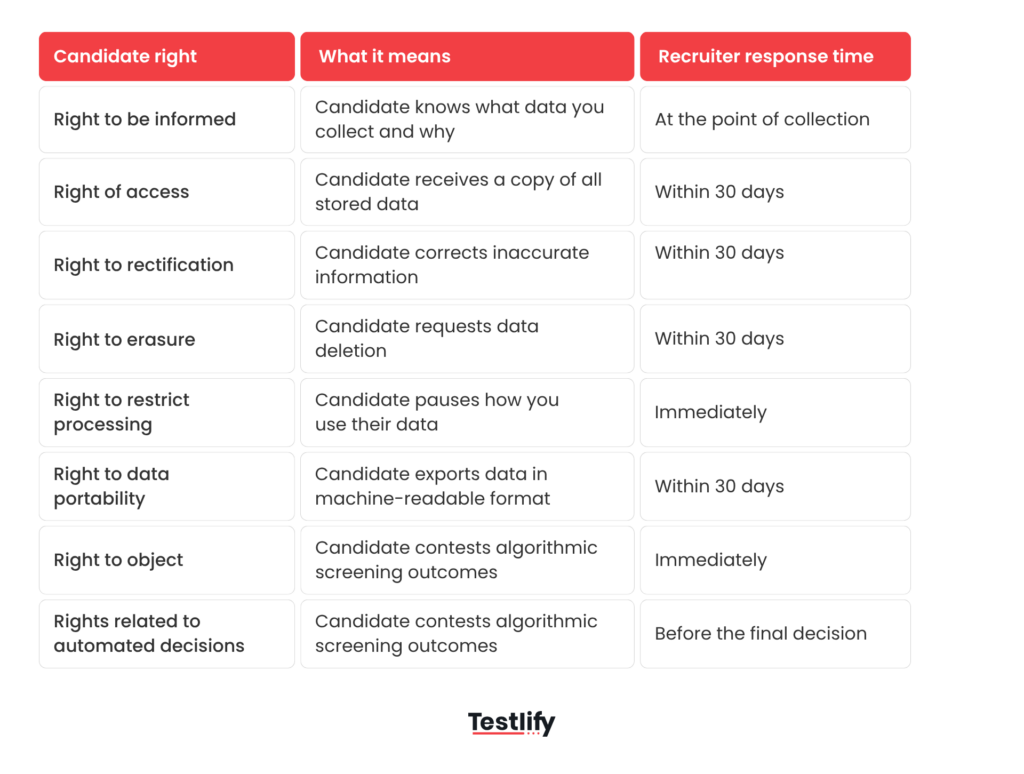
Candidates hold rights that give them direct control over their personal data throughout the hiring process. The platform must enforce each right within statutory deadlines, typically one month from request.
What should recruiters do to uphold candidate rights
Recruiters carry the legal obligations of data controllers because they decide why their company collects candidate information. These obligations extend across vendor selection, internal training, and incident response.
Hiring teams must complete six core duties to meet controller obligations. They must conduct Data Protection Impact Assessments before launching new hiring tools.
Organizations must also appoint a Data Protection Officer when scale requires it, document every processing activity, train recruiters on lawful processing, sign Data Processing Agreements with every vendor, and report breaches to authorities within 72 hours.
Which GDPR compliance strategies work best for recruitment teams?
Effective GDPR compliance strategies combine policy, technology, and accountability inside one operating model. Recruitment leaders who treat compliance as a workflow design choice outperform those who treat it as a legal afterthought.
GDPR compliance strategies for hiring teams must include the following actions:
- Map every candidate data flow from the application form to the offer letter to identify hidden processing activities.
- Standardize consent language across job boards, your career site, and your applicant tracking system so candidates see consistent terms.
- Centralize data inside one compliant platform instead of spreading resumes across email, spreadsheets, and shadow tools.
- Set automated retention rules that delete unsuccessful candidate records after the legally permitted period, typically six months to two years.
- Run quarterly access reviews to remove ex-employees and inactive recruiters from the system.
These strategies reduce both fine exposure and operational drag. Forbes reports that companies that consolidate hiring data inside compliant platforms cut data subject access request response times by 71%.
How to assess compliance with GDPR security requirements?
Recruiters assess compliance with GDPR security requirements by running structured evaluations against Article 32 of the regulation, which defines the technical and organizational measures every processor must implement. The assessment covers six audit categories that map directly to vendor security questionnaires.
Use the checklist below when you evaluate any pre-employment screening platform.
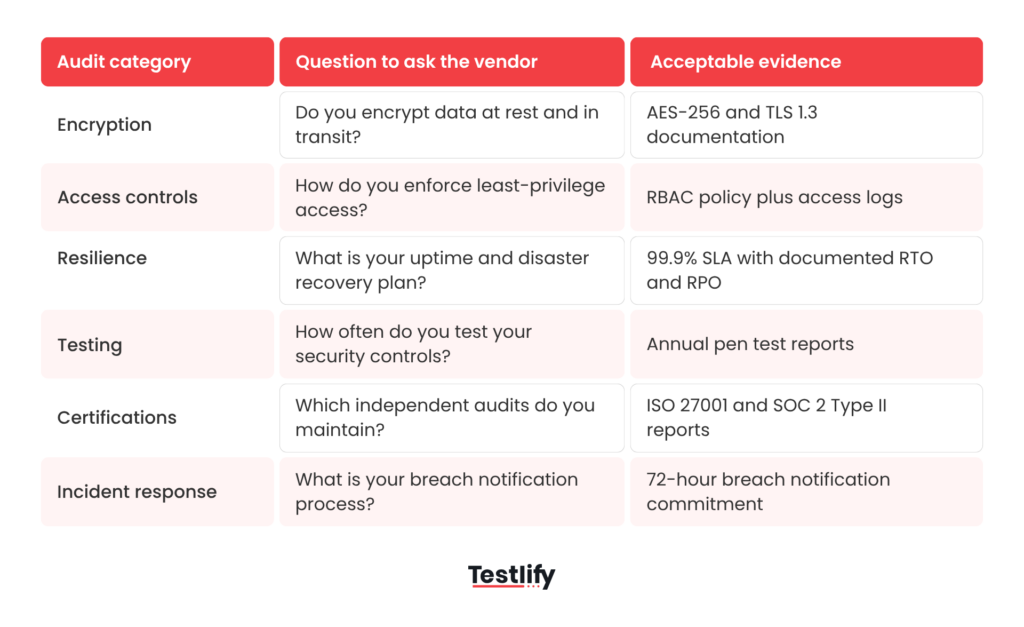
Hiring leaders should require vendors to share their full security documentation before signing a contract. Testlify, for instance, provides a trust vault that publishes certifications, sub-processor lists, and security white papers.
Does GDPR compliance in the US apply to recruiters?
Yes, GDPR compliance in US recruitment applies whenever an American company processes data belonging to anyone physically present inside the EU at the time of data collection. The regulation follows the data subject, not the company headquarters, so a New York recruiter screening a Berlin-based engineer triggers GDPR obligations immediately.
US recruiters face three specific compliance triggers. They process EU candidate data the moment a European applicant submits a resume, they offer goods or services in EU markets through career sites visible inside Europe, and they monitor EU candidate behavior through cookies, assessments, or analytics tools.
The regulation also overlaps with several US state laws that recruiters must navigate in parallel. The California Privacy Rights Act, Colorado Privacy Act, and Virginia Consumer Data Protection Act now mirror many GDPR requirements, and BambooHR research shows that 64% of US HR teams now follow GDPR-style controls as a default standard for their remote hiring workflows.
What practical steps help recruiters ensure GDPR compliance today?
Recruiters can ensure GDPR compliance today by completing a focused 10-step action plan that covers vendors, policies, consent, and monitoring. Each step takes less than one week to implement when the team commits dedicated resources.
Follow this sequence to close compliance gaps inside the next quarter.
- Audit your current tech stack and list every tool that touches candidate data, from job boards to skills assessment tools.
- Sign a Data Processing Agreement with each vendor that processes candidate data on your behalf.
- Update your privacy notice to reflect every data category, processing purpose, and retention period.
- Add a granular consent layer to your application form that separates job-specific consent from talent pool consent.
- Configure automated retention rules inside your chosen talent assessment software to purge expired candidate records.
- Build a candidate rights workflow that routes access, correction, and deletion requests to a single owner with a 30-day deadline.
- Train every recruiter and hiring manager on lawful data handling, with refresher sessions every six months.
- Run a Data Protection Impact Assessment before deploying any new recruitment automation tools that score or rank candidates.
- Document your breach response plan with named owners, escalation paths, and the 72-hour notification clock.
- Schedule quarterly compliance reviews that test consent capture, retention enforcement, and access controls.
Recruitment leaders who follow this plan report measurable risk reduction within one quarter. Research shows that hiring teams that run quarterly GDPR reviews cut data incident rates by 53%, which directly improves their recruitment analytics and audit posture.
Final thoughts
GDPR compliance now defines the baseline for every credible recruitment platform, and the cost of getting it wrong keeps climbing.
LinkedIn data shows that 81% of EU candidates abandon applications when they distrust how a company handles their data, so compliance directly impacts your hiring funnel and not just your legal exposure.
Recruitment leaders who select compliant platforms, sign rigorous Data Processing Agreements, and operationalize candidate rights inside daily workflows turn GDPR from a cost center into a trust signal.
If you want to simplify GDPR-compliant hiring at scale, Testlify helps teams run secure, candidate-friendly assessments with enterprise-grade data protection, transparent workflows, and seamless ATS integrations built for modern recruitment.
Book a demo with Testlify to see how we can help your team hire confidently at scale.
Frequently asked questions (FAQs)

Related resources
View all
Hiring Risks & Safeguards
The real cost of a slow hiring process
Hiring Risks & Safeguards
Are traditional background checks enough for HR compliance?

Hiring Risks & Safeguards
Post-hire employee monitoring and behavioral analysis

Hiring Risks & Safeguards
How to prevent qualification fraud in hiring?

Hiring Risks & Safeguards
Candidate ghosting in recruitment: Solutions
Hiring Risks & Safeguards
Candidate dishonesty: Key red flags
Get started.
Hire on proof, not resumes.
Run your first skills-based assessment free — no credit card required.