
Why AI powered phone screening is smarter for recruiters
Slash the busywork in first-round calls. Learn how Testlify’s AI phone screening trims time-to-hire, spots top talent fast, and treats every candidate fairly.
An AI phone screen is an automated voice interview. Software calls the candidate, asks a fixed set of questions, transcribes the answers, and scores them against a rubric you wrote. Nobody dials, and nobody waits three days for a callback.
That matters because the first round is where hiring stalls. SHRM's 2025 recruiting benchmarks put the median time to fill at roughly a month and a half, for senior and junior roles alike. Most of that is not interviewing. It is the gap between an application landing and a human getting around to the first call.
TL;DR
- An AI phone screen replaces the first-round call, not the interview. It collects evidence; a person still decides.
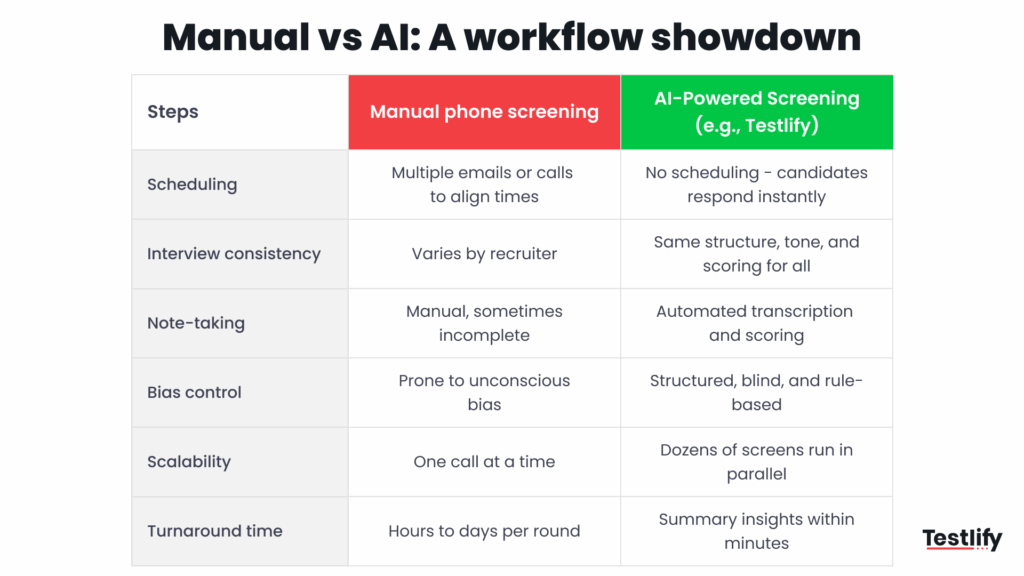
- The call runs on the candidate's schedule, which is what kills the scheduling loop, not raw speed.
- You get a transcript, a score and a summary back. Read the transcript. The score alone is not a decision.
- The legal bar is real and specific. In New York City you owe candidates 10 business days of notice and an annual bias audit.
- Most candidates are fine with AI reading an application. They object to AI making the call on who gets hired, and the law is heading the same way.
- Skip it for roles with tiny applicant pools, senior hires, or anything where the conversation is the sell.
 ChatGPT
 Gemini
 Claude
 Grok
Grok Perplexity
What is AI phone screening?
AI phone screening is a first-round voice interview run by software instead of a recruiter. The system phones each applicant, works through the questions you set, records and transcribes the conversation, then returns a scored summary. Every candidate gets the same questions in the same order, which is the part that makes the output comparable.
It is not a robocall and it is not a chatbot with a phone number. A current voice agent takes turns: it asks, waits, listens, and follows up. Testlify's candidate screen says "You're muted while the AI is speaking" during a live voice interview, which tells you the turn-taking is genuine rather than a recorded prompt playing at someone.

How does an AI phone screen actually work?
Four things happen on the call, and they happen in order:
- The call connects. The candidate either gets an outbound call or triggers one when they are ready. Testlify's candidate flow is literally that plain: "Call me", then "ringing", then "you're connected", ending on "Call completed! Thanks for your time."
- Speech becomes text. The system transcribes as the candidate talks, and it has to cope with accents, background noise and people who trail off mid-sentence.
- The answer gets read. Language models check whether the answer addressed the question, and pull out the facts you asked for: notice period, shift availability, location, license, salary range.
- A score comes back. Answers are scored against the rubric you defined, and the transcript travels with the score so a human can check the working.
Step four is where teams get careless. A score with no transcript attached is a number you cannot argue with, and that is exactly the kind of evidence that falls apart in a discrimination claim.
What an AI powered phone screener does in one call
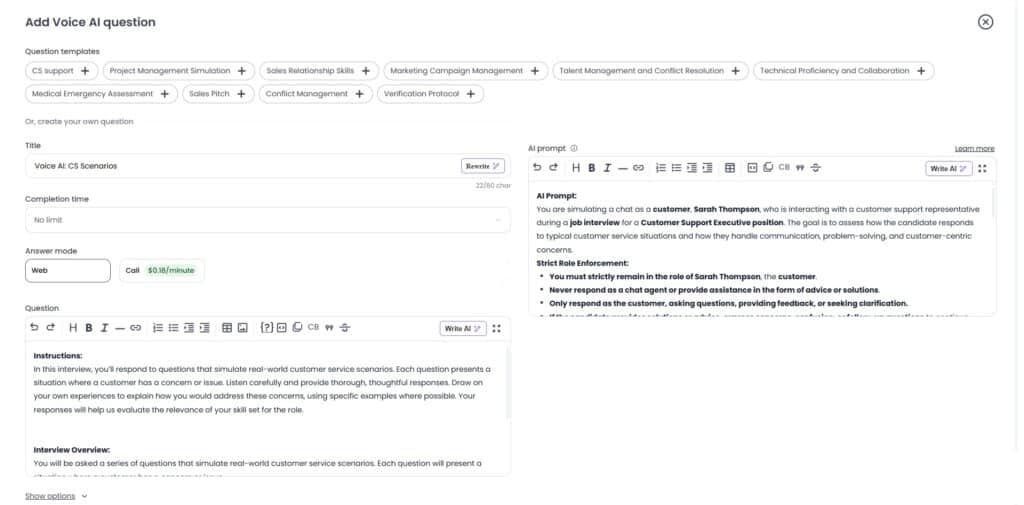
A single screen can cover more ground than a rushed human call usually does. Testlify's interviewer setup lets you choose the AI voice and persona, write the prompt, set how many attempts a candidate gets, cap the recording time, and pick the language. There are 150+ interview templates if you would rather start from one. Transcripts are automatic and multilingual, and they generate for any recording of at least 30 seconds.
The economics are unremarkable in a good way. Testlify bills AI phone interviews at $0.18 per minute, so a ten-minute screen costs less than two dollars. Against a recruiter's hour, the math is not close.
What is a phone screening agent?
A phone screening agent is the configured voice interviewer itself: a prompt, a question set, a scoring rubric and a voice, bundled into something that can hold a short structured conversation. The word "agent" is doing marketing work in most places you will read it. What you are actually buying is a script that listens and a scorer that explains itself.
What does a recruiter get back after the call?
Four artifacts, and they are worth separating because teams treat them as one thing:
What you get | What it is good for | Where it misleads |
|---|---|---|
Transcript | Checking what was actually said, word for word | Nothing, this is the honest artifact |
Score | Ranking a large pool quickly | Treating a rubric score as a verdict on the person |
AI summary and insights | Skimming 80 calls before lunch | Summaries flatten the odd, interesting answer |
Pronunciation and delivery signals | Roles where spoken clarity is the job | Reading fluency as competence on roles where it is not |
Testlify's pronunciation insights report accuracy, fluency and prosody, which is genuinely useful for a support or sales line and close to meaningless for a warehouse supervisor. Use the signal the role justifies and turn the rest off.
The product ships its own warning on this, and it is the right one:
AI scores and insights are for guidance only. Use human judgment for final decisions.
That is not legal boilerplate. Testlify makes "Include AI score in the final average" a toggle you can switch off, so a team can run AI scoring as advice and nothing more, and route any question to a named reviewer with "Requires manual review from reviewer". This is what the Testlify Human+AI Evidence-Based Hiring Framework means in practice: AI gathers structured evidence at volume, and a person owns the decision. The evidence gets better. The accountability does not move.
How accurate is AI phone screening?
Accurate at the thing it does, which is narrower than the sales pitch. Transcription and fact extraction are reliable. Asking whether someone has a forklift license, can work Saturdays, or has done payroll for a 200-person company gets you a dependable answer. Judgment calls do not work that way, and no vendor has published evidence that a ten-minute voice sample predicts job performance.
The honest framing is consistency, not clairvoyance. A human screener on their ninth call of the day asks shorter questions and listens less. Software does not get bored. That consistency is worth real money, and it is also the strongest legal argument for the approach: every candidate hears the same thing.
Pro tip: read ten transcripts against their scores before you trust any rubric you have written. Teams usually find one question that everybody answers identically, which means it is measuring nothing and is just costing candidates their time.
Is AI phone screening legal?
Yes, with conditions that vary by where your candidates live. New York City is the clearest example. Under Local Law 144, an automated employment decision tool must have passed a bias audit within one year of use, the audit results have to be publicly available, and candidates must get notice at least 10 business days before the tool is used on them. Illinois and Maryland regulate the video-and-face end of this, and the EU AI Act puts employment screening in its high-risk tier.
Three practical consequences, whatever your jurisdiction:
- Tell people. Disclose that the call is automated before it starts, not in a footer.
- Keep the evidence. Prompts, scores and transcripts are your audit trail. Testlify stores every prompt, score and decision trail for export, which is the boring feature that saves you in year two, and its approach to reducing bias in scoring is documented rather than assumed.
- Offer a way around it. A candidate with a speech difference or a bad line needs an alternative route, and refusing one is where accommodation claims start.
Candidate sentiment is pulling in the same direction as the regulators. Pew Research found 71% of Americans oppose AI making a final hiring decision, with just 7% in favor and 22% unsure. Application review splits far more evenly: 41% against, 28% for, 30% undecided. Read together, those numbers are a fairly precise instruction. Screening with AI is tolerated. Deciding with it is not.
How do you choose the right screening tool?
Most buying guides on this topic compare feature grids. The questions that actually predict whether you keep using the thing after month three are duller.
How to choose automated phone screening software
- Can you read the transcript next to the score? If the score is not auditable, walk away.
- Can you turn the AI score off? The ability to run it advisory-only is what lets you pilot without betting the funnel on it.
- Does it write back to where your team already works? Testlify covers 100+ ATS integrations, priced as an add-on on the self-serve plans rather than bundled, so check the line item before you assume it is included. If you have not picked one yet, start from a shortlist of applicant tracking systems and work backwards to what the screen has to write into.
- What does one screen cost, fully loaded? Per-minute pricing is easy to model. Per-seat pricing on a tool three people touch is not.
- Who owns the recordings, and for how long? Retention is a policy decision, not an IT detail.
The tell for a weak product is a demo that spends its time on the voice sounding human and none of it on the review screen. The voice is the easy part now. The review screen is where your team lives.
Where does this fit in your hiring process?
Between application and the first human conversation, replacing the qualifying call. It is not an interview and should not be sold to candidates as one.
Where AI phone screen recruiting fits your funnel
The pattern that works for lean teams, and lean here means the sub-200-person companies where one person runs hiring alongside another job: application lands, automated screen goes out the same day, the knockout facts get verified, and a shortlist with transcripts reaches the hiring manager by the next morning. The manager reads four transcripts instead of dialing forty numbers.
It earns its place in high-volume, phone-heavy hiring. Agencies filling seasonal accounts, retail and hospitality chains, construction firms staffing a site, outsourcing operations running shift work. If you are hiring two people a quarter, the setup time will not pay for itself, and a well-run screening interview by a human beats it.
Pair it rather than isolating it. A voice screen answers "can this person do the shift, and do they want it?" A skills assessment answers "can they actually do the work?" Teams that run AI interviews at volume alongside a short role-specific test get a shortlist with two independent signals, and two signals pointing the same way is a much better reason to book an hour of a manager's time than one.
When should you skip the AI phone screen?
Four cases, and vendors are quiet about all of them:
- Small applicant pools. Twelve applicants for a specialist role do not need automation. They need twelve phone calls.
- Senior and executive hiring. The first call is a negotiation and a sell. Automate it and the good ones stop answering.
- Roles where the phone is a barrier. Speech differences, second-language candidates under time pressure, bad rural connections. Offer an asynchronous or written path.
- A process nobody has fixed first. Automating a screen full of questions that do not predict anything just produces bad shortlists faster.
There is a quieter risk too. Pew found 52% of US workers are worried about future AI use in the workplace, against 36% who feel hopeful. Candidates carry that into your funnel. A screen that opens by explaining what the call is, how long it takes, and who reads the result costs thirty seconds and buys back most of the goodwill.
Ready to try one? You can create a Testlify account and build a voice screen on a single high-volume role, or book a demo and have someone walk the review screen with you first. Start with one role, keep your current process running next to it for two weeks, and compare the shortlists before you scale it.
Key takeaways
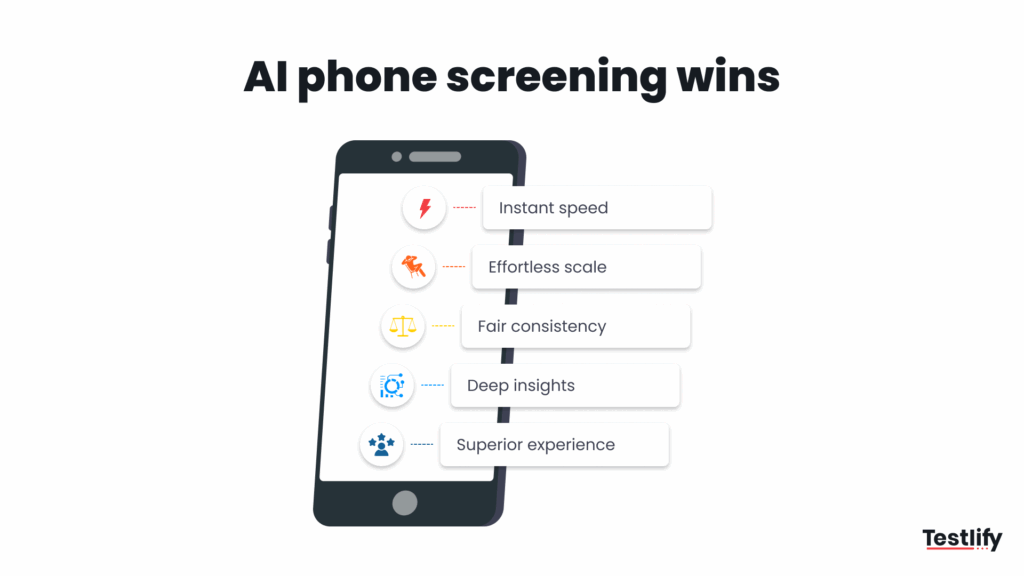
- The bottleneck is the wait, not the call. With median time to fill near a month and a half, the hours lost sit between an application arriving and someone dialing. An automated screen that runs the same day removes that gap, which is why teams see the change in speed before they see it anywhere else.
- The transcript is the product. Scores rank candidates; transcripts let you defend the ranking. Insist on reading both together, and treat any tool that hides the transcript behind a summary as a compliance problem waiting to surface.
- Consistency is the real accuracy claim. Software does not get tired on call nine, so every candidate gets the same questions. That is a defensible fairness argument, and it is a very different claim from predicting who will perform.
- The law has already drawn the line. Bias audits and 10 business days of notice in New York City, high-risk classification in the EU. Build disclosure and audit trails in from day one; retrofitting them after a complaint is far more expensive.
- Candidates accept screening, not deciding. With 71% opposed to AI making the final call, keep a named human on the decision and say so out loud in your candidate messaging.
- Volume justifies it, scarcity does not. High-applicant, shift-based and seasonal hiring pays back the setup. Two hires a quarter will not, and a human call will serve you better.
Frequently asked questions (FAQs)

B2B SaaS Content Writer
Rishav Kumar is a B2B SaaS content writer with 4 years of experience. He loves crafting engaging content. Always exploring fresh ideas, he's passionate about helping businesses grow through impactful writing.
LinkedInRelated resources
View all
HR & recruitment
How modern HR teams are using visual storytelling to attract top talent

HR & recruitment
How AI interviews work for candidate screening
HR & recruitment
Rethinking talent validation in a skills-based hiring world
HR & recruitment
How to streamline the interview process with AI
HR & recruitment
7 Mobile tools to simplify HR Tasks

HR & recruitment
How to incorporate gamification in corporate training
Get started.
Hire on proof, not resumes.
Run your first skills-based assessment free — no credit card required.