
Pre-hire testing: 7 strategies for fairer, faster hiring
How to run pre-hire testing that works: build tests from a job analysis, set cutoffs early, keep tests short and fair, and track results.
Pre-hire testing is the use of job-related tests, such as skills tests, cognitive ability tests, situational judgment tests and work samples, to measure what candidates can do before you interview or make an offer. Done well, it gives every applicant the same fair test and gives your team evidence instead of guesses from a resume.
TL;DR:
- Pre-hire testing measures job skills before interviews, so recruiters spend interview time on the candidates most likely to succeed.
- Start from a job analysis: pick the 4 to 6 skills that matter most for the role, then choose one test type per skill.
- Put a short skills screen of 15 to 20 minutes right after the application, and keep the full test under 60 minutes.
- Set cutoff scores and weights before you invite anyone, and treat a test score as one input next to a structured interview.
- In the US, tests must be job-related, and a pass rate for any group below four-fifths (80%) of the highest group's rate is generally treated as a sign of adverse impact.
- Track completion rate, pass-through rate, time-to-hire, quality of hire and the four-fifths ratio every quarter, and fix the test when a number slips.
 ChatGPT
 Gemini
 Claude
 Grok
 Perplexity
What is pre-hire testing?
Pre hire testing is a structured step in hiring where candidates complete standardized, job-related tests before an interview or offer. Every candidate for a role takes the same test under the same conditions, and results are scored against the same benchmark, so hiring teams can compare people on skill rather than on resume keywords or first impressions.
Pre hire testing and pre-employment skills testing are close cousins. Pre-employment skills testing usually means tests of hard skills (Excel, coding, accounting, writing), while pre-hire testing is the wider program that can also include cognitive ability, personality and situational judgment tests. Most hiring teams use the two terms interchangeably.
Pre hire testing is not the same as background checks, drug tests or medical exams. Those are screening steps with their own rules, and medical exams in the US can only come after a conditional job offer.
For a full list of test formats, see our guide to the [types of pre-hire tests](/types-of-pre-hire-testing/). The rest of this article focuses on how to build a testing strategy that holds up.

Why are hiring teams investing in pre-hire testing?
Hiring teams invest in pre-hire testing because resumes no longer show who can do the job, and the pressure to hire well keeps rising. Skills tests give recruiters a fast, consistent way to sort large applicant pools and to defend each decision with evidence.
The numbers back this up:
- Skills matter most for quality of hire: LinkedIn's Future of Recruiting 2025 found that 93% of talent acquisition professionals say accurately assessing a candidate's skills is crucial for improving quality of hire, yet only 25% feel highly confident they can measure quality of hire at all.
- Roles are still hard to fill: SHRM's 2025 Talent Trends survey of 2,040 HR professionals found that 69% of organizations still struggle to fill full-time roles.
- Jobs need new skills: The same SHRM survey reports that 28% of organizations now require new skills for full-time roles and 47% are updating existing roles to include them.
- AI-written applications are common: Generative AI makes polished resumes and cover letters easy to produce, so a written application says less about real ability than it did a few years ago.
Pre-hire testing addresses all four. A short test shows the skill directly, takes minutes to score, and gives every candidate the same chance, which is what teams under volume pressure need.
Which tests belong in a pre-hire testing program?
A pre-hire testing program usually combines a skills test for the core job tasks with one test of how the person thinks or behaves at work. The right mix depends on the role, its level and how many applicants you expect.
Test type | What it measures | Best for | Typical length |
|---|---|---|---|
Role and skills tests | Job knowledge and hard skills (Excel, accounting, sales, customer support) | Almost every role | 10 to 20 min |
Coding tests and simulations | Programming, debugging, real tasks in an IDE or MS Office | Engineering, data, admin roles | 30 to 60 min |
Cognitive ability tests | Reasoning, numerical and verbal problem solving | Roles that need fast learning | 10 to 15 min |
Situational judgment tests | Choices in realistic work scenarios | Customer-facing roles, managers | 10 to 15 min |
Personality and culture tests | Work style and preferences | Team fit conversations, never as a sole filter | 10 to 15 min |
Language and typing tests | Language level, typing speed and accuracy | Support, BPO and contact center roles | 5 to 15 min |
Work samples and video answers | How the person handles a real task or question | Senior, creative and client-facing roles | 15 to 45 min |
Skills-based hiring is now mainstream for early careers. The NACE Job Outlook 2025 survey found that 64.8% of employers use skills-based hiring practices for new entry-level hires. Close to 40% of those employers use assessments they built themselves and about a quarter use externally created tools, which is why off-the-shelf libraries and custom tests usually sit side by side.
Browse role-specific options in the Testlify test library, or learn more about cognitive ability tests and situational judgment tests.
How do you build a pre-hire testing strategy?
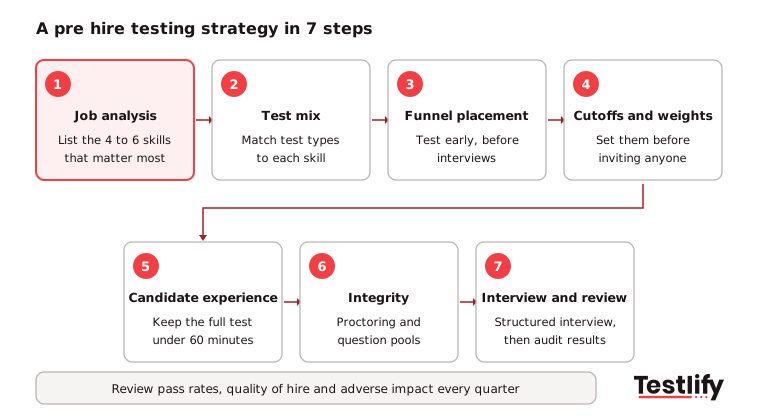
A pre-hire testing strategy is built in seven steps: analyze the job, choose the test mix, place tests early in the funnel, set cutoffs and weights, design for candidates, protect integrity, and combine results with structured interviews. Each step closes a gap that makes testing unfair or useless.
Hiring teams are also adding AI to this work quickly. SHRM's 2025 Talent Trends report found that AI use in HR tasks climbed to 43% in 2025, up from 26% in 2024, so expect AI to help with test building and scoring while people keep the final say.
1. Start from a job analysis
Every good test starts with a job analysis. Sit with the hiring manager and two or three top performers and list the tasks the person does every week. Then name the 4 to 6 skills that separate strong performers from average ones. Anything not on that list does not belong in the test.
Pro tip: Write one sentence per skill describing what "good" looks like on the job, for example "reconciles a 500-row account statement in under an hour with no errors". That sentence becomes the scoring guide later.
2. Match the test mix to the role
Map each skill to one test type from the table above. A customer support role might combine a support skills test, a typing test and a situational judgment test. A backend developer role might combine a coding test with a short cognitive test. Avoid stacking five tests "just in case": every extra test adds time and drop-off without adding much information.
3. Place tests early in the funnel
Tests save the most time when they come before interviews, not after. A common pattern is a short skills screen right after the application, a deeper task for the shortlist, and then structured interviews for the final few.
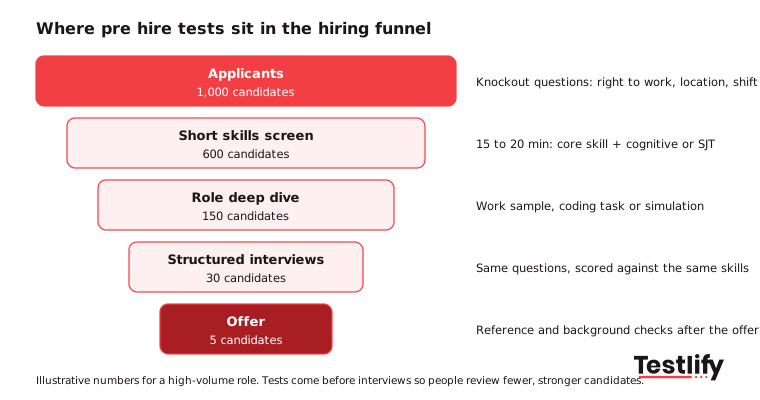
This matters most for selective hiring assessments, where a role draws hundreds of applicants for a handful of seats. Testing everyone who meets the basic requirements is fairer than screening resumes by hand, because each person is judged on the same evidence.
4. Set cutoff scores and weights before you invite anyone
Decide before the first invite how scores will be used. Pick a cutoff for a pass, or a ranking approach where the top group moves on, and agree on the weight of each test. A simple starting point is to weight each test by how much of the job it covers, then adjust after the first 50 to 100 candidates once you see the score spread.
Writing this down protects you twice. Recruiters cannot move the bar for a favored candidate, and if a decision is ever challenged, you can show the rule was set in advance.
5. Design for the candidate experience
Long tests lose good people. Keep the short screen to 15 to 20 minutes and the full test under 60 minutes. Tell candidates what the test covers, how long it takes and how results are used.
Make it work on mobile, offer the test in the candidate's language where you can, and offer reasonable accommodations, such as extra time or a screen reader, to anyone who asks. Good candidate experience is also a fairness issue, because drop-off is rarely spread evenly across groups.
6. Protect test integrity
Remote testing invites copying, outside help and now AI-written answers. Use question pools and randomization so no two candidates see the same test, and switch on proctoring that fits the stakes: full-screen mode, tab tracking, copy and paste blocking, webcam snapshots and AI assistance detection.
Read more about anti-cheating and proctoring options and how they flag suspicious sessions for a person to review.
7. Combine results with structured interviews
A test score is evidence, not a verdict. Use it to decide who to interview and what to probe, then run structured interviews where every candidate gets the same questions, scored against the same skills from step 1. When the test and the interview disagree, dig into why before you decide.
If you want a step-by-step view of how to run each assessment day to day, read our guide to the pre-employment hiring and assessment process.
Key takeaway: The strategy is set before the first candidate applies. Skills, test mix, cutoffs and weights are written down, so every candidate meets the same bar.
How do you keep pre-hire testing fair and legal?
Pre-hire testing stays fair and legal when every test is job-related, every candidate takes it under the same conditions, pass rates are checked by group, and candidates with disabilities can ask for accommodations. In the US, the rules come from Title VII, the ADA and the ADEA, and some cities add their own rules for AI tools.
The EEOC's guidance on employment tests sets out the core duties:
- Job-related and consistent with business necessity: A test that screens out a protected group more often is unlawful unless it measures what the job needs, and even then a less discriminatory alternative that works as well should be used.
- Reasonable accommodation: Employers must offer accommodations on tests, such as readers or audio versions, unless that causes undue hardship.
- No medical questions before an offer: Disability-related questions and medical exams wait until after a conditional job offer.
- Same rules for everyone: Employers may not adjust scores or use different cutoffs based on race, color, religion, sex or national origin.
- Vendors do not carry your risk: A vendor's documentation helps, but the employer remains responsible for how a test is used.
Two newer rules matter for teams that use AI scoring. New York City's Local Law 144, enforced since July 5, 2023, requires a bias audit of automated employment decision tools within one year of use, a public summary of the results, and notice to candidates 10 business days before the tool is used. In Europe, the GDPR applies to candidate data, so tell candidates what you collect, why, and how long you keep it.
GDPR and CCPA are privacy laws: they govern how you store and share test data, not who you may hire. Discrimination rules come from equal employment law, so a compliant program needs both a privacy notice and an adverse impact check. Our guide on how HR teams keep pre-hiring assessments compliant goes deeper on each region.
How do you know if pre-hire testing is working?
Pre-hire testing is working when more of the people you hire succeed in the role, hiring gets faster, candidates finish the test, and no group passes at a much lower rate than others. Track a short set of numbers every quarter and compare them with the period before testing.
Metric | What it tells you | Warning sign |
|---|---|---|
Completion rate | Share of invited candidates who finish the test | A drop after you add a test or questions usually means it is too long or unclear |
Pass-through rate | Share who pass each stage | Almost everyone passes (cutoff too low) or almost no one does (too high) |
Time-to-hire | Days from application to accepted offer | No change after testing means tests sit too late in the funnel |
Interview-to-offer ratio | Interviews needed for one offer | Still high means the test is not separating candidates |
Quality of hire | Performance ratings, 90-day retention, hiring manager satisfaction | New hires who score high on the test still struggle in the role |
Impact ratio by group | Each group's pass rate divided by the highest group's pass rate | Any ratio below 0.80 |
LinkedIn's Future of Recruiting 2025 report found that the most common ways teams measure quality of hire are job performance ratings (66%), new hire retention (60%) and hiring manager satisfaction (44%). Pick the two that your HR systems already record, and compare them for hires made with and without the test.
The last row is the four-fifths rule from the US Uniform Guidelines. Under 29 CFR 1607.4(D), a selection rate for any race, sex or ethnic group that is less than four-fifths (80%) of the rate for the group with the highest rate is generally regarded as evidence of adverse impact.
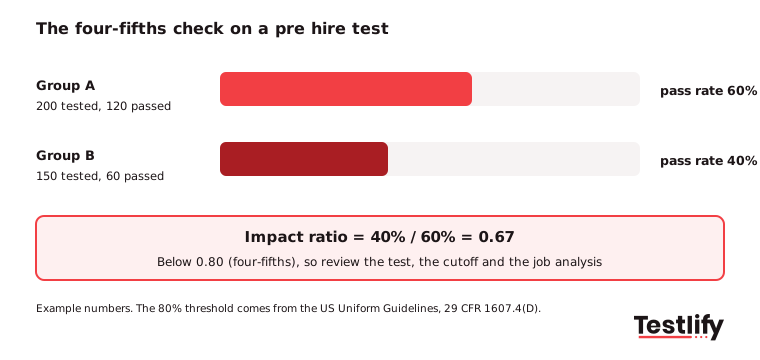
In the example above, group B's pass rate is 40% and group A's is 60%, an impact ratio of 0.67. That does not prove the test is unlawful, but it means you should check whether every part of the test maps back to the job analysis, whether the cutoff is higher than the job needs, and whether a different test would work as well with less impact.
Testlify's reporting and analytics show pass rates and score spreads per assessment, which makes this check quick.
What mistakes weaken pre-hire testing?
The mistakes that weaken pre-hire testing are testing the wrong skills, making tests too long, treating a score as the final answer and never reviewing results. Each one either loses good candidates or lets weak ones through, and most come from skipping the job analysis.
- Generic tests for specific jobs: A general aptitude test alone tells you little about a payroll specialist's skill with payroll rules. Pair it with a role test.
- Personality tests as a filter: Personality results help shape interview questions, but a pass-or-fail gate on personality alone is hard to tie back to the tasks of the job.
- Too many tests: We have seen candidate completion fall sharply once a test runs past an hour. Cut the test that adds the least information.
- Moving the cutoff per candidate: Changing the bar case by case removes the fairness that makes testing worth doing.
- No feedback loop: A test set up three years ago may no longer match the role. Review it whenever the job description changes and at least once a year.
- Ignoring accommodation requests: Every request needs a quick, documented answer. Silence is a legal risk and a poor candidate experience.
How does Testlify support pre-hire testing?
Testlify supports pre-hire testing with a library of 3,500+ tests, an AI test builder that turns a job description into a role-specific assessment in under a minute, and 20+ proctoring checks to protect results. Candidates can take tests in 15+ languages, and scores sync to 100+ ATS and HRIS tools.
Hiring teams use Testlify to:
- Build the test mix fast: Combine role, coding, cognitive, situational judgment, language and typing tests in one assessment, or add your own questions from 25+ question types.
- Rank candidates on one scale: Weighted scoring and benchmarks produce a ranked shortlist, with a per-skill breakdown for every candidate.
- Keep results honest: Full-screen enforcement, tab and copy-paste tracking, webcam snapshots and AI assistance detection flag sessions for review.
- Show your fairness work: the matching model behind testlify's candidate scoring completed a third-party NYC local law 144 bias audit on june 16, 2023.
Across the teams we work with, the fastest wins come from replacing the manual resume screen for one high-volume role with a 20-minute skills test, then expanding role by role. Browse the Testlify test library to find tests for your open roles and start a 7-day free trial with no credit card, or book a demo to plan a testing program for your hiring team.
Frequently asked questions (FAQs)

People and Talent Partner
Arushi Shah runs day-to-day talent acquisition and candidate experience at Testlify. She writes on interviewing, structured hiring, and giving candidates a fair, fast process.
LinkedInRelated resources
View all
HR & recruitment
Unbiased Assessments: An HR Guide to Fair Hiring and Reviews
HR & recruitment
An HR guide to pre-employment testing

HR & recruitment
How to implement fair and effective employment testing

HR & recruitment
How to avoid bias in employment testing: 9 best practices
HR & recruitment
Sourcing tools for recruiters: 10 types to use in 2026

HR & recruitment
Best sourcing tools for recruiters in 2027: 10 picks compared
Get started.
Hire on proof, not resumes.
Run your first skills-based assessment free — no credit card required.