
The cost of a bad hire in the age of AI: What every company should know
Learn the costly impact of a bad hire and how AI tools can help make smarter hiring decisions in today’s tech-driven world.

Bad hires are costly for any organization, and with the rise of AI, the stakes have only gotten higher. Today, recruiters have powerful tools at their disposal to improve hiring decisions. However, the impact of a single bad hire can still ripple through an organization, affecting finances, team morale, productivity, and even the company’s reputation.
According to the U.S. Department of Labor, a bad hire can cost a company up to 30% of the employee’s first-year earnings.
Let’s see why bad hires are so costly, the hidden repercussions they bring, and how leveraging AI can help minimize these risks.
 ChatGPT
 Gemini
 Claude
 Grok
Grok Perplexity
What is a bad hire?
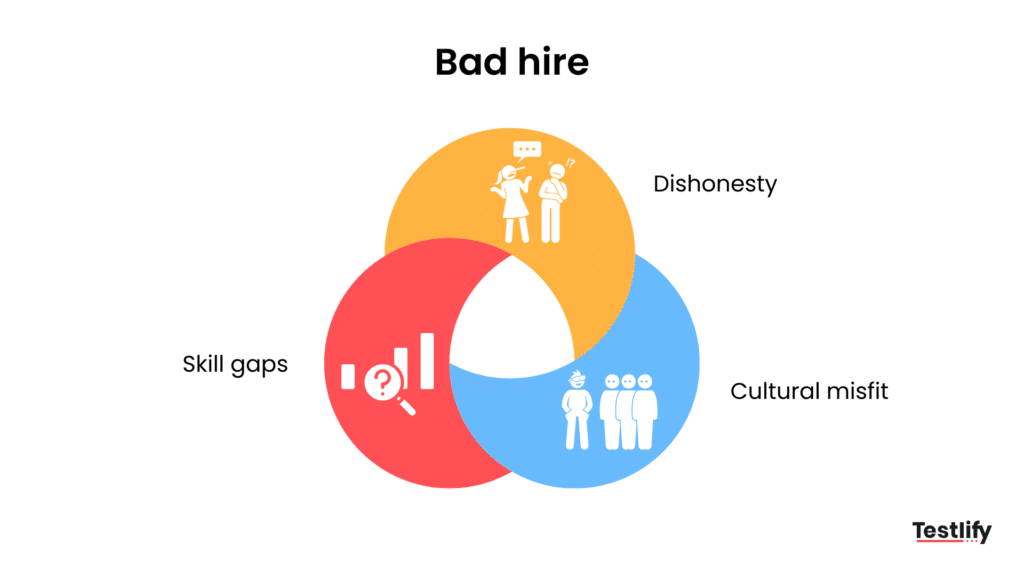
Bad hire is an employee who does not meet expectations, doesn’t fit into the company’s culture or underperforms. This can happen for various reasons; he does not have the required skills, does not have enough motivation, or simply does not get along with others in the team.
The worst part? You hire the wrong people, even with a rigorous hiring process. They might look good on paper, sail through interviews, and even charm their way into the team—only to prove later that they are never the right fit.

Understanding the true cost of a bad hire
Recruiting a candidate is one of the most important hiring decisions an organization needs to make. One bad hire can drain the organization’s resources, shift its teams’ focus in undesirable directions, and bring things to a screeching halt. However, it’s impossible to put a number on this cost. So, what does the bad hire cost?
According to SHRM, nearly 75% of employers have admitted to hiring the wrong person for a position, with 37% reporting negative impacts on employee morale.
Direct financial losses include recruitment expenses, onboarding and training costs, salary, and other benefits & packages in case they need to be fired. However, most indirect costs usually outweigh the direct costs: lost productivity, shaken team morale, and time taken to rectify the error.
Breaking down the costs: Time, money, and morale
The cost of a bad hire is more than a salary. Breaking down where the money goes:
- Recruitment costs: Each candidate incurs costs, whether for job ads, background checks, or agency fees.
- Training and onboarding expenses: Every new hire requires resources to get up to speed, which involves time and money.
- Salary and benefits: Even if the hire doesn’t work out, the company still pays their wages, benefits, and, if necessary, severance.
- Opportunity costs: The work that could have been accomplished if the right candidate had been chosen.
Time and productivity losses
74% of employers have made bad hires, with 66% reporting losses in productivity as a direct result. A wrong hire means hours that could have been utilized elsewhere in an even more fruitful enterprise, from planning to a team-building exercise.
In addition to that, more hours will be spent reviewing performance issues, attending corrective meetings, and eventually replacing the employee, thus deferring the department’s progress.
Impact on team morale
A bad hire demotivates the rest of the team. High-performing employees get frustrated continually having to pick up the slack or get around the challenges of the bad hire. In extreme cases, this frustration can decrease engagement or attrition among valued employees.
The repercussions of a bad hire
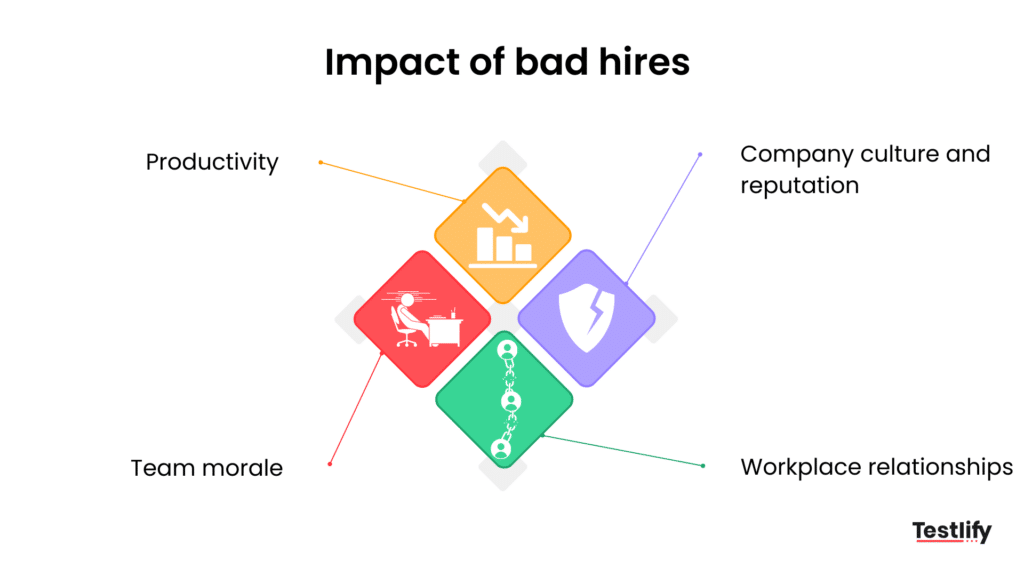
A bad hire can do more than just impact a company’s bottom line; it can disrupt team dynamics, affect morale, and hinder overall productivity. From financial losses to a weakened company culture, understanding the full scope of these repercussions is necessary for every recruiter aiming to strengthen their hiring strategy.
Lowered team performance
A bad hire can hinder the performance of an entire team. Projects could lag and become poor in quality, especially when other members have to compensate for one poor performer.
Damage to company culture
Every organization wants to establish and maintain a particular culture. A bad hire who fails to fit into that culture or happens to be working against it can create a stir, causing an ado in the workplace.
Negative brand reputation
Bad hires may deal with clients or customers. Suppose poor customer service or substandard deliverables are the aftereffects of such a bad hire. In that case, the business stands to suffer at the hands of being left with a horrible reputation, losing a great deal of business.
How AI is transforming the hiring process
AI has brought a level of sophistication to the recruitment process that never could have been fathomed even a decade ago. Machine learning, predictive analytics, and natural language processing can help you be even more informed in their hiring decisions.
The role of AI in screening candidates
AI tools allow resume analysis en masse and can scan through various qualifications, qualities, and experience levels. This increases the speed of screening procedures, with recruiters screening closer matches.
AI-powered skills assessment tools like Testlify helps shortlisting candidates based on their skills and knowledge and help you hire objectively.
On-the-job skill testing
AI now enables real-time skill assessments during the hiring process, allowing candidates to demonstrate their abilities through simulations or tasks relevant to the role. These tests provide recruiters with deeper insights into how a candidate would perform on the job, helping to ensure they possess the necessary skills before hiring. This approach reduces the risk of skill gaps and ensures a closer fit with the job requirements.
Predicting candidate success
AI-based evaluations can gauge much more than the technical skills of an individual. They can also measure soft skills and cultural fits and, hence, make predictions about whether that candidate would truly excel in that kind of role or in that particular team.
Reducing unconscious bias
AI minimizes unconscious biases that creep into the human mind while making decisions. Standardizing the screening and assessment processes helps AI create a fair hiring environment.
AI tools that help prevent bad hires
AI-powered tools have transformed the recruitment landscape, enabling recruiters to assess candidates more accurately and efficiently. A LinkedIn survey revealed that 55% of recruiters believe AI tools help save time during the hiring process.
These tools, from video interviews to behavioral assessments, help identify the best-fit candidates and reduce the risk of costly hiring mistakes.
1. Skill assessment platforms
AI-based skill assessment platforms like Testlify can do the job of specifically assessing the skills aligned with the requirement of a job role, giving much depth about the candidate’s efficiency.
2. Video Interview tools
With AI tools, recruiters can conduct structured video interviews, analyze expressions, and follow the cues provided by the vocal tone. Such data lines may add to a greater understanding of whether a candidate is engaged or honest during the interview process.
3. Behavioral assessment tools
Behavioral evaluations, through the use of AI, take you past the resume and job description. These evaluate the behavioral traits of the subjects: adaptability, team compatibility, and more. These enable a well-rooted prediction to judge the possibilities of a candidate’s long-term capabilities.
Calculating the positive impact of AI on the business
AI-driven hiring processes don’t just reduce the likelihood of a bad hire; they contribute directly to the company’s growth and efficiency. By making smarter hiring decisions, you can see measurable improvements in productivity, retention, and even team morale. Here are some ways AI positively impacts the business:
Data-driven decision-making: With AI’s predictive insights, hiring decisions are less biased and more data-centric, leading to smarter, more consistent hiring outcomes.
Enhanced productivity: AI-based candidate assessments match individuals to roles that align with their strengths, helping them perform better and contribute faster.
Improved retention rates: By identifying candidates who fit both skill and culture requirements, AI reduces turnover, saving costs associated with rehiring and retraining.
Optimized time and cost savings: Automated resume screening, video interviewing, and skill testing streamline recruitment, significantly reducing time-to-hire and cost-per-hire.
Preventing bad hires: Best practices in the age of AI
With AI reshaping recruitment processes, adopting new practices has become essential to making successful hires. By combining data-driven insights, clear job descriptions, and continuous learning, recruiters can make smarter hiring decisions that benefit both the team and the organization.
1. Define job roles clearly
Defining job responsibilities, skills, and experience required for a specific job is necessary to attract the right candidate. A job description that is too general or vague can lead to mismatched applications.
2. Use data-driven assessments
Skills assessments, personality tests, and AI-powered psychometric tests can provide data that traditional interviews cannot. These tools provide information on the candidate strengths and weaknesses and whether he or she fits into the company culture.
3. Leverage ai-powered screening and selection
AI-based screening programs-including predictive analytics, machine learning algorithms, and credit-report-based scoring, greatly reduce the likelihood of missing future red flags in a candidate’s background.
4. Continuous learning for hiring teams
Where hiring practices evolve at light speed with AI-driven innovation, recruiters must be trained constantly and enabled to be in the best position to apply AI products while remaining ahead of emerging best practices.
Conclusion
Today, the entire game has changed with this AI-driven world. You cannot afford to trust old hiring practices anymore, as the cost of a bad hire is too high in terms of money, productivity and reputational terms. Fortunately, AI empowers recruiters with its tremendous power to enhance hiring decisions, reduce bias, and more accurately predict candidate success.
Therefore, the clear message for recruiters is that embracing AI in recruitment is no longer just a technological upgrade but a strategic necessity that will eventually outdo the costly mistakes of bad hires and allow companies to invest time in developing a stronger and more engaged workforce.
For further reading, explore Cost Accountant.
Frequently asked questions (FAQs)

Content Writer
Yashika Khandelwal is a Content Writer with 3+ years of experience creating research-backed content on hiring, talent assessment, and HR technology. She is a registered Organizational Psychologist and subject matter expert who combines behavioral science with practical recruitment insights to produce accurate, evidence-based content.
LinkedInRelated resources
View all
HR & recruitment
How AI is changing the game for job applicants: Navigating the risks in hiring
HR & recruitment
Top 7 recruitment KPIs and how to effectively track them in 2026

HR & recruitment
9/80 work schedule: A definitive guide for 2026

HR & recruitment
What is job enlargement and how to implement it? Pros & Cons

HR & recruitment
Corporate Recruiting: Definition, Process, and Best Practices
HR & recruitment
Skills vs competencies: What’s the difference?
Get started.
Hire on proof, not resumes.
Run your first skills-based assessment free — no credit card required.