
Benefits of video and audio interviews: a 2026 guide for hiring teams
How video and audio interviews speed up screening, when to pick each format, the risks and rules to know, and how to run them well.
Video and audio interviews are job interviews held over a camera or a voice connection instead of in a room. They run live, like a video call, or one-way, where candidates record answers to set questions on their own time. For hiring teams, the main benefits are faster screening, no scheduling back and forth, and answers that every reviewer can compare on the same terms.
TL;DR: This guide explains the four formats of video and audio interviews and the benefits each brings to hiring teams and candidates. It shows when an audio interview works better than video, where these interviews belong in the hiring process, and the drawbacks to plan for, including candidate fraud. It closes with the rules on recording and AI scoring, a set of best practices and how Testlify supports both formats.
 ChatGPT
 Gemini
 Claude
 Grok
 Perplexity
What are video and audio interviews?
Video and audio interviews are interviews where the candidate and the employer meet through a screen or a voice line rather than face to face. The term covers four formats, and the difference that matters most is whether a person asks the questions live or the candidate answers recorded questions at a time that suits them.
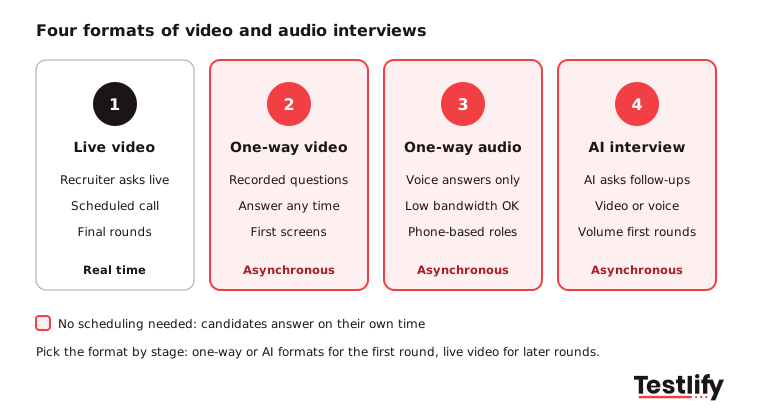
Format | Who asks the questions | When it happens | Best for |
|---|---|---|---|
Live video interview | A recruiter or hiring manager | Scheduled, in real time | Final rounds, senior and client-facing roles |
One-way video interview | Recorded or written questions | Any time within a response window | First screens, volume hiring, communication-heavy roles |
One-way audio interview | Recorded or written questions, voice answers only | Any time within a response window | Phone-based roles, low-bandwidth regions, language checks |
AI interview (video or voice) | An AI interviewer that can ask follow-ups | Any time, on demand | High-volume first rounds that need a conversation, not a monologue |
One-way formats are also called asynchronous or pre-recorded interviews. For a closer look at that format, see the pros and cons of pre-recorded video interviews.

What are the benefits of video and audio interviews for hiring teams?
Video and audio interviews give hiring teams six practical benefits: faster screening, no calendar juggling, lower cost per hire, a wider talent pool, fairer comparisons and a recorded record the whole team can review. The one-way formats deliver most of these gains, because the recruiter spends minutes reviewing answers instead of an hour on every call.
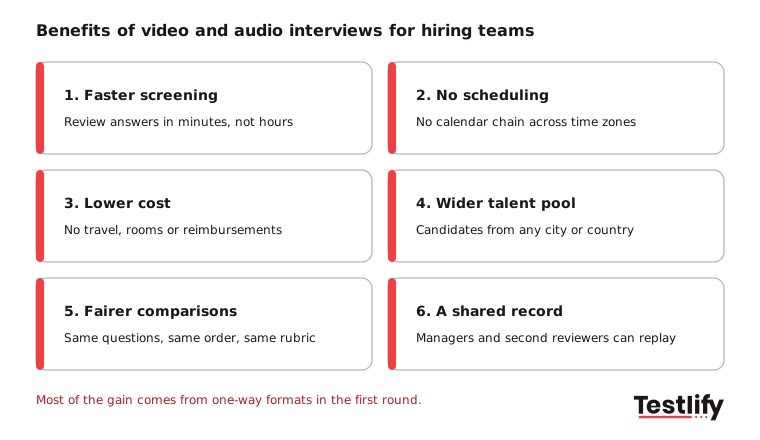
- Faster screening: A recruiter can review several recorded interviews in the time one live call takes, and candidates answer within days rather than waiting for a free slot.
- No scheduling back and forth: One-way interviews remove the email chain needed to line up a candidate, a recruiter and a hiring manager across time zones.
- Lower cost: No travel, rooms or reimbursements, and less recruiter time per candidate in the first round.
- A wider talent pool: Candidates can apply from other cities and countries, which helps with remote roles and hard-to-fill skills.
- Fairer comparisons: Every candidate answers the same questions in the same order, so reviewers score answers rather than how a conversation happened to go.
- A record to share: Hiring managers watch or listen to the answers they care about, and a second reviewer can check a borderline call.
The pressure to screen faster is real. SHRM's 2025 Talent Trends found that 69% of organizations still struggle to fill full-time roles, and AI use in HR tasks rose to 43% in 2025 from 26% a year earlier. LinkedIn's Future of Recruiting 2025 reports that 37% of organizations are using or testing generative AI in recruiting, that those teams save about 20% of their work week, and that 26% put the time saved into skills assessment.
Key takeaway: The biggest gains come from the one-way formats in the first round. Live video still earns its place later, when you need a two-way conversation.
How do video and audio interviews benefit candidates?
Video and audio interviews benefit candidates by giving them control over when and where they interview. A candidate with a day job, a caregiving routine or a long commute can answer in the evening, from home, without taking time off or paying for travel.
- Flexible timing: Candidates choose the hour that suits them within the response window.
- No travel: No commute, parking or time off work for a first conversation.
- A fairer first impression: Candidates answer the same questions as everyone else, and many tools allow a practice question before the real ones.
- Less pressure in audio formats: Some candidates speak more naturally when they are not on camera.
- A faster answer: When screening moves faster, candidates hear back sooner, which shapes how they see the employer.
When should you use an audio interview instead of video?
An audio interview works better than video when the job itself is done by voice, when candidates may have weak internet connections, or when how someone looks adds nothing to the decision. Video works better when presence, slides or a screen share are part of the job.
Choose audio when | Choose video when |
|---|---|
The role is phone-based: contact center, inside sales, support, dispatch | The role is client-facing in person or on camera |
You are checking spoken language, tone and clarity | You need to see a presentation, a demo or a whiteboard answer |
Candidates may be on mobile data or low bandwidth | Candidates have reliable connections and a quiet space |
You want reviewers to focus on what is said, not on backgrounds or appearance | Body language and on-camera presence matter for the role |
You hire at volume and want the shortest possible task | The pool is small and each candidate gets more time |
Audio is often the better first step for BPO and contact-center hiring, where a candidate's voice on a call is the job. For a deeper look, read how conversational AI audio interviews work.
Where do video and audio interviews fit in the hiring process?
Video and audio interviews fit best right after a short skills test and before live interviews with the hiring manager. The skills test filters on ability, the one-way or AI interview checks communication and role basics, and the live rounds go deep with the few people left.
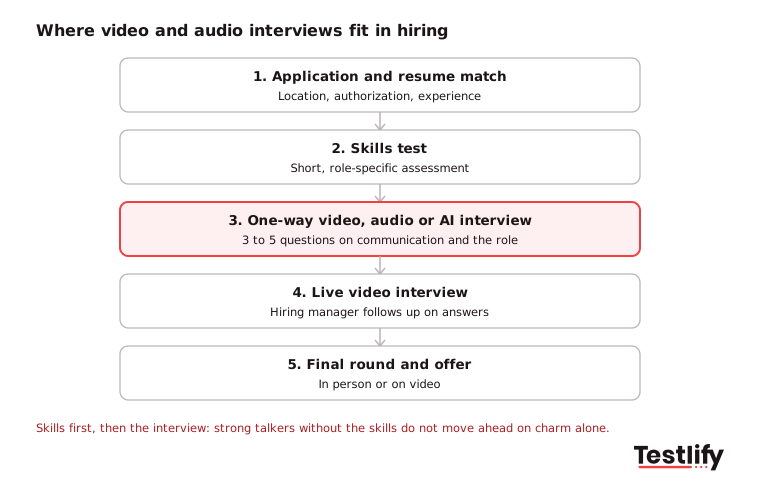
- Application and resume match: Basic requirements such as location, work authorization and experience.
- Skills test: A short, role-specific assessment on the core tasks of the job.
- One-way video, audio or AI interview: Three to five questions on communication, motivation and how the candidate handles real situations in the role.
- Live video interview: The hiring manager follows up on the recorded answers and the test results.
- Final round and offer: In person or on video, depending on the role.
Putting the skills test first keeps the interview short and stops strong communicators who lack the skills from moving ahead on charm alone.
What are the drawbacks of video and audio interviews?
Video and audio interviews have five drawbacks to plan for: some candidates feel awkward talking to a camera, one-way formats feel impersonal, technical problems interrupt answers, remote interviews are easier to fake, and AI scoring needs clear criteria to be trusted. Each one has a practical fix.
- Camera discomfort: Some strong candidates freeze on camera. Fix: offer a practice question, allow one re-record and never reject on video presence alone.
- An impersonal feel: Candidates cannot ask questions or hear about the team. Fix: add a short intro video from the hiring manager and follow up quickly with every candidate.
- Technical problems: Weak connections, microphones or browsers cut answers short. Fix: run a system check before the first question and offer an audio option.
- Fraud and impostors: Remote interviews make it easier to use a stand-in or read AI-written answers. Gartner predicts that by 2028 one in four candidate profiles worldwide could be fake, and 6% of 3,000 candidates in a 2025 Gartner survey admitted to interview fraud, as HR Dive reported. Fix: identity checks, webcam snapshots and AI-assistance detection.
- Low trust in AI scoring: The same Gartner research found only about a quarter of candidates trust AI to evaluate them fairly. Fix: tell candidates how answers are scored and keep a person reviewing every decision.
For more on each issue, see the challenges of using video and audio interviews and how to prevent impostors in video interviews.
What rules apply to recorded and AI-scored interviews?
Recorded and AI-scored interviews fall under privacy law everywhere and under specific AI hiring laws in some places. At a minimum, tell candidates the interview is recorded, explain how it will be used, get consent and delete recordings on schedule.
- Illinois: The Artificial Intelligence Video Interview Act, in force since January 1, 2020, requires employers that use AI to analyze recorded video interviews to tell applicants in advance, explain how the AI works and what it looks at, and get consent. Videos may only be shared with people needed to evaluate the applicant and must be deleted within 30 days of a request, as Amundsen Davis summarizes.
- New York City: Under Local Law 144, an automated employment decision tool needs a bias audit within one year of use, a public summary of the results, and notice to candidates 10 business days before use. Enforcement began on July 5, 2023.
- EU and UK: Recordings are personal data under GDPR, so you need a lawful basis, a clear retention period and a way for candidates to ask for access or deletion. See the GDPR compliance overview.
This is a summary, not legal advice. Check the rules for each location you hire in with your legal team.
How do you run video and audio interviews well?
Video and audio interviews work well when every candidate gets the same short set of job-related questions, clear instructions, a fair response window and a scorecard that reviewers agree on before the first answer comes in. Most of the good practice is decided before you send the first invite.
- Keep it short: Three to five questions and 15 minutes or less of candidate time for a first round.
- Ask job-related questions: Situational and behavioral questions tied to the role. For more on planning them, read the guide to video interviews.
- Set the scoring rubric first: Agree what a strong, average and weak answer looks like for every question. See how to score video and audio interview responses.
- Give a fair window: Three to five days to respond, with a reminder before the deadline.
- Explain the format: Say how many questions there are, how long each answer can be, whether a re-record is allowed and how answers are reviewed.
- Offer a practice question and a system check: Both cut drop-off from nerves and technical trouble.
- Use more than one reviewer for close calls: Recorded answers make a second opinion cheap.
- Review the data: Track completion rate, time to review and how interview scores line up with later rounds.
Pro tip: Write the questions as if they were part of a structured interview. The same questions and the same rubric for every candidate are what make one-way answers comparable.
How does Testlify support video and audio interviews?
Testlify supports video and audio interviews as part of the same assessment a candidate takes for skills, so recruiters see test scores and interview answers side by side. Teams can add one-way video and audio questions, or run two-way AI interviews by video, voice or chat.
- One-way video and audio questions: Two of 25+ question types, mixed with skills questions from a library of 3,500+ tests on the test library.
- AI interviews: Video AI, Voice AI and Chat AI interviewers that ask role-based questions and score every answer against the same criteria. See the video interviewing tool.
- Integrity checks: 20+ proctoring checks, including webcam snapshots, AI assistance detection and speech authenticity detection for Voice AI and Video AI answers. More on anti-cheating and proctoring.
- Scoring and review: Automated scoring with AI candidate insights, a Reviewers Portal for hiring managers, and 15+ languages for candidates.
- ATS sync: Two-way sync with 100+ ATS and HRIS tools through Testlify integrations.
Testlify's matching model completed a third-party NYC Local Law 144 bias audit on June 16, 2023. You can try one-way video and audio interviews with a 7-day free trial, no credit card needed.
Frequently asked questions

Related resources
View all
HR & recruitment
How to use audio and video interviews to assess candidates
HR & recruitment
The most common signs of a bad hire

HR & recruitment
How to recover from a bad hire
HR & recruitment
What to do if you’ve made a bad hire

HR & recruitment
How to use data to drive talent management decisions
HR & recruitment
7 strategies recruiters use to recognize top talent
Get started.
Hire on proof, not resumes.
Run your first skills-based assessment free — no credit card required.