
Conversational AI interviews for entry-level hiring
Explore how conversational AI interviews are reshaping entry-level hiring, promoting fairness, and setting a new benchmark for efficiency in today’s talent market.
Conversational AI interviews screen entry-level candidates the way a sharp recruiter would, one question at a time, except the AI can talk to every applicant at once. For high-volume first-job roles, that is the gap between reading a stack of near-identical resumes and opening a ranked shortlist by morning.
Entry-level hiring is, at heart, a volume problem. U.S. employers make about 5.2 million hires and absorb about 3.1 million quits every month, and first-job postings pull the biggest applicant piles of all. A conversational AI interview owns that first screen: it runs a short chat, voice, or video conversation with each candidate, scores the answers against one rubric, and hands recruiters the people worth a human call.
This guide covers what conversational AI interviews are, how they work, whether they actually make hiring better, and where entry-level teams get the most out of them, so you can decide if the approach fits your next hiring wave or your next 500.
TL;DR
- Conversational AI interviews are two-way chat, voice, or video conversations that screen every applicant on the same rubric, then rank them for a human recruiter to review.
- They fit entry-level roles best, where applicant volume is highest and the first screen eats the most recruiter time.
- The evidence is strong when AI screens first and people decide last: AI-screened candidates passed the later human interview 53.12% of the time, against 28.57% from resume screening.
- The real win is consistency and speed, not replacing recruiters. Every candidate gets the same questions; the hiring team still makes the call.
- Bias drops because interviewers stop drifting, but the rubric, questions, and scoring still need human review.
- Start with one high-volume role, one clear rubric, and a human review step, then scale from there.
 ChatGPT
 Gemini
 Claude
 Grok
Grok Perplexity
What are conversational AI interviews?
A conversational AI interview is a two-way chat, voice, or video conversation between a candidate and an AI interviewer. It asks role-specific questions, listens to each answer, asks a natural follow-up, and scores the response against a rubric the recruiter set. The output is a ranked shortlist, not another pile of resumes.
It is not a static form or a scripted chatbot. The AI reads what the candidate actually said and adapts the next question, so it assesses skills in context rather than checking keywords. Think of it as an active screen of how someone handles a real task, which is exactly what a resume cannot show. For teams weighing this against older methods, it sits alongside other alternatives to traditional interviews, with one difference: it scales to every applicant, not just the few who reach a phone screen.

Why is entry-level hiring so hard in 2026?
Entry-level hiring is hard because the volume is brutal and the signal is thin. First-job applicants rarely have a track record, so resumes look alike, and every open role can draw hundreds of them. Screening each one by hand is slow, and slow screening loses the good ones.
The money makes the stakes clear. The average U.S. cost per hire is about $4,129, and that is just to fill the seat. Get the pick wrong and it costs far more: Gallup estimates that replacing an employee runs one-half to two times their annual salary, roughly 40% for a frontline worker, 80% for a technical role, and up to 200% for a manager. A weak first screen quietly feeds every one of those costs.
So the entry-level challenge is not really ‘find great people.’ It is ‘evaluate a flood of look-alike applicants fast, fairly, and without burning out the recruiting team.’ That is the exact job a conversational AI interview is built for.
How do conversational AI interviews work?
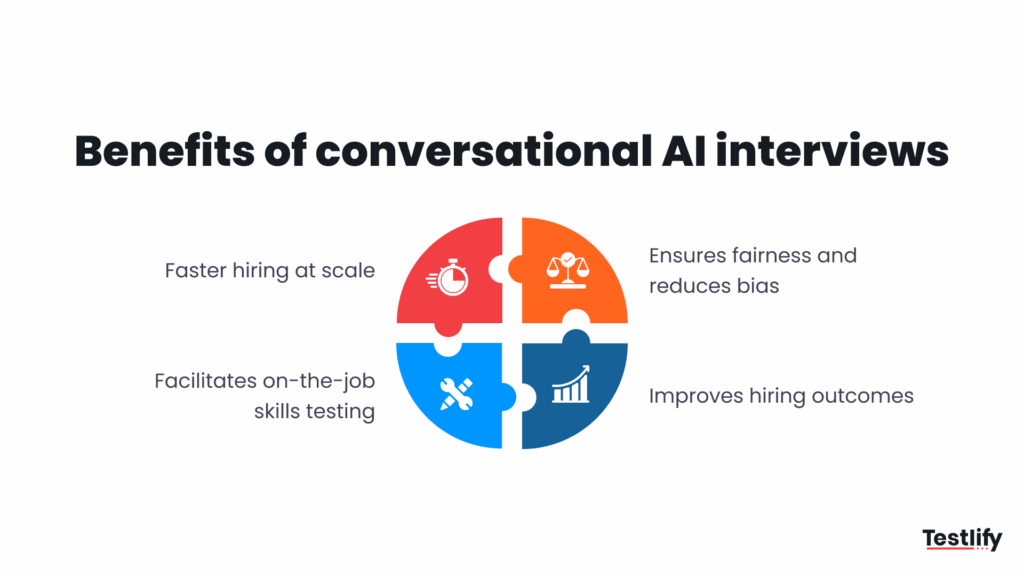
A conversational AI interview runs in four moves: the recruiter defines the role, the questions, and a rubric; the AI interviews every applicant on demand; it scores each answer with a short reason; and a recruiter reviews the ranked shortlist. AI does the screening, people make the decision.
- Set the brief. Pick the competencies that matter for the role, write or auto-generate the questions, and define how a strong answer scores.
- Invite everyone. Every applicant gets the same interview link and can take it on their own time, on a phone or a laptop, in any time zone.
- Interview in context. The AI asks the questions, listens, and follows up on what the candidate says, testing communication, judgment, and role skills through a real conversation.
- Score with reasons. Each answer is graded against the rubric with a short rationale and the candidate quote behind it, so the score is auditable, not a black box.
- Hand off to a human. Recruiters open a ranked shortlist and spend their time on the top candidates instead of the first 200 screens.
Pro Tip: Keep a human review step on every AI-screened shortlist, even a fast one. The AI is there to rank and explain, not to auto-reject. A two-minute reviewer check on the borderline scores is what keeps the process fair and keeps a good candidate from being cut on a bad audio day.
Do AI interviews actually make hiring better?
Yes, when the AI screens first and people decide last. In a Stanford study cited by the World Economic Forum, candidates screened by an AI-led structured interview passed the later human interview 53.12% of the time, against 28.57% for those filtered by resume screening. The AI interviews were also more consistent, with less swing in quality from one candidate to the next.
That fits where the value is. McKinsey puts the biggest slice of generative-AI value in HR, about 20%, in talent acquisition, recruiting, and onboarding, the front of the funnel where entry-level volume lives. The catch is design: the gain shows up in an ‘AI first, human later’ setup, where AI runs the broad screen and hiring managers interview the top of the ranked list. Point AI at the final decision instead of the screen and you lose the benefit, and the trust.
How does conversational AI interviewing compare to traditional screening?
The clearest way to see the difference is side by side. A resume-and-phone screen and a conversational AI interview aim for the same outcome, a good shortlist, but they behave very differently once applicant volume climbs.
What you are comparing | Resume and phone screen | Conversational AI interview |
|---|---|---|
Time to a shortlist | Days of manual review and phone tag | Same day, as candidates apply |
Candidates reached | Only the few who make the phone list | Every applicant, at once |
Consistency | Varies by interviewer and mood | Same questions and rubric for all |
What it tests | Credentials on paper | Skills and judgment in context |
Bias exposure | Interviewer drift, gut feel | Lower drift, but rubric needs review |
Recruiter time | Spent on first-pass screening | Spent on the top of the shortlist |
None of this makes recruiters optional. It moves their hours from the bottom of the funnel, where a human adds little, to the top, where judgment about fit and potential actually decides the hire.
Where do entry-level teams use AI interviews?
Conversational AI interviews earn their keep in high-volume, high-turnover roles, the ones where a team has to screen far more people than it can call. They also shine for structured high-volume hiring and large graduate intakes. A few patterns show up again and again:
- Contact centers: a short voice interview measures empathy, clarity, and problem-solving before a candidate ever handles a live call.
- Retail and hospitality: quick chat or video prompts show how a candidate handles a peak-hour rush or an unhappy customer, calmly or not.
- Healthcare support roles: role-relevant questions surface who follows protocol and communicates with care under pressure.
- Logistics and operations: walk candidates through a misrouted shipment or a safety call to read their decision-making.
- Junior tech roles: pair the interview with a short skills check and job simulations to test real problem-solving over textbook answers.
- Campus and graduate drives: for large-scale campus hiring, every student gets the same fair screen on the same day, no matter which college they came from.
How does Testlify run conversational AI interviews?
Testlify runs conversational AI interviews across chat, voice, and video, then scores them against your success profile. The design follows the Testlify Multi-Signal Talent Evaluation Model: one signal is fragile, so instead of betting the hire on a single resume or a single test, the platform combines several role-relevant signals (a written answer, a spoken response, a short skills check) and advances a candidate only when they point the same way. For entry-level hiring, where any one signal is noisy, that is what makes a shortlist you can trust.
Chat AI
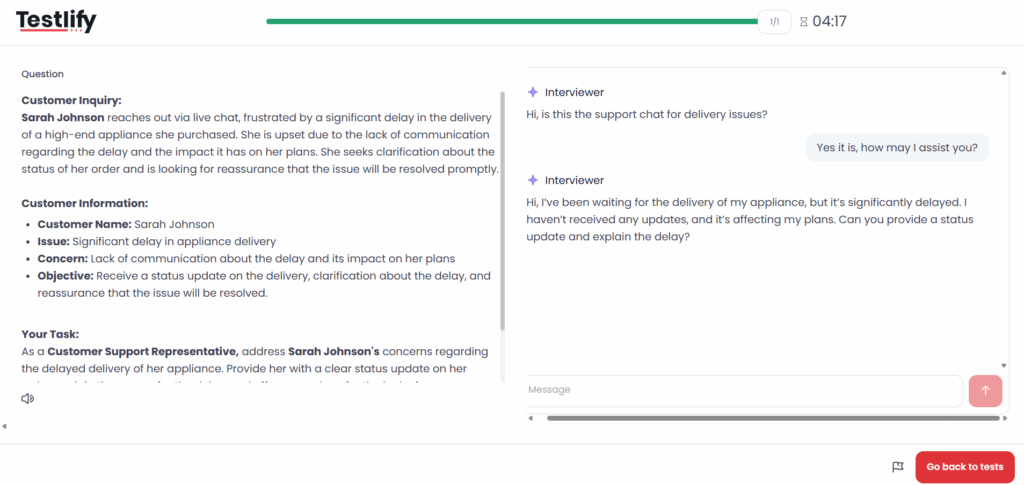
Chat AI puts candidates in realistic text-based situations, a billing dispute, a frustrated customer, a pile of tasks to prioritize, to read problem-solving, written communication, and composure under pressure. It surfaces skills a resume never shows.
Voice AI
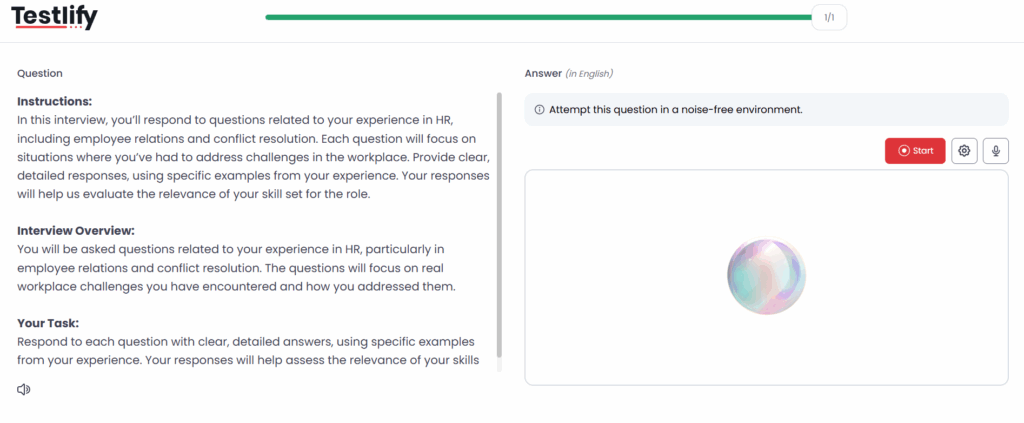
Voice AI has candidates answer role-specific prompts out loud, which shows verbal fluency, tone, and confidence. For support, sales, and other client-facing entry roles, that is often the single most predictive signal, and it also powers audio interviews for call-center hiring at scale.
Video AI
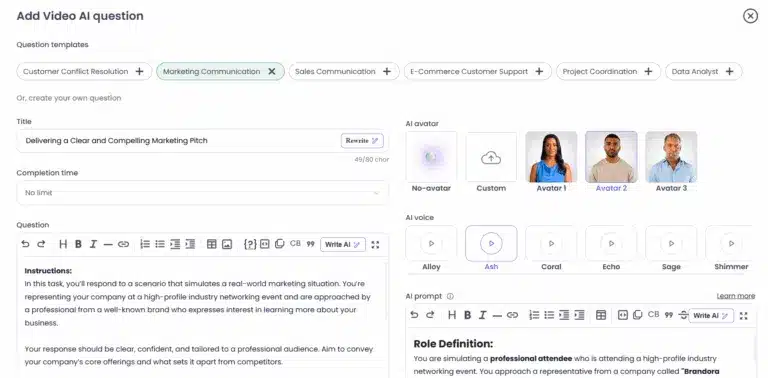
Video AI uses an AI avatar to guide candidates through job-relevant situations in asynchronous interviews, adding non-verbal cues, confidence, and clarity to the picture. Candidates record when it suits them, which lifts completion rates in high-volume drives.
Scoring and review
Every response is graded on clarity, relevance, and content against your rubric, benchmarked to your success profile, and checked by a bias dashboard that watches pass-rate parity across groups. Scores flow into your ATS so recruiters act on a ranked shortlist, not a spreadsheet. To see how the pieces fit together, Testlify’s own launch of AI conversational interviews walks through the full flow.
Here is the shape of it in practice. A 500-person retailer hiring 60 seasonal associates a quarter can send every applicant a 15-minute Voice AI interview the same day they apply, score them all on one rubric, and hand recruiters a ranked shortlist before the first human call, turning a multi-week screen into a next-morning decision without dropping the consistency bar.
See conversational AI interviews on your own roles. Screen every entry-level applicant on the same rubric, test real skills in chat, voice, and video, and hand your recruiters a ranked shortlist instead of a resume pile.
Book a demo with Testlify and put the first screen on autopilot, with your team still making every call.
Key takeaways
- Screen with AI, decide with people. The evidence (53.12% vs 28.57% pass rates on the later human interview) holds when AI runs the first screen and humans make the final call. Wire it that way and you keep both the speed and the trust.
- Volume is the real entry-level problem. With millions of hires and quits every month and thin first-job resumes, the bottleneck is evaluating look-alike applicants fast. AI interviews clear that bottleneck without adding recruiters.
- Consistency is the quiet advantage. Same questions, same rubric, every candidate. That cuts interviewer drift, which is where a lot of hidden bias and a lot of bad hires actually come from.
- Fairness is not automatic. Lower drift helps, but the rubric, questions, and training data still need human review. Skip that and you just automate the old bias faster.
- Multiple signals beat one. A single resume or test is noisy for a first-job hire. Combining chat, voice, and a skills check (the Multi-Signal Talent Evaluation Model) is what makes a shortlist you can defend.
- The payoff is where the cost is. A stronger first screen protects the $4,129 average cost per hire and the far larger cost of replacing a bad one, so the return shows up on the roles you hire most.
- Start small, then scale. Pick one high-volume role, one clear rubric, and a human review step. Prove it there before you roll it across every entry-level opening.
Frequently asked questions (FAQs)

Content Writer
Yashika Khandelwal is a Content Writer with 3+ years of experience creating research-backed content on hiring, talent assessment, and HR technology. She is a registered Organizational Psychologist and subject matter expert who combines behavioral science with practical recruitment insights to produce accurate, evidence-based content.
LinkedInRelated resources
View all
AI interviews
What are AI interviews and do they really work?

Skill assessment
What skills-based hiring data shows beyond the US and UK

HR & recruitment
AI across all stages of the hiring process in 2026

AI in recruitment
Best practices for hiring data analysts using assessments?

Candidate assessment
What tools support voice responses for language proficiency testing?

Candidate assessment
How do ATS-integrated assessments streamline hiring workflows?
Get started.
Hire on proof, not resumes.
Run your first skills-based assessment free — no credit card required.