
Best Alternatives to Traditional Interviews for Modern Hiring
Discover the top interviewing platforms for HR teams to streamline hiring, boost efficiency, and improve candidate experience at scale.

The best alternatives to traditional interviews are structured methods that measure what a candidate can do, not how well they talk in a 45-minute chat. Skills assessments, work sample tests, structured interviews, and AI-assisted interviews all predict job performance more reliably than a free-flowing conversation, and they treat every applicant by the same yardstick. This guide compares seven of them, shows where each one fits, and helps you build a hiring process that is faster and fairer at the same time.
 ChatGPT
 Gemini
 Claude
 Grok
Grok Perplexity
TL;DR
- Traditional unstructured interviews are among the weakest ways to predict who will actually do the job well. Structured, evidence-based methods beat them.
- The strongest alternatives are skills assessments, work sample tests, structured interviews, async video interviews, AI interviews, and cognitive or personality tests.
- Most teams do not need to pick one. The best results come from stacking two or three signals and scoring them the same way for every candidate.
- If you are looking for a Spark Hire, Modern Hire, or Hireflix alternative, the real upgrade is not a different video tool. It is adding a skills signal before the interview.
- Pick methods by what the role actually needs, keep the process the same for everyone, and put the human decision at the end, not a black box.

Why do traditional interviews fail to predict performance?
Unstructured interviews fail because they are inconsistent. Two interviewers ask different questions, weigh answers differently, and lean on gut feel, so the same candidate can pass with one and fail with another. That inconsistency is exactly what makes the result hard to trust and easy to bias.
The research backs this up. In a 2022 re-analysis of decades of selection studies published in the Journal of Applied Psychology, structured interviews ranked as the single strongest predictor of job performance, well ahead of the loose, unstructured chat most teams still run. The gap is not small. A structured process asks every candidate the same questions and scores them against the same rubric, which is what turns an interview from a vibe check into evidence.
There is a cost angle too. SHRM benchmarking data put the average US cost per hire at $5,475 and time to fill at 42 days, though that figure comes from its fiscal 2015 report and hiring costs have not fallen since. A mis-hire made on a hunch does not just cost that again when the person leaves. It costs the ramp time, the team disruption, and the second search. Better screening is one of the cheapest ways to protect that spend.
What are the alternatives to traditional job interviews?
The alternatives to traditional job interviews fall into six practical buckets: skills assessments, work sample tests, structured interviews, async video interviews, AI interviews, and cognitive or personality tests. Each one replaces "how did they come across" with "here is what they can actually do," and each one applies the same standard to every applicant.
The timing matters. The World Economic Forum's Future of Jobs Report 2025 estimates that 39% of the core skills workers need will change by 2030 and that 59% of the workforce will need reskilling or upskilling over the same period. The same report puts the share of workers who have completed training at 50%, up from 41% in its 2023 edition, so demand for new skills is running ahead of supply. When the skills themselves are moving that fast, a resume and a friendly conversation tell you even less than they used to. Measuring the skill directly is the point.
1. Skills assessments
A skills assessment asks candidates to prove a specific competency before anyone books a call: a coding task for a developer, a spreadsheet exercise for an analyst, a writing sample for a content role. You get a scored, comparable result for every applicant, which makes the shortlist objective instead of a stack of resumes ranked by who went to which school.
This is where the time savings show up. A 500-person company hiring 20 support reps a quarter can send a short scenario-based skills test at the top of the funnel and only interview the people who clear the bar, cutting a screening loop of about 30 days down to roughly 10. Skills tests are the strongest single upgrade for high-volume roles.
Best for
Technical & non-technical roles, high-volume hiring, and any job where output is measurable. Less useful on its own for senior leadership hires, where judgment and track record carry more weight.
2. Work sample tests and job simulations
A work sample test asks candidates to do a slice of the real job. A designer mocks up one screen, a sales rep runs a mock discovery call, and a support agent answers three realistic tickets. Because the task mirrors day-one work, it predicts performance strongly and gives candidates a genuine preview of the role.
The catch is effort. Well-built simulations take time to design and to score fairly, so keep them short (30 to 45 minutes) and reserve the heavy ones for roles you hire often. Pay candidates for anything that resembles real deliverable work, both for fairness and for your employer brand.
3. Structured interviews
A structured interview keeps the conversation but fixes what makes it unreliable. Every candidate gets the same questions in the same order, and each answer is scored against a defined rubric. That one change is why structured interviews outperform their unstructured cousin by a wide margin and why Google publicly moved its hiring onto structured interviewing after finding it far more predictive.
You do not need new software to start. Write four to six role-relevant questions, agree on what a strong answer looks like, and have interviewers score independently before they discuss. The discipline is the product here, not the tooling.
4. Async (one-way) video interviews
In an async video interview, candidates record answers to set questions on their own time, and your team reviews them later. It removes the scheduling Tetris of live calls and lets you screen applicants across time zones without a single calendar invite. Every candidate answers the same prompts, so the comparison stays clean.
Used well, one-way video interviews replace the first phone screen, not the deep-dive interview. The honest limitation: video rewards polish and confidence, which can smuggle bias back in. Pair it with a skills signal so you are not shortlisting on presentation alone.
5. AI interviews: chat, audio, and video
AI interviews use a conversational agent to ask questions, adapt follow-ups, and produce a structured summary for a human to review. They come in three formats, and the right one depends on what the role really needs to prove.
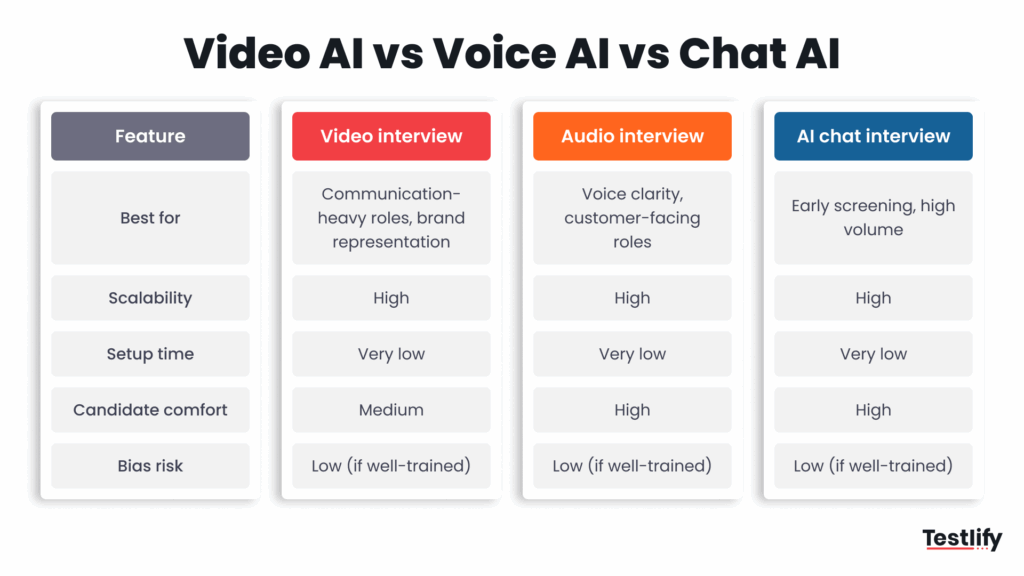
Chat AI interviews
Text-based chat AI interviews work well for early screening and roles where written clarity matters. They are low-pressure for candidates and easy to run at scale.
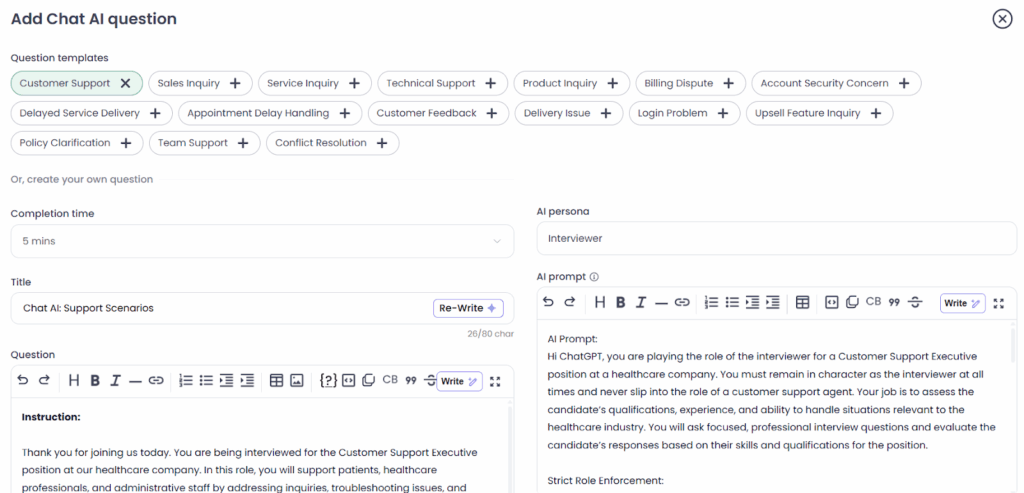
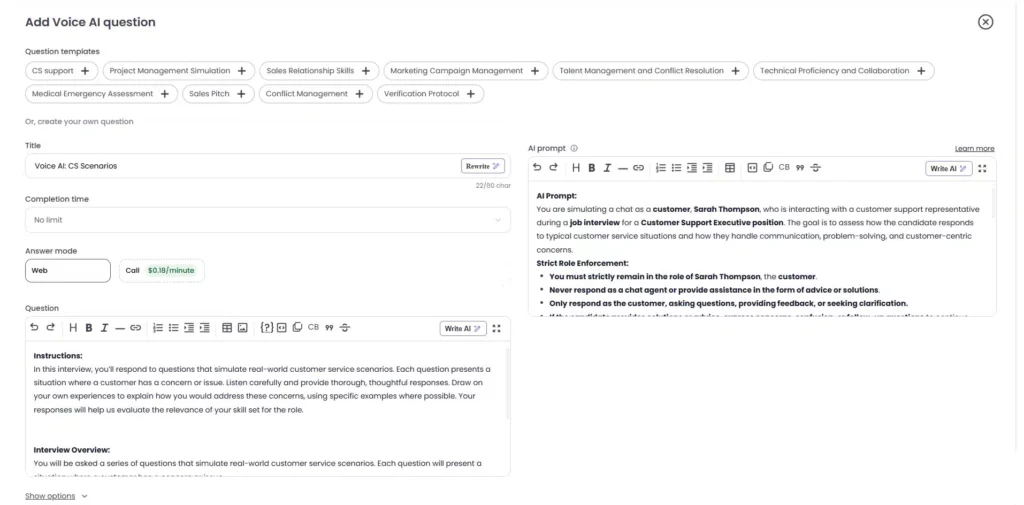
Audio and video AI interviews
Audio interviews suit customer-facing and communication-heavy roles where tone matters.
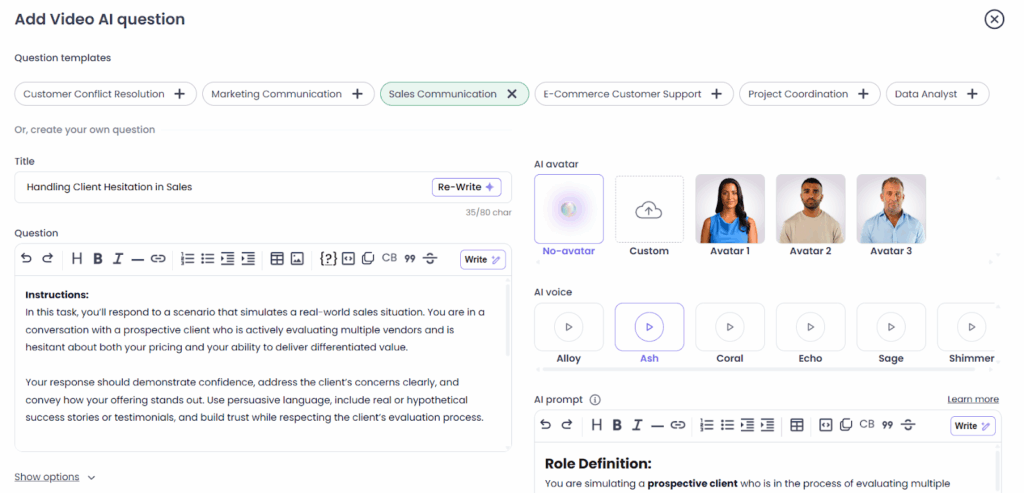
Video AI interviews add body language and presence for later-stage screening. In every case, a person reviews the summary and makes the call, so the AI assists and never decides.
Related Read: Why traditional sources of recruitment are failing modern employers?
6. Cognitive and personality assessments
Cognitive ability tests measure reasoning, problem-solving, and learning speed. Personality and behavioral assessments map traits and work styles to the role. Both add a signal a resume cannot, and both are most useful as one input among several, never as a single pass-fail gate.
Use them to widen your view of a candidate, not to narrow it unfairly. Validate that the trait you are testing actually maps to success in the role, and be ready to explain the result to the candidate. If you cannot justify a cutoff, do not use one.
Looking for a Spark Hire alternative?
If you are looking for a Spark Hire alternative, the useful question is not "which other video tool?" but "what is the video screen missing?" Most Spark Hire alternatives on the market are simply other one-way video products, which misses the point. One-way video captures how a candidate presents. It does not tell you whether they can do the work. Teams that switch usually want a skills signal added in front of the video, so the shortlist is scored on ability first and presentation second.
That is the practical difference to look for in any alternative: does it only record answers, or does it also measure a competency you can defend? A platform that combines a skills test with an async or AI interview does both in one candidate flow, which is where most of the time and bias savings actually come from.
What makes a strong SparkHire alternative?
A strong SparkHire alternative does more than record answers. Look for one that scores a role-relevant skill before the video stage, applies the same rubric to every candidate, and keeps a human reviewer on the final call. If the only thing that changes is the recording interface, the switch will not change who gets hired.
Modern Hire alternative and Hireflix alternatives
The same logic applies if you are weighing Modern Hire and Hireflix alternatives. Modern Hire leaned into assessments plus interviews; Hireflix is focused on one-way video. When you compare replacements, judge them on three things: the range of signals they capture (skills, cognitive, interview), how consistently they score every candidate, and whether a human stays in control of the final decision.
A tool that only does video is a feature, not a hiring system. The stronger move is a platform that runs the skills test, the interview, and the reviewer scoring in one place, so you are not stitching three vendors together and losing the audit trail in between.
Which interview platforms support compliant hiring processes?
Interview platforms support compliant hiring processes by making evaluation consistent and defensible. Compliance risk in hiring comes from decisions you cannot explain: different questions for different candidates, scores with no rubric, no record of why one person advanced. A structured platform fixes that by design.
Look for the same questions and scoring for every applicant, a stored record of each evaluation, role-relevant assessments you can validate, and a clear human decision point. That evidence trail is what protects you if a rejected candidate ever challenges the process, and it is exactly what an unstructured interview cannot produce.
Is there an alternative to hiring staff?
Yes. Before you open a role, three alternatives to hiring staff are worth a look: upskilling someone already on the team, moving an internal candidate across, or contracting the work for short-term or specialist needs. Each one skips the cost and time of a full external search.
When you do hire, the same evidence-first idea applies. Assess internal candidates and contractors with the same skills-based methods you would use externally, so the decision rests on demonstrated ability rather than on who is already familiar. Fair is consistent, whoever the candidate is.
How do these alternatives compare?
Method | What it measures | Best for | Setup effort |
|---|---|---|---|
Skills assessments | Job-specific ability | High-volume and technical roles | Low |
Work sample tests | Real-task performance | Roles with measurable output | High |
Structured interviews | Judgment and reasoning | Almost every role | Low |
Async video interviews | Communication and fit | Remote and first-round screening | Medium |
AI interviews | Structured responses at scale | Large applicant pools | Medium |
Cognitive and personality tests | Reasoning and work style | A supporting signal | Low |
How do you choose the right alternative?
Start with the role, not the tool. Write down the two or three competencies that actually decide success in the job, then pick the method that produces evidence for each one. A developer role points to a coding assessment plus a structured interview. A support role points to a scenario test plus an async video screen.
This is the idea behind the Testlify Multi-Signal Talent Evaluation Model: one signal is fragile, several role-relevant signals create confidence. Instead of betting a hire on a single interview or a single test, you combine two or three independent signals (a skills score, an interview rubric, a reviewer rating) and advance the candidates where the signals agree. It keeps the final judgment with your team while giving them evidence to judge on.
Pro tip: Do not run all six methods on one role. Two well-chosen signals scored consistently beat five signals applied unevenly. Add a third only when the first two disagree often enough to slow decisions down.
Curious what a scored, role-relevant signal looks like against your own shortlist? Book a demo and walk through an assessment flow built around one of your open roles.
Key takeaways
- Structure is the real upgrade. The lift from these alternatives comes from asking every candidate the same thing and scoring against a rubric, not from any one clever format. That is what makes structured methods more predictive and easier to defend.
- Measure ability, not polish. Skills assessments and work samples show what a person can do, which is the signal a resume and a friendly chat both miss. Put a skills signal before the interview, not after.
- Stack two or three signals. One input is fragile. Combining a skills score, an interview rubric, and a reviewer rating catches what any single method would miss, and it is the core of the Multi-Signal Talent Evaluation Model.
- A video tool is not a hiring system. If you are replacing Spark Hire, Modern Hire, or Hireflix, the win is adding a defensible skills signal, not swapping one recording tool for another.
- Keep the decision human. Let assessments and AI structure the evidence, then let your team make the call. That is what keeps the process fair, explainable, and compliant.
Frequently asked questions
What are leading alternatives to traditional hiring?
Leading alternatives to traditional hiring include skills-based hiring, pre-employment assessments, structured interviews, work sample tests, job simulations, and AI-powered screening platforms like Testlify. These approaches help employers evaluate candidates based on their actual skills and job readiness rather than relying solely on resumes, degrees, or past experience.

Content Writer
Yashika Khandelwal is a Content Writer with 3+ years of experience creating research-backed content on hiring, talent assessment, and HR technology. She is a registered Organizational Psychologist and subject matter expert who combines behavioral science with practical recruitment insights to produce accurate, evidence-based content.
LinkedInRelated resources
View all
HR & recruitment
AI interviewer vs human interviewer: Who makes better hiring?

HR & recruitment
Why remote companies are leaning on AI interviews for global hiring

HR & recruitment
HR in the higher education industry
HR & recruitment
Why AI powered phone screening is smarter for recruiters

HR & recruitment
How modern HR teams are using visual storytelling to attract top talent

HR & recruitment
How AI interviews work for candidate screening
Get started.
Hire on proof, not resumes.
Run your first skills-based assessment free — no credit card required.