
How AI is changing the game for job applicants: Navigating the risks in hiring
Discover how AI is transforming recruitment, its benefits and risks for job applicants, and tips for recruiters to ensure fair, ethical hiring practices.

The route to many industries has changed with the advent of AI, and recruitment is one such example. With AI, efficiency in the hiring process increases, saves time, reduces bias, and enables the recruiter to sift through thousands of applicants quickly. Moreover, this has also changes how job seekers use to apply for jobs.
A Gartner study suggests, 43% of HR leaders reported using AI for talent acquisition and 38% candidates using AI for job search.
But while this presents opportunities in new ways, there are also risks that recruiters and job applicants need to navigate around.
This blog explores how AI is changing the face of recruitment, the benefits and risks it poses to job seekers, and how recruiters can help counterbalance those risks.
 ChatGPT
 Gemini
 Claude
 Grok
Grok Perplexity
The role of AI in hiring
This ranges from sourcing potential candidates to conducting preliminary assessments and scheduling interviews thereby integrating AI into different parts of the hiring process. With the ability of AI-powered tools and algorithms to analyze vast volumes of data in just a matter of seconds, hiring can be done much faster and on a much greater scale. Here’s how:
1. AI in candidate sourcing
Platforms with AI will be able to identify potential candidates by searching job boards and social media profiles and even through passive talent pools. This can help the recruiters discover people they might have otherwise not spotted. Even candidates these days use an AI-powered tool to search for relevant vacancies that fit their skills and knowledge.
2. AI in skills assessment
AI is also used in skills assessments, where job applicants are given tasks or tests relevant to a specific job role. The AI may grade these tests, providing objective measures that will be invaluable for recruiters in getting to know a candidate’s capabilities.
Testlify is an AI-powered talent assessment platform that has features like automated scoring, anti-cheating features, and more for a bias-free and objective assessment of candidates.
3. AI in interviewing
AI shall be able to conduct pre-recorded video interviews in which candidates answer a set of questions on camera, and the AI analyzes their responses for such things as tone, word choice, and even facial expressions. Testlify’s video interview feature helps you assess candidates without the hassle of scheduling in-person interviews.

Benefits of AI in recruitment for job applicants
AI in recruitment brings many benefits to recruiters as well as job applicants.
According to Harvard Business Review, 55% of job seekers believe AI-powered hiring processes, like resume screening, can lead to bias.
The most significant benefits are making the process more transparent and faster. Some of these benefits are listed below:
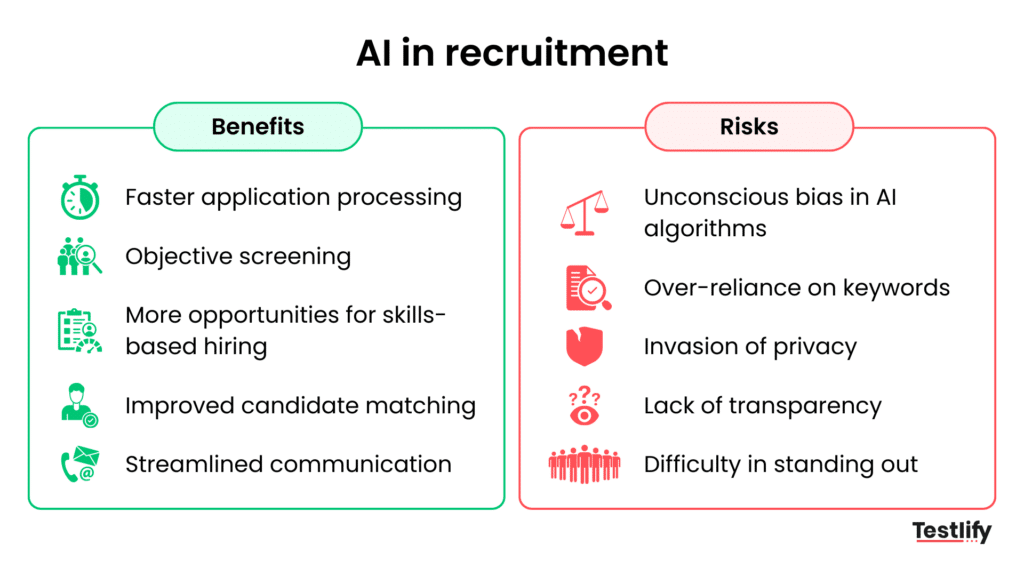
1. Faster application processing
The most significant advantage of AI is its speed. Instead of having candidates wait for weeks before hearing back, they may get faster responses concerning whether they have moved on to another stage.
2. Objective screening
If done correctly, AI can deliver a much more objective screening process. Screening the candidates goes with the skill and qualifications, as humans may unconsciously take their biases with them.
This benefits the candidates as they’re assessed purely based on their skills without bias and recruiters as they get to identify the candiates with the right skills and knowledge.
3. More opportunities for skills-based hiring
As AI tools can assess actual skills rather than solely on degrees or job titles, this brings out chances that an individual may not have had the usual qualifications but has the needed skills.
Risks of AI for job applicants
Even though AI has numerous positive implications, risks emerge, especially in applicant assessment. Some such risks are:
1. Unconscious bias in AI algorithms
But the biggest problem is bias- the chance of being locked into whatever data it is trained on. An AI system is only good as its training data is good: if it is trained on biased data for whatever reason, because a company has traditionally been biased toward males, for example, so will the AI.
2. Over-reliance on keywords
AI often scans resumes for particular keywords. This will disadvantage some applicants who may have the needed skills but do not use the terms the algorithm searches for. Such reliance on keywords can easily lead to the absence of viable candidates. Using skills assessments in place of screening resumes helps shortlist the right candidates for the role.
3. Invasion of privacy
Other AI tools don’t only track what the candidates say but also track the way they say it, including tracking facial expressions, tone of voice, and even gaze. Such invasiveness on the part of the tools to the candidates raises ethical questions about data privacy.
4. Lack of transparency
Many candidates aren’t aware of when they are under actual analysis by AI. Even if they do, they don’t know what decision it has reached in making its judgment. This leads to mistrust of the hiring process.
5. Difficulty in standing out
AI systems are trying to look for certain attributes of a candidate and can be very efficient. Still, it reduces the chance for the candidate to raise himself through unique qualities or experiences that might be valuable but may not fall within the algorithmic search of the AI.
The ethical dilemma: Are we automating bias?
Many posit that AI is a way of eliminating human bias in hiring. AI will evaluate purely based on qualifications and performance and not predicated on unconscious biases. However, in practice, AI can further support and indeed amplify bias if the source is based on biased sources.
For example, an AI developed based on hiring records from a firm that has hired many white males would continue to prefer applicants like the old historical ones. Such would result in gender-based, racial, or even more types of discrimination being inherently built into the system without recruiters knowing.
What can recruiters do to combat AI bias?
- Regular audits: AI systems should be regularly audited for bias. This includes looking at the data that the AI is being trained on, as well as how it evaluates candidates over time.
- Diverse data: The data sets that train AI should be diverse and inclusive, representing a broad spectrum of candidates.
- Human oversight: AI should not be the final decision-maker. Human oversight is crucial to ensure fairness and catch any red flags the AI might miss.
Impact of AI on diversity and inclusion
AI can be a tool to support or hinder efforts by the organization to create a diverse and inclusive hiring process. On the positive side, it reduces some biases in the screening and shortlisting or even during interviews of candidates that may not come into view otherwise due to gender, race, or age.
Skills assessment platforms like Testlify helps you identify and assess candidates objectively for their skills and knowledge and hire from anywhere around the globe with the online assessments brining in a more diverse and inclusive workplace.
Best practices for using AI to enhance diversity and inclusion:
- Anonymous screening: Using AI to remove personal details like name, gender, and age from resumes can help reduce bias during the initial screening process.
- Bias-free job descriptions: AI tools can analyze job descriptions to ensure they don’t contain biased language that might deter certain candidates from applying.
- Inclusive sourcing: AI can be used to identify and reach out to candidates from underrepresented groups, helping to widen the talent pool.
The future of AI in recruitment: What to expect
Although AI is not yet at the helm of recruitment, its future will be truly eventful. The development of new tools and innovations makes the role of AI in recruitment much larger. Among trends, we could soon expect to include:
1. Greater use of predictive analytics
Predictive candidate success: AI has become smarter at predicting potential successful candidates. Based on previous hiring and performance data, AI will predict which candidates will work well in a role. This allows companies to hire faster, retain candidates, and perform better.
2. AI-powered career pathing
AI can identify the best career paths that suit a candidate’s skills and interests. Using its understanding of the job market and analysis of the candidate profile, AI will recommend the next best move a candidate should consider for a better future and ensure recruiters match candidates according to their long-term needs.
3. AI in employee retention
Moreover, it will be used for hiring purposes and retaining workers by analyzing employee data, predicting who is prone to walk out, and suggesting interventions to keep that worker engaged.
4. AI-assisted interviews
Soon, AI would play more significant roles in interviews, such as alerting recruiters to real-time feedback on the interview process. For example, AI would show interviewers answers that indicate some bias or question candidates based on their responses.
Mitigating the risks of AI in hiring: Tips for recruiters
Balancing recruiters into using AI appropriately to take all the benefits while still lessening the risks will require recruiters to be balanced. And here are some tips for just that:
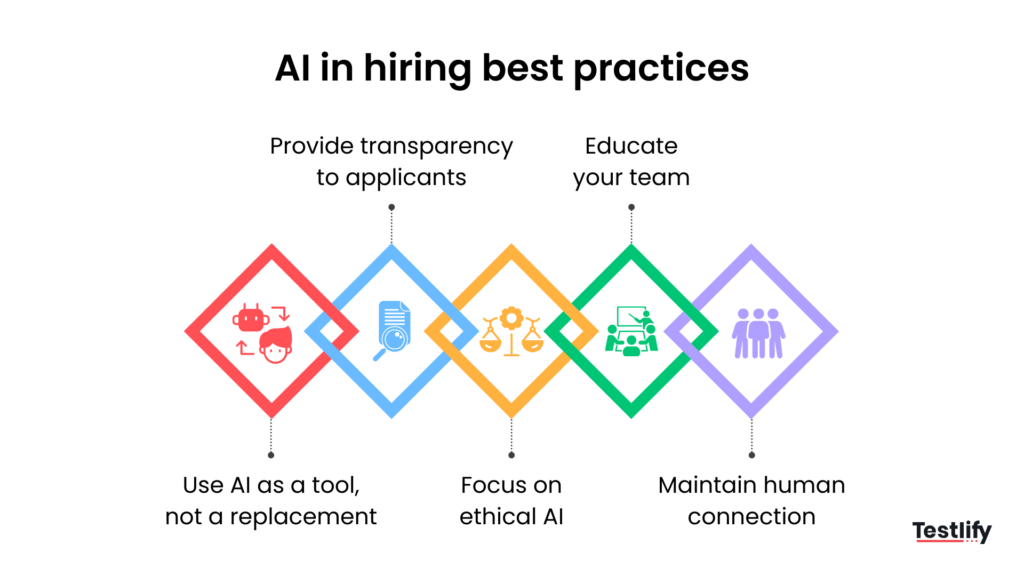
1. Use AI as a tool, not a replacement
AI should assist the recruiter, not replace them. Human judgment will always make the final decision because AI cannot measure cultural fit or unique traits that might make the candidate an excellent hire.
2. Provide transparency to applicants
Let applicants be made aware of whether and how AI is being used in the hiring process. This is one way to develop trust so that candidates understand how hiring decisions are reached.
3. Focus on ethical AI
Use vendors that focus on ethical AI. This means that the same AI systems are built to restrict bias and are monitored through regular audits in those systems, in which audit challenges them further to ensure the system’s equity.
4. Educate your team
Educate your recruiting staff on how to use AI, what to expect, and its limitations. Recognizing where AI is a good fit and where AI may not perform as needed can better inform recruiter decisions.
5. Maintain human connection
Hiring is about people. Though AI can immensely make the process smoother, it remains a human relationship that is only advanced by phone calls, emails with personalized addresses, and face-to-face interactions that can make all the difference in a positive hiring experience.
Conclusion
AI is no doubt changing the face of hiring. Whether there are clear advantages for recruiters and applicants alike, risks are attached to it – bias, privacy, and transparency. How many recruiters take note of such tools being used ethically to enhance the hiring process rather than impede it?
Through such thoughtful applications of AI and AI-powered skills assessment platforms, you can create an efficient and fairer hiring process that maintains the human touch embedded in recruiting- which makes it a uniquely personal experience.
For further reading, explore Game Animator & Game Artist.
Frequently asked questions (FAQs)

Content Writer
Yashika Khandelwal is a Content Writer with 3+ years of experience creating research-backed content on hiring, talent assessment, and HR technology. She is a registered Organizational Psychologist and subject matter expert who combines behavioral science with practical recruitment insights to produce accurate, evidence-based content.
LinkedInRelated resources
View all
HR & recruitment
Top 7 recruitment KPIs and how to effectively track them in 2026

HR & recruitment
9/80 work schedule: A definitive guide for 2026

HR & recruitment
What is job enlargement and how to implement it? Pros & Cons

HR & recruitment
Corporate Recruiting: Definition, Process, and Best Practices

HR & recruitment
Skills vs competencies: What’s the difference?

HR & recruitment
How to create talent sourcing strategies in 6 easy steps?
Get started.
Hire on proof, not resumes.
Run your first skills-based assessment free — no credit card required.