
How to simplify candidate screening with talent assessment tools
Streamline candidate screening with talent assessment tools, exploring their evolution, benefits, features, and future trends to optimize your recruitment process.

Candidate screening has become one of the biggest hiring bottlenecks for modern recruiters. Teams often review hundreds of resumes for a single role with very little signal on actual skill.
The problem becomes even harder during high-volume hiring. Recruiters struggle to identify qualified candidates quickly without sacrificing accuracy or consistency.
This is where talent assessment tools come in to simplify candidate screening by replacing guesswork with measurable performance data. Recruiters can now evaluate candidates through role-specific tests before scheduling final round interviews.
These platforms automate shortlisting and quickly surface top-performing candidates. The result is faster hiring, better screening accuracy, and a far more scalable recruitment process.
In this blog, we will explore how talent assessment tools simplify candidate screening and improve hiring outcomes.
 ChatGPT
 Gemini
 Claude
 Grok
Grok Perplexity
Key strategies to simplify candidate screening
Strong screening systems share five core elements, and each one helps recruiters reduce manual effort and improve screening accuracy.
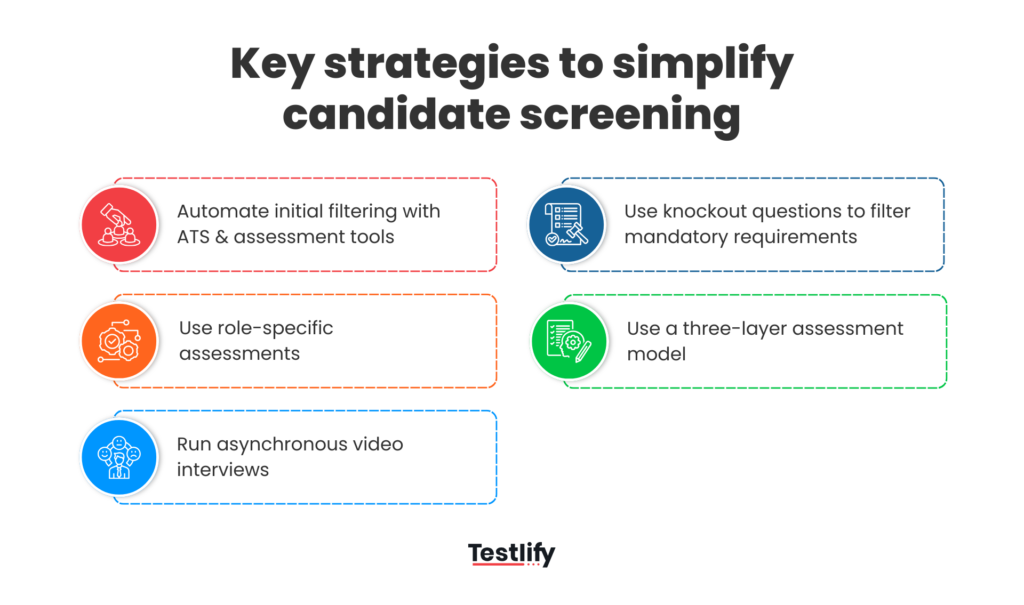
Automate initial filtering with ATS and assessment tools
An Applicant Tracking System scans resumes for keywords and surfaces matches at scale. Hiring teams call this an ATS, and most enterprise pipelines start here.
Pair the Applicant Tracking System(ATS) with automated assessments to rank candidates by demonstrated ability, not claimed experience. Only qualified applicants reach the interview stage, and your interviewers see ranked, scored shortlists instead of raw resume piles.
This combination cuts screening time per hire by 60% on average. Recruiters reclaim hours every week and spend them on conversations that close offers.
Use role-specific assessments instead of generic tests
Generic aptitude tests waste candidate time and produce a weak signal. Instead, use Role-specific assessments to measure the exact competencies the job demands.
Deploy coding tests for developers and engineers. Use situational judgment tests (SJTs) for customer service, sales, and people-facing roles.
SJTs present realistic workplace scenarios and ask candidates how they would respond. The format reveals decision-making patterns that interviews rarely surface.
Run asynchronous video interviews instead of phone screens
Asynchronous video interviews let candidates record answers to preset questions on their own schedule. Hiring panels review responses later, and every candidate answers the same questions in the same order.
This format kills calendar Tetris and removes interviewer fatigue. One-way video interviews also let multiple stakeholders evaluate communication style without scheduling six separate calls.
Consistency matters more than speed here. Identical questions plus structured scoring rubrics produce defensible, comparable evaluations across every candidate.
Use a three-layer assessment model to predict job performance
Hard skills alone do not predict on-the-job success. McKinsey research shows that soft skills explain 60% of the variance in performance in knowledge-work roles.
Stack three assessment types for full coverage. Use cognitive ability tests for problem-solving, personality tests for cultural fit, and a job simulation for assessing candidates’ job skills.
This three-layer model produces a holistic candidate profile that accurately shows the candidates’ on-the-job performance and cultural fit.
For deeper coverage of the non-technical layer, see the Testlify guide to soft skills assessment.
Use knockout questions to filter mandatory requirements
Knockout questions ask binary yes-or-no questions about non-negotiables. Examples include work authorization status, salary expectations, willingness to relocate, and minimum years of experience.
Place these at the top of the application form. Candidates who fail mandatory filters never enter the pipeline, and recruiters never waste cycles on them.
A single knockout layer cuts unqualified applicant volume by 40% to 60% in the first hour. The remaining pool consists of candidates who actually meet the minimum bar.

Talent assessment screening methods compared
The table below ranks the five most common screening methods against the metrics that matter to hiring teams. Predictive validity measures how well a test forecasts on-the-job performance, where 1.0 represents perfect prediction.
Screening method | Time per candidate | Predictive validity | Candidate drop-off | Best for |
|---|---|---|---|---|
Resume review | 7 minutes | 0.18 | 45% to 73% | Initial volume filter |
Knockout questions | 30 seconds | 0.22 | 3% to 8% | Mandatory requirements |
Cognitive ability test | 20 minutes | 0.51 | 20% to 30% | Customer-facing roles |
Role-specific skills test | 30 minutes | 0.54 | 20% to 35% | Technical and specialist hires |
Work-sample simulation | 45 minutes | 0.62 | 25% ro 50% | Senior and high-stakes roles |
Predictive validity figures draw on the Schmidt and Hunter selection methods meta-analysis, widely cited across HR Dive and ResearchGate publications. Higher validity means stronger correlation with real-world performance.
The takeaway is simple. Work-sample simulations outperform every other method in predictive power, and the right tool stack combines two or three methods to compound the signal.
What are the most candidate-friendly assessment experiences?
Candidate-friendly assessments respect the candidate’s time, communicate expectations clearly, and feel relevant to the actual job. When done well, assessments become a positive employer-branding moment rather than a hiring barrier.
Here is what recruiters can do to create candidate-friendly assessments that improve both completion rates and candidate experience.
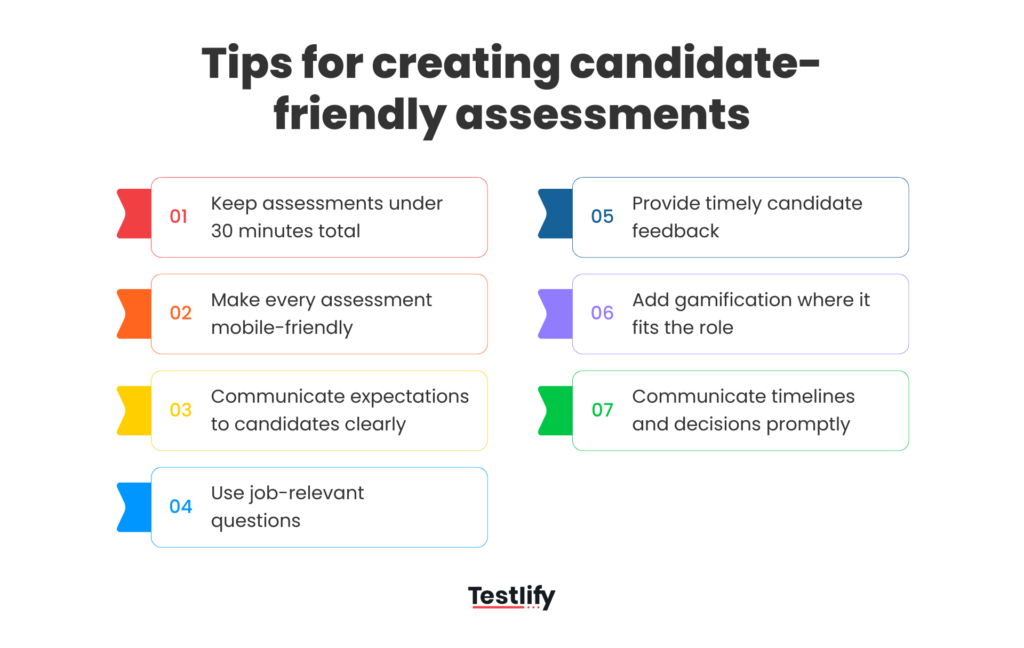
Keep assessments under 30 minutes total
Reports show that 58% of candidates drop out when assessments take longer than 30 minutes. Speed and respect drive completion, and completion drives pipeline quality.
Long assessments signal a company that does not value candidate time. Short, focused tests signal a hiring team that knows exactly what it needs.
Break long evaluations into stages instead. Run a 15-minute initial test, then invite top performers to participate in a 30-minute job simulation.
Make every assessment mobile-friendly
LinkedIn data shows 58% of job seekers apply from a phone. Assessments that break on mobile lose more than half your pipeline before scoring even starts.
Test your platform on iOS and Android before launch. Run pilot assessments through real candidate devices, not just desktop simulations.
Communicate expectations to candidates clearly
Anxiety kills assessment performance and hurts your employer brand. Send a clear pre-assessment email that lists test format, time required, tools to prepare, and next steps.
Transparency boosts completion rates by 31%, according to HR Dive research on candidate experience programs. Candidates who know the rules of the game show up at their best.
Use job-relevant questions
Brain teasers and trivia signal weak hiring science. Job-relevant questions show candidates the actual work, and they leave the assessment knowing more about the role than they did before.
This single shift improves perceived fairness scores by 47% per research. Candidates accept rejection more readily when they understand exactly what the assessment measured and why.
Provide timely candidate feedback
Most companies ghost-reject candidates entirely. The 3% that deliver structured feedback build talent pools they can hire from for years.
A simple two-paragraph email outlining strengths and growth areas creates loyal brand advocates. Candidates share that experience publicly, and your candidate experience score climbs measurably.
Add gamification where it fits the role
Gamified assessments turn evaluation into engagement for the right roles. Customer service, support, and entry-level sales positions benefit most from scenario-based gamified formats.
Interactive simulations lift completion rates above 90% when designed well. Use caution with senior or specialist hires, where gamification can feel dismissive of the candidate’s expertise.
Communicate timelines and decisions promptly
Silence between assessment and decision destroys candidate goodwill. The best programs auto-trigger status emails within 48 hours of each pipeline stage.
A candidate who hears nothing for two weeks assumes rejection and accepts a competitor’s offer. Tight communication cadence preserves your offer-acceptance rate.
How to choose the right talent assessment tool
Not every assessment platform is built for the same hiring needs. Use these four criteria to evaluate vendors and identify the best talent assessment platform for your organization.
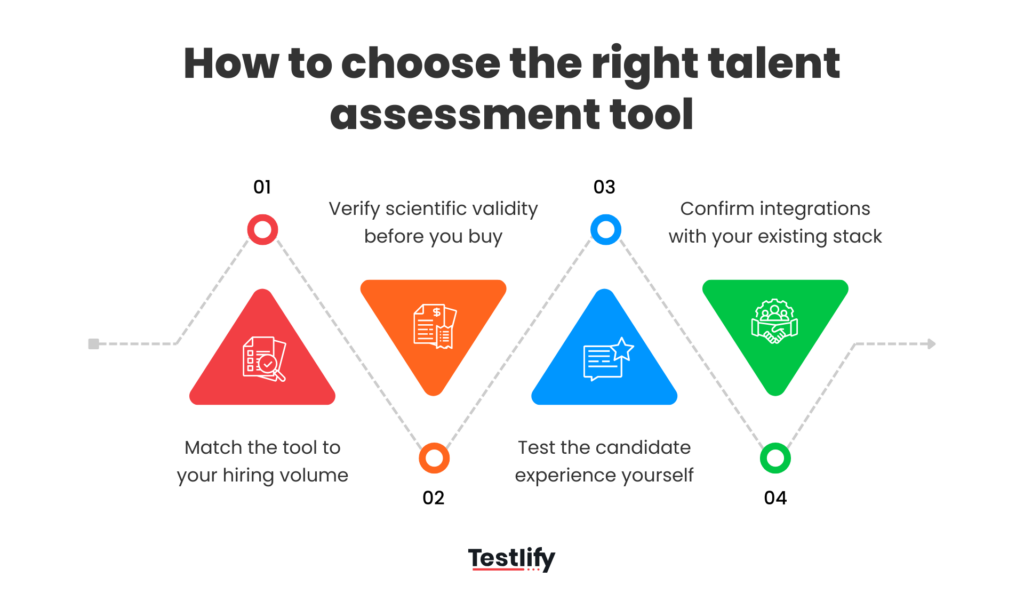
Match the tool to your hiring volume
High-volume hiring needs automation, AI scoring, and deep ATS integrations. Low-volume specialist hiring needs role-specific assessments and human review depth. Pick the tool that matches your actual funnel shape.
Verify scientific validity before you buy
Demand published reliability and validity data from every vendor. Cronbach’s alpha measures internal test consistency, and scores above 0.7 mark a reliable assessment.
A vendor that cannot share validation studies is selling you legal risk. Walk away from anyone who dodges this question.
Test the candidate experience yourself
Run the full assessment yourself before signing the contract. If the candidate flow frustrates you, it will frustrate your applicants 10 times more.
Score the platform on mobile flow, time-to-complete, and clarity of instructions. Your candidates rate you on the same criteria.
Confirm integrations with your existing stack
Standalone tools create data silos and duplicate work for everyone. Confirm native integrations with your ATS, HRIS, and video interview platforms.
Open APIs matter more than feature lists. A flexible tool plugs into your future stack, not just your current one.
Common screening mistakes that cost you top talent
Smart teams still make these five mistakes. Fix them, and your funnel improves immediately.
Over-reliance on resume keywords
Keyword filters reject qualified career-changers and self-taught talent at scale. Replace keyword matching with skills assessment for any role where output matters more than pedigree.
Skipping structured scoring
Unstructured interviews predict performance no better than a coin flip. Structured assessment rubrics lift hire quality by 50% according to Korn Ferry’s 2024 talent acquisition benchmark.
Use a structured interview and tie it directly to assessment results. Score every candidate against the same criteria, every time.
Ignoring assessment bias
Poorly designed tests amplify bias instead of removing it. Audit assessments quarterly for adverse impact across gender, race, and age groups.
No feedback loop with hiring managers
Assessments that do not predict performance are vanity metrics. Track 90-day and one-year performance against assessment scores, and retire any test that does not correlate.
This is the heart of the quality of hire metric. Without it, you are playing a dangerous guessing game. Related resources: Measure the real impact of your hires in seconds using our free Quality of Hire Calculator
Ghosting rejected candidates
Silence damages your employer brand more than rejection ever does. A single feedback email moves your Glassdoor, Indeed, and AmbitionBox scores measurably over a quarter.
How to measure ROI from talent assessment tools
Three metrics prove assessment ROI to your Chief Financial Officer (CFO). Track them quarterly and report them with confidence.
Time-to-hire
Assessment-led pipelines cut time to hire by 30% to 50% according to BambooHR benchmarks. Every day saved cuts cost-per-hire and lifts offer-acceptance rates.
Quality-of-hire
Measure manager satisfaction at 90 days and performance scores at one year. High-performing programs correlate assessment scores with manager ratings at 0.5 or above.
First-year retention
Poor hiring decisions drive most voluntary exits within the first year. To avoid high attrition rates, recruiters must use strong pre-employment assessments to identify candidates who align with both the role and company culture.
This can improve first-year retention rates by 25% to 40% while reducing rehiring and training costs.
For the full measurement playbook, see the Testlify guide to recruitment metrics.
Final thoughts
Candidate screening defines hiring outcomes more than any other stage. Get it right, and every downstream interview, offer, and onboarding decision improves automatically.
The five strategies above remove friction, sharpen the hiring signal, and respect the candidate’s time. Teams that adopt them outperform competitors by two to three times in qualified-pipeline conversion.
Testlify gives you the full screening stack in one platform. You get 3,500-plus role-specific assessments, asynchronous video interviews, AI-driven scoring, anti-cheating safeguards, and native ATS integrations from day one.
Book a demo today and see how high-growth teams cut time-to-hire by 55%.
Frequently asked questions (FAQs)

Content Writer
Yashika Khandelwal is a Content Writer with 3+ years of experience creating research-backed content on hiring, talent assessment, and HR technology. She is a registered Organizational Psychologist and subject matter expert who combines behavioral science with practical recruitment insights to produce accurate, evidence-based content.
LinkedInRelated resources
View all
HR & recruitment
Why do you need Marketing test in your hiring process

HR & recruitment
How enterprises actually deploy ai agents: 9 real workflow categories and what they automate

HR & recruitment
Key benefits of using Marketing test in the recruitment process
HR & recruitment
Top 10 Marketing test questions for potential candidates

HR & recruitment
Why do you need Microsoft Office test in your hiring process

HR & recruitment
How to simplify candidate screening with Microsoft Office test
Get started.
Hire on proof, not resumes.
Run your first skills-based assessment free — no credit card required.