
Transferable Skills: Definition, Meaning & Examples
Discover the importance of transferable skills. Learn how to identify, develop, and leverage these versatile abilities for workforce success.

Transferable skills are abilities that keep their value when someone changes jobs, teams, or industries. Communication, problem-solving, time management, and leadership travel with a person. Knowing one company's billing system does not. For a hiring team, transferable skills are the part of a candidate's record that predicts what happens after the role changes.
That used to be a career-advice topic. It is a workforce-planning one now. The U.S. Bureau of Labor Statistics found that people born between 1957 and 1964 held an average of 12.9 different jobs between ages 18 and 58, and median job tenure has fallen to 3.9 years. Most of a person's working life is spent doing something other than the job they were first hired for.
Almost every guide on this topic is written for the candidate: which skills to put on a resume. This one is written for the other side of the table, where the harder question sits. Anyone can claim adaptability. How do you verify it before you make an offer?
 ChatGPT
 Gemini
 Claude
 Grok
Grok Perplexity
TL;DR
- Transferable skills move with a person across roles and industries. Job-specific skills do not.
- A skill counts as transferable when it stays useful after the job changes, whether it is a people skill or a technical one.
- Employers expect 39% of workers' core skills to change by 2030, so hiring only for today's task list ages badly.
- Self-reported transferable skills are close to worthless. Structured assessments and behavioral evidence are what separate the claim from the capability.
- Most companies that say they hire on skills have not changed who they actually hire. The fix is measurement, not new wording in the job post.

What are transferable skills?
Transferable skills are abilities that stay useful when the role, team, employer, or industry changes. They are built through work, study, volunteering, and ordinary life, and they carry across contexts because they are about how a person operates rather than which tools they happen to know.
A warehouse supervisor who reorders a shift to cover an absence without missing a dispatch window is doing the same work as a project manager resequencing a delivery plan. Different vocabulary, same skill.
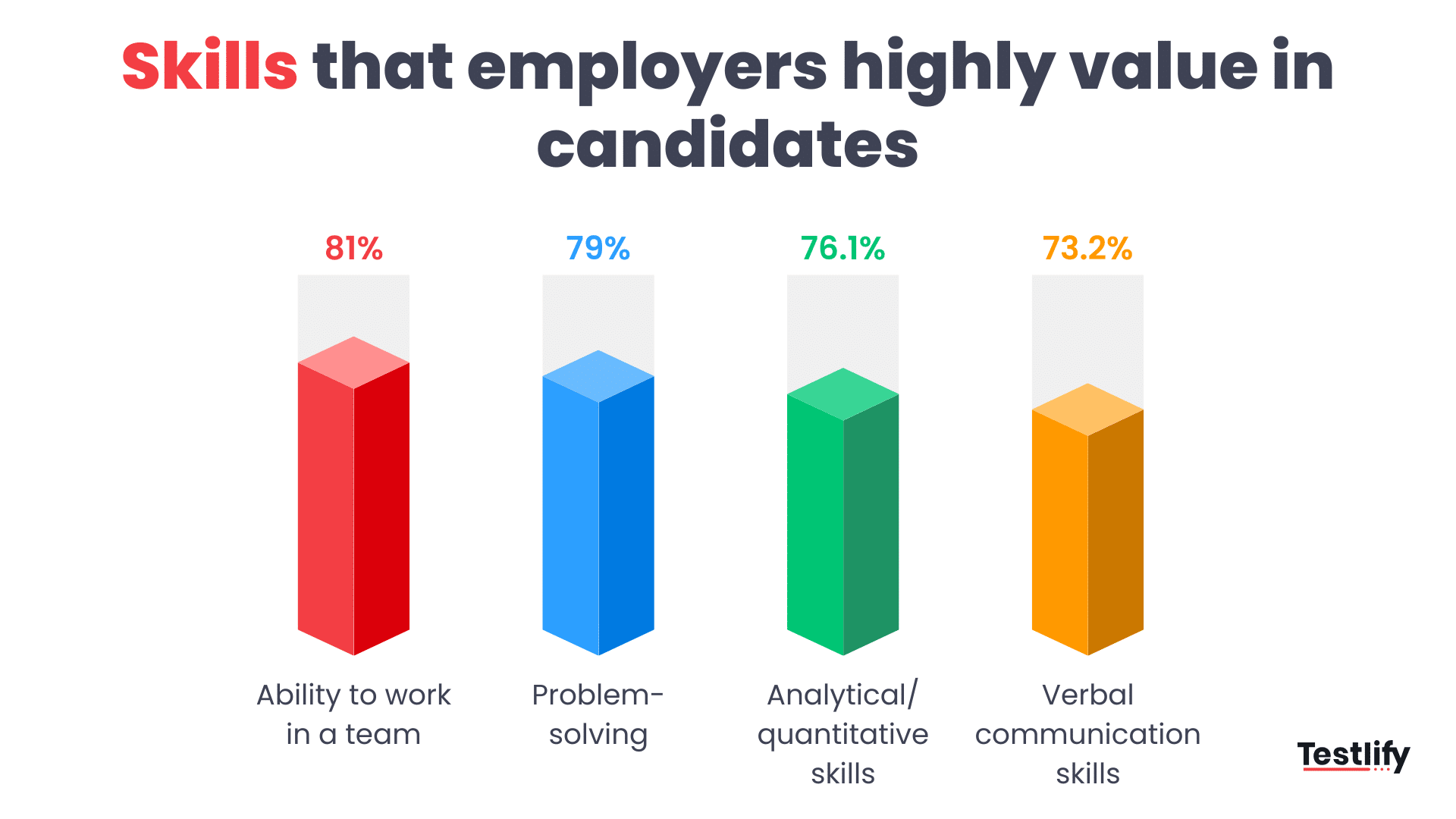
Transferable skills vs soft skills and hard skills
These three terms are often used interchangeably, but they describe different things about a skill. Soft skills and hard skills tell you what type of skill someone has, while transferable skills tell you whether that skill can be carried from one role, industry, or workplace to another. Understanding that distinction makes it easier to see where the categories overlap and where they differ.
- Soft skills are personality-driven traits such as empathy, patience, or curiosity. Most are transferable, but the label describes what kind of skill it is, not whether it moves.
- Hard skills are technical and learned, such as writing SQL or operating a forklift. Some transfer widely and some do not.
- Transferable skills can be either. Running a project-management tool is technical, and it moves cleanly from a construction firm to a software company. Coding in a proprietary in-house language is technical too, and it moves nowhere.
So the deciding factor is not the skill type. It is whether the skill survives a change of context. Treating "transferable" and "soft" as synonyms is the most common mistake in this area, and it quietly excludes the technical skills that transfer best.
Why do transferable skills matter now?
Because the half-life of job-specific knowledge keeps shortening while the half-life of judgment does not. The World Economic Forum's Future of Jobs Report 2025 found that employers expect 39% of core skills to change by 2030, and that analytical thinking is the most sought-after core skill, with about 7 in 10 companies calling it essential. Analytical thinking is not a tool. It is a transferable skill.
Put that next to the tenure data. Median tenure of 3.9 years, and 2.7 years for workers aged 25 to 34, means a person hired for a fixed set of tasks will likely outlast those tasks inside your own company, never mind their career. Hiring for the current job description optimizes for the shortest part of the employment relationship.
The cost argument is simpler. Every internal move you can fill from your existing workforce is a requisition you do not open, a notice period you do not wait out, and a ramp you shorten because the person already knows how the company works.
Pro tip: Before you write a job description, list the three things about this role that will almost certainly be different in two years. Whatever survives that list is what you should actually be assessing for. It is usually judgment, communication, and how someone handles being wrong, not the tool named in the job title.
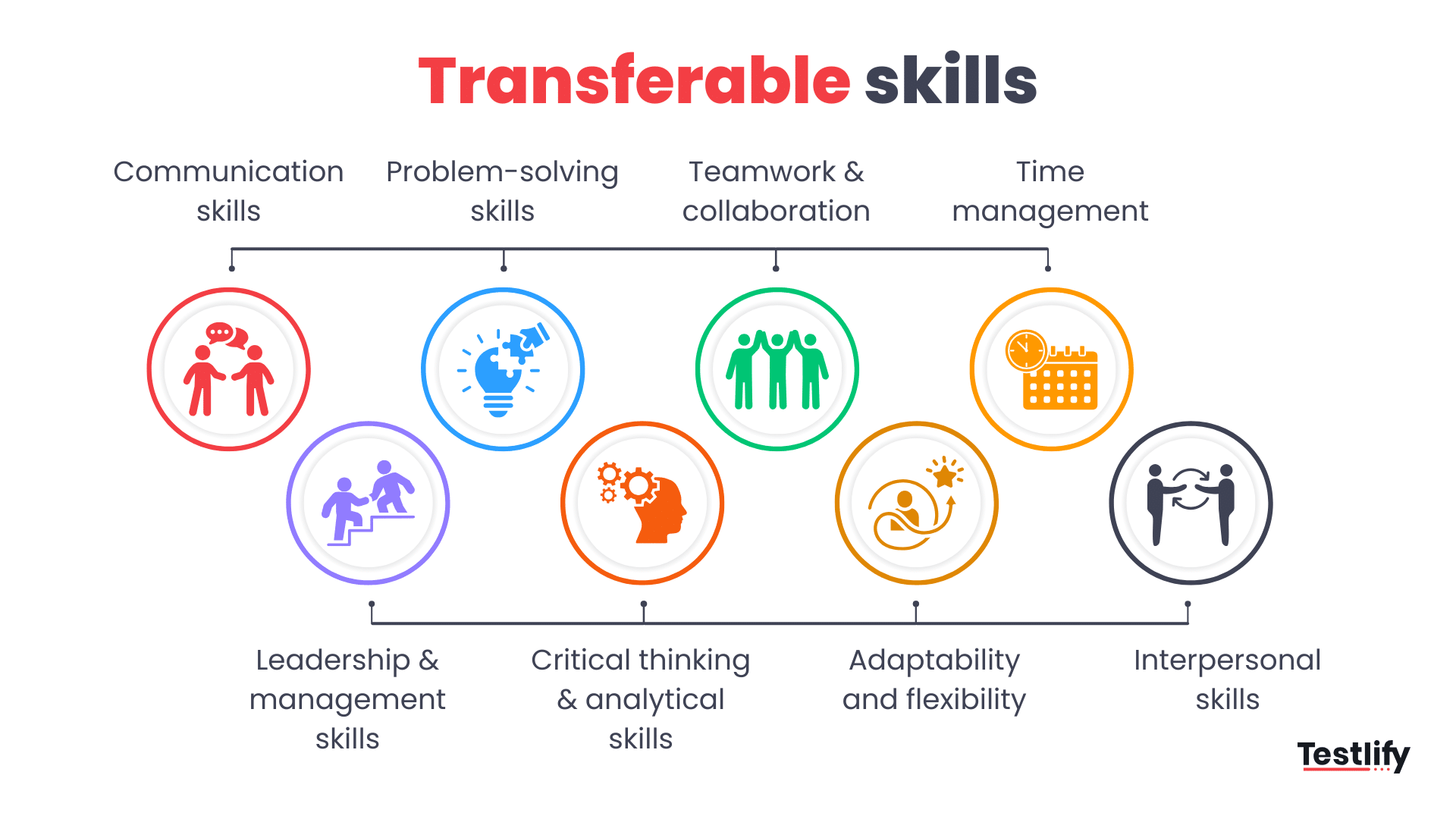
What are the top 8 transferable skills?
These eight show up in nearly every role and industry, which is what makes them worth assessing rather than assuming.
1. Communication
Getting an idea into someone else's head accurately, then checking that it landed. It splits three ways: written (emails, reports, documentation), verbal (meetings, presentations, difficult conversations), and non-verbal (tone, body language, what silence signals in a room).
What it looks like: a project coordinator turning a technical blocker into a plain-language update an executive can act on. The same skill carries into consulting, account management, and people leadership.
You can measure it directly with a communication test rather than inferring it from how polished someone sounds in an interview, which mostly measures interview practice.
2. Problem-solving
Finding the real problem, generating options, and choosing one under time pressure. The transferable part is the diagnostic habit, not the domain.
What it looks like: a retail associate noticing that returns are spiking for a single product, tracing it to packaging rather than the product itself, and proposing the fix. That is the same instinct a systems analyst uses to debug a broken workflow.
A scored problem-solving test shows the approach, not just the answer, which is the part that transfers.
3. Teamwork and collaboration
Contributing to a shared outcome you do not control alone. It includes listening, disagreeing productively, and adjusting your plan around other people's constraints.
What it looks like: a marketing coordinator aligning sales, product, and design on one launch, resolving a timeline conflict without escalating it to a manager.
Use a teamwork test to see how a candidate behaves when their preference loses.
4. Time management
Deciding what does not get done. Prioritization, sequencing, and protecting the deadline that actually matters when several are labeled urgent.
What it looks like: an event planner holding five vendor deadlines in one week without dropping any, which is the same prioritization an operations manager applies across workstreams.
A time management test surfaces this before it shows up as a missed quarter.
5. Leadership and management
Getting work done through other people. Decision-making, delegation, motivation, and conflict resolution, none of which require a formal title.
What it looks like: a senior individual contributor mentoring two juniors and settling a scope disagreement between them before it reaches their manager. Leadership potential is visible well below the management line, and it is one of the strongest signals for internal mobility.
Testlify's leadership test measures decision-making, team management, and communication under pressure.
6. Critical thinking and analysis
Using evidence to evaluate information, question assumptions, identify gaps, and reach a well supported conclusion rather than simply accepting the answer everyone expects.
What it looks like: a financial analyst spotting a spending anomaly buried in a report and tracing it to its cause, the same skill a merchandiser uses to catch a demand-forecasting error.
This is the easiest skill to claim and the hardest to prove in conversation, which is why a scored critical thinking assessment beats a candidate's self-description.
7. Adaptability and flexibility
Adjusting quickly when tools, priorities, processes, or teams change while maintaining performance. As roles and workplace demands continue to evolve, the ability to learn, adapt, and stay effective makes this a core skill rather than a nice to have.
What it looks like: an employee who picked up a new project-management system mid-quarter with no drop in output, and the same flexibility that lets someone move from a startup's ambiguity to an enterprise's process without stalling.
Nearly every candidate calls themselves adaptable. An adaptability test shows how someone actually responds to change instead of how they describe themselves.
8. Interpersonal skills
Building working relationships across seniority, function, and culture. Empathy, emotional intelligence, and reading a room are the components.
What it looks like: a support rep de-escalating a frustrated client by naming the concern before offering a solution, which is exactly what carries that person into account management later.
An interpersonal skills test gives you evidence for the part of the job that never appears in the job description.
Transferable skills list: 25 examples by category
A full list of transferable skills is more useful when each entry is tied to what it looks like in practice and where it actually moves. Use this table to build interview prompts and assessment criteria, not just to recognize the words on a resume.
Category | Specific example | What it looks like in practice | Where it transfers |
|---|---|---|---|
Communication | Active listening | Understanding a client's real need before responding | Call center rep to account manager |
Communication | Public speaking and presenting | Explaining a complex idea to a non-expert room | Teacher to sales |
Communication | Written communication | Reports and emails that need no follow-up | Analyst to product manager |
Communication | Negotiation | Reaching a deal both sides accept | Procurement to HR salary talks |
Problem-solving | Root-cause analysis | Tracing a recurring issue to its source, not its symptom | Manufacturing QA to IT support |
Problem-solving | Lateral thinking | Finding a workaround under budget or resource limits | Marketing to operations |
Problem-solving | Troubleshooting under pressure | Diagnosing and fixing an issue live, customer waiting | Field technician to customer success |
Teamwork and collaboration | Cross-functional coordination | Aligning engineering, product, and design on one deliverable | Engineer to product owner |
Teamwork and collaboration | Conflict mediation | Resolving a peer disagreement without escalation | Nurse unit coordination to project manager |
Teamwork and collaboration | Giving and receiving feedback | Delivering critique that improves the work | Designer to any people-facing role |
Time management | Prioritization under competing deadlines | Deciding what slips when everything is urgent | Event planner to operations manager |
Time management | Running parallel projects | Holding 3 or more workstreams without dropping any | Freelancer to corporate coordinator |
Time management | Deadline management | Hitting external, non-negotiable dates consistently | Paralegal to executive assistant |
Leadership and management | Delegation | Assigning work by strength, not by convenience | Restaurant shift lead to team manager |
Leadership and management | Influence without authority | Getting peers to act with no reporting line | Senior IC to scrum master |
Leadership and management | Coaching and performance feedback | Helping someone improve, not just telling them to | Retail supervisor to L&D specialist |
Critical thinking and analysis | Data interpretation | Turning a spreadsheet into a decision | Financial analyst to marketing analyst |
Critical thinking and analysis | Pattern and trend identification | Spotting a change before it becomes obvious | Data scientist to merchandiser |
Critical thinking and analysis | Risk assessment | Weighing what could go wrong before committing | Auditor to compliance or product risk |
Adaptability and flexibility | Adopting new tools | Switching software with no productivity dip | Any role during a systems migration |
Adaptability and flexibility | Handling shifting priorities | Re-planning the week when leadership changes direction | Startup employee to enterprise employee |
Adaptability and flexibility | Working across cultures and time zones | Adjusting communication style for a global team | Remote support to global account management |
Interpersonal skills | Empathy in client-facing work | De-escalating a frustrated stakeholder | Healthcare aide to HR |
Interpersonal skills | Relationship building | Building a contact who matters two years later | Sales to business development |
Interpersonal skills | Reading organizational dynamics | Knowing who needs to sign off before asking | Office manager to change management consultant |
How do you identify transferable skills in candidates?
You measure them. Resumes describe transferable skills in the same four adjectives regardless of whether the person has them, so the resume is the wrong instrument. Four methods work, and they work best stacked.
1. Behavioral interviews with a scoring rubric
Ask for a specific past situation, then score the answer against criteria written before the interview. "Tell me about a conflict you resolved at work" is only useful if every interviewer grades the answer the same way. Without the rubric it is a conversation, not a measurement.
2. Skills assessments and situational judgment tests
SHRM research covering 1,688 HR professionals found that 79% of them consider assessment scores as important as or more important than traditional criteria, and 78% said the quality of their hires improved after adopting assessments. That research was published in 2022, and the direction of travel since has been toward more measurement, not less. Design the skills assessment around tasks the person will actually face, not trivia about the tools.
3. Read responsibilities, not job titles
Titles compress badly across companies. A customer service representative at a 40-person firm may own escalation handling, vendor chasing, and a weekly report, none of which the title suggests. Read what the person was accountable for.
4. Ask about work outside the job scope
Side projects, cross-team fill-ins, and the thing someone volunteered for when a colleague left are where transferable skills get exercised without a title granting permission. Those stories tend to be true, because nobody rehearses them.
5. Map the skill to the evidence before you assess
Instead of starting from a test, start from the role: name the competencies that matter, then connect each one to measurable evidence through assessments, simulations, interviews, references, and structured reviewer feedback. Adaptability stops being an adjective and becomes a row with a defined evidence source and a benchmark. Testlify supports the evaluation; the hiring decision stays with your team.
How do you build transferable skills in your team?
Identifying these skills at the hiring stage only helps the people you have not hired yet. Your existing payroll is the larger opportunity, and the cheaper one.
Cross-training and job rotation
Moving someone into an adjacent function for a fixed period builds range faster than any course, because the skill is exercised under real consequences. It also tells you who adapts before you bet a promotion on it.
Structured mentoring, not informal pairing
Mentoring works when it has a stated goal and a review date. "Have coffee occasionally" produces goodwill and no measurable skill. Name the capability being developed and check progress against it.
Stretch assignments with a real deadline
Give someone a piece of work slightly beyond their current level, with support and a genuine due date. Leadership, prioritization, and communication under pressure are all trained this way and cannot really be trained any other way.
Baseline, then re-measure
Run an assessment before the development effort and again after. Without a baseline you cannot tell a training program that worked from one that everyone enjoyed. This is also what turns internal mobility from a hope into a plan, because you know which capabilities you already hold.
Hire for transferable skills, not job titles
If a candidate's adaptability, judgment, and communication are the things most likely to matter in two years, they deserve more evidence than a self-description in an interview. Testlify's test library covers communication, problem-solving, leadership, adaptability, critical thinking, and the other capabilities on this page, scored consistently across every candidate so shortlists are built on the same evidence rather than on who interviewed best.
To see how it would fit your hiring process, book a demo and bring a role you are struggling to fill.
Key takeaways
- Portability is the test, not skill type. A transferable skill stays useful after the job changes, and it can be technical as easily as behavioral. Teams that treat "transferable" as a synonym for "soft" skip the technical skills that transfer best, such as tool fluency and data interpretation.
- The tenure data changes the math. With median tenure at 3.9 years, and 2.7 years for workers aged 25 to 34, most people will outlast the job description they were hired against. Hiring for the current task list optimizes for the shortest part of the relationship, so weight the durable capabilities higher in your scorecard.
- 39% of core skills are expected to shift by 2030. That is the case for assessing judgment and adaptability rather than only tool knowledge, and it is why analytical thinking now tops the employer demand list. Build at least one durable capability into every role scorecard.
- Self-reported soft skills carry almost no signal. Every candidate claims adaptability and communication. Structured assessments and rubric-scored behavioral interviews are what turn the claim into evidence you can compare across a shortlist.
- Announcing skills-based hiring changes nothing on its own. Fewer than 1 in 700 hires shifted when firms dropped degree requirements, because a removed credential leaves a vacuum. Put a measurement where the credential was, or screeners revert to the old proxies.
- Your existing workforce is the cheaper pool. Cross-training, stretch assignments, and mentoring with a review date build transferable skills faster than courses. Baseline with an assessment first, or you cannot prove the program worked.
FAQs

Content Writer
Yashika Khandelwal is a Content Writer with 3+ years of experience creating research-backed content on hiring, talent assessment, and HR technology. She is a registered Organizational Psychologist and subject matter expert who combines behavioral science with practical recruitment insights to produce accurate, evidence-based content.
LinkedInRelated resources
View all
HR & recruitment
What is a returnship: Benefits and best practices

HR & recruitment
Graduate recruiting: Definition, process, and proven strategies

HR & recruitment
What is balanced scorecard (BSC)? A guide for 2026

HR & recruitment
Top employee selection methods to hire the best talent

HR & recruitment
Top digital record keeping tips for recruiters

HR & recruitment
Top 8 HR priorities to look at in 2026
Get started.
Hire on proof, not resumes.
Run your first skills-based assessment free — no credit card required.