
Recruitment technology: Meaning, benefits and hiring use cases
Recruitment technology improves hiring with tools for sourcing, screening, assessments, interviews, communication, and analytics.

Recruitment technology is the software and tools hiring teams use to attract, screen, assess, interview, communicate with, and hire candidates more efficiently. It helps companies manage the hiring process with more speed, structure, and visibility.
This matters because hiring breaks down fast when the process is slow or scattered. Candidates drop off, recruiters lose time on manual work, and hiring managers do not always get clear data to compare candidates fairly.
In this guide, we’ll cover what recruitment technology includes, how it improves hiring, where it fits in the funnel, and how to choose the right tools for hiring.
 ChatGPT
 Gemini
 Claude
 Grok
Grok Perplexity
What is recruitment technology?
Recruitment technology is best understood as the system that keeps hiring organized. It helps recruiters and hiring managers manage each step, from job posting to the final hiring decision, without depending only on emails, spreadsheets, or manual follow-ups.
The goal is to make the recruiter’s work easier and more consistent. For example, one tool may help collect applications, another may screen candidates, another may assess skills, and another may schedule interviews. When these tools work together, the hiring team gets a clearer view of every candidate and every stage of the process.
This is useful because hiring decisions often involve many people. Recruiters need to move fast, hiring managers need clear information, and candidates need timely updates. Recruitment technology brings these moving parts into a more structured workflow.

TL;DR – Key takeaways
- Recruitment technology helps hiring teams attract, screen, assess, interview, communicate with, and hire candidates in a more organized way.
- The main types include job boards, ATS, recruitment CRM, sourcing tools, screening tools, skills assessments, video interviews, scheduling tools, and analytics.
- The best tools solve a clear hiring problem, such as slow screening, poor candidate communication, weak reporting, or inconsistent interviews.
- AI is making recruitment technology faster, but human judgment is still needed for fair and responsible hiring decisions.
- Choose tools that fit your workflow, improve candidate experience, integrate with your current tech stack, and give your team useful hiring data.
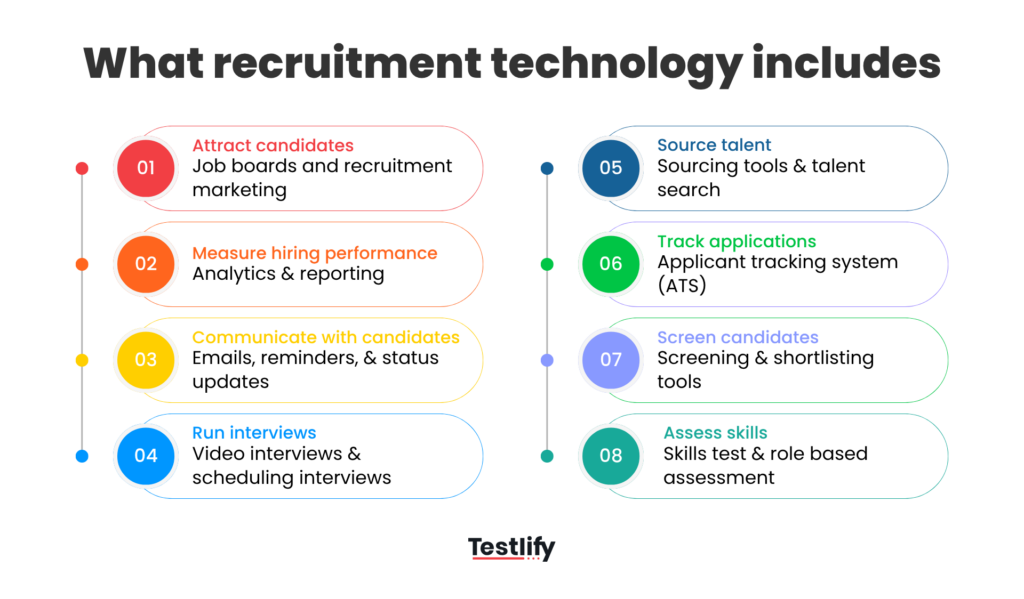
What are the types of recruitment technology?
Recruitment technology covers different tools across the hiring process. Some tools help attract candidates, some organize applications, and others help teams screen, assess, interview, or communicate better. Below are the main types hiring teams usually use:
Type of recruitment technology | What it helps with | Best used for |
|---|---|---|
Job boards | Publishing open roles where candidates can find them | Reaching active job seekers |
Recruitment marketing tools | Promoting the employer brand and open roles | Attracting better-fit candidates |
Sourcing tools | Finding candidates across databases, platforms, and talent pools | Reaching passive or hard-to-find talent |
Applicant tracking system (ATS) | Collecting applications and tracking candidates through each hiring stage | Keeping the hiring process organized |
Candidate relationship management (CRM) | Building and managing long-term candidate relationships | Nurturing past, passive, or future candidates |
AI-powered screening tools | Sorting applications based on role requirements | Reducing manual resume review |
Skills assessment tools | Testing job-relevant skills before interviews | Evaluating candidates beyond resumes |
Video interview tools | Running live or recorded interviews | Making interviews more structured and flexible |
Interview scheduling tools | Coordinating calendars and interview slots | Reducing back-and-forth communication |
Candidate communication tools | Sending updates, reminders, and next steps | Improving candidate experience |
Recruitment analytics tools | Tracking hiring data and funnel performance | Finding delays, drop-offs, and source quality issues |
Workflow automation tools | Moving candidates between stages and sending reminders automatically | Reducing manual admin work |
Candidate database | Storing candidate profiles and application history for reuse | Getting better access to past applicants |
Interview scorecards | Helping interviewers rate candidates on the same criteria | Making interview feedback more consistent |
Not every company needs every tool. A small team may only need an ATS, assessment tool, and scheduling support. A larger hiring team may need a full recruitment tech stack with sourcing, CRM, automation, analytics, and integrations.
The right choice depends on the problem you are trying to solve. If too many unqualified candidates are reaching interviews, screening and assessment tools matter more. If candidates are dropping off, communication and scheduling tools may need attention first.
Candidate relationship management tools are sometimes marketed as Talent Relationship Management, or TRM, software. Beyond just storing contacts, keeping a warm pipeline of pre-screened candidates lets teams move faster when a role opens, reduces how much a team has to rely on last-minute external sourcing, and tends to improve quality of hire since those candidates are already engaged with the company.
Explore More: Types of recruitment technology shaping the future of recruitment
How does recruitment technology improve the hiring process?
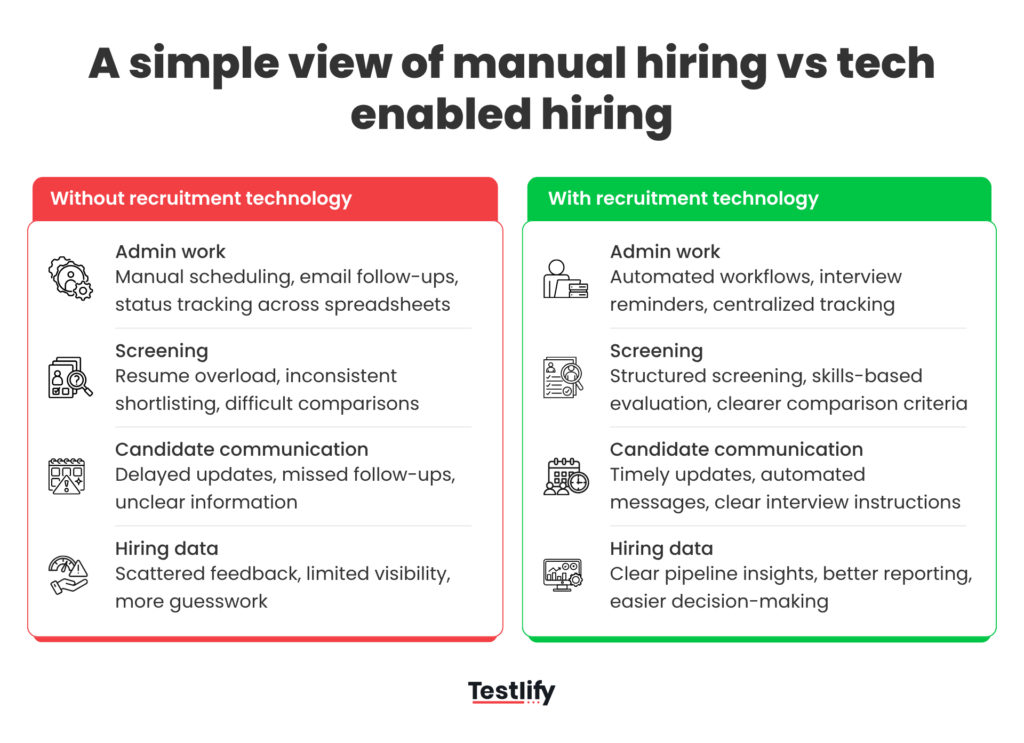
Recruitment technology improves hiring by removing slow manual work, keeping candidate information in one place, and helping hiring teams make decisions with more structure. It does not replace recruiters. It gives them more time to focus on the parts of hiring that need judgment, context, and human conversation.
This matters because hiring teams are already dealing with more applications, longer coordination loops, and higher candidate expectations. Greenhouse reported that recruiter workload rose by 26% in one quarter, partly because AI tools have made it easier for candidates to apply at scale. That makes a clear hiring workflow more important than ever.
A related data point: LinkedIn has found that the average time to hire across a range of functions is 41 days when teams rely on traditional, offline hiring methods, another reason a structured hiring workflow matters.
It reduces repetitive admin work
A lot of recruiting time goes into small but necessary tasks: posting jobs, sorting applications, sending updates, scheduling interviews, moving candidates between stages, and reminding hiring managers to give feedback.
Recruitment technology helps by automating parts of this work. For example, an applicant tracking system can collect applications in one place, send status updates, and keep the hiring team aligned on the next step.
This does not mean recruiters stop doing the work. It means they spend less time chasing forms, emails, and calendar slots, and more time speaking with the right candidates.
It makes screening more consistent
Manual screening can vary from recruiter to recruiter. One person may focus on job titles. Another may focus on years of experience. A third may give more weight to education.
Recruitment technology adds more structure to this stage. Skills assessments, resume screening, scorecards, and interview rubrics help hiring teams evaluate candidates against the same role requirements.
This is where platforms like Testlify can fit naturally. Recruiters can use job-relevant assessments to compare candidates on skills instead of relying only on resumes. That makes screening more practical, especially when the talent pool is large.
LinkedIn’s 2025 Future of Recruiting report also supports this shift. It found that companies using more skills-based searches were 12% more likely to make a quality hire.
It improves candidate communication
Poor communication is one of the biggest reasons candidates lose trust during the hiring process. Candidates want to know where they stand, what comes next, and whether the company respects their time.
Recruitment technology helps teams send timely updates, interview reminders, rejection emails, and next-step messages. Even a simple update is better than silence.
This matters because it has been found that 52% of candidates said they had been ghosted, while 79% said they would reapply to a company if they received feedback after an interview.
A related 2025 survey found that 57% of job seekers had abandoned a job application midway because the process felt too complicated or time-consuming, the same drop-off problem showing up from the candidate’s side of the funnel.
So the point is simple: better communication does not just improve candidate experience. It also protects the employer brand and keeps good candidates open to future roles.
It gives hiring teams better data
Without data, hiring teams often rely on memory or scattered opinions. Recruitment technology gives them a clearer view of what is happening across the hiring process.
Teams can track things like:
- Which job boards bring better candidates
- Where candidates drop-off
- How long each hiring stage takes
- Which assessments predict stronger performance
- Which hiring managers are delaying feedback
This helps recruiters and hiring managers fix real problems instead of guessing. For example, if many candidates drop-off before the interview, the issue may be slow scheduling, unclear communication, or a long application process.
Where can recruitment technology be used in the hiring funnel?
Recruitment technology can support almost every stage of the hiring funnel. The point is not to add more tools everywhere. The point is to use the right tool where the process slows down, becomes unclear, or creates extra work for the hiring team.
Hiring stage | What teams need to manage | Recruitment technology that helps |
|---|---|---|
Attract | Reaching the right candidates for open roles | Job boards, career pages, recruitment marketing tools |
Source | Finding active and passive candidates | Sourcing tools, talent databases, candidate relationship management CRM |
Track | Keeping applications and candidate status organized | Applicant tracking system |
Screen | Shortlisting candidates based on role fit | Screening tools, knockout questions, resume filters |
Assess | Checking real skills before moving candidates ahead | Skills assessments, job simulations, role-based tests |
Interview | Running structured interviews without too much coordination | Video interviews, interview scheduling tools, scorecards |
Engage | Keeping candidates updated throughout the process | Email reminders, status updates, candidate communication tools |
Decide | Comparing candidates and reviewing feedback | Hiring dashboards, interview notes, assessment reports |
Measure | Understanding what is working and what is slowing hiring down | Recruitment analytics and funnel reports |
For example, if a team gets too many applications but very few qualified candidates, the problem may sit in screening or assessment. If good candidates are dropping off before interviews, the issue may be scheduling or communication. If hiring managers are unsure whom to move forward, the team may need better scorecards, assessment data, or reporting.
This is where recruitment technology works best. A platform like Testlify, for instance, fits naturally in the assessment stage by helping teams evaluate candidates with job-relevant tests before interviews.
Read More: How to use recruitment technology to assess candidates?
What are the benefits of recruitment technology?
Recruitment technology helps hiring teams run a more organized and reliable process. It reduces the gaps that often slow teams down or make decisions harder. Below are the key benefits:
- Less manual work: Recruiters spend less time on repetitive tasks like scheduling, reminders, status updates, and application tracking.
- Faster hiring: When tasks, feedback, and candidate stages are easier to track, teams can move candidates forward without long delays.
- More consistent screening: Screening tools, assessments, and scorecards help hiring teams compare candidates against the same role requirements.
- Better candidate experience: Candidates get clearer instructions, timely updates, and fewer confusing gaps during the hiring process.
- Stronger collaboration: Recruiters and hiring managers can work from the same candidate information, instead of checking separate emails, notes, or spreadsheets.
- Clearer hiring data: Teams can see where candidates drop-off, which sources bring better applicants, and which stages are taking too long.
- Better hiring decisions: Recruitment technology gives teams more context through assessment results, interview feedback, and hiring data, so decisions are not based only on resumes or gut feel.
The value depends on how well the tool fits the problem. If screening is weak, assessment tools may help. If candidates are dropping-off, communication and scheduling tools may matter more. If leadership cannot see bottlenecks, analytics should be the priority.
Also Read: Recruitment technology case studies: How companies improve hiring
How should companies choose the right recruitment technology?
Choosing recruitment technology should not start with a feature list. It should start with one simple question: what part of your hiring process is not working well today?
A tool is only useful when it solves a real problem. Otherwise, it becomes another platform the hiring team has to manage.
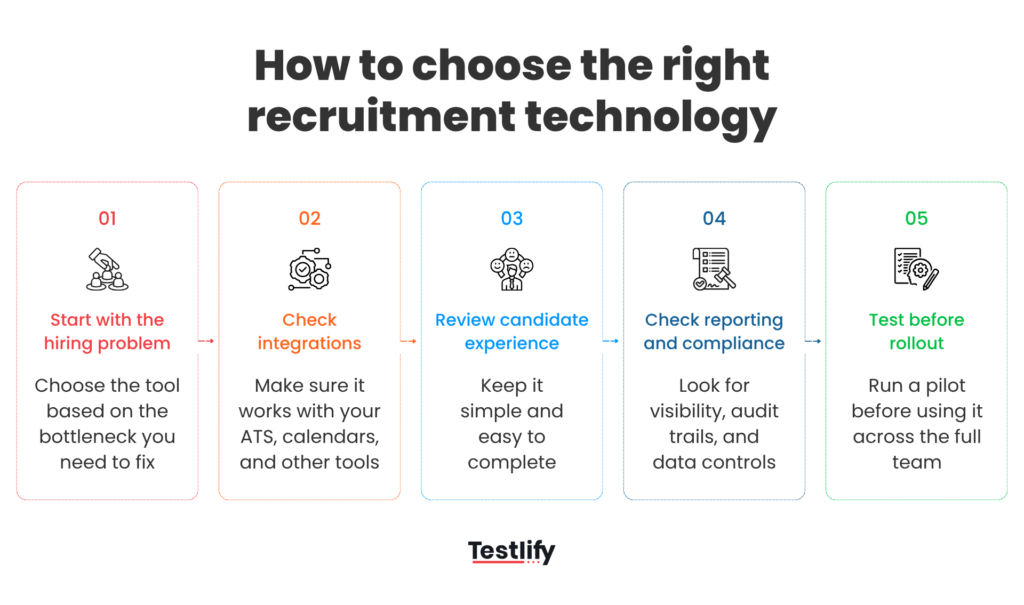
Start with the hiring problem
Before comparing vendors, identify the main hiring gap. For example:
- If recruiters spend too much time reviewing resumes, look at screening or assessment tools.
- If candidates are dropping off, review communication and scheduling tools.
- If hiring managers give inconsistent feedback, look for scorecards and structured interview tools.
- If leadership has no visibility into hiring performance, recruitment analytics should be a priority.
- If the team struggles to find candidates, sourcing tools or a recruitment CRM may help.
This keeps the decision practical. You are not buying “recruitment technology” in general. You are fixing a specific hiring problem.
Check integration with your current tools
A new tool should fit into the systems your team already uses. If it does not connect well, recruiters may end up copying data between platforms, which creates more work instead of reducing it.
Check whether the tool connects with your:
- Applicant tracking system
- HRIS or HRMS
- Email and calendar tools
- Job boards
- Assessment or interview platforms
- Communication tools
- Reporting dashboards
For example, if a team uses an ATS to manage applications, an assessment platform like Testlify should support the hiring workflow without forcing recruiters to manage candidate data manually in two separate places.
Review candidate experience
Recruitment technology should make the process easier for candidates too. A tool may look good for the hiring team, but if it creates long forms, confusing steps, or unclear instructions, candidates may lose interest.
Look at the process from the candidate’s side:
- Is it easy to apply?
- Are instructions clear?
- Can candidates complete steps on mobile if needed?
- Are tests or interviews reasonable in length?
- Do candidates receive timely updates?
- Is the process accessible and fair?
Good recruitment technology should reduce friction, not add more of it.
Look for reporting and compliance support
The right tool should help the hiring team understand what is happening inside the process. Basic reporting is not enough if the team cannot see where delays, drop-offs, or quality issues are happening.
Look for reporting that shows:
- Candidate source performance
- Time spent at each hiring stage
- Screening and assessment results
- Interview feedback
- Candidate drop-off points
- Hiring team activity
Compliance also matters, especially when using AI, assessments, or candidate data. Check for privacy controls, role-based access, audit trails, and clear data handling policies.
Test the workflow before rollout
Do not roll out a tool across the team without testing it first. Start with one role, one hiring team, or one workflow. During the pilot, check:
- Can recruiters use it without extra training every day?
- Do hiring managers understand the output?
- Is the candidate experience smooth?
- Does the tool reduce manual work?
- Does it help the team make better decisions?
- Does it integrate cleanly with your existing process?
The best recruitment technology is easy for recruiters to use, clear for hiring managers, and simple enough for candidates to complete without confusion.
Recommended: How to choose the right recruitment software
How is AI changing recruitment technology?
AI is changing recruitment technology by making routine hiring work faster and easier to manage. It can help with job descriptions, candidate search, resume review, interview notes, candidate messages, and hiring analytics.
This shift is already happening. Gartner found that 38% of HR leaders were piloting, planning, or had already implemented generative AI, up from 19% in June 2023. Recruiting use cases like job descriptions and skills data were among the top priorities.
Here’s where AI is making the biggest difference:
- Sourcing becomes faster: AI can help recruiters find candidates based on skills, experience, and role fit instead of relying only on job titles or keywords. Modern AI matching also goes beyond keyword search. It can pick up context and surface likely soft skills that a resume does not state directly, which keyword-only tools tend to miss.
- Screening becomes easier to manage: AI-powered tools can help sort large applicant pools, highlight relevant profiles, and reduce the time spent on first-level resume review.
- Skills-based hiring becomes more practical: AI can support better matching between role requirements and candidate skills.
- Candidate communication becomes quicker: AI chatbots and automated messages can answer basic questions, share next steps, and send reminders without making candidates wait for every update. Some tools also use conversational AI to run a first pass of screening questions or coordinate interview times directly with candidates, cutting out extra back-and-forth.
- Recruiters get better summaries: AI can help summarize resumes, interview notes, assessment results, and hiring feedback, so teams can review information faster.
- Hiring data becomes easier to use: AI can help spot patterns in the funnel, such as where candidates drop off, which sources perform better, or which stages are slowing down.
But AI should not run the hiring process on its own. Hiring still needs human judgment, clear role criteria, and careful review. The EEOC has also warned that AI and algorithmic tools can hide or repeat bias if employers do not use them carefully.
The best use of AI in recruitment technology is simple: let AI handle repetitive work, but keep people responsible for decisions that affect candidates.
Also Recommended: AI in recruitment: The complete 2026 strategy guide
What are the future trends in recruitment technology?
Recruitment technology is moving toward tools that help teams hire faster, assess skills better, and keep the process easier to manage for both recruiters and candidates. Below are the main trends to watch:
Trend | What it looks like in practice | Why it matters |
|---|---|---|
AI-assisted hiring workflows | AI helps with sourcing, screening, summaries, scheduling, and communication | Saves time on repetitive work |
Skills-based hiring | Teams focus more on skills and job readiness, not just resumes or job titles | Improves fit and supports better hiring decisions |
Structured assessments | More companies use tests, simulations, and role-based tasks before interviews | Makes evaluation more consistent |
Better candidate experience tools | Faster updates, simpler steps, and clearer communication during hiring | Reduces confusion and candidate drop-off |
Integrated recruitment tech stacks | ATS, assessments, interviews, CRM, and analytics work together better | Reduces tool silos and manual work |
Stronger reporting and analytics | Teams track source quality, bottlenecks, drop-off points, and hiring performance more closely | Helps teams improve the process using real data |
More focus on AI governance | Companies review bias, privacy, fairness, and compliance before scaling AI tools | Helps teams use automation more responsibly |
Learn More: Top recruitment technology trends for 2026
How does diversity and inclusion (D&I) software fit into recruitment technology?
Diversity and inclusion software is a newer category of recruitment technology. It focuses on reducing bias earlier in the hiring process, rather than just reporting on diversity numbers after the fact.
- Blind recruitment: resumes and applications can be anonymized, removing details like name, gender, or education that could reveal identity, so candidates are compared mainly on qualifications and skills.
- Diverse candidate sourcing: some tools give recruiters access to databases of underrepresented talent, widening the pool beyond a team’s usual sourcing channels.
- Inclusive job descriptions: other tools scan job postings for language that may discourage certain candidates from applying and suggest more neutral wording.
This fits alongside the screening and assessment tools already covered above. It is worth a look for teams that want their hiring process to be fair by design, not just measured after the fact.
Final takeaway
Recruitment technology works best when it makes hiring simpler, not more complicated. The right tools should help your team save time, screen candidates more fairly, communicate clearly, and make better decisions with real hiring data.
But technology alone will not fix a weak process. Start with the problem, choose tools that fit your workflow, and keep the candidate experience at the center.
If you want to assess candidates with more confidence before the interview stage, book a demo with Testlify and see how skills-based hiring can fit into your recruitment process.
Frequently asked questions (FAQs)

B2B SaaS Content Writer
Rishav Kumar is a B2B SaaS content writer with 4 years of experience. He loves crafting engaging content. Always exploring fresh ideas, he's passionate about helping businesses grow through impactful writing.
LinkedInRelated resources
View all
Recruitment Technology
Case studies of companies that successfully used recruitment technology

Recruitment Technology
How to choose the right recruitment technology

HR Toolkit
Performance Evaluation Template: Free Form, Rating Scale and Examples

HR & recruitment
What Is Leadership Coaching? A 2026 Guide for HR Teams

Workplace culture
12 Best Employee Engagement Strategies That Work in 2026

Skill assessment
Skills Taxonomy vs Skills Ontology: A Guide for Hiring Teams
Get started.
Hire on proof, not resumes.
Run your first skills-based assessment free — no credit card required.