
How long should the hiring process take?
Discover how long the hiring process should take, factors that impact it, and best practices to streamline your recruitment for faster, better hires.

When hiring for a role, it’s important to bring in the right people on board. However, one of the most frequent questions during the hiring process is, “how long should the hiring process take?” It’s not simply a case of filling a vacancy; it’s about getting the ideal person for your team and not letting the process go on forever. But what is the right balance between speed and completeness?
In this article, we will get into the hiring timeline, the process, why it may take longer than you’re looking for, and how you can make the process efficient for the candidates and your hiring team.
 ChatGPT
 Gemini
 Claude
 Grok
Grok Perplexity
What are the steps in the hiring process?
Let’s understand the steps before proceeding with how long the hiring process takes. The common hiring process may differ from one business to another, but the general steps of most hiring processes are:
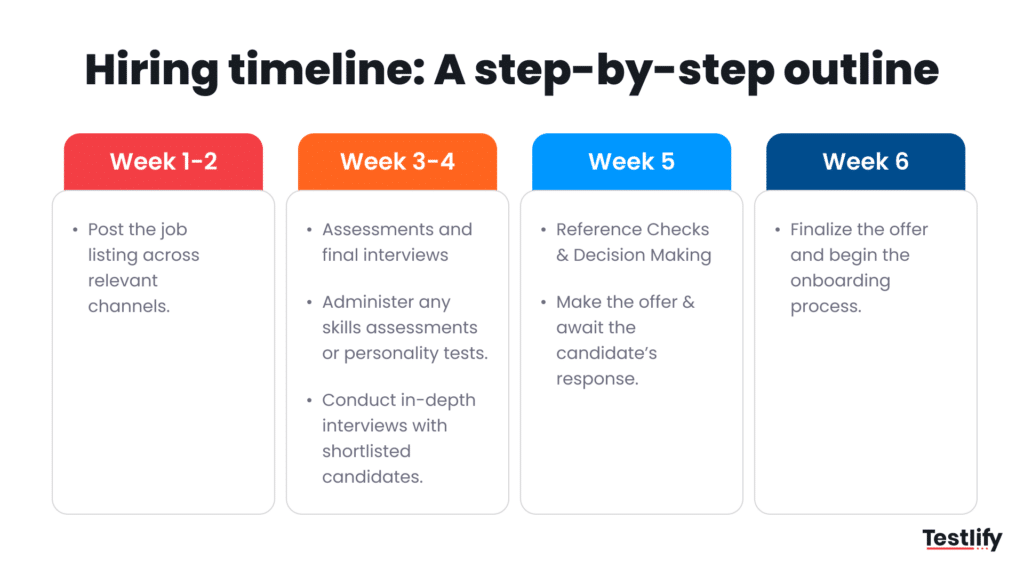
1. Job posting
The initial important step in the recruitment process is the job posting. It entails developing a concise, specific job description that defines the duties, necessary skills, qualifications, and company environment.
This is achieved so that the company attracts suitable candidates for the position. It is normal for companies to utilize various platforms, such as job boards, company websites, and social media, to reach a wider audience. A clear and well-drafted job posting makes the job accessible to the potential candidates, laying the ground for a successful recruitment process.
2. Skills assessment
Skills assessments help evaluate the candidates’ skills and competencies beyond what’s listed on their resumes. This could include technical tests, problem-solving exercises, or personality assessments designed to gauge whether a candidate fits the role. Testlify has a comprehensive test library that has assessments ranging from role-specific to cognitive ability tests to psychometric tests.
Numerous organizations make this step a part of the hiring process to guarantee that the candidate is ascertained to have the required skills for the position. Tests offer factual information, assisting hiring managers in making knowledgeable choices and minimizing the likelihood of making a bad hire based on interview impressions.
3. Interviews
The interview process starts after you’ve narrowed down your pool of candidates. Depending on the company, interviews may be done in several rounds or styles, including phone, video, or face-to-face.
The interviews assess the candidate’s abilities, experience, and cultural compatibility. Various team members may be engaged in the interview process to obtain different views. Interviews also offer a platform for the candidates to pose questions, enabling both parties to determine whether the job and company are suited to their expectations.
4. Reference checks
Before making an offer, most employers make reference checks to confirm the information applicants present. Reference checks entail contacting previous employers, colleagues, or other references provided by the applicant to confirm their employment history, qualifications, and fit for the job..
5. Job offer
Should a candidate pass all the stages of the selection process, the next course of action is to extend a formal job offer. This offer usually consists of important specifics like the title of the job, salary, benefits, date of commencement, and other employment conditions.
The offer is typically subject to satisfactory reference checks and background screening. Open communication at this stage is important since the candidate will need to take time to read and negotiate the offer. Upon agreement of terms by both parties, the candidate can formally accept the position.
6. Onboarding
Onboarding is the last step in the recruitment process. Once the candidate has accepted the job offer, they are brought into the firm and their work unit and introduced to the tools required to perform well. Onboarding includes giving new employees crucial resources like training tools company policy, and configuring their working environment.
It also involves welcoming them to the company culture and making them feel supported and welcomed. A successful onboarding process ensures new employees integrate smoothly, increasing job satisfaction and long-term retention.

Why does the hiring process take so Long?
The hiring process may take weeks or months, depending on various factors. While some organizations can hire within a few days, others encounter delays. Let’s look at some reasons why the hiring process takes a while.
1. Candidate evaluation
Getting the right person hired involves careful analysis, which is not done in a hurry. Interviewers must screen resumes, hold interviews, and look at evaluations, all of which take time. And there is usually a to-and-fro process of arranging and rearranging interviews.
2. Internal stakeholder alignment
Within numerous organizations, various departments or staff members must take part in hiring. HR, the manager initiating the hire, team leaders, and even the senior leadership team may be stakeholders. Getting everybody’s calendars synced and aligned with who gets hired can contribute to delays.
3. Hiring budget constraints
Recruitment can sometimes be delayed because of internal budgetary restrictions, particularly regarding salary or benefits packages. It may take longer if the organization has issues with budget constraints or if compensation needs to be negotiated with the candidate. For instance, an employer may need to obtain approvals from finance or senior management before making a specific salary or package offer, which may take time.
4. Candidate availability
The availability of candidates for interviews usually causes delays in the recruitment process. Most candidates are already employed; fixing interview times would mean coordinating against their work timings. Candidates can also be shortlisting several offers, and this can cause increased waiting time since they have to balance interview dates or make choices.
5. Approval processes
In some companies, multiple approvals must be completed before the offer can be made. These approvals can be from HR, the hiring manager, finance, or senior management. Each level of approval opens up the risk of delay.
What is Average time to hire?
So, how long should the hiring process take? According to SHRM, the average time to hire (from posting the job to extending an offer) is around 42 days. However, this varies significantly depending on the industry, role, and company size.
- Tech positions may take longer due to the industry’s highly competitive nature.
- Entry-level roles or positions with less stringent skill requirements may take less time.
On the other hand, companies that use more efficient methods like streamlined interviews or pre-assessment tools like Testlify helps reduce time to hire and often complete the process in less than 30 days.
The goal should always be to balance the need for thoroughness with speed to avoid losing top candidates to competitors.
How long is too long to hire?
There is no one-size-fits-all rule for how long hiring should take, but there are a few indicators that your process may be dragging on too long.
1. Candidate drop-off
If the process takes over 4-6 weeks from start to finish, then candidates could get bored and lose interest, especially if they’re investigating other possibilities. If you find a large percentage of candidates dropping out of the process or accepting another offer, it might indicate that your process is too long.
2. Diminishing candidate quality
The longer you wait to make a hire, the more likely it is that the best talent will have moved on. If you’re continuously delaying your hiring process, you may be stuck with less-qualified or less-motivated candidates than rivals have already poached.
3. Poor candidate experience
A long recruitment process can be frustrating for applicants. It can hurt your employer’s brand if they feel they are being kept in limbo without proper communication. Long timeframes can create a bad experience, and applicants might decide not to work for your organization, even if hired.
What factors determine how long the hiring process takes?
Several factors impact how long it will take to hire a candidate. Some of them are within your control, while others are not. These are a few typical factors:
1. The role and its requirements
Also Read: Hiring process steps you should never skip
The specialization and complexity of the position have a major influence on the duration of the hiring process. Recruitment for senior roles, such as C-suite or technical roles that demand specialized technical skills, tends to take longer than recruiting entry-level or administrative staff. These positions need a more meticulous assessment of the candidate’s qualifications, experience, and cultural alignment.
2. Number of applicants
The quantity of applicants for a position directly impacts the duration of the hiring process. The more applications, the longer it takes to screen, sort, and assess each applicant’s fit for the role. This translates to more time spent screening resumes, interviewing, and potentially giving tests.
3. Recruitment team size
The capacity and number of your recruitment team can play a major role in determining the duration of the hiring process. A small HR team might find it difficult to screen resumes, arrange interviews, and carry out assessments effectively, causing delays. Larger recruitment teams, on the other hand, can split up tasks, process the work quickly, and progress candidates through the stages faster.
4. Approval and budgeting
Budget approval and approval processes have the potential to slow down the hiring process. In most organizations, several stakeholders, such as the finance department, HR, and the hiring managers, will need to sign off on the hiring decision. If there is delay in receiving approvals from the main decision-makers or where the budget for the role is uncertain or has to be renegotiated, the process can be delayed.
Risks in lengthy hiring practices
While care is important when hiring, prolonged and protracted processes carry with them some risk. These risks can directly impact your firm’s success.
1. Loss of top talent
One of the greatest risks of a protracted hiring process is the loss of top talent. Top talent tends to be highly sought after and might be holding out for other offers. If your recruitment process is too lengthy, these candidates might accept jobs at other firms even before you make an offer.
This can result in lost opportunities and deprive your organization of the best talent for the job. To prevent this, it’s important to make your process streamlined and swift while still being able to properly evaluate.
2. Negative reputation
A long hiring process can create a negative perception among candidates about your firm. When candidates are faced with extended delays or poor communication, they may feel frustrated or underappreciated.
This negativity can translate into negative reviews about your firm on job websites, social media, or word of mouth. A bad reputation as a slow-paced employer can make it more difficult to recruit high-potential candidates in the future, as applicants will choose firms that have quicker, more efficient hiring procedures. Being open and efficient is the most important thing to do in order to defend your employer brand.
3. Cost of delays
Slowing down the hiring process has a cost. The longer the vacancy, the more time and resources are wasted by HR professionals, hiring managers, and other members of the team who are involved in the recruitment process. This can result in increased operational expenses and take away time from other critical tasks.
Moreover, having a position vacant for a long time can result in lost productivity, particularly if the position is key to the performance of the team. The value of the delays, in both resources and lost opportunity, can prove very expensive to your organization’s bottom line.
Best practices for a quick and easy hiring process
Here are some best practices that can help you streamline your hiring process without sacrificing quality:
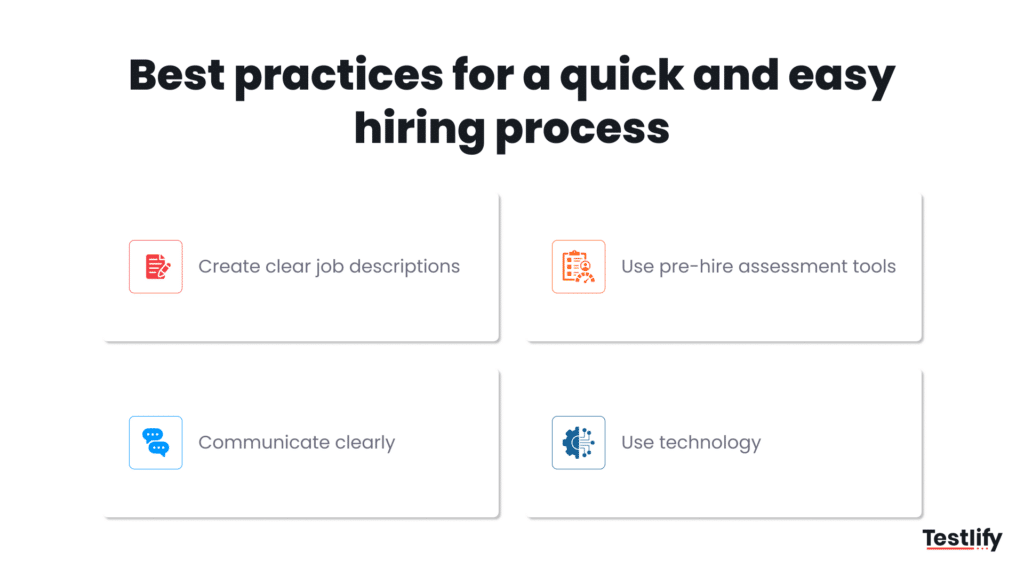
1. Create clear job descriptions
Creating a clear and detailed job description is crucial to attracting the right candidates and setting the stage for a smoother hiring process. A well-crafted job description outlines the responsibilities, required skills, and qualifications, reducing confusion and helping potential applicants understand exactly what the role entails.
2. Use pre-screening tools
Pre-screening tools, such as automated resume screening and pre-interview assessments, can save valuable time and streamline your hiring process. These tools help filter out unqualified candidates early on by automatically scanning resumes for relevant keywords, experience, and qualifications.
3. Communicate clearly
Clear communication throughout the hiring process is key to maintaining a positive candidate experience and avoiding unnecessary delays. Keeping candidates informed about where they stand whether they’re moving to the next stage or when they can expect a decision helps reduce uncertainty and frustration. Regular updates also demonstrate professionalism and respect for the candidate’s time.
4. Use technology
Adopting the right technology can significantly speed up the hiring process. Hiring platforms and automation tools can take care of repetitive tasks such as scheduling interviews, sending follow-up emails, and tracking candidate progress.
This reduces administrative burden, minimizes errors, and frees up time for HR professionals to focus on higher-level tasks, like evaluating candidates and making final decisions.
Create a seamless recruitment process with testlify
To take your hiring process to the next level, incorporate Testlify, our talent evaluation tool that makes it easy to test candidates’ abilities and personality. With pre made assessments and tailor-made tests, Testlify makes you take informed decisions quickly, with a better candidate experience.
Testlify automates the screening of candidates, enabling you to concentrate on the best-fit candidates, and minimizing time spent on manual evaluation.
Conclusion
The duration of the recruitment process varies based on several factors, ranging from the job’s complexity level to the number of people in your recruitment team. While it’s important to act fast to prevent losing the best talent, it’s equally vital to be cautious to guarantee that you’re hiring the best person for your business.
Following best practices, leveraging technology, and optimizing your processes can cut your hiring cycle short without diminishing quality. Make the process remain efficient, transparent, and candidate-friendly, and you’ll discover that not only do you hire quicker, you also attract superior talent.
Frequently asked questions (FAQs)

Content Writer
Yashika Khandelwal is a Content Writer with 3+ years of experience creating research-backed content on hiring, talent assessment, and HR technology. She is a registered Organizational Psychologist and subject matter expert who combines behavioral science with practical recruitment insights to produce accurate, evidence-based content.
LinkedInRelated resources
View all
HR & recruitment
10 free job offer email templates

HR & recruitment
How Dedicated Development Teams Improve Project Delivery and Efficiency

HR & recruitment
The Science of Persuasive Communication: Why HR Leaders Should Master Academic Writing

HR & recruitment
5 Tips for Organizing the Perfect Workation for Your Team

HR & recruitment
University partnerships: a 2026 hiring playbook for employers

HR & recruitment
Smarter ways to identify top talent: How AI is transforming hiring practices
Get started.
Hire on proof, not resumes.
Run your first skills-based assessment free — no credit card required.