
Pros and cons of pre-recorded video interviews for hiring teams
Pre-recorded video interviews save screening time but bring real risks. Here are the pros, cons, fixes and rules hiring teams should know.

Pre-recorded video interviews are one-way interviews where candidates answer a fixed set of questions on camera, on their own time, and the hiring team reviews the recordings later. Used at the screening stage, they save hours of phone screens and give every candidate the same questions. Used badly, they feel cold, shut out some candidates and invite snap judgments.
TL;DR / Key Takeaways
- Pre-recorded video interviews are one-way screens where candidates record answers to set questions on their own time, and the team reviews them later.
- They save recruiter time, remove scheduling and give every candidate the same questions, so answers are easy to compare.
- The main downsides are no follow-up questions, an impersonal feel, camera nerves, access gaps, bias from appearance and candidate drop-off.
- Most cons trace back to setup. Add a hiring manager intro, a practice question, one re-record and a written scoring rubric.
- Ask 3 to 5 questions, with 30 to 60 seconds of think time and 1 to 3 minutes per answer. Keep the total under 20 minutes.
- Use them for early screening in high-volume roles, not senior hires. Pair them with a skills test rather than rejecting on video alone.
- Gartner found only 26% of candidates trust AI to evaluate them fairly. Tell candidates a person reviews their answers and what the criteria are.
 ChatGPT
 Gemini
 Claude
 Grok
 Perplexity
What are pre-recorded video interviews?
Pre-recorded video interviews are a screening step in which the employer sets questions in advance and candidates record their answers through a link, with no interviewer on the call. The same format goes by several names: one-way video interviews, asynchronous video interviews and recorded video interviews.
Pre-recorded video interviews usually sit between the application and the first live conversation. They replace the 20 to 30 minute phone screen that recruiters run to check communication, motivation and must-have requirements. The difference is that the recruiter writes the questions once and reviews answers when it suits them, instead of booking a call with every applicant.

How do pre-recorded video interviews work?
Pre-recorded video interviews work in six steps: the team writes role-based questions, sets the rules for answering, invites candidates, candidates record, the team reviews against a scorecard, and the team decides who moves on.
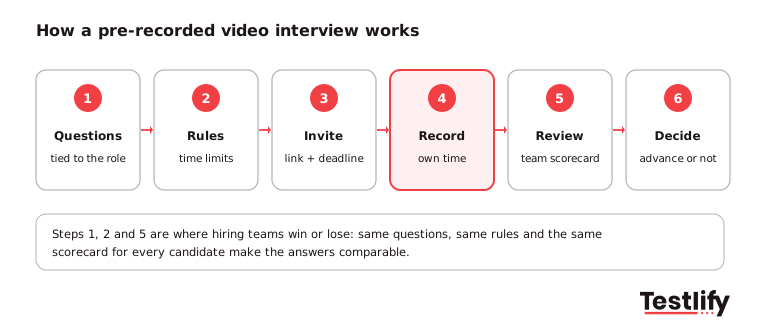
- Write the questions: Pick 3 to 5 questions tied to the skills the role needs. Questions can appear as text or as a short video from the hiring manager.
- Set the rules: Choose think time before each answer, the answer time limit, whether re-records are allowed and the deadline to finish.
- Invite candidates: Each candidate gets a link, usually straight from the ATS, with a deadline of a few days.
- Candidates record: Each candidate reads or watches a question, gets a short time to think, then records an answer on a laptop or phone.
- Review with a scorecard: Recruiters and hiring managers watch the answers and rate each one against the same criteria. An interview scorecard keeps ratings consistent across reviewers.
- Decide: Strong candidates move to a live interview or a skills test; the rest get a clear, prompt answer.
What are the pros of pre-recorded video interviews?
Pre-recorded video interviews save recruiter time, remove scheduling, widen the talent pool and give every candidate the same questions. The format matters most for teams screening many applicants: SHRM's 2025 Talent Trends report found that nearly 70% of organizations still struggle to recruit for full-time roles, so time spent on first-round calls is time not spent on the candidates who matter.
- No scheduling: Candidates record when they are free, including evenings and weekends, so no one waits a week for a call slot.
- Faster screening: Recruiters can review a 3-minute answer in less time than a 30-minute phone screen, and stop early when a must-have is missing.
- Wider reach: Time zones and travel stop being barriers, which helps with remote roles, campus hiring and hiring across regions.
- Consistency: Every candidate gets the same questions in the same order, which is the core of a structured interview and makes answers easier to compare.
- Team review: Hiring managers can watch the same answers as recruiters, so feedback is based on what the candidate said, not a recruiter's notes.
- Less pressure for some candidates: Think time and a re-record option help candidates who freeze in live calls show what they know.
- A record of the decision: Saved answers and scores show why a candidate moved forward or did not, which helps with audits and disputes.
What are the cons of pre-recorded video interviews?
Pre-recorded video interviews remove the two-way conversation, which is where most of the downsides come from. Candidates cannot ask questions, interviewers cannot probe, and both sides lose the rapport that a live call builds.
- No follow-up questions: A vague answer stays vague. Reviewers cannot ask "what did you do next?" or test how deep a claim goes.
- An impersonal feel: Talking to a screen with no one listening feels odd, and some candidates read the format as a sign the employer does not value their time.
- Camera nerves: Some strong candidates come across badly on camera, especially with a visible countdown.
- Technology and access gaps: Not everyone has a quiet room, a good camera or stable internet. Candidates with disabilities may need a different format altogether.
- Room for bias: Reviewers see faces, accents, homes and lighting before they hear the answer. Without a rubric, those cues can sway the score, the same risk covered in our guide to unconscious bias in hiring.
- Integrity risks: A friend can record in the candidate's place, or the candidate can read an answer written by an AI tool off a second screen.
- Drop-off: Some candidates, often the most in-demand ones, will skip a one-way interview rather than sit through it.
How can hiring teams fix the cons?
Hiring teams can fix most of the cons through how they set up the interview, not by dropping the format. Each con has a practical counter, summed up below.
Con | Fix | Who owns it |
|---|---|---|
No follow-up questions | Keep the one-way round short and save probing for a 15-minute live call | Recruiter |
Feels impersonal | Add a short intro video from the hiring manager explaining the role and next steps | Hiring manager |
Camera nerves | Offer a practice question and allow one re-record per answer | Recruiter |
Tech and access gaps | Allow phone recording, give 3 to 5 days, and offer an alternative format on request | TA ops |
Bias from looks or setting | Score each answer against a written rubric; have two reviewers on borderline cases | Hiring team |
Stand-ins and read-out answers | Use identity checks and integrity flags on recorded answers | TA ops |
Drop-off | Keep the total time under 20 minutes and say so in the invite | Recruiter |
For more on spotting stand-ins, see how to prevent impostors in video interviews.
Key takeaway: Most complaints about pre-recorded video interviews trace back to setup: too many questions, no intro, no practice round, no rubric. Fix the setup and most of the cons shrink.
How do pre-recorded interviews compare with live and AI interviews?
Pre-recorded interviews sit between live video interviews and AI interviews. Live interviews give the most depth but cost the most time; AI interviews add follow-up questions and automated scoring; pre-recorded interviews give a fixed, human-reviewed snapshot at low cost.
Pre-recorded (one-way) | Live video | AI interview | |
|---|---|---|---|
Scheduling | None | Both sides must meet | None |
Follow-up questions | No | Yes | Yes, generated from the answer |
Who reviews | People, after the fact | People, in the moment | AI scores, people check |
Consistency | High (same questions) | Varies by interviewer | High (same criteria) |
Recruiter time per candidate | A few minutes | 30 to 60 minutes | A few minutes |
Candidate can ask questions | No | Yes | Limited |
Best stage | Early screening | Final rounds | Early screening at volume |
Many teams now chain the formats: a skills test or AI interview first, a short one-way video for communication, and live interviews for the final shortlist. Our comparison of AI interviewers and human interviewers covers where each one fits.
When should you use pre-recorded video interviews?
Pre-recorded video interviews fit best when a role draws many applicants, communication matters to the job and the team needs a quick, fair first filter. Good fits include customer support, sales development, retail and hospitality, campus and graduate hiring, and roles hired across time zones.
Pre-recorded video interviews are a weaker fit for senior and executive roles, where candidates expect a conversation, and for small, niche searches where every candidate is already known. Teams should also avoid them as the only step before rejection: a recording shows how someone talks about their work, not whether they can do it, so pair it with a skills test.
Pro tip: Put the one-way interview after a short skills test, not before it. Candidates who have already shown they can do the work are more willing to spend ten minutes on camera, and reviewers watch fewer videos.
How do pre-recorded video interviews affect candidate experience?
Pre-recorded video interviews give candidates flexibility but cost them the chance to ask questions and get a feel for the team. Vendor surveys report high satisfaction (a 2025 survey by video interview vendor Recright found that 83% of candidates would recommend video interviewing), but those numbers come from companies that sell the product.
Trust is the bigger issue when automation is involved. A Gartner survey of 2,918 job candidates in early 2025 found that only 26% trust AI to evaluate them fairly, and 25% said they trust an employer less when AI is used to evaluate them. Candidates are more comfortable when they know a person reviews their answers and what the criteria are.
Candidate experience improves when the employer tells candidates who will watch the video, how long it takes, what happens next and when they will hear back. Our guide to building a positive candidate experience covers the rest of the funnel.
What laws apply to recorded video interviews?
Recorded video interviews fall under general anti-discrimination law everywhere, and under specific rules when AI analyzes or scores the recordings. Hiring teams in the US and EU should know four sets of rules.
- New York City: Under Local Law 144, employers cannot use an automated employment decision tool unless it had a bias audit within the past year, the results are public, and candidates get notice. Enforcement began on July 5, 2023.
- Illinois: The Artificial Intelligence Video Interview Act (820 ILCS 42), in force since January 1, 2020, says employers that use AI to analyze recorded interviews must tell candidates, explain what the AI looks at and get consent first. Videos may be shared only with people needed to evaluate the candidate and must be deleted within 30 days of a request. See our overview of Illinois employment laws.
- European Union: The EU AI Act treats AI used to evaluate candidates as high-risk, with duties on human oversight and record-keeping, and since February 2, 2025 it bans AI that infers emotions in the workplace, including from interview video.
- Disability and accessibility: US employers must offer reasonable accommodation in the hiring process, which can mean extra time, captions or a phone or live interview instead of a recording.
Plain human review of a recording, with no AI scoring, falls outside the AI-specific rules, but the anti-discrimination rules still apply to how reviewers judge it.
What are the best practices for pre-recorded video interviews?
The best practices for pre-recorded video interviews come down to keeping the interview short, explaining it clearly and scoring it the same way for everyone. The settings below are a good starting point.
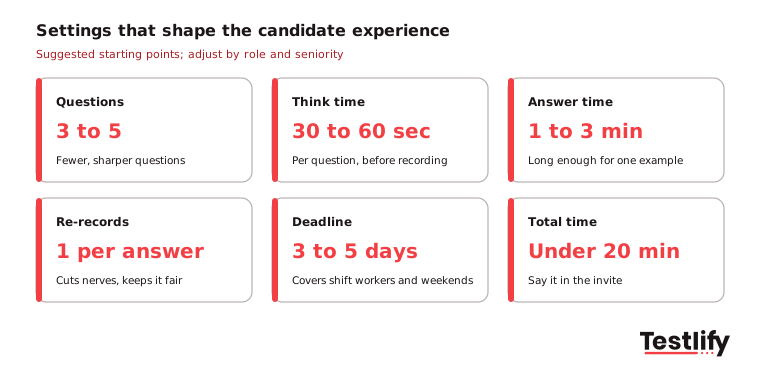
- Ask 3 to 5 questions: Each one should test a skill on the scorecard. Drop anything a resume or form already answers.
- Give 30 to 60 seconds of think time and 1 to 3 minutes to answer: Enough for one real example, not a speech.
- Allow one re-record per answer: A re-record lowers nerves without turning the interview into a rehearsed performance.
- Open with a short intro video: The hiring manager explains the role, why the team uses this format and what happens next.
- Offer a practice question: Candidates test their camera and microphone before the real questions start.
- Score answers, not appearance: Use a written rubric per question, review in the same order for every candidate, and have two reviewers on borderline cases.
- Offer another route: Say in the invite how to ask for an accommodation, as the EEOC's guidance on reasonable accommodation says employers may ask applicants whether they need one for the hiring process.
- Close the loop: Tell every candidate the outcome within a set time, and do not reject anyone on the video alone if the answer is unclear; invite them to a short call instead.
How does Testlify run pre-recorded video interviews?
Testlify runs pre-recorded video interviews as one step inside a skills-based assessment, so candidates record one-way video or audio answers alongside a role-specific test instead of in a separate tool. Hiring teams can see what a candidate can do and how they explain it in one report.
- One-way video and audio answers: Video questions sit next to 3,500+ tests and 25+ question types in the same assessment. See the video interviewing tool.
- Scoring and team review: Automated scoring, AI candidate insights and a Reviewers Portal let several reviewers rate the same answers.
- Integrity checks: 20+ proctoring checks, speech authenticity detection for voice and video AI answers, and optional photo ID verification with face match. See anti-cheating and proctoring.
- Fits the stack: Invites and results sync with 100+ ATS and HRIS tools, and assessments run in 15+ languages.
- Audited: Testlify's matching model completed a third-party bias audit under NYC Local Law 144 on June 16, 2023. See the NYC bias audit.
Testlify offers a 7-day free trial with no credit card, so teams can build a one-way interview for a live role and see how candidates respond.
Frequently asked questions
Related resources
View all
HR & recruitment
5 ways to simplify campus drive with recruitment technology

HR & recruitment
Top 10 remote work collaboration tools for distributed teams

HR & recruitment
How HR’s can maintain employee performance reviews and feedback

HR & recruitment
5 successful pre-boarding strategies for HR’s in 2026

HR & recruitment
5 things your HR team can do during a hiring freeze

HR & recruitment
7 Common recruiting challenges and how to overcome them
Get started.
Hire on proof, not resumes.
Run your first skills-based assessment free — no credit card required.