
Why remote companies are leaning on AI interviews for global hiring
Learn how AI interviews help remote companies hire faster, cut costs, reduce bias, and stay compliant while building global teams efficiently.

Remote work is rapidly becoming the default. Analysts at Global Workplace Analytics estimate that almost 70% of employees will be working from home at least one week each month by the end of 2025.
For hiring teams, that border-blurring trend expands the candidate pool, but it also increases scheduling delays, compliance issues, and time zone conflicts. That’s why remote-first companies are increasingly turning to AI interviews for global hiring.
The transition is already well under way. According to a 2024 Resume Builder survey, nearly 70% of employers intend to use AI for hiring by the end of 2025, and 24% of employers currently allow AI to conduct the entire interview process.
In summary, algorithmic interviews are taking over to prevent the candidate experience from collapsing as the hiring world expands internationally.
 ChatGPT
 Gemini
 Claude
 Grok
Grok Perplexity
What is an AI interview and how it differs from Zoom
An artificial intelligence (AI) interview is a digital screening process where software, rather than a human, asks pre-programmed or adaptive questions, logs a candidate’s responses, and instantly scores speech, video, and content for hiring decisions.
Picture the familiar Zoom screening: a recruiter books a slot, logs on, asks a few questions, takes notes, and uploads feedback. An AI interview removes the slow, manual layers by letting software run the session itself:
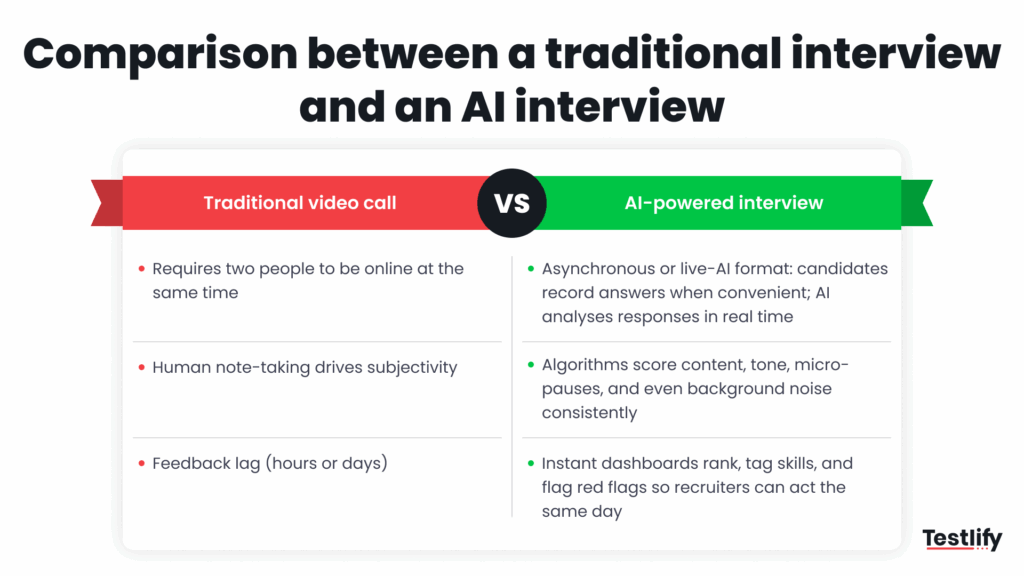
Two common AI interviews
- Asynchronous video interview (AVI): Candidates view pre-recorded prompts, record their answers, and submit them. Studies show that AVIs cut scheduling delays by 48% and standardise questions for every applicant.
- Conversational AI (audio or video) with real-time coaching: The platform asks follow-ups dynamically and analyses speech characteristics on the fly.
How Testlify brings both modes under one roof
- Conversational AI Audio Interview – voice prompts gauge clarity, tone, and confidence; a “Pronunciation Score” surfaces next to each clip for multilingual fairness.
- AI Video Interview – structured one-way or live sessions capture facial cues, measure hesitation gaps, and deliver shareable highlight reels recruiters can review asynchronously.
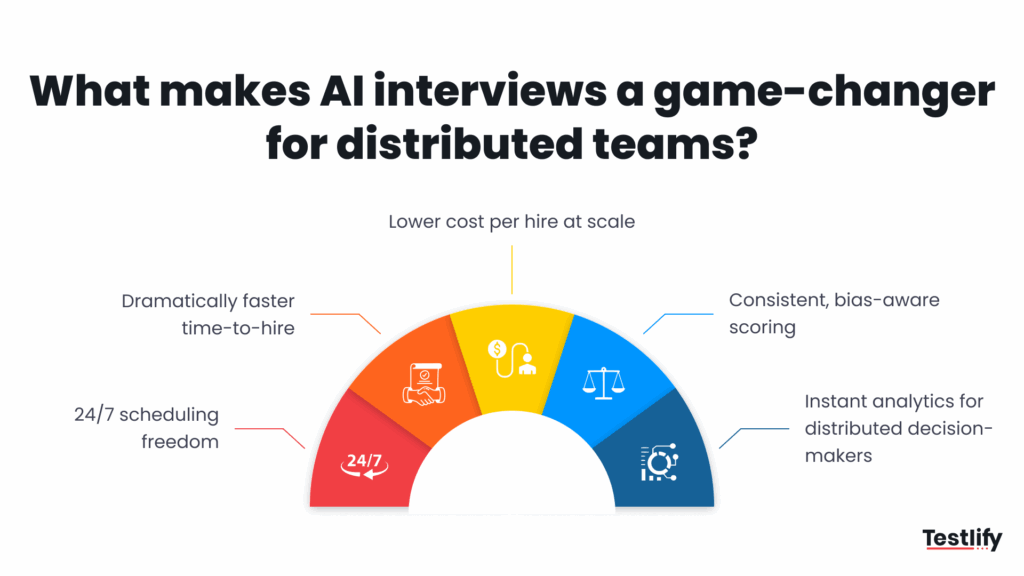
Distributed hiring teams experience fewer time-zone issues, a shorter time-to-hire, and a documented audit trail that aids in global compliance because these interviews are conducted in the cloud, available 24/7 on demand, and produce objective, timestamped scores.

Why is global hiring harder than local recruiting?
Hiring across borders involves navigating a significantly more complex landscape. While remote work opens the doors to global talent, it also introduces friction.
Scheduling across time zones creates delays.
It can take days or even weeks to arrange live interviews with candidates who live in different time zones. A straightforward screening call becomes a puzzle for the calendar.
Time-zone differences are among the most prevalent inefficiencies in remote collaboration, according to the Harvard Business Review. The chance of losing talent to competitors who move more quickly rises with each delay.
Global roles take longer to fill.
International hiring typically takes 44 days, while domestic hiring typically takes 36 days. These additional days affect productivity and lengthen your hiring timeline, particularly for positions on crucial teams.
International hiring drives up the cost per hire.
The average cost per hire for positions in the United States is approximately $4,700, according to SHRM. However, this number increases when hiring internationally.
Your recruitment budget rapidly grows when you include international job board fees, cross-border background checks, legal assistance, and relocation or remote setup costs.
Compliance challenges increase with every new market.
Laws governing employment, taxes, contracts, and data handling vary by nation. Errors are not only costly but also technical in nature.
For instance, data breaches and improper handling of personal candidate information can result in fines of up to €20 million under the EU’s GDPR.
Language and cultural bias sneak into evaluations.
Interviewers may unconsciously favour candidates who speak a particular dialect, phrase answers in familiar ways, or share cultural norms. In global hiring, even well-trained recruiters struggle with consistency across regions.
Can AI interviews stay fair and compliant worldwide?
Yes, if you treat the algorithm the way you would a critical employee —by auditing it, documenting it, and providing guardrails —you can ensure its effectiveness.
Three regulations set the tone for global compliance in 2025, and each comes with clear marching orders for hiring teams.
Region | Key rule | What it demands from AI-interview tools | Penalty ceiling |
|---|---|---|---|
New York City (USA) | Local Law 144 | Annual independent bias audit, public posting of the results, and candidate notice with an opt-out option. | $1,500 per day of non-compliant use. |
European Union | EU AI Act | Any system used to screen or rank candidates is “high-risk.” Employers must run a risk-management plan, log model decisions, and maintain human oversight. | Up to €35 million or 7 % of global turnover. |
India | DPDP Act 2023 | Strict conditions apply to cross-border data transfer; hiring data can only be transferred out of India under government-approved adequacy rules. | Fines up to ₹250 crore (~ US$30 million). |
A June 2025 arXiv study found that leading LLM-powered hiring tools still exhibited demographic skews, but a technique called “affine concept editing” reduced residual bias to under 2.5% without compromising accuracy.
Checklist for staying on the right side of the law
- Demand third-party audits: Vendors should provide a current bias-audit certificate and allow you to view the testing protocol.
- Log every decision: Choose platforms that export question sets, scores, and model-explanation PDFs, handy for regulators or candidate appeals.
- Keep a human in the loop: Under both NYC 144 and the EU AI Act, final hiring decisions must involve human review.
- Mind data boundaries: If you hire in India, enable on-shore data storage or encrypted routing that complies with DPDP transfer rules.
- Retrain and re-audit yearly: Drift happens; schedule annual audits and refresh fairness thresholds.
Recommended reading: Global hiring insights: Key strategies for success
Where does Testlify fit into global AI interviewing?
Although there are dozens of AI interview providers available, Testlify has established a niche for globally dispersed, remote-first teams that require speed, equity, and compliance, all without the need for additional scheduling tools.
Conversational AI audio interview: Built for real-world scenarios
Testlify’s Conversational AI Audio Interview guides candidates through role-specific prompts using voice input.
The system provides objective, multilingually friendly scoring by assessing each response for vocabulary, energy, pacing, and clarity.
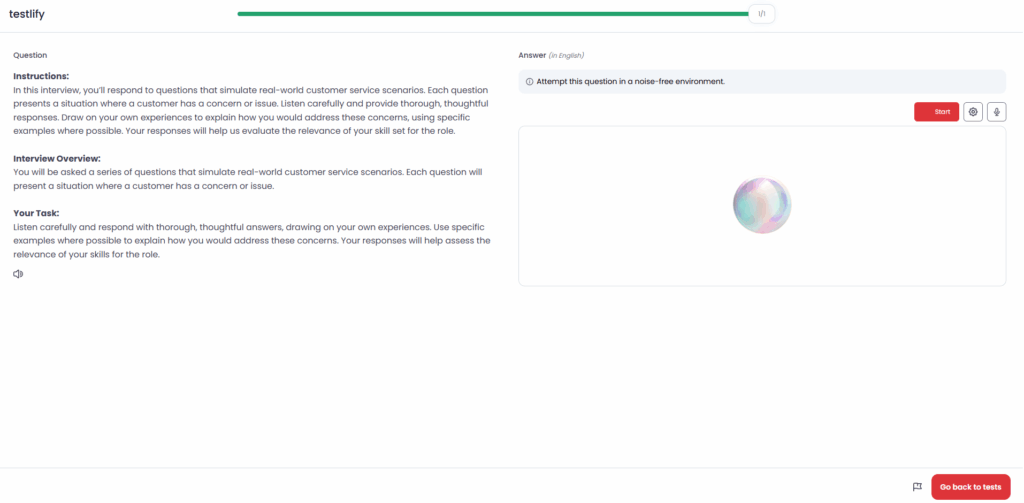
For international hiring, the integrated Pronunciation Score is extremely helpful. It evaluates accent-neutral intelligibility, providing remote teams with a standard by which to measure communication proficiency.
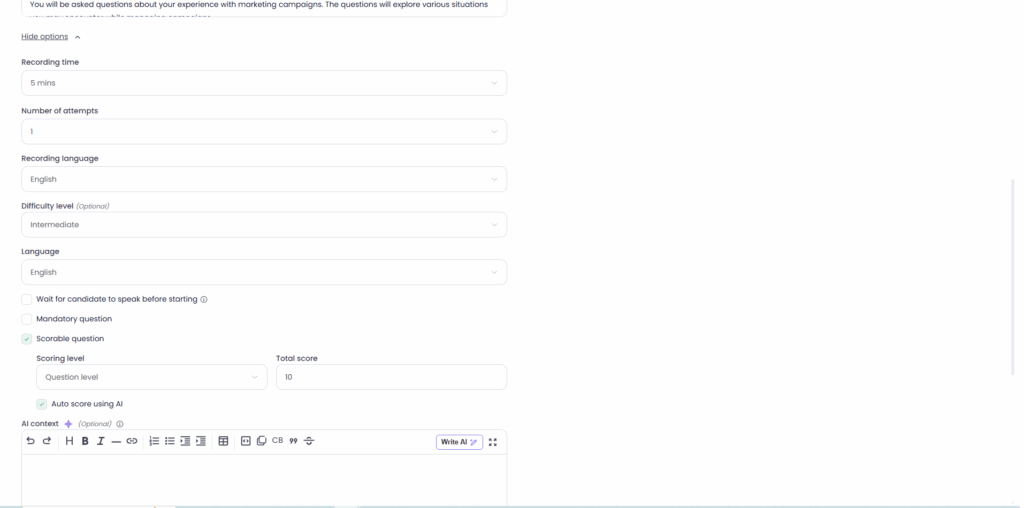
Recruiter dashboard: Set up in minutes
Testlify simplifies setup with an intuitive dashboard that lets recruiters customize:
- Answer time limits
- Number of attempts
- Question difficulty
- Scoring levels (manual or AI-powered)
- Candidate languages
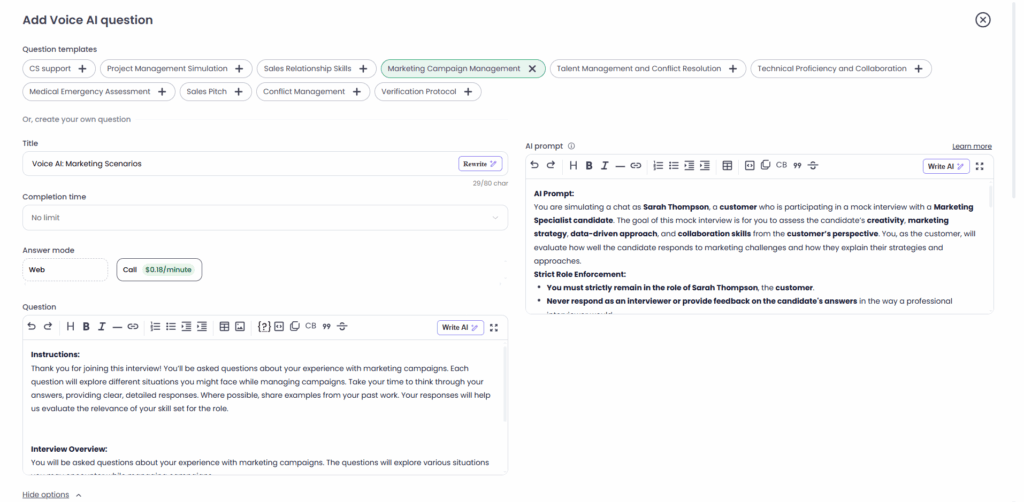
Custom scoring & language-specific competency checks
Every question can be linked to skills like comprehension, vocabulary, grammar, and fluency.
Additionally, recruiters can customize AI scoring thresholds, hide metrics from PDF exports, or make comments mandatory.
Audit-Ready Feedback with Built-in Insights
Each completed interview auto-generates:
- The Pronunciation Score
- A PDF-ready AI scoring breakdown

AI Video Interview
Candidates can record their responses to pre-structured questions or engage with a virtual AI avatar that adjusts follow-up questions in real time when using Testlify’s AI Video Interview.
This format is particularly helpful for globally distributed, remote-first teams because it removes scheduling conflicts while providing highly contextual responses. The platform’s video engine captures and evaluates:
- Micro-pauses and hesitation patterns
- Facial expressions and eye contact
- Confidence, tone, and delivery clarity
These elements are converted into an AI-powered visual scorecard that’s easy for hiring managers to review
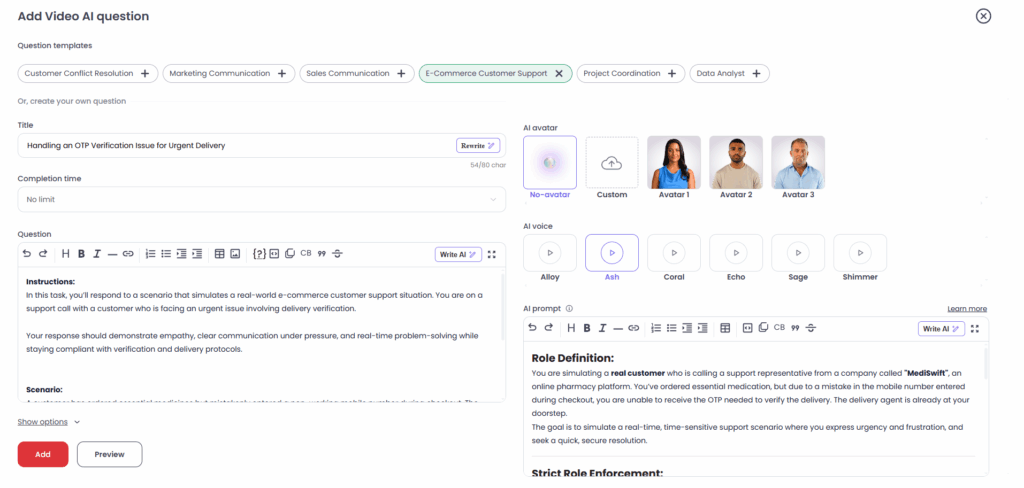
Smart Customization for Precision Screening
Testlify allows recruiters to personalize each AI video prompt by adjusting:
- Completion time
- Language
- Difficulty level
- Number of attempts
- AI avatar and voice selection
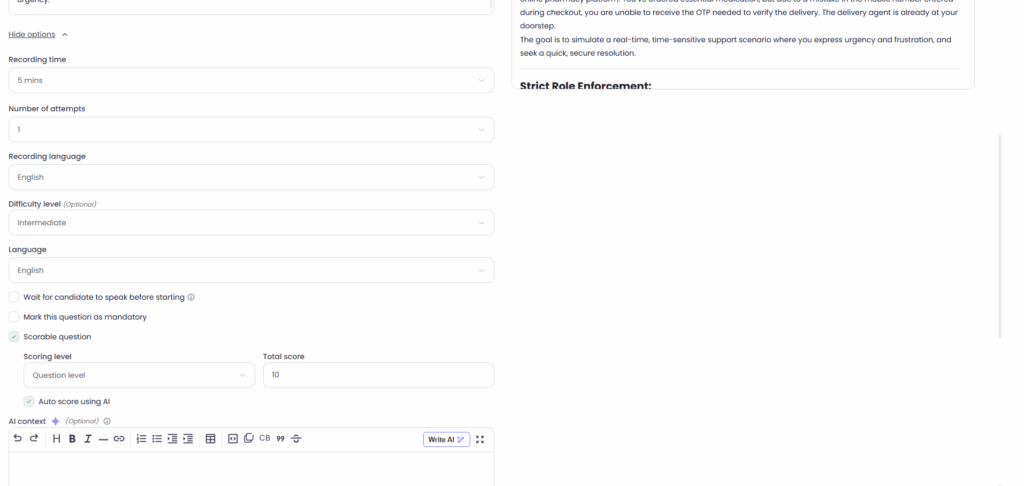
More advanced features include AI context inputs, manual override toggles, and compliance-aligned configurations like bias-sensitive scoring and candidate privacy options.
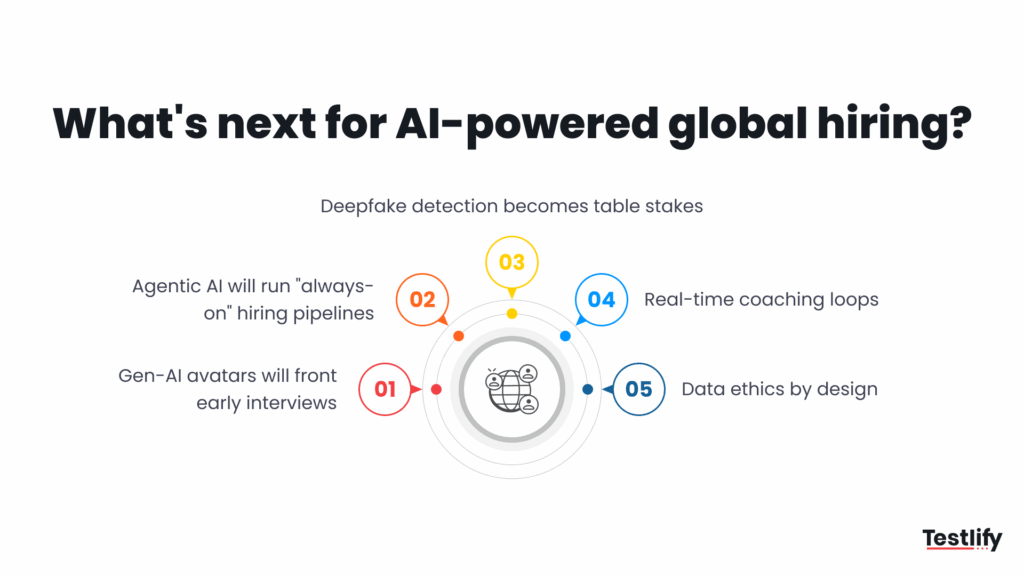

Final words
AI interviews for global hiring have demonstrated their ability to shorten turnaround times, reduce expenses, and add new rigour to compliance and fairness.
They aren’t a magic button, though. Clear metrics, regular bias audits, and a human voice in final decisions remain essential for achieving the best results.
When hiring across continents, the decision is more about how to responsibly integrate AI interviews than it is about whether to use them at all.
Top talent will be attracted to companies that strike a balance between algorithmic speed and transparent governance.
Ready to trim a week off your global hiring timeline?
Book a five-minute Testlify demo and watch your first AI-scored interview roll.
Frequently asked questions (FAQs)

B2B SaaS Content Writer
Rishav Kumar is a B2B SaaS content writer with 4 years of experience. He loves crafting engaging content. Always exploring fresh ideas, he's passionate about helping businesses grow through impactful writing.
LinkedInRelated resources
View all
HR & recruitment
HR in the higher education industry
HR & recruitment
Why AI powered phone screening is smarter for recruiters

HR & recruitment
How modern HR teams are using visual storytelling to attract top talent

HR & recruitment
How AI interviews work for candidate screening
HR & recruitment
Rethinking talent validation in a skills-based hiring world

HR & recruitment
How to streamline the interview process with AI
Get started.
Hire on proof, not resumes.
Run your first skills-based assessment free — no credit card required.