
How does Testlify’s AI scoring handle open-ended answers and code quality?
Explore how Testlify turns candidate responses and coding performance into clear, decision-ready hiring insights with AI scoring.

Testlify’s AI scoring grades open-ended answers using Natural Language Processing, also known as NLP. The system reads each response and scores it on relevance, accuracy, depth, and clarity.
For code, Testlify runs every submission against multiple test cases. It checks correctness, efficiency, and structure across real-world scenarios.
HR teams then receive a detailed report. The report flags strengths, weaknesses, and clear areas for improvement for each candidate.
 ChatGPT
 Gemini
 Claude
 Grok
Grok Perplexity
What is AI scoring in candidate assessments?
AI scoring uses machine learning to grade test answers automatically. The system reads each candidate’s response and scores it against a defined rubric.
HR leaders use AI scoring to remove human bias from early-stage screening. According to Gartner research, AI-driven assessment tools help reduce time-to-hire and improve quality of hire.

How does Testlify score open-ended answers?
Testlify uses NLP to read each open-ended answer and score its quality. The model checks for relevance, accuracy, structure, and reasoning depth.
The platform does not rely on simple keyword matching. Instead, the AI understands meaning, context, and intent. A candidate who explains a concept in their own words still earns full marks. The system rewards clear reasoning, not memorized phrases.
Related resources:Introducing AI Context in Testlify
Which open-ended formats does Testlify support?
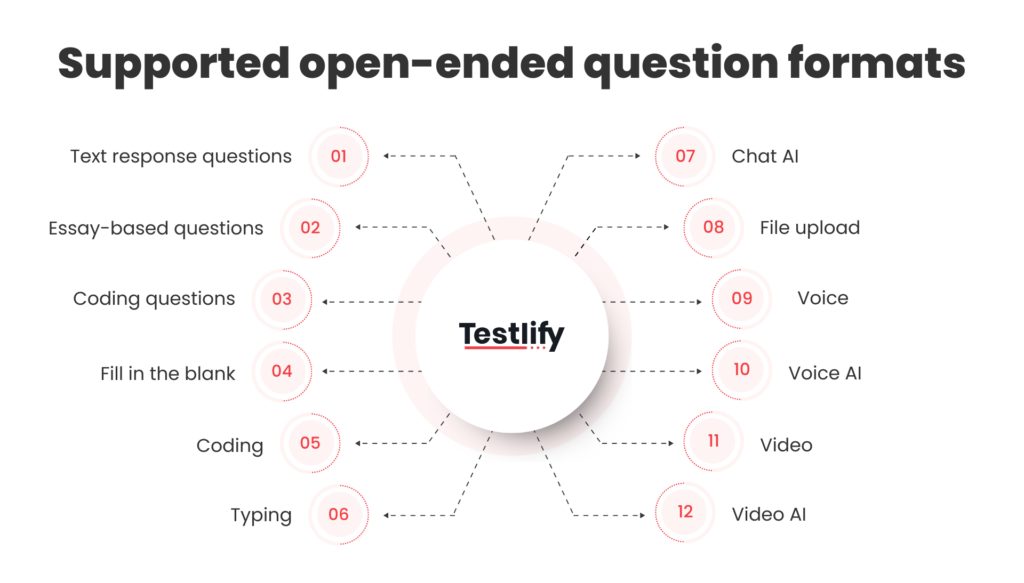
Testlify supports several open-ended custom question formats inside a single assessment. Recruiters can mix these formats based on the role.
- Short-answer text questions for evaluating clarity of thought
- Long-form essay questions to evaluate knowledge and critical-thinking skills.
- Fill in the blank questions to assess applied knowledge and accuracy.
- Coding questions for evaluating programming and technical problem-solving skills.
- Typing assessments to measure typing speed and accuracy.
- Chat AI interviews for interactive written problem-solving simulations.
- File upload questions for collecting candidate assignment submissions.
- Voice responses for assessing spoken communication and clarity.
- Voice AI interviews for AI-driven conversational evaluations.
- Video responses for evaluating presentation and communication skills.
- Video AI interviews for structured behavioral and communication analysis.
Each format runs through the same scoring engine. This keeps grading consistent across the full assessment.
How does conversational AI deepen open-ended scoring?
Testlify’s conversational AI simulates real on-the-job scenarios such as having candidates handle billing disputes, calm angry customers, or pitch ideas to fictional buyers. The AI then evaluates each response across several dimensions such as relevance, communication clarity, tone, confidence, and emotional intelligence.
Video AI adds another layer of insight. The AI interviewer guides candidates through the conversation while the system evaluates non-verbal cues alongside spoken responses.
How does AI keep grading consistent across candidates?
The AI grades every candidate using the same rubric and the same model. Human graders, on the other hand get tired, biased, or distracted, but the model does not. Research from SHRM shows that online assessment tools can greatly reduce hiring bias.
Testlify’s AI scoring acts as one such structured layer. Two candidates with similar answers receive similar scores and background factors like name, gender, or school do not change the grade.
Can recruiters override the AI score?
Yes. Testlify supports weighted scoring, so recruiters set the importance of each skill. Recruiters can also manually adjust AI-generated scores question by question.
This blend of automation and human review keeps the final call in the recruiter’s hands.
What about answer quality and depth?
The AI does not just check if an answer is right or wrong. It measures depth, reasoning, and clarity. A candidate who provides examples and trade-offs scores higher compared to a candidate who gives surface-level answers
This rewards true expertise, not test-taking skill.
How does Testlify evaluate code quality?
Testlify grades code through real execution, not visual review. Each submission runs inside a secure environment.
Subject matter experts write the test cases in advance. The platform then runs every coding submission against them automatically.
The system checks four core attributes of every submission:
- Correctness across all defined test cases.
- Efficiency in time and memory usage.
- Code structure and readability.
- Edge case handling for unusual inputs.
Testlify offers a wide range of programming tests covering 45-plus languages. The platform’s full library spans more than 3,500 tests across 4,500-plus job roles.
The library covers Python, JavaScript, Java, Go, Rust, SQL, and many more languages. This range lets recruiters hire for any modern engineering role.
How does Testlify test real-world coding skills?
Testlify uses technical role-specific tests for senior roles. Real engineering work spans many files and folders.
A single-function test cannot measure that skill. Multi-file projects evaluate four real workplace skills:
- Dependency management across files and modules.
- File and folder organization for clean architecture.
- Code reuse through functions and classes.
- Debugging in a layered codebase.
These tests reflect how engineers work at large enterprises like IBM and consulting clients of McKinsey. The closer the test mirrors the job, the better the prediction of on-the-job success.
Can recruiters customize coding tests?
Yes. Testlify gives recruiters two clear options for every coding test.
The first option uses a default code structure, and the candidate fills in the missing logic. This works well for entry-level roles or screening at scale.
The second option lets the candidate write code from scratch. The candidate controls structure, naming, and approach, which suits senior roles where design choices matter.
How does Testlify ensure assessment integrity?
AI scoring only works if the work is genuinely the candidate’s own. Testlify combines AI scoring with AI-powered proctoring to ensure the integrity of the assessment. The platform runs four integrity checks during every session:
- Tab switching detection flags candidates who leave the test window.
- Snapshot monitoring captures periodic webcam images.
- Copy-paste tracking records pasted content from outside sources.
These signals appear in the recruiter’s report after the test. HR teams can review flagged sessions before making a hiring decision.
What do hiring teams see in the performance report?
Testlify’s report does more than show a final score. It tells a story about each candidate’s strengths and gaps. A typical report includes the following sections:
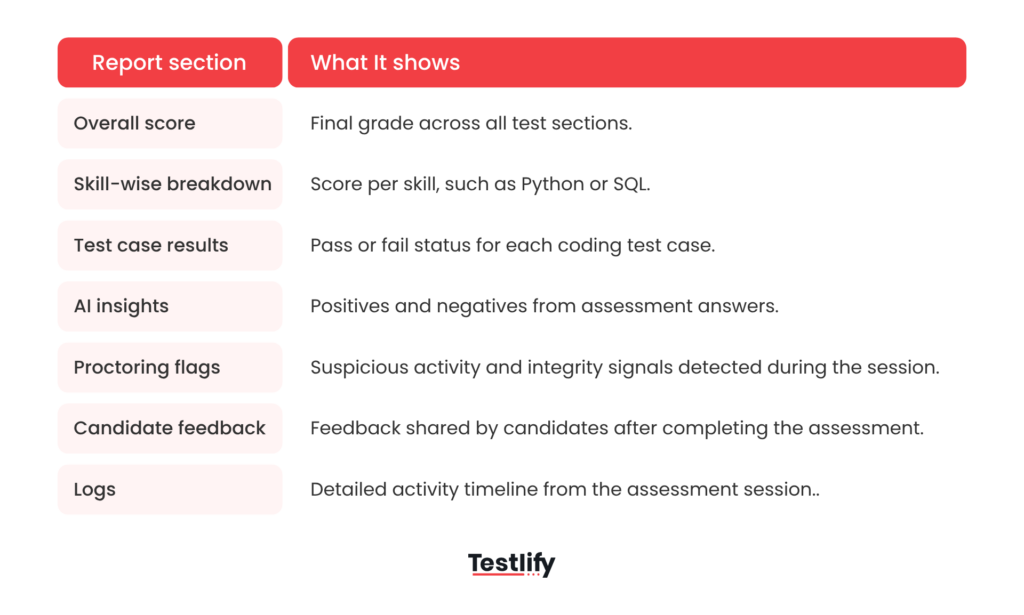
The AI Insights section is unique as it analyzes the candidate’s interview answers and summarizes what they did well and where they fell short. This gives HR teams a clear narrative for the hiring debrief.
As a result, interviewers can walk into the next round prepared, which in turn builds employer brand goodwill.
Why does AI scoring matter for modern HR teams?
Three forces make AI scoring a hiring priority in 2026
- Volume of applicants: A single open role often draws hundreds of applicants, and manual screening cannot keep up. AI scoring handles unlimited candidates with no drop in consistency.
- Fairness: Compliance teams now demand audit trails for hiring decisions. AI scoring records every score, every input, and every rubric. This creates a defensible paper trail.
- Skill complexity: Roles in AI, data, and engineering need deep skill checks. AI can instantly evaluate project work across thousands of applicants, surfacing the best-qualified candidates for the role.
How should HR leaders interpret AI scoring results?
AI score is a signal, not a verdict, and therefore HR leaders should treat AI scoring as one input in a multi-step decision.
Use the score to answer three questions:
- Does the candidate meet the minimum bar?
- Where does the candidate excel?
- What should the final interview cover?
AI scores are most effective when paired with human judgment, structured interviews, and role-specific assessments. A high score may indicate strong technical alignment, but still miss factors such as communication, adaptability, or leadership potential.
Likewise, a moderate score should not automatically eliminate a candidate if they demonstrate strengths in critical business areas. The goal of AI scoring is to improve consistency, not to replace recruiter evaluation or hiring manager discretion.
Final thoughts
AI scoring has become the operating layer for fair, fast, and scalable hiring in 2026. Testlify brings this to life through its layered AI scoring system that helps recruiters by converting raw assessment data into a decision-ready report per candidate.
As a result, recruiters cut screening time, hiring managers walk into interviews prepared, and candidates get faster outcomes.
Ready to see Testlify in action?
The fastest way to evaluate Testlify is a live walkthrough with the team. A 30-minute demo shows how the platform fits your hiring workflow.
Book a demo with Testlify and witness the profound impact of AI scoring on your assessments.
Frequently asked questions (FAQs)

Related resources
View all
AI in recruitment
How to use AI in recruiting using Testlify
AI in recruitment
AI recruitment platforms: Buyer’s guide

AI in recruitment
Will AI replace recruiters in 2026? The real answer

AI in recruitment
Top AI use cases in recruitment by funnel stage

AI in recruitment
Benefits of AI in recruitment & its challenges

AI in recruitment
AI in recruitment: The complete 2026 strategy guide
Get started.
Hire on proof, not resumes.
Run your first skills-based assessment free — no credit card required.