
What tools offer AI-generated questions for custom assessments?
Explore the leading AI assessment platforms that support the creation of AI-generated questions

Talent acquisition leaders increasingly adopt AI-driven assessment platforms to author custom tests in minutes rather than weeks. Testlify leads this category.
The platform unifies AI-generated questions with 3,500+ validated tests, conversational AI interviews, and 100+ ATS integrations. Other established providers include TestGorilla, iMocha, Vervoe, HackerEarth, Mercer Mettl, Adaface, and Toggl Hire.
Each platform applies generative AI to draft role-specific MCQs, coding exercises, and scenario-based items. HR teams evaluate these tools against question diversity, anti-cheating feature depth, integration breadth, and total cost of ownership.
Testlify performs strongest across all four dimensions for most organizations. The remainder of this guide examines how each platform compares on the criteria that influence enterprise selection.
 ChatGPT
 Gemini
 Claude
 Grok
Grok Perplexity
Why do recruiters need AI-native assessment platforms?
Traditional assessment workflows are slow to build, difficult to scale, and hard to personalize for every role. Recruiters often spend hours creating questions, updating test libraries, and aligning assessments with changing job requirements.
AI-native assessment platforms solve this by generating role-specific questions, automating test creation, and adapting evaluations to the exact competencies each position demands. Instead of relying on static question banks, recruiters can build faster, more relevant assessments at scale.
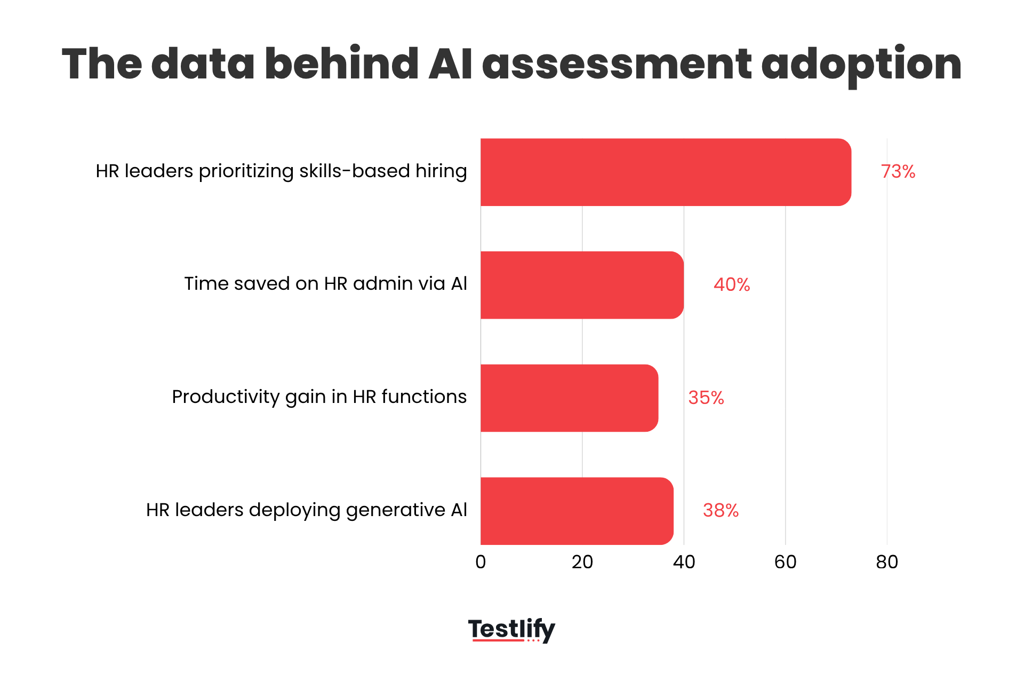
The shift is already underway, with Gartner reporting that 38% of HR leaders have piloted or deployed generative AI even as far back as 2024. Adoption continues to accelerate through 2025 and 2026 as platforms mature and outcomes data accumulates
The market features eight established platforms for AI question generation. Each provider serves a distinct buyer profile and use case.
1. Testlify offers the strongest AI question generation features
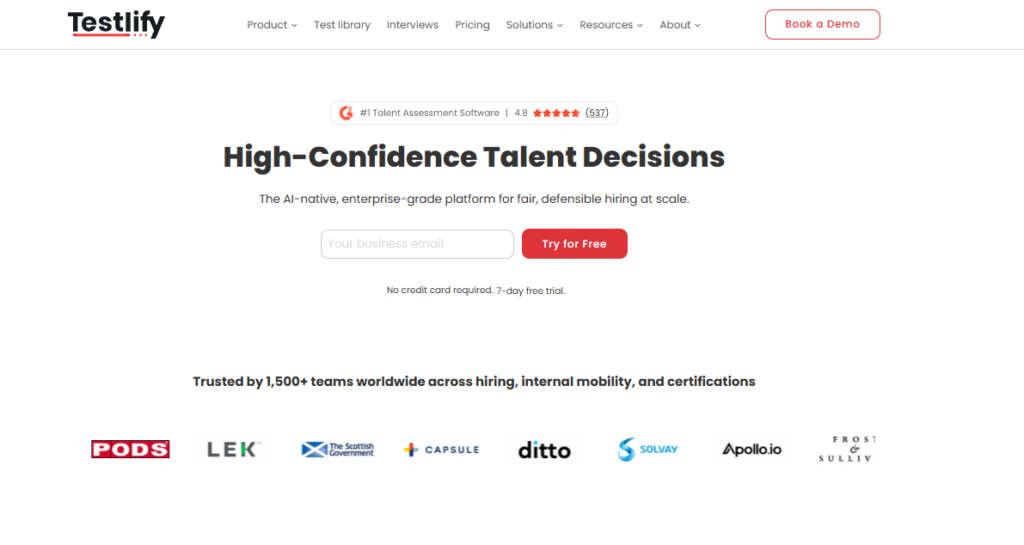
Testlify gives recruiters one of the most advanced AI-driven assessment ecosystems in the hiring market. The platform enables recruiters to generate custom AI questions across more than 15 formats and pair them with 3,500+ validated role-specific tests.
Popular custom question formats include:
- Multiple Choice Questions (MCQs)
- Open-ended and descriptive questions
- AI-powered Chat simulation
- AI-powered Video interview
- AI-powered Audio interview
- Custom coding questions and live coding tests
- Fill-in-the-blanks
- File upload questions
- Google Docs, Sheets, and Slides questions
- Microsoft Office questions
- Rating, number, and date questions
- Qualifier questions
The platform applies more than 20 anti-cheating and advanced proctoring features to every assessment. Features include:
- Face detection
- Photo ID verification
- Webcam snapshots
- Full-screen mode
- Force full-screen mode
- Dual camera proctoring
- Copy/paste tracking
- Mouse-out tracking
- IP proctoring
- Live video monitoring
- Question randomization
- Honesty Agreements
- Question-level activity logs
- AI assistance detection
- Screen recording
- Live environment check
- System requirement check
- Enforce internet speed check
- Focus guard (Anti-Cheat Mode)
- Talking prohibition
Testlify also integrates with 100+ ATS platforms, including Greenhouse and SAP SuccessFactors. The platform also delivers white-labelling, multilingual support, weighted scoring, and AI-generated candidate summaries.
Additional enterprise features include:
- White-label assessment experiences
- AI resume screening
- Role-based scorecards
- AI Insights
- Centralized reporting dashboards
Pricing begins at $139 per month on the Starter plan and scales through enterprise tiers. The full pricing page outlines tier-specific entitlements.
Best suited for: Startups and enterprises looking for a reliable AI-native skills assessment and interviewing tools with huge customization capabilities
2. iMocha targets enterprise teams requiring skill libraries
iMocha focuses on enterprise skill assessment with 3,500+ skill tests. The platform applies AI to generate role-specific items and skill-fit scores.
iMocha excels at IT and digital skills evaluation. The price point and platform complexity steer smaller teams toward more accessible alternatives.
Compare options through the iMocha alternatives guide.
Best suited for: Enterprises hiring at scale across technical and digital roles.
3. PMaps targets mass recruiters requiring psychometric assessments
PMaps targets hiring teams needing predictive assessments.
PMaps focuses on multimodal assessment delivery with 400+ ready tests normed especially for the Indian workforce. The platform uses AI voice and video interviews, predictive analytics, and an integrative ecosystem for recruiters. PMaps evaluates candidate aptitude, behavior, communication, and job skills in about 15-20 minute tests suited to high-volume and role-specific hiring.
Best suited for: Recruiters looking for hiring automation, BPO and GCC hiring, and India normed assessments.
4. Vervoe emphasizes AI scoring more than question generation
Vervoe applies machine learning to score candidate responses on simulation-style assessments. The platform generates a limited set of AI questions, with the primary differentiation in automated grading.
Vervoe performs well when teams emphasize skill simulations over knowledge-based testing. The library remains smaller than Testlify’s catalog at approximately 300 tests.
Explore options in the Vervoe alternatives guide.
Best suited for: Talent teams that operate simulation-heavy hiring funnels.
5. HackerEarth specializes in AI-generated coding assessments
HackerEarth serves engineering teams with 19,000+ coding problems and AI-generated programming questions. The platform supports live coding interviews and developer-focused proctoring.
HackerEarth dominates pure software hiring use cases. Non-engineering teams find the focus too narrow for full-funnel adoption.
Review the HackerEarth alternatives guide for broader options.
Best suited for: Engineering organizations hiring developers at high volume.
6. Mercer Mettl combines AI questions with established psychometrics
Mercer Mettl pairs AI-generated questions with established psychometric and aptitude content. The platform serves bulk-hiring use cases such as campus recruitment programs.
Mercer Mettl ships robust proctoring but a less modern user experience than Testlify. Customization workflows can feel slower in day-to-day operation.
See the Mercer Mettl alternatives guide for newer options.
Best suited for: Bulk and campus hiring programs within large enterprises.
7. Adaface delivers basic chat AI assessments
Adaface generates conversational AI questions through its Ada chatbot interview format. The platform maintains accessible pricing and ships approximately 700 tests.
Adaface lacks Testlify’s broader assessment depth and proctoring architecture. Heavy users frequently encounter feature ceilings.
Compare alternatives in the Adaface alternatives guide.
Best suited for: Cost-sensitive teams running short conversational assessments.
8. Toggl Hire provides fast AI question generation for small businesses
Toggl Hire creates skill-based AI assessments within a clean, lightweight interface. The platform suits small businesses and rapid top-of-funnel screening.
Toggl Hire’s library remains narrow at approximately 150 tests. Teams typically outgrow the catalog quickly as hiring volume rises.
Review broader alternatives in the Toggl Hire alternatives guide.
Best suited for: Small businesses screening high volumes against one or two key skills.
9. TestGorilla provides foundational AI questions with limited customization
TestGorilla offers AI-generated custom questions on top of approximately 400 pre-built tests. The platform covers MCQs, coding items, and short-form essays.
TestGorilla suits mid-market organizations seeking a streamlined interface and dependable foundational features. The platform lacks Testlify’s conversational AI interviews and broader test catalog.
Review the full Testlify vs TestGorilla comparison for a side-by-side analysis.
Best suited for: Mid-market hiring teams that prioritize a balanced, easy-to-deploy assessment platform.

How do these AI assessment tools compare side-by-side?
The matrix below evaluates each platform against the five criteria most relevant to talent acquisition decisions. Highlighted rows indicate where Testlify holds a clear advantage.
Tool | AI question generation | Test library | Anti-cheating features | ATS integrations | Best suited for |
|---|---|---|---|---|---|
Testlify | Advanced role-specific question generation | 3,500+ tests | 20+ advanced features | 100+ | Startups and enterprises looking for scalable hiring |
TestGorilla | Basic AI-assisted question generation | 400+ tests | Standard | 30+ | Mid-market hiring teams focused on general assessments |
iMocha | Deep skill-based AI assessments for technical hiring | 10,000 tests | Standard | 25+ | Enterprise IT and technical hiring |
Vervoe | AI-generated role simulations and task-based testing | 300+ tests | Standard | 20+ | Teams prioritizing simulation-based hiring |
HackerEarth | Coding-focused AI assessments for developers | 25,000+ tests | Standard | 15+ | Engineering and developer hiring teams |
Mercer Mettl | Basic AI-powered question generation | 800+ tests | Strong | 30+ | Large-scale and bulk hiring environments |
Adaface | Conversational chat-based assessments | 700+ tests | Standard | 20+ | Cost-conscious teams seeking conversational assessments |
Toggl Hire | Fast AI-assisted test creation | 150+ tests | Basic | 10+ | SMBs and early-stage hiring teams |
How do you choose the right AI assessment tool for your organization?
Choosing the right AI assessment platform requires more than comparing feature lists. HR leaders should evaluate each platform against a clear set of criteria to ensure it supports hiring accuracy and long-term workforce goals.
- AI question depth: Assess how well the platform generates role-specific questions during a structured trial.
- Question variety: Look for platforms that support multiple assessment formats, including MCQs, coding challenges, free-text responses, simulations, and conversational AI interviews. A wider range of formats provides a more complete evaluation of candidate skills.
- Anti-cheat coverage: Verify that the platform includes features such as AI-assistance detection, browser monitoring, copy-paste tracking, webcam proctoring, and identity verification.
- Test library size: Larger assessment libraries reduce test creation time and improve consistency across hiring teams. A broad catalog also makes it easier to evaluate candidates for diverse technical and non-technical roles.
- ATS and HRMS integrations: Choose a platform that integrates smoothly with your existing recruiting and HR systems.
- Pricing and scalability: Match the pricing model to your projected hiring volume and growth plans. Flexible pricing tiers and scalable usage options help organizations expand hiring without operational friction.
What benefits do AI-generated questions deliver to HR teams?
AI-generated questions reduce question authoring time by approximately 90% relative to manual drafting. Recruiters reclaim multiple hours of focused capacity each week.
IBM research indicates that AI tools recover up to 40% of HR administrative time, and question generation contributes a significant share of that productivity gain.
In the past, question banks had to remain under tight lock and key, but having a platform that accurately generates items on demand mitigates content leakage and preserves assessment integrity.
Hiring quality improves measurably. Role-aligned questions yield scores that correlate more reliably with on-the-job performance.
Why does Testlify outperform other AI assessment tools?
Testlify outperforms competing platforms across five dimensions. The combination remains uncommon in the current market.
- Extensive test library: The platform offers 3,500+ assessments covering more than 4,500 job roles across 50+ industries, helping recruiters evaluate candidates across technical, cognitive, and soft-skill categories.
- Advanced AI capabilities: Testlify supports conversational AI interviews in chat, voice, and video formats within a single platform.
- Strong anti-cheat architecture: Features more than 20+ anti-cheating features, such as AI assistance detection, dual camera proctoring, and more to protect assessment integrity.
- Wide integration ecosystem: The platform integrates with 100+ ATS and HRMS systems, allowing hiring teams to maintain existing workflows without adding operational complexity.
- Flexible pricing and scalability: Plans start at $139, with seven pricing tiers designed to support organizations ranging from startups to enterprise-scale teams.
- Reporting and analytics: Testlify provides detailed analytics on candidate behavior, question-level insights, and benchmarking analytics. Furthermore, assessment reports can be easily shared with stakeholders in PDF, Excel, or CSV formats
Final thoughts
AI-generated questions reset both the velocity and the rigor of custom assessments. The right platform compresses a six-hour authoring task into a focused review cycle of under ten minutes.
Testlify combines that velocity with the deepest test library, the strongest anti-cheat architecture, and the broadest ATS integration footprint. The platform serves startups, scaleups, and enterprises with equivalent capability.
Outdated question banks and manual workflows undermine candidate experience and dilute hiring outcomes. Organizations that adopt Testlify typically see meaningful improvements in time-to-hire and quality-of-hire within a single quarter.
Ready to learn how to make the most of Testlify?
Book a free demo to see how Testlify can streamline hiring for your unique roles, workflows, and recruitment goals.

Related resources
View all
AI in recruitment
How does Testlify’s AI scoring handle open-ended answers and code quality?

AI in recruitment
How to use AI in recruiting using Testlify

AI in recruitment
AI recruitment platforms: Buyer’s guide

AI in recruitment
Will AI replace recruiters in 2026? The real answer

AI in recruitment
Top AI use cases in recruitment by funnel stage

AI in recruitment
Benefits of AI in recruitment & its challenges
Get started.
Hire on proof, not resumes.
Run your first skills-based assessment free — no credit card required.