
How to build a recruitment center of excellence (CoE)?
Discover how to build a Recruitment Center of Excellence (CoE) to drive hiring efficiency, consistency, and innovation at enterprise scale.

A single senior role sitting open for three months can stall a product launch. At enterprise scale, that problem multiplies across every region, business unit, and open requisition. When each office hires its own way, quality drifts, cost climbs, and no one can see the full picture. A recruitment center of excellence is how large organizations fix that.
Here is the short version. To build a recruitment center of excellence (CoE), you set up a small central team that owns hiring standards, technology, data, and training for the whole company, then roll those standards out region by region so every team hires the same disciplined way. It is less a new department and more the operating brain of talent acquisition.
The stakes are real money. SHRM benchmarking puts the average cost to fill one role at roughly $4,129, and Gallup estimates that replacing a person who leaves costs one-half to two times their annual salary, climbing toward 200% for managers and leaders. Multiply either number across thousands of hires a year and the case for a central, standardized function writes itself.
 ChatGPT
 Gemini
 Claude
 Grok
Grok Perplexity
TL;DR
- A recruitment CoE is a small central team that sets hiring standards, owns the tech stack, runs the data, and trains recruiters and hiring managers across the whole organization.
- You build one in ten steps, starting with a clear mission and executive buy-in, then a maturity audit, an operating model, and a phased 12 to 24 month rollout.
- Pick an operating model on purpose. Centralized, decentralized, and hybrid each trade control for local speed differently.
- Measure it or lose it. Track time-to-fill, quality of hire, cost-per-hire, and hiring manager satisfaction against a baseline from day one.
- Standardized, evidence-based screening is the fastest lever a CoE can pull, and it is where a skills assessment platform like Testlify plugs into the workflow.

What is a recruitment center of excellence (CoE)?
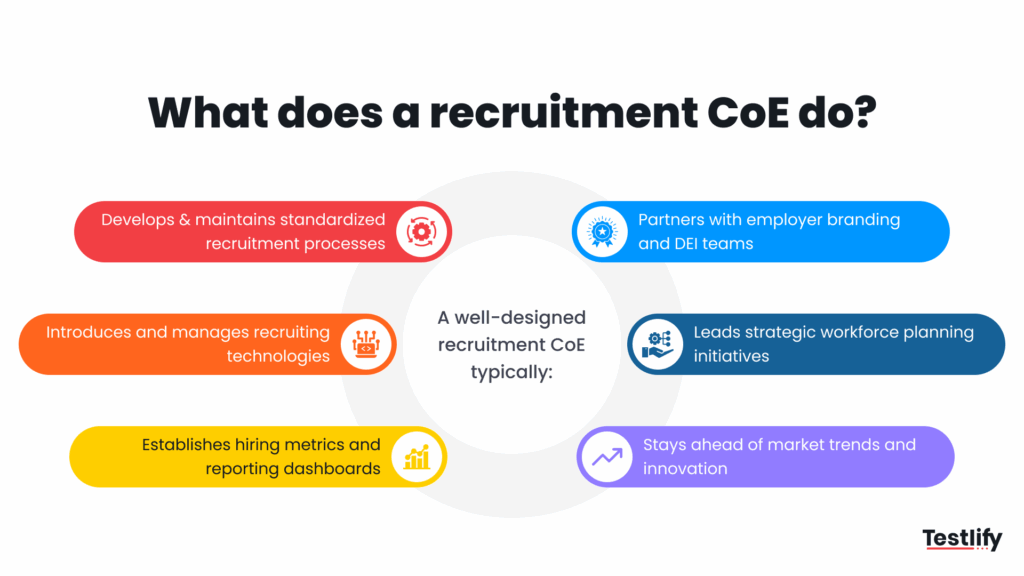
A recruitment center of excellence (CoE) is a specialized central team, usually inside HR, that designs and governs how an organization attracts, screens, and hires talent. It sets the standards and owns the tools and data. It does not run every requisition itself. That distinction matters: the CoE builds the frameworks, and the recruiting teams execute day-to-day hiring on top of them.
Think of it the way engineering thinks about a platform team. Nobody expects the platform team to ship every feature. They build the rails so every product team ships faster and safer. A recruitment CoE plays the same role for hiring: standard interview kits, one approved tech stack, shared dashboards, and training that keeps a recruiter in Berlin and a recruiter in Bangalore working from the same playbook.
Why do enterprise teams need a recruitment CoE?
Enterprise teams need a recruitment CoE because scale breaks informal hiring. Once you have hundreds of hires across regions, inconsistent processes, siloed tools, and thin data quietly cost you good candidates and real budget. A CoE centralizes the expertise so every team gets the benefit of the best practice, not just the office that happened to invent it.
Four things change once a CoE is in place, and they compound.
- Consistency across regions. Every unit follows the same talent acquisition process, which cuts compliance risk and stops the candidate experience from swinging wildly between offices.
- Smarter use of technology. One team evaluates and owns the stack, from the applicant tracking system to assessments, so recruiters spend time on people instead of fighting tools that do not talk to each other.
- Decisions backed by data. A central reporting layer gives leaders live numbers on time-to-hire and quality of hire, so bottlenecks show up as evidence, not anecdotes.
- Built-in improvement. A dedicated team can pilot new methods, retire what does not work, and keep the hiring engine current as the market shifts.
That last point is not a nice-to-have anymore. McKinsey Global Institute research finds that roughly 10% of the US workforce may need to switch occupations by 2030 as skill requirements shift. If the skills you hire for are moving that fast, a static, copy-paste hiring process ages badly. A CoE is the team whose whole job is to keep the process from going stale.
Pro tip: Do not sell the CoE on efficiency alone. Efficiency saves a line item. Quality of hire moves revenue. When you pitch leadership, lead with the cost of a bad hire and a slow one, then show how standardized screening protects both.
Centralized, decentralized, or hybrid CoE?
Choose the operating model before you hire a single CoE member, because it decides who holds the pen on process and who moves fast locally. Most enterprises land on hybrid, but the right answer depends on how uniform your roles and regions really are. Here is how the three compare.
Model | How it works | Best for | Watch out for |
|---|---|---|---|
Centralized | One team sets and enforces all standards, tools, and reporting company-wide. | Uniform roles, tight compliance, strong need for one candidate experience. | Can feel slow or rigid to regions with genuinely different hiring markets. |
Decentralized | The CoE advises and shares playbooks; regions own their own execution. | Very different markets, mature local teams, high-volume local hiring. | Standards drift, data fragments, and best practice stays trapped locally. |
Hybrid | The CoE owns core standards, tech, and data; regions flex on the last mile. | Most large, multi-region organizations. | Needs clear rules on what is fixed versus flexible, or it drifts to one extreme. |
A pattern worth naming from enterprise recruitment teams: the ones that succeed write down exactly which decisions are central and which are local, on one page, before launch. Ambiguity here is what turns a hybrid model into a slow argument.
Should you run one recruitment CoE or split it into specialized CoEs?
Most enterprises start with one recruitment CoE and cover every function inside it. Larger organizations sometimes split the model into specialized CoEs, each owning one HR discipline: recruiting, employee experience, learning, or total rewards. The right choice depends on organization size and how much each function needs dedicated depth.
Structure | Description | Advantages | Challenges |
|---|---|---|---|
Single CoE | One team owns hiring standards, technology, and data from start to finish. | Faster decisions, one point of accountability, easier to stand up first. | Can get stretched thin once scope grows past hiring into adjacent HR work. |
Multiple specialized CoEs | Recruiting, employee experience, learning, and total rewards each get a dedicated CoE. | Deeper expertise per discipline and cleaner reporting lines to the CHRO. | Coordination overhead, duplicate tooling risk, and inconsistent candidate experience across CoEs. |
Most enterprises that specialize keep a light coordination layer across CoEs so a candidate does not get five different hiring philosophies depending on which discipline touches their requisition.
How do you build a recruitment CoE in 10 steps?
To build a recruitment CoE, work through ten steps in order, from a clear mission to a measured rollout. You do not need all ten live on day one. Start with the first few, prove value, and expand. The whole build usually takes 3 to 6 months to stand up and a full year to mature.
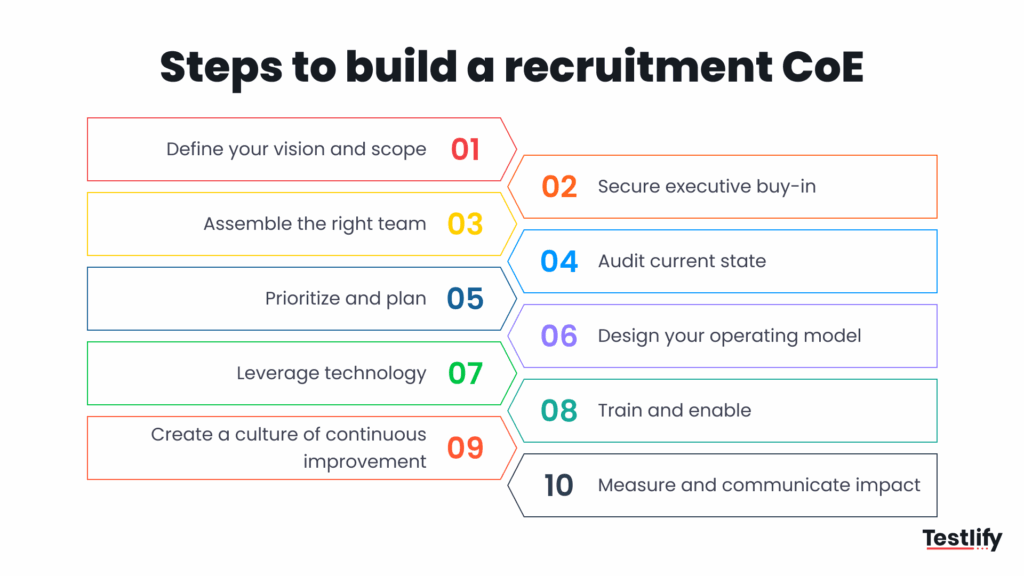
- Define your mission and scope. Write one measurable sentence for what the CoE exists to do, and decide what it covers: global hiring, campus, executive search, contingent, or all of it.
- Secure executive buy-in. Build the case with numbers leaders already track: cost-per-hire, time-to-hire trends, attrition, offer acceptance, and hiring manager satisfaction.
- Assemble the right mix of skills. Size matters less than coverage. You need strategy, process, technology, analytics, enablement, and employer brand represented, even if two people wear four hats at first.
- Audit your current state. Run a maturity check across process, tools, data, training, diversity hiring, and candidate experience. You cannot fix what you have not measured.
- Prioritize gaps and quick wins. Rank fixes by impact and effort. Standardizing interview kits and adding one screening assessment often beats a year-long platform migration.
- Design the operating model. Lock in centralized, decentralized, or hybrid, and put the fixed-versus-flexible rules in writing. Set up a steering group so the business has a seat.
- Choose and own the technology. The CoE evaluates and manages the stack: ATS, CRM for pipelining, recruitment technology, assessment tools, and analytics. This is where the Testlify Hiring Workflow Method fits, running evidence-based hiring at scale through standardized assessments, automation, ATS integrations, and reporting so the same disciplined workflow holds across every region.
- Train and enable. Great process fails without adoption. Train recruiters on tools and sourcing, hiring managers on structured interviews and unconscious bias, and executives on reading the dashboards.
- Build a culture of improvement. Treat the CoE like a product team. Run quarterly surveys, hold retrospectives after big hiring pushes, and fold candidate feedback back into the process.
- Measure and communicate impact. Track the core metrics, then tell the story in dashboards and town halls. Visible wins are what keep a CoE funded.
Step 7 is where most of the payoff sits. Standardized, evidence-based screening does more for quality of hire than any other single change, because it replaces gut-feel resume sorting with a consistent signal. McKinsey research found that hiring for skills is about five times more predictive of job performance than hiring on education, and more than twice as predictive as hiring on experience. A CoE is how you make that kind of screening the default everywhere, not a one-team experiment.
Who belongs on a recruitment CoE team?
A recruitment CoE needs six capabilities covered, not six headcount. In a lean start, one person can own strategy and analytics while another handles process and enablement. As value shows up, you specialize. The roles to cover:
- CoE leader: sets direction and reports into HR leadership.
- Process owner: maintains the global hiring frameworks and keeps them consistent.
- Technology specialist: manages the ATS and the rest of the recruiting stack.
- Analytics lead: builds the dashboards and turns numbers into decisions.
- Enablement partner: trains recruiters and hiring managers so new methods actually stick.
- Employer brand and DEI liaison: keeps attraction inclusive and on-message.
How do you measure a recruitment CoE’s success?
Measure a recruitment CoE against a baseline you capture before it launches, then track the same handful of metrics every quarter. Without a starting line, you cannot prove the CoE moved anything. These are the numbers that matter and rough enterprise reference points to aim past.
Metric | What it tells you | Reference point |
|---|---|---|
Time-to-fill | How fast the funnel moves from open req to accepted offer. | SHRM benchmarks land near 44 days; push below it. |
Cost-per-hire | Total spend to make one hire. | About $4,129 on average; standardization drives it down. |
Quality of hire | Performance and retention of the people you hired. | Track 90-day and 12-month retention against your own baseline. |
Hiring manager satisfaction | Whether the business trusts the process. | Survey every hire; aim for a rising score quarter over quarter. |
Offer acceptance rate | Whether candidates say yes. | A strong enterprise target sits around 85% or higher. |
Quality of hire is the one to protect above all. It is the hardest to measure and the most tied to revenue, which is why standardized assessment data feeding a time-to-fill and quality dashboard beats a stack of separate spreadsheets every time.
What are the common recruitment CoE pitfalls?
The common pitfalls are the same few every time, and all of them are avoidable. Watch for these:
- Overcomplicating the process. The point is scalable and simple, not a maze of approvals. Every extra step is friction a recruiter has to fight.
- Operating in a silo. A CoE that does not talk to recruiters, HR, and the business drifts into building things nobody asked for.
- Ignoring local needs. A framework that works in the US may not fit India or Germany. Standardize the core, flex on the last mile, and protect the candidate experience in each market.
- Underinvesting in change management. New tools and processes ask people to work differently. Without clear communication, training, and a few early wins, adoption stalls.
Make evidence-based screening your CoE default
The fastest win for a new recruitment CoE is one consistent, skills-based screen every team uses before the first interview. Testlify gives your CoE a large library of role-based skills, cognitive, and personality assessments that plug into your ATS, so quality of hire stops depending on which office is hiring. Book a demo to see how it fits your stack, or start a free trial and standardize screening this quarter.
Key takeaways
- A CoE builds the rails, teams run the trains. The central team owns standards, tools, data, and training, while recruiters keep executing hires. Blur that line and the CoE either becomes a bottleneck or gets ignored.
- The business case is cost plus quality. With cost-per-hire near $4,129 and a departure costing up to two times salary, standardization pays back fast, but the bigger prize is quality of hire, which is what actually moves revenue.
- Pick your operating model deliberately. Centralized, decentralized, and hybrid each trade control for local speed. Write down what is fixed and what is flexible before launch so a hybrid model does not decay into an argument.
- Screening is the highest-impact step. Skills-based assessment is about five times more predictive of performance than education, so making one consistent screen the default is the single change with the best return.
- Baseline first, then measure quarterly. Capture time-to-fill, cost-per-hire, quality of hire, and hiring manager satisfaction before launch, or you will never prove the CoE worked.
- Adoption is the real risk. Most CoEs fail on change management, not strategy. Budget for training and early wins as seriously as you budget for tools.
Frequently asked questions

Content Writer
Yashika Khandelwal is a Content Writer with 3+ years of experience creating research-backed content on hiring, talent assessment, and HR technology. She is a registered Organizational Psychologist and subject matter expert who combines behavioral science with practical recruitment insights to produce accurate, evidence-based content.
LinkedInRelated resources
View all
HR & recruitment
Seasonal and project-based hiring: Playbook for volume flexibility

HR & recruitment
Why Employer Value Proposition (EVP) is your talent magnet in 2026?

HR & recruitment
eSIM for HR and Global Talent Mobility: 6 Ways eSIM Transforms HR Management

HR & recruitment
How to evaluate professional certifications for recruiting success

HR & recruitment
What CTOs should know before hiring DeFi developers

HR & recruitment
Internal mobility vs. external hiring: Striking the right balance
Get started.
Hire on proof, not resumes.
Run your first skills-based assessment free — no credit card required.