
How to stand out in a competitive talent market
Discover how HR teams in large organizations can attract and retain top talent with smart strategies in this competitive talent market.

Attracting and retaining top talent is tougher than ever. The job market has shifted dramatically, top candidates are flooded with offers, expectations are higher, and the old playbook no longer works. If you’re part of a large organization’s HR team, you’re probably asking: How can we stand out in such a competitive talent market?
Let’s dive deep into strategies that go beyond perks and paychecks. From creating meaningful employee experiences to strengthening your employer brand, this blog covers everything you need to know to win the talent war.
 ChatGPT
 Gemini
 Claude
 Grok
Grok Perplexity
Why the talent market is so competitive right now
The dynamics of hiring have changed dramatically in recent years. The job market is driven by candidates, not employers, and organizations must adapt quickly to stay competitive. Understanding why the market is so tight is the first step in crafting a winning talent strategy.
The shift in power: Talent has the upper hand
Not long ago, companies had the upper hand in the hiring process. Skilled candidates, especially in tech, healthcare, finance, and creative roles, hold all the cards. With remote work opportunities and global hiring, they have more choices than ever.
Gen Z and millennials expect more
Younger generations aren’t just looking for jobs, they’re looking for purpose, flexibility, growth, and alignment with personal values. They want more than a paycheck; they want a reason to believe in your company.
The digital transformation race
Every company is now a tech company in some form. Digital transformation has accelerated, and the demand for talent who can navigate AI, data, and innovation is through the roof.

Ways to stand out in a competitive talent market
In a crowded field of employers vying for the same top talent, differentiation is key. From employer branding to internal mobility, there are actionable strategies that can help your organization rise above the noise and become an employer of choice. Let’s explore how you can stand out and attract the best.
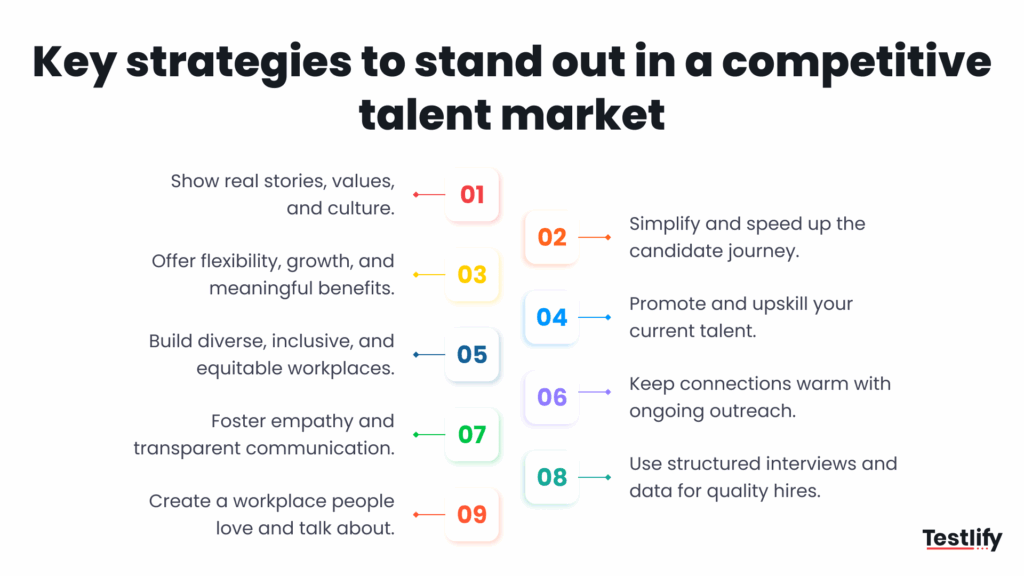
1. Start with your employer brand
Your employer brand is how current and prospective employees perceive your organization. It’s your identity in the talent market.
If you haven’t Googled your company plus the word “careers” recently, try it. What comes up? Glassdoor reviews? Reddit threads? People are talking about your workplace, whether you’re part of the conversation or not.
It’s tempting to polish your brand until it shines like a showroom car, but authenticity wins in the long run. Be honest about your culture, your leadership style, and your goals. Highlight your values, not just the ones on the wall, but the ones that guide everyday decisions.
Showcase your people. Share stories from employees at all levels and from diverse backgrounds. Let them talk about challenges, victories, and the day-to-day experience. Video content works wonders here.
2. Rethink the candidate experience
You could have the best brand in the world, but if your hiring process is slow, unclear, or overly complex, you’ll lose great candidates fast.
These days, convenience is everything. Simplify your application process. Ditch the 40-question forms. Make your careers site mobile-friendly. Use AI to streamline resume screening but don’t forget the human touch.
Nothing frustrates candidates more than the “black hole” where resumes go to die. Keep communication flowing. Even a simple “We received your application” or “Here’s what to expect next” goes a long way.
Great candidates are evaluating you just as much as you’re evaluating them. Train hiring managers to create a two-way conversation. Provide agendas, prep materials, and follow up with feedbackeven if it’s a no.
3. Offer more than money
Yes, salary matters. But top talent wants a full package financially, emotionally, and professionally.
Remote working, hybrid models, and flexible hours are here to stay. Employees value autonomy. If your roles don’t allow for full flexibility, think about what you can offer.
The best benefits are the ones people actually use. Mental health support, caregiving resources, learning stipends, fertility benefits, and financial planning services. These matter more than free snacks and ping pong tables.
People want to work for companies that care about more than profit. What impact are you making in the world? How are you supporting diversity and inclusion? Employees stay where they feel they belong and where their work matters.
4. Invest in internal mobility
You might not have to look far to find your next star performer. Often, the best candidates are already inside your organization.
Employees need to see how they can grow with you. Create clear, accessible career maps. Offer mentoring and cross-functional projects. Encourage lateral moves, not just upward promotions.
Reward loyalty and potential. It sends a strong signal when you invest in your people. Make promotion criteria transparent and fairand train managers to support development, not hoard talent.
Upskilling and reskilling aren’t just nice-to-haves, they’re essential. Build a culture of continuous learning. Offer microlearning, certifications, and stretch assignments. Show your team that growth is part of the deal.
5. Embrace diversity, equity, inclusion, and belonging (DEIB)
DEIB isn’t a buzzword, it’s a business strategy. Diverse teams are more innovative, resilient, and aligned with customer needs.
True inclusion means changing systems, not just celebrating heritage months. Audit your policies. Examine your leadership pipeline. Pay attention to who’s speaking in meetings and who isn’t.
Measure representation, pay equity, retention by demographic, and promotion rates. Share your findings, even if they’re imperfect. Transparency builds trust.
DEIB shouldn’t live in one team’s inbox. Leaders, managers, and peers all have a role. Offer training, create safe spaces for dialogue, and hold people accountable for behavior and outcomes.
6. Build a strong talent community
Not every great candidate will join you right away. That doesn’t mean they’re lost forever.
If someone makes it to the final round and doesn’t get the role, they’re still a valuable contact. Build talent pools and send occasional updates or personalized notes.
Consider webinars, virtual open houses, or Q&As with leaders. Make these events informative and interactive not just recruiting pitches. It keeps your brand warm and human.
LinkedIn isn’t just for job postings. Share insights, highlight team wins, celebrate milestones, and engage in conversation. Build a community, not just a follower count.
7. Rethink leadership at all levels
A company’s ability to attract and retain talent is often a direct reflection of its leadership. People don’t leave companiesthey leave managers.
Great leaders know how to coach, not just command. Invest in leadership development programs focused on empathy, feedback, inclusion, and growth.
Engagement shouldn’t be left to HR surveys. Build it into performance reviews and leadership metrics. Reward those who create thriving teams.
Especially in uncertain times, employees want leaders who are real. Share what you knowand what you don’t. Invite input. Listen deeply. This builds trust.
8. Move fast, but Don’t rush
Speed matters in a hot talent market, but that doesn’t mean hiring in panic mode.
Reduce the number of interviews. Empower hiring managers. Use structured interview guides to align evaluators and reduce bias.
It’s easy to fall into the trap of hiring just to fill seats. But a wrong hire can cost more than a vacancy. Be agile, not careless.
Use skills assessments, performance benchmarks, and structured scoring systems to inform decisions. Combine gut feel with facts.
9. Create a culture people talk about (In a good way)
Culture isn’t what you write in the employee handbook. It’s how people feel when they come to work every day.
Appreciation is a huge driver of engagement. Make it public, specific, and timely. Recognition from peers can be just as powerful as from managers.
From work anniversaries to new baby announcements, build traditions. These small touches create a sense of connection and care.
Even big organizations can feel personal. Empower teams to create subcultures, rituals, and bonding opportunities. Offer real-time support, not just once-a-year check-ins.
Final thoughts
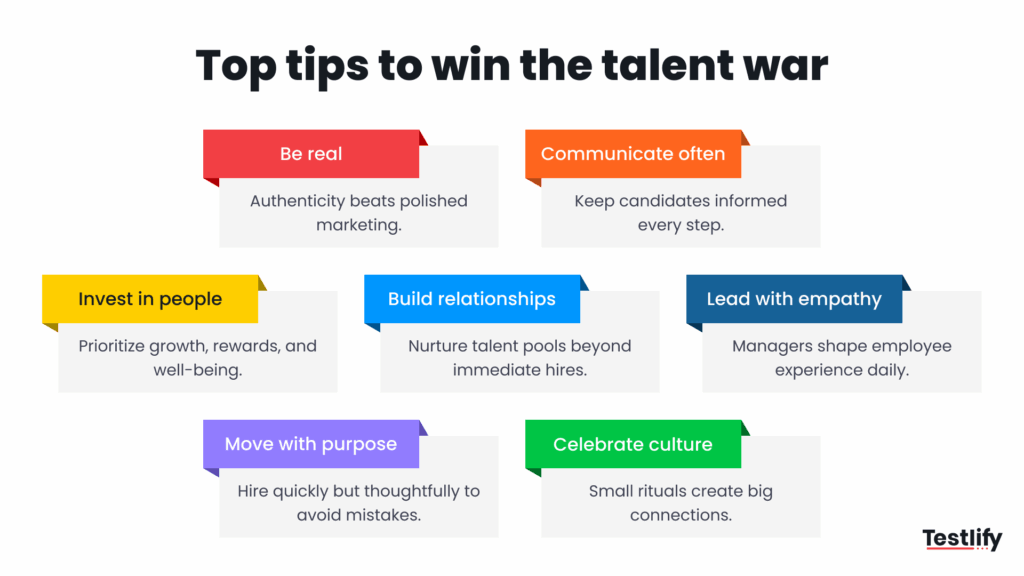
Standing out in a competitive talent market isn’t about flashy perks or marketing gimmicks. It’s about doing the deep work, understanding what people want, being authentic, treating candidates with respect, and creating an environment where great people can thrive.
If you’re in HR, you have an exciting challenge ahead. You’re not just filling jobs. You’re shaping the future of your company through the people you bring in and the ones you keep.
So ask yourself: Are we the kind of place where top talent wants to work, grow, and stay?
If not, now’s the time to change that. Because in the race for talent, standing still is the same as falling behind.
Frequently asked questions (FAQs)

Content Writer
Yashika Khandelwal is a Content Writer with 3+ years of experience creating research-backed content on hiring, talent assessment, and HR technology. She is a registered Organizational Psychologist and subject matter expert who combines behavioral science with practical recruitment insights to produce accurate, evidence-based content.
LinkedInRelated resources
View all
HR & recruitment
How image-to-video AI is transforming HR communication

HR & recruitment
Speed vs accuracy in enterprise hiring funnel

HR & recruitment
How to build a recruitment tech stack that works at enterprise scale

HR & recruitment
How to hire startup web app development company

HR & recruitment
How small businesses can use scheduling software to attract top talent

HR & recruitment
Key hiring metrics every large organization should monitor
Get started.
Hire on proof, not resumes.
Run your first skills-based assessment free — no credit card required.