
Upskilling and reskilling differences: Which fits your needs?
Discover the key differences between upskilling and reskilling to determine which strategy suits your workforce and drives business success.

Experience is dead. In 2025 and beyond, skills matter the most. The skills needed to excel in a job five years ago are no longer enough today. Upskilling and reskilling aren’t just buzzwords—they’re essential strategies for retaining top talent and staying competitive in a rapidly changing world.
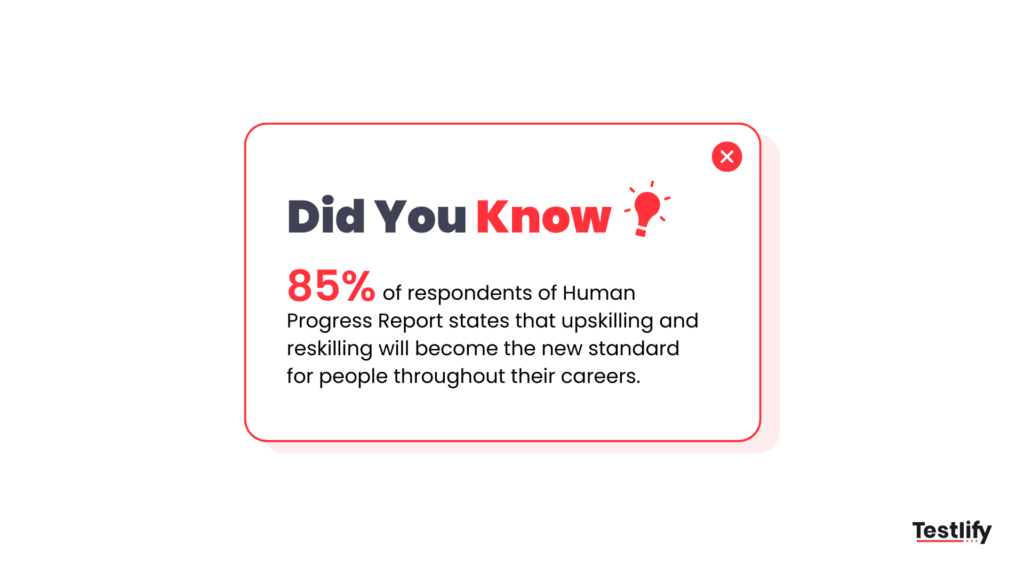
It’s not just companies that prioritize skill development; employees do, too. In fact, 94% of workers say they’d stay longer with companies that invest in their career growth.
Modern employees seek more than job security and high pay—they want opportunities to develop their skills, grow professionally, and build a future. Let’s explore why upskilling and reskilling are critical in shaping the future of work.
 ChatGPT
 Gemini
 Claude
 Grok
Grok Perplexity
What is upskilling?
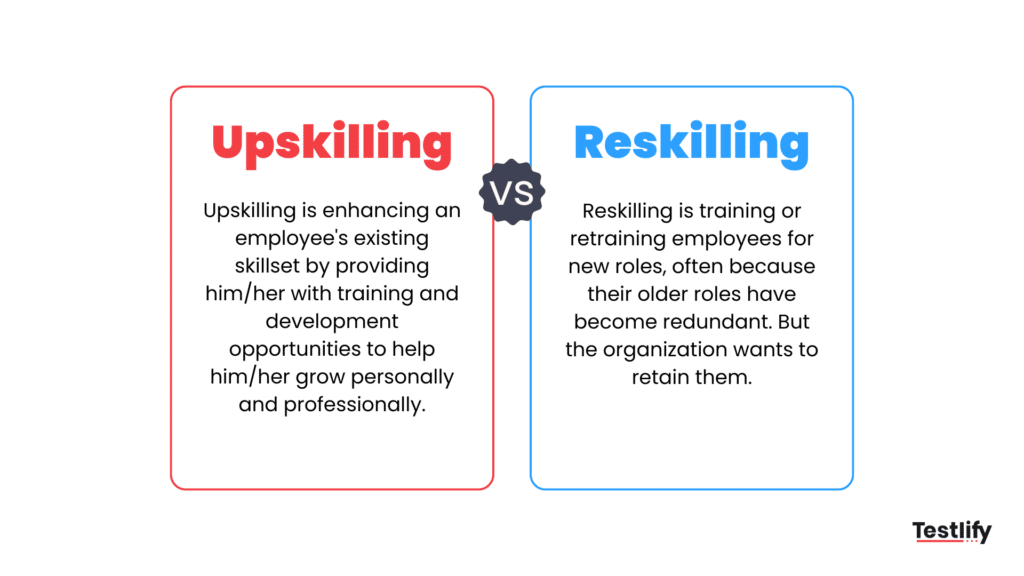
Upskilling refers to acquiring new skills or improving existing ones to improve the knowledge in a particular role or industry. It is typically aimed at enhancing an individual’s abilities by learning additional skills to perform better in their current role.
Upskilling is about growing an employee’s proficiency within a role. Simply put, it is like improving an existing product by adding more features.
Such a process improves employee skilling and adaptability, especially in today’s changing work environment. Upskilling also helps improve job satisfaction and career growth.
Example of upskilling: A graphic designer mastering advanced animation tools to enhance their current skill set.

What is reskilling?
Reskilling refers to learning an entirely new skill outside the employee’s existing skillset. It is often employed when workers want to change their career path.
Reskilling is all about change. It is like getting a new product meant for a different purpose.
This is necessary when specific jobs become unwanted or individuals want to switch jobs to a new field. Example of reskilling: A graphic designer learning web development to transition into a front-end developer role.
Upskilling and reskilling: Which one should you choose?
The choice between upskilling and reskilling depends on what you want to achieve.
You might want to upskill if there is a skill or talent gap. Reskilling can be a great option if you see potential in an employee’s strengths that could make them valuable in a different role.
While upskilling helps you move further in your current career, reskilling enables you to train for a new career.
Difficulty-wise, upskilling is easier because of the availability of online resources, less time required, etc. Reskill, however, is more challenging as it requires you to gain an entirely new set of skills.
For organizations, reskilling and upskilling for a future-ready workforce are primary drivers of internal mobility. LinkedIn studies show that companies that excel at internal mobility retain employees twice as much as those that don’t.
Also read: An HR’s guide to internal mobility
Difference between upskilling and reskilling
Though both upskilling and reskilling provide employees with learning opportunities, the main difference is that reskilling involves learning skills for a different job. In contrast, upskilling involves learning skills for the same job.
Employers and HR professionals must understand the upskilling vs. reskilling concept and implement the right strategies to stay ahead in the job market.
Below listed are the top four differences.
1. Upskilling focuses on improving skills, while reskilling focuses on gaining new skills
Upskilling means teaching your employees additional skills to improve their current performance. It makes employees capable of doing complex tasks tied to their current role or position. For example, you can upskill a social media marketer with copywriting skills so they can write copies that better resonate with the audience.
Furthermore, upskilling offers employees a new set of skills that helps to close the talent gap. It encourages your team members to learn and enhance their skills as they progress continuously. Research shows that 74% of employees agree that upskilling improves job performance.
Reskilling is when employees learn new skills for a different job role. Unlike a mid-career crisis, this transition aligns the new role with the previous one while requiring extra training and new skills to succeed in the new position.
How do you choose between upskilling and reskilling?
- Choose upskilling when you want to help employees grow in their current roles by improving or adding to their existing skills.
- Choose reskilling when employees need to shift to a different role within the company due to changes in business demands, technology, or market trends.
Put simply, the first step is to assess the skill set of employees.
2. Upskilling happens more frequently than reskilling.
Though upskilling and reskilling may happen anytime, depending on the company’s needs and vacant jobs, upskilling tends to occur more frequently.
This is because upskilling isn’t just about learning new skills; it also involves adjusting to new processes, technologies, or tools in the workplace.
In contrast, reskill happens when companies need to handle changes in the work environment. Managers may decide to retain or transfer employees whose skills may be better used in another department or role.
Also read: How to create a supportive work environment for employees
For example, instead of laying off employees when a department is closed, your company could reskill some employees for other roles.
3. Upskilling helps employees perform better, while reskilling helps employees transition into new roles better.
Providing employees with the tools to upskill helps them perform better by enhancing their existing skills. This improvement can lead to greater efficiency, better results, and reduced team skill gaps.
Upskilling also equips employees with the capabilities needed to advance in their careers, ideally within your organization, fostering both personal and professional growth.
Reskilling, on the other hand, prepares employees for entirely new roles. This is especially useful for positions that may soon become obsolete or redundant. Employees who show initiative and wish to transition to different departments can also benefit from reskilling.
4. Upskilling provides a clear path for career advancement, while reskilling offers a lateral shift.
Upskilling helps employees advance along a clear career path, allowing them to take on more responsibility in similar roles within your company. In contrast, reskilling often leads to a lateral career move, where employees switch to a new role that requires different technical skills but similar soft skills.
Why upskilling and reskilling is important?
Upskilling and reskilling are crucial for addressing employee turnover and adapting to rapid industry changes. Many managers think employees leave solely due to pay, but a lack of career growth is often a bigger factor.
Pew Research Center states that 63% of employees left their jobs due to a lack of career advancement opportunities. Workers want opportunities to advance, take on new challenges, and feel valued.
Upskilling empowers employees to grow by learning new skills, such as soft skills, keeping them engaged and motivated. It helps build an internal talent pipeline, enabling organizations to fill senior roles without relying on external hiring.
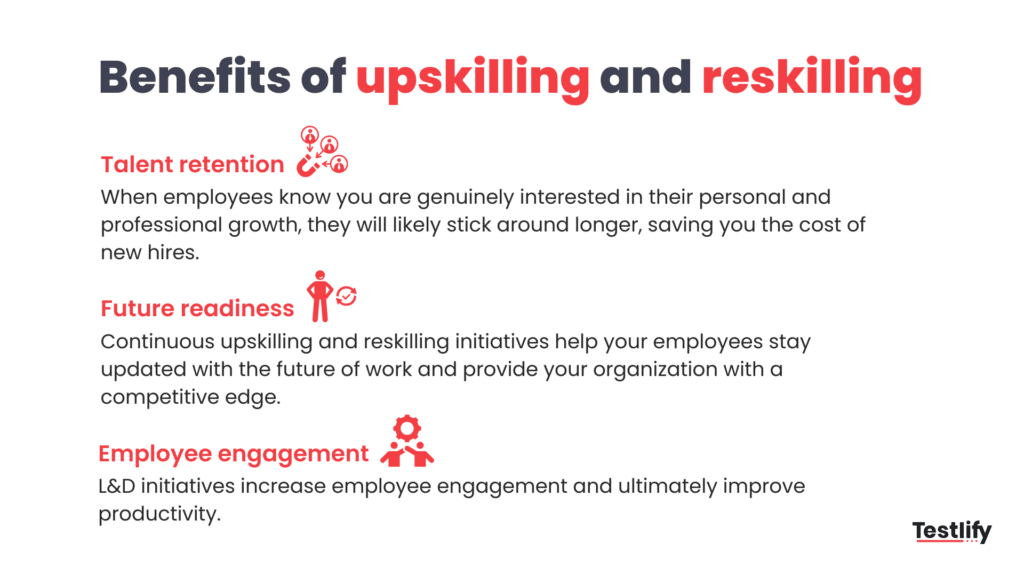
When employees see their company investing in their growth, they are more satisfied and productive, leading to better business outcomes.
Reskilling is equally important in a world where technology and market demands constantly evolve. The OECD estimates that 1.1 billion jobs will be transformed over the next decade due to AI and machine learning advancements and shifts toward green technologies.
Without reskilling programs, businesses risk widening skill gaps that could leave critical roles unfilled or poorly staffed. Hiring skilled talent externally is becoming increasingly costly, making internal reskilling a smarter investment.
Also read: Skills gap: How Testlify’s assessments can identify top talent
Organizations can stay agile and competitive by preparing employees to transition into new roles, minimizing skill mismatches, and ensuring long-term success.
When to apply reskilling and upskilling strategies?
The final verdict is that upskilling and reskilling are crucial to a company’s success. Reskilling can be used in many situations, but it’s essential when your organization needs to keep valuable employees whose roles are no longer relevant.
For example, if a department is shut down or an important software system is discontinued, some employees may find that their original roles are no longer needed. In these cases, reskilling is essential to help them transition into other roles within the company.
Another scenario is when your company’s strategy shifts, requiring staff to move between departments. For instance, if the focus changes to sales, some customer support staff may need to be reassigned to sales support roles.
Reskilling current employees is a cost-effective way to fill these positions and retain experienced workers instead of hiring new staff.
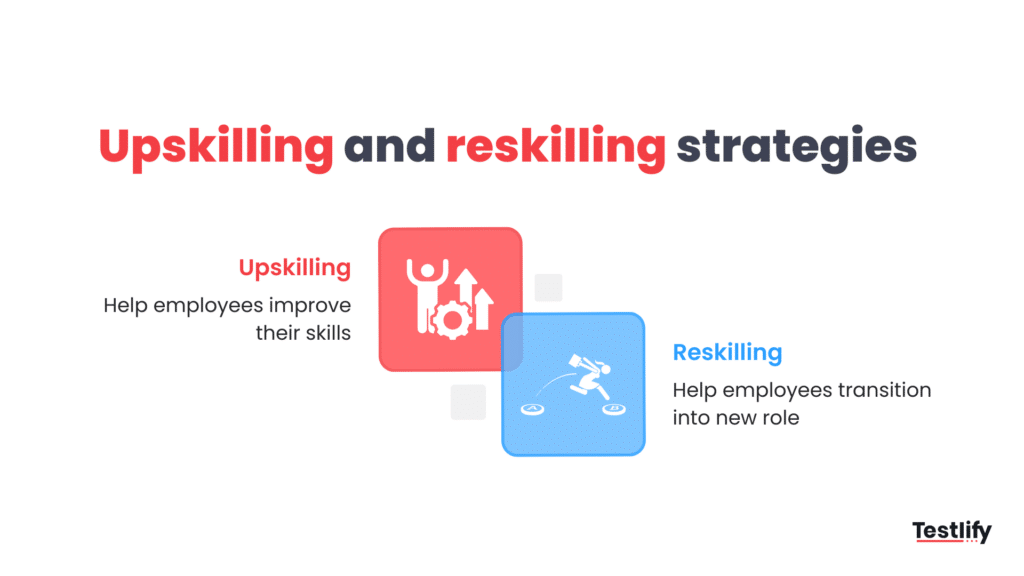
Unlike reskilling, upskilling isn’t about teaching employees to perform new roles. Instead, it’s about improving their skills to be more effective in their current positions. As job demands evolve, upskilling ensures your team stays capable and competitive.
Upskilling is particularly useful when your organization faces new trends or technological advancements. By prioritizing upskilling, you ensure your employees continue to grow and adapt to industry changes, helping them remain effective and valuable in their roles.
Frequently asked questions (FAQs)

Related resources
View all
HR & recruitment
A recruiter’s guide to Employee Net Promoter Score (eNPS)
HR & recruitment
Spans and Layers: How to Right-Size Your Org Structure

HR & recruitment
Workforce Reduction: Steps, Alternatives, and Best Practices

HR & recruitment
7 ways to start your talent search and sourcing strategy
HR & recruitment
HR Benchmarking: Types, benefits and challenges

HR & recruitment
Agile recruitment: Step-by-step process and benefits
Get started.
Hire on proof, not resumes.
Run your first skills-based assessment free — no credit card required.