
Should pre-hire tests be mandatory for all?
Should pre-hire tests be mandatory for all? Discover the pros, cons, legal risks & best practices to use assessments smartly in your hiring process.

What if a single test could decide whether someone even gets a shot at your company? Sounds efficient? But is it always fair?
Over 55% of companies today use some form of pre-employment testing. Yet only a fraction actually validate whether those tests are fair or legally compliant.
And now comes the real question: should these tests be mandatory for all job applicants across all roles? Is it a reliable filter or just another gatekeeper?
Let’s break it down!
 ChatGPT
 Gemini
 Claude
 Grok
Grok Perplexity
What are pre-hire tests?
Pre-hire tests are tools used to assess a candidate’s potential before hiring. These tests aim to evaluate specific traits, skills, or capabilities that go beyond what a resume or interview might reveal.
Consider pre-hire tests as filters designed to predict how well a candidate might perform in a role. Companies use different types of pre-employment assessments depending on the nature of the role. Some of the most common include,
- Cognitive ability tests
- Skills tests
- Personality tests
- Physical ability tests
Each test type makes hiring decisions more predictive of job performance and reduces guesswork in employee selection procedures.
While these tests can offer insights, they’re not always foolproof. Context matters. Role relevance matters. And above all, the way a test is designed and implemented can make or break its effectiveness.

Why do companies use pre-employment tests?
Hiring the wrong person costs money, time, team morale, and business momentum. That’s why more companies are shifting towards pre-employment assessments as a core part of employee selection procedures.
- To predict job performance early – Pre-hire tests give hiring teams a snapshot of how someone will perform.
- To go beyond the resume – Resumes can be misleading. Interviews can be biased. But tests offer objective data.
- To standardize the hiring process – Pre-employment tests bring consistency. Every applicant gets the same challenge. This makes the hiring process more fair.
- To reduce turnover and mis-hires – When candidates are matched to the proper role based on actual skills and personality traits, they’re likelier to stay and perform well.
- To improve legal defensibility (When validated) – When job-relevant and validated, these tests can legally support hiring decisions by showing they’re based on consistent criteria.
The legal lens: What do the laws say?
Pre-employment tests may help companies streamline hiring, but they also bring legal responsibilities. These tests can lead to serious compliance issues if not appropriately designed.
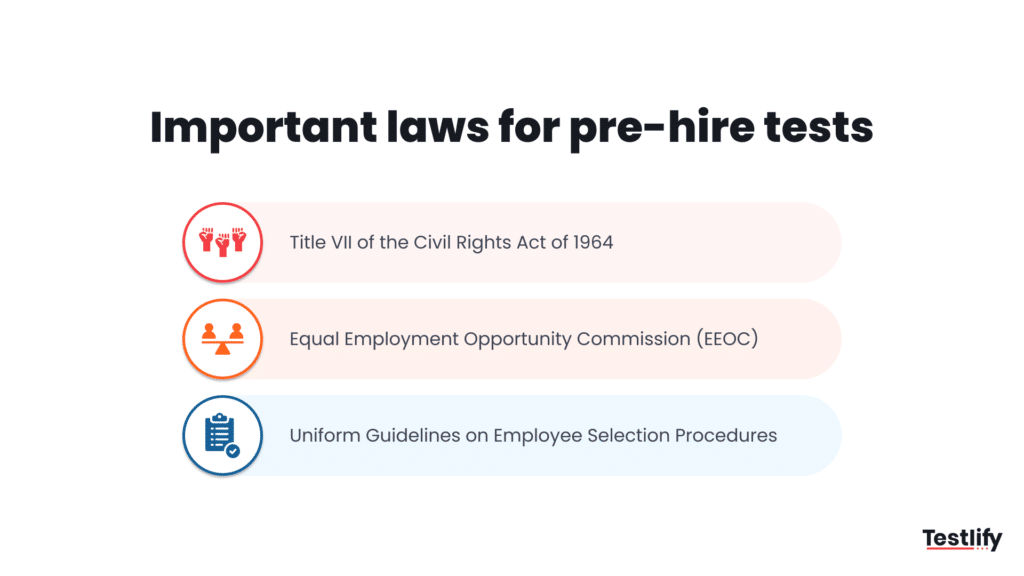
That’s where the U.S. legal framework guides and regulates how organizations assess job applicants. One of the key laws to be aware of is the Title VII of the Civil Rights Act of 1964, which prohibits discrimination in hiring based on race, color, religion, sex, or national origin.
The Equal Employment Opportunity Commission (EEOC), or Employment Opportunity Commission, is the federal agency responsible for enforcing these rules.
Also Read – 5 Benefits of EEOC-compliant pre-employment testing
The EEOC has taken action against many companies for using assessments that unfairly filter out candidates without proper justification. Their job is to ensure all candidates receive a fair and equal shot at employment, regardless of background.
The Uniform Guidelines on Employee Selection Procedures were created to guide businesses further. These guidelines on employee selection clarify how employers can use tests fairly.
According to these guidelines, any assessment used in hiring must be directly tied to the job requirements, consistently applied to all applicants, and supported by proper validation studies.
Explore More – What is concurrent validity? Definition & examples
In recent years, there have been several EEOC cases where companies faced penalties for using biased or irrelevant testing methods. In short, if your hiring process includes pre-employment tests, legal compliance is essential.
Should pre-hire tests be mandatory for all roles?
It’s tempting to think that pre-hire tests can solve all hiring problems. But the reality isn’t that straightforward. Making these tests mandatory for all job applicants might do more harm than good.
Different roles demand different evaluation methods. For example, a sales position may benefit from a personality test, but a graphic designer might be better assessed through a task-based skills test.
However, applying a one-size-fits-all testing model can lead to irrelevant or unfair assessments, especially in creative or unstructured roles.
Another factor is candidate experience. When tests feel excessive or irrelevant, top talent may drop out of the process early.
When designed with care, pre-hire tests can enhance the employee selection process and improve the quality of hires. But should they be made compulsory across the board? Not really. The key lies in strategic use.
Resumes vs pre-hire tests: Which one wins?
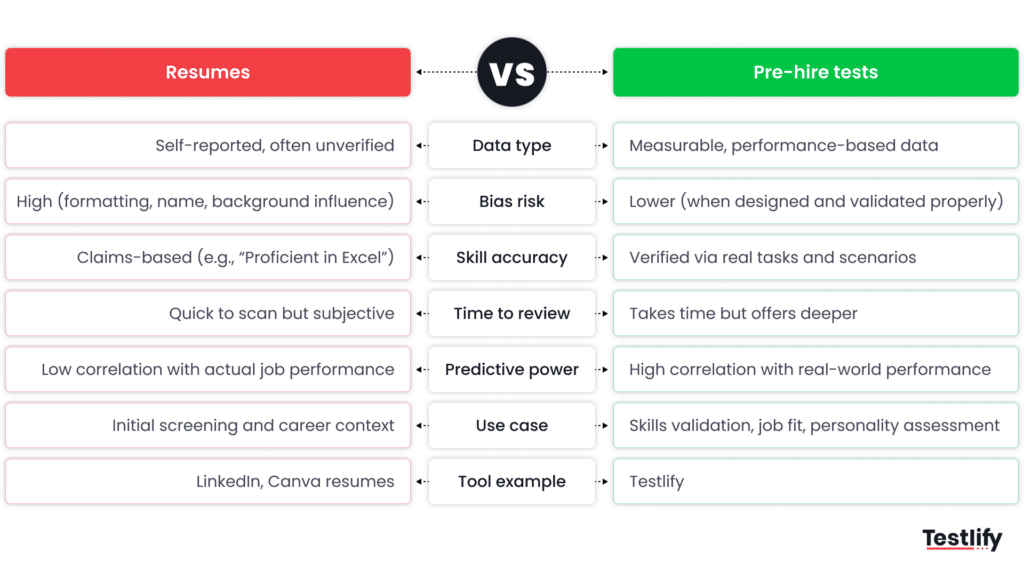
Resumes have long been the starting point of the hiring process. But let’s be honest: they often tell half the story. While a polished resume might open the door, it doesn’t always prove the candidate can actually do the job.
That’s where pre-employment assessments come in. These tests move beyond surface-level information and focus on actual performance indicators.
A resume might say someone is “proficient in Excel,” but a skills test will reveal whether they can handle advanced formulas under pressure.
Unlike resumes, which can be inflated or templated, test results offer measurable data. This helps hiring teams make decisions based on ability, not just presentation.
Tools like Testlify help businesses do exactly that. From technical assessments to soft skills evaluation, Testlify allows recruiters to validate capabilities with job-relevant tests.
That said, resumes still serve a purpose. And when used alongside assessments, they help build a fuller picture of the job applicant.
So, which one wins? The most effective approach combines both: use resumes to screen and tests to validate.
Best practices for using pre-employment assessments
Here’s how to get the best out of pre-employment assessments without falling into common traps:
- Keep it role-specific – Running the same test is the wrong practice for every role. Use tests that match the actual skills needed for the job — not just something generic.
- Choose tools you can trust – Pick assessments that are validated and fair. Tools like Testlify offer science-backed tests that actually reflect real job demands.
- Stay legally safe – Follow EEOC guidelines. If your test unfairly filters out a group, it can backfire. Make sure it’s relevant, consistent, and job-linked.
- Don’t test just to test – Use assessments as part of the bigger picture — mix them with interviews, projects, or reference checks. No single test should carry the whole weight.
- Keep reviewing – Hiring needs evolve. So should your assessments. Review them regularly to ensure they still fit the roles you’re hiring for.
Bottom line? Testing is powerful, but only when it’s smart, fair, and focused.
Final thoughts: One size doesn’t fit all
Some jobs need hard skill validation, some demand personality checks, while others need real-world project reviews. Forcing every applicant through the same test can do more harm than good.
What actually works? Smart hiring.
That means using assessments where they make sense, aligning them with job requirements, and combining them with human determination. These tests can reduce hiring bias and save your team from expensive mis-hires if used strategically.
And if you’re thinking of bringing that strategy to life — Testlify is built just for that. It gives you role-specific, bias-free assessments designed to help you hire with confidence, not guesswork.
Frequently asked questions (FAQs)

B2B SaaS Content Writer
Rishav Kumar is a B2B SaaS content writer with 4 years of experience. He loves crafting engaging content. Always exploring fresh ideas, he's passionate about helping businesses grow through impactful writing.
LinkedInRelated resources
View all
HR & recruitment
Top 9 email templates for referrals & internal hiring

HR & recruitment
11 Campus hiring & job fair email templates that work

HR & recruitment
Internal job posting email: Free Templates & guide

HR & recruitment
Internship & probation confirmation emails: templates & guide
HR & recruitment
12 HR communication email templates for hiring managers
HR & recruitment
Discriminant validity: Definition, examples & formula
Get started.
Hire on proof, not resumes.
Run your first skills-based assessment free — no credit card required.