
Concurrent Validity: Definition, Examples, and Uses (2026)
Struggling to validate your hiring tests? Learn what concurrent validity is, why it matters in recruitment, and how it ensures reliable assessments. A complete guide for HRs and recruiters.

Concurrent validity is the evidence that a test measures what it claims to measure, checked by comparing its scores against a trusted test taken at the same time. If strong candidates score high on both, the new test is doing its job. If they do not, the test is measuring something else.
For anyone relying on pre-employment assessments, this one check separates a hiring tool you can defend from a number that just looks objective. Here is how concurrent validity works, how to read the score, and where it helps or misleads.
TL;DR
- Concurrent validity tells you if a hiring test measures the right skill right now, by correlating its scores with a proven test given at the same time.
- It is a form of criterion validity. Its sibling, predictive validity, checks whether scores forecast future job performance instead.
- You measure it with a correlation coefficient. In hiring, about 0.35 and up is useful evidence, and 0.50 and up is strong.
- The catch: your result is only as good as the benchmark test. A flawed reference makes the comparison meaningless.
- Validated assessments matter because selection methods predict performance unevenly. Structured, evidence-based methods sit at the top.
 ChatGPT
 Gemini
 Claude
 Grok
Grok Perplexity
What is concurrent validity?
Concurrent validity is a type of criterion-related validity that asks one question: does this test agree with an already trusted test when both are taken at roughly the same time? You score the same people on the new test and the established one, then check how closely the two sets of scores move together.
The established test is the benchmark, sometimes called the gold standard because the field already trusts it. High agreement is evidence the new test taps the same skill. Low agreement is a warning that it does not, no matter how polished the questions look. That is the whole idea, and it is why teams reach for concurrent validity when they want a fast read on a test instead of waiting a year for job outcomes.

Other types of validity
Concurrent validity does not exist in isolation. Here is where it sits among the other validity types you will run into in hiring research.
Criterion validity
Criterion validity measures how well an assessment aligns with a real-world outcome or benchmark. It has two forms: concurrent validity, which compares results at the same time, and predictive validity, which evaluates how well scores forecast future performance.
Construct validity
Construct validity examines whether an assessment truly measures the underlying trait it claims to measure, such as problem solving, conscientiousness, or leadership. A strong correlation with another test alone is not enough to establish construct validity.
Predictive validity
Predictive validity measures how well assessment scores predict future outcomes, such as job performance, training success, or employee retention. Unlike concurrent validity, it evaluates whether today’s scores accurately forecast what happens later.
Content validity
Content validity assesses whether an assessment covers the full range of knowledge, skills, and abilities required for the role. For example, a software engineering test that measures only coding syntax but ignores debugging and system design has weak content validity.
Face validity
Face validity considers whether an assessment appears to measure what it claims to measure. While it can improve candidate confidence and acceptance, it is based on perception rather than evidence and provides the weakest form of validity.
Convergent validity
Convergent validity checks whether a test correlates well with other measures of the same trait, the way two different empathy scales should broadly agree. Strong convergent validity is one of the building blocks that support overall construct validity.
Discriminant validity
Discriminant validity evaluates whether an assessment does not correlate strongly with measures of unrelated traits. For example, a leadership assessment should not closely mirror a general intelligence test if it is intended to measure leadership ability.
Incremental validity
Incremental validity asks whether adding a new test improves prediction beyond what you already have, not whether the new test works in isolation. If GPA alone predicts job performance at 0.30 and adding a cognitive ability test pushes that to 0.45, the new test has real incremental validity.
Why does concurrent validity matter in hiring?
An unvalidated test does not just look risky on paper. It costs real money, ranks below better-validated methods, and can quietly undermine every decision built on top of it.
The cost of an unvalidated test
It matters because an unvalidated test can reject good people and wave through weak ones, and you pay for both. SHRM put the average cost to fill a single role at $4,129 in its benchmarking data, and a mis-hire multiplies that through lost ramp time and a re-run search.
Not all methods validate equally
A 2022 re-analysis of decades of selection research found the old validity figures had been overstated, trimming many by .10 to .20 points once a statistical error was corrected. On the updated numbers, structured interviews rank as the single best-validated method at about r = .42, ahead of job knowledge tests (.40) and cognitive ability tests (.31).
The takeaway for hiring teams: the method you pick has a real ceiling on how well it predicts performance, so checking that a given test actually works is not optional.
Keeping your evidence honest
Start with the role, map each competency that matters to measurable evidence, then collect that evidence through assessments, simulations, interviews, and structured reviewer feedback. Concurrent validity is one of the checks that keeps that evidence honest.
If a test you are relying on does not agree with a trusted measure of the same competency, the evidence it produces is shaky, and so is any decision built on it. This is a structure you fill in for your own roles, with validated tools doing the actual measuring.
Concurrent validity vs. predictive validity
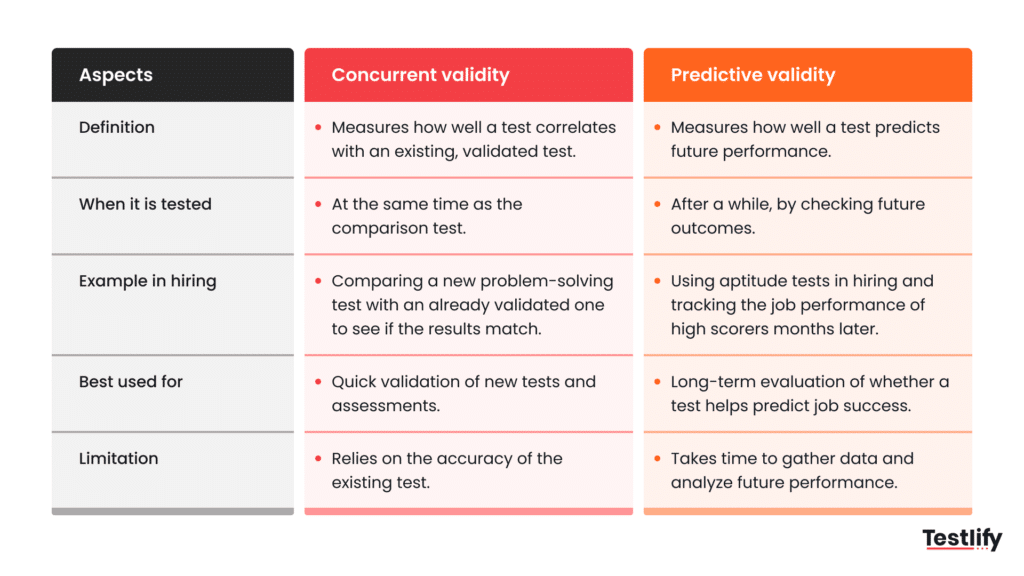
Both are branches of criterion validity, so the difference comes down to timing. Concurrent validity compares a test against a proven measure right now, using people whose performance you already know, whereas predictive validity scores candidates first and waits to see how they do on the job months later.
The pre-selection caveat
One honest caveat about concurrent designs: you are testing people who already cleared your hiring bar and survived in the job. That group is narrower than your applicant pool, so the correlation can read lower than the test’s true strength. It is a reason to treat a modest score as a floor, not a verdict, and to confirm with a predictive study when the stakes are high.
How do you measure concurrent validity?
You measure concurrent validity by administering a new test and an established benchmark to the same group at roughly the same time, then calculating how closely the two sets of scores align. If people who score highly on the benchmark also score highly on the new test, the new assessment demonstrates good concurrent validity.
Follow these five steps.
1. Choose a valid benchmark
Select an established assessment that has strong evidence for measuring the same skill, ability, or trait. The quality of your benchmark determines the quality of your validation study.
2. Test the same group
Administer both the new assessment and the benchmark to the same participants within a short time frame. Keep testing conditions as consistent as possible so external factors do not influence the results.
3. Calculate the correlation
Compare the two sets of scores using a correlation coefficient. This shows how closely the new assessment agrees with the benchmark. Use these ranges as practical guidelines rather than strict rules.
- 0.50 and above: The new assessment closely aligns with the benchmark and provides strong evidence of concurrent validity.
- 0.35 to 0.49: The assessment shows a meaningful relationship with the benchmark and can be useful alongside other hiring evidence.
- 0.20 to 0.34: The relationship is limited. Review the assessment’s content, scoring, or benchmark before relying on it for hiring decisions.
- Below 0.20: The assessment shows little agreement with the benchmark and should be revised or replaced before being used in decision-making.
4. Interpret the results
An acceptable correlation depends on what the assessment measures. Broad psychological traits often produce lower correlations than narrow technical skills, so always evaluate the result alongside the purpose of the assessment, the quality of the benchmark, and the hiring context.
5. Validate with additional samples
One study is rarely enough. Repeat the analysis with different candidate groups to confirm that the results remain consistent across populations.
Example of concurrent validity in recruitment
The idea is easier to see in a real scenario than in the abstract. Here is how one company actually put it to use.
The problem
Picture a 600-person software company that screens support engineers with a long, expensive reasoning test. It wants a shorter cognitive ability test that takes 20 minutes instead of 60, but only if the short version measures the same thing.
The result
So the team runs a concurrent study. Forty current support engineers take both tests in the same week. The scores correlate at 0.58. That is strong agreement, so the company can retire the hour-long test and move to the short one with evidence behind the switch, not a hunch.
Had the correlation come back at 0.18, the short test would have been quietly measuring something else, and rolling it out would have meant screening people on noise. This is exactly the kind of decision concurrent validity is built to inform: fast, low-risk, and grounded in numbers rather than vendor claims.
Advantages of concurrent validity
Concurrent validity is fast and practical, which is why teams reach for it first. Here is where that speed actually pays off.
Quick to run
You get evidence in one testing cycle instead of waiting months for job outcomes, so a new test can go live sooner. That speed is exactly why concurrent validity is usually the first check teams reach for.
Cheaper than building from scratch
Comparing against a proven test beats trial and error, saving the cost of a long validation program. You are borrowing evidence from a test the field already trusts instead of building a case from zero.
Cuts obvious mistakes
A test that fails the comparison gets caught before it screens a single real candidate. That single check can save a hiring team from months of decisions built on a broken instrument.
Drawbacks of concurrent validity
Concurrent validity’s strengths come with real edges. Pretending otherwise is how a test gets trusted past what the evidence actually supports.
Inherits the benchmark’s flaws
If the reference test is biased or outdated, a high correlation just proves your new test copies it. The comparison is only as trustworthy as the benchmark you chose to run it against.
Says nothing about the future
Agreement today is not proof a candidate will perform next year. For that, you need predictive validity.
Ages badly in fast-moving roles
When the skills a job needs shift quickly, last year’s benchmark may no longer reflect the work. A concurrent study that looked strong twelve months ago can quietly go stale without anyone rerunning it.
Invites false confidence
A strong number tempts teams to skip construct validity and fairness checks. One correlation is one signal, not a clean bill of health.
Pro tip: never lean on a single concurrent study to clear a test. Pair it with a check that the test is fair across candidate groups, and plan a predictive study for any assessment that drives high-stakes decisions. One correlation buys you speed, not certainty.
Strengthen assessment validity with Testlify
Running validation studies by hand is slow work. Testlify’s library of role-based assessments is built and benchmarked against industry standards, so your team starts from validated tools instead of an empty test builder. See how it fits your roles.
Key takeaways
- Concurrent validity is a now check, not a forever check. It shows a test agrees with a trusted measure today, which matters because it lets you catch a broken assessment before it touches live hiring instead of after a bad quarter of hires.
- The benchmark makes or breaks the study. Your result only means something if the reference test is sound, so vetting the benchmark deserves as much care as the new test, or the whole comparison is built on sand.
- Read the coefficient against the role. A 0.40 correlation can be strong for a complex trait and weak for a narrow skill, which means a single cutoff number across all roles will mislead you. Judge it in context.
- Concurrent and predictive validity answer different questions. Use concurrent for a fast pre-rollout read and predictive when you need proof of future performance, because treating one as the other is how teams over-trust a quick result.
- Method choice has a real ceiling. Updated research puts structured methods at the top and even those explain only part of performance, so combining validated signals beats betting a hire on any single test.
- One correlation is a start, not a clearance. Pair concurrent validity with fairness and construct checks, because a strong number can hide bias or a test that measures the wrong thing entirely.
Frequently asked questions (FAQs)

B2B SaaS Content Writer
Rishav Kumar is a B2B SaaS content writer with 4 years of experience. He loves crafting engaging content. Always exploring fresh ideas, he's passionate about helping businesses grow through impactful writing.
LinkedInRelated resources
View all
HR & recruitment
Skills ontology: what it is and how HR leaders use it

HR & recruitment
Implicit vs explicit bias: Difference and impact in workplace

HR & recruitment
What is role mapping? Process, benefits

HR & recruitment
What is recruitment planning and how to create a recruitment plan?

HR & recruitment
An HR’s guide to skills taxonomy

HR & recruitment
What is departmentalization: Types, benefits and examples
Get started.
Hire on proof, not resumes.
Run your first skills-based assessment free — no credit card required.