
How to set new hires up for success in their first 90 days
A practical plan for new hires: what to do before day one, a 30-60-90 day plan, the legal deadlines, feedback and how to measure success.

New hires succeed when the first 90 days are planned as carefully as the hiring process that found them. That means the paperwork and tools are ready before day one, the manager owns a written 30-60-90 day plan, a buddy answers everyday questions, and progress is checked against clear goals instead of guessed at.
 ChatGPT
 Gemini
 Claude
 Grok
 Perplexity
TL;DR
- A successful talent management strategy starts with clear business priorities, defined roles, and an understanding of the skills your workforce needs.
- Map critical roles, assess existing employee skills, and identify gaps before deciding whether to hire, train, or develop talent internally.
- Use skills assessments to make hiring and development decisions based on measurable skills rather than resumes or assumptions.
- Run hiring and employee development initiatives together as a 90-day pilot, with clear ownership and measurable goals.
- Track five key metrics: time to fill, quality of hire, skills gap closure, regretted turnover, and internal fill rate.
- Start with practical tools such as a skills assessment platform, HRIS, and shared tracker. Invest in a full talent management suite as your process scales.

What does it take to set new hires up for success?
Setting new hires up for success takes four things: clear expectations for the role, the tools and access to start working, people who help them settle in, and regular feedback against agreed goals. Onboarding is the process that delivers all four, and it lasts months, not the first day.
Many teams still treat the first week as the whole job. SHRM's guide to new hire integration describes onboarding as a process that can last up to 12 months, with check-ins at one month and again at three to six months. Orientation is only the welcome on day one, and the two are easy to mix up.
Our guide on orientation versus onboarding explains where one ends and the other begins.
Why do new hires leave in the first 90 days?
New hires usually leave early because the job is not what they expected, the first weeks feel like paperwork instead of real work, or nobody checks in. The first 90 days decide whether the person settles in or starts looking again, so the cost of a weak start shows up fast.
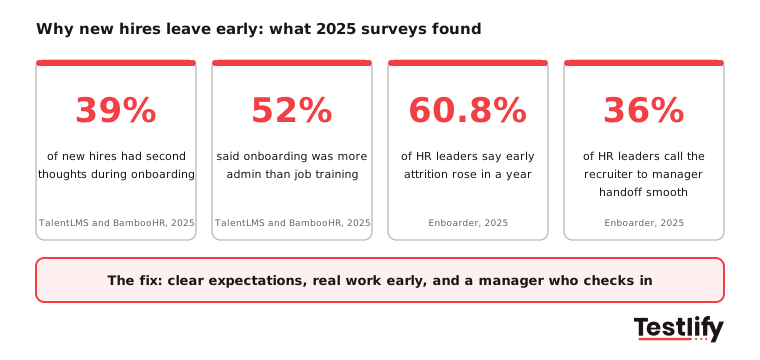
Recent data shows how fragile this window is:
- Second thoughts: The TalentLMS and BambooHR 2025 Employee Onboarding Report surveyed 1,156 US employees hired in the past year. 39% had second thoughts about the job during onboarding, and 49% of Gen Z hires did.
- Too much admin: In the same report, 52% said onboarding focused more on admin tasks than on practical job training.
- Rising early attrition: Enboarder's 2025 survey of 1,000 HR leaders in the US, UK and Australia found that 60.8% saw early attrition rise over the past 12 months, and 20.5% said up to half of their new hires leave within 90 days.
- Broken handoffs: Only 36% of those HR leaders called the handoff between recruiting, HR and the hiring manager smooth, and 28.8% had seen hiring managers give new hires no training or guidance at all.
Every early exit restarts the hiring cycle. You can put a figure on that loss with the attrition rate calculator.
What should you do before day one for new hires?
Before day one, finish the paperwork, set up the laptop and logins, name a buddy, and send a short note with the first-week schedule. Preboarding removes the admin from week one, so the first days can go to people and real work instead of forms.
Use this preboarding list as a starting point:
- Send the paperwork early: Tax forms, benefits choices, and policy sign-offs can all be completed online once the offer is accepted.
- Get the tools ready: Laptop, email, software licenses, and system access should work on the first morning.
- Name a buddy: Pick a peer who is not the new hire's manager and tell both people before day one.
- Share the first-week plan: Who they will meet, what they will learn, and one small task they will finish.
- Brief the team: Tell colleagues who is joining, what the role covers, and how it relates to their own work, so nobody is surprised by overlapping duties.
For a complete list by stage, use our onboarding checklist.
Pro tip: Book the manager's week-one meetings with the new hire before the offer is even signed. Calendars fill up fast, and a new hire who waits days to see their manager reads it as a signal.
What must HR complete in the first weeks for new hires?
HR must complete two legal steps for new hires in the United States: verify work eligibility on Form I-9 and report the hire to the state new hire directory. Both have fixed deadlines, and both are easy to miss during a hiring push when dozens of people start in the same month.
- Form I-9: USCIS says employers must complete Section 2 of Form I-9 within 3 business days of the employee's first day of work for pay.
- State new hire reporting: Federal law (42 U.S.C. 653a) sets the outer limit. Employers must report each new hire, with name, address, Social Security number, and start date, no later than 20 days after hiring, and states can set a shorter window. Alabama, for example, asks for reports within 7 days. Read more in our glossary entry on new hire reporting.
Outside the US, the rules differ by country, so check the local labor ministry before the first start date in a new market.
What should a 30-60-90 day plan for new hires include?
A 30-60-90 day plan for new hires sets one focus for each month: learn the role in the first 30 days, contribute in days 31 to 60, and own results by day 90. Each stage lists goals, the people to meet, the training to finish, and how the manager will judge progress.
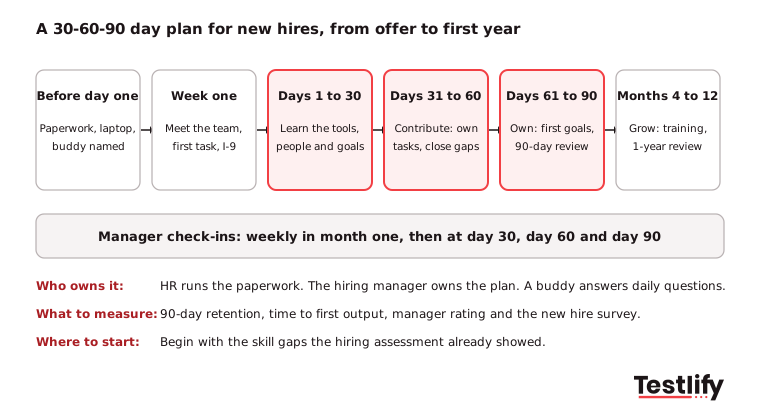
Stage | Focus | Typical goals | Manager check |
|---|---|---|---|
Days 1 to 30 | Learn | Meet 8 to 10 key people, learn the tools, finish one small real task | Weekly one-to-one, day-30 review |
Days 31 to 60 | Contribute | Take on regular work, close the top skill gap, ask for feedback | Every two weeks, day-60 review |
Days 61 to 90 | Own | Hit 2 or 3 measurable goals, own a project, set a development plan | Day-90 review |
Months 4 to 12 | Grow | Build the next skills, widen scope, plan the next step | Quarterly, one-year review |
Keep the plan short. Two or three measurable goals per stage are enough, and they should be written down on the first day so the new hire knows how success will be judged. If the role has a formal probation period, line the day-90 review up with it, as covered in our guide to probation period management.
How can hiring assessment results shape onboarding?
Hiring assessment results show each new hire's strengths and gaps before they start, so onboarding can focus training on what that person actually needs. A candidate who scored high on the core skill but lower on a tool or a soft skill gets a plan that targets that gap first.
Most onboarding plans are written for the role, not the person. Yet the hiring process already produced a skills profile for every hire. Use it like this:
- Read the per-skill breakdown: Testlify reports break scores down by skill, with AI-written strengths and gaps for each candidate.
- Turn gaps into first-month goals: A support hire who scored lower on written English gets writing practice and reviewed replies in weeks two to four.
- Reuse follow-up questions: AI-suggested follow-up questions from the interview stage make good topics for the first one-to-one.
- Retest when it matters: For roles where a skill is critical, the same skills test can be run again internally at day 90 to check progress.
This also gives you a feedback loop for hiring. If new hires who scored well on a skill are struggling with it at day 60, the test or the cut-off needs a closer look. Our guide on how to improve quality of hire covers that loop in more detail.
How should managers and mentors support new hires?
Managers and mentors support new hires in different ways. The manager sets goals, gives feedback and removes blockers. A mentor or buddy answers the everyday questions a new hire may not want to ask the boss. Most new hires need both in the first 90 days.
The manager carries most of the weight. In the TalentLMS and BambooHR report, 75% of new hires said their manager was there to support them, while 67% were satisfied with HR support. That makes manager readiness a real risk. Gallup's State of the Global Workplace report puts manager engagement at 22% in 2025, down from 31% in 2022, so many managers are stretched before a new hire even arrives.
- Give managers a script: A one-page plan with the week-one meetings, the 30-60-90 goals and the check-in dates.
- Pick buddies with care: Choose peers who know the work and enjoy explaining it. Our guide to the buddy system covers how to set one up.
- Map the network: Ask the new hire to meet people outside their own team in the first 30 days, not only their direct colleagues.
How often should new hires get feedback?
New hires should get feedback every week in the first month, then at least every two weeks until day 90, with formal reviews on day 30, day 60, and day 90. Short, frequent check-ins catch problems while they are still small and show the new hire that someone is paying attention.
Feedback should run both ways. The TalentLMS and BambooHR report found that 29% of new hires were never given the chance to give feedback on their onboarding. Ask three questions at each review: what is clearer than a month ago, what is still confusing, and what would help most in the next 30 days.
Watch for early warning signs: a new hire who stops asking questions, misses small deadlines, or seems unsure who to go to. These are cues for a manager conversation, not for waiting until the next formal review. Many of the same mistakes start on day one, so it is worth reviewing the most common new hire orientation mistakes as well.
How do you measure success for new hires?
Success for new hires is measured with a small set of numbers tracked at day 30, day 90, and one year: 90-day retention, time to first real output, the manager's rating against the plan, and the new hire's own survey score. Together they show whether onboarding works and whether hiring picked the right people.
Metric | What it shows | When to measure |
|---|---|---|
90-day retention | Whether new hires stay through the riskiest window | Day 90, by team and by role |
Time to first real output | How fast new hires start contributing | First owned task or project |
Manager rating | Progress against the 30-60-90 goals | Day 30, 60 and 90 |
New hire survey | Clarity, support and fit, from the new hire | Day 30 and day 90 |
Quality of hire | Whether hiring choices hold up | Six months to one year |
Track these by hiring source and assessment score as well as by team. If one source or score band has much weaker 90-day retention, that is a hiring issue, not an onboarding one. The quality of hire calculator gives you a simple way to combine these signals.
Key takeaway: New hires rarely fail because of one bad day. They drift when nobody owns the plan. Give the manager a written 30-60-90 plan, start from the skill gaps hiring already found, and check in every week of the first month.
Ready to give new hires a better start?
The best onboarding plans start before the offer, with a clear picture of what each person can already do. Browse the Testlify test library to find role-based skills tests, or start a 7-day free trial, no credit card required, and see the per-skill report you can hand to every hiring manager.
Frequently asked questions (FAQs)
Related resources
View all
HR & recruitment
How to give constructive feedback to candidates

HR & recruitment
How to create a seamless candidate experience

HR & recruitment
How to Streamline Screening and Selection in 2026

HR & recruitment
How to create clear and engaging job postings

HR & recruitment
How to Bridge Communication Gaps During Interviews

HR & recruitment
Transparent Communication in Hiring: A 2026 Guide for Recruiters
Get started.
Hire on proof, not resumes.
Run your first skills-based assessment free — no credit card required.