
How AI is helping startups attract top talent?
AI tools cut startup hiring costs by 75% and time-to-hire by 55%. See how lean startups use AI resume screeners, skills tests, and onboarding bots to land proven talent 2× faster without blowing runway.
The global artificial intelligence (AI) market is projected to reach $1.85 trillion by 2030. Companies that don’t use AI for any kind of activity are at risk of stagnation.
Moreover, International Data Corporation (IDC) found that companies lose 20-30% of their total revenue annually due to inefficiencies, which AI could tremendously reduce. For startups, this is a risk most can’t afford.
The good news is, there are several ways AI can help startups attract top talent without burning a hole in their finances. Read on to know exactly how.
- Pinpoint the real problem: Shoestring budgets, zero brand fame, and one recruiter juggling 20 requisitions are the top three blockers; AI removes all three.
- Screen for skills: AI-powered skills tests (like Testlify) reduce bad-hire rates by 55% and save roughly $ 15,000 in replacement costs.
- Automate sourcing: Automated sourcing bots scan millions of profiles in seconds, surfacing passive candidates that human recruiters might never find.
- Use AI chatbots: AI scheduling & FAQ chatbots reclaim 75% of recruiter admin hours.
- Focus on retention: AI onboarding bots pulse eNPS at 30, 60, and 90 days and auto-flag burnout risks (exceeding 45 hours per week), reducing first-month churn by 25%.
 ChatGPT
 Gemini
 Claude
 Grok
Grok Perplexity
Why do startups struggle to find the top talent?
The competition for high-performing sales and marketing teams has become incredibly intense.
New startups must compete with established companies to attract tech sales professionals and other strategic thinkers who can execute projects and demonstrate essential soft skills, such as emotional intelligence and adaptability.
These candidates also need to know how to adapt to a startup culture, especially if they are used to working in a corporate environment.
Not to mention, the unpredictability of startup scaling means that teams must be completely comfortable with rapid change, which may be too challenging for corporate staff.
To find the right candidates, startups must utilize the expertise of specialist recruiters in their industry, who can leverage what is arguably the most important new technology in recruitment: artificial intelligence (AI).
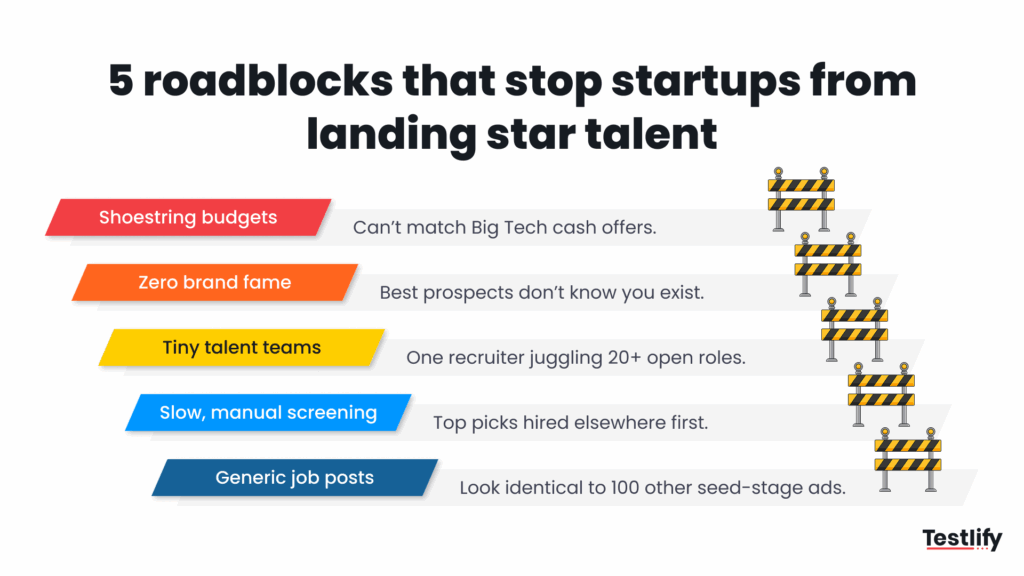
For boot-strapped startups, the higher cost of advanced AI tools can be a real hurdle, making them hesitant to explore these solutions. Unfortunately, research shows that businesses failing to adopt AI tools experience a direct profit loss of up to 2.5% and potentially up to 14% annually. The real balance is to find affordable yet effective AI tools for startups at a low cost.

Top 4 ways AI helps startups attract top talent (how you can do it)
AI in recruitment is no longer a passing trend; it’s everywhere, and if you don’t know how to use it, you’ll be lagging—a big time. There are multiple ways AI is helping startups attract top talent. Recently, companies are increasingly turning towards conducting hackathons to attract early-stage talent.
Startups that don’t run hackathon activities can still use AI tools to broaden the diversity of hackathon talent.
AI-powered platforms can be used to source candidates from diverse backgrounds, automatically analyze their skill sets and experience, and match them to relevant projects or challenges. Apart from these, some other ways are:
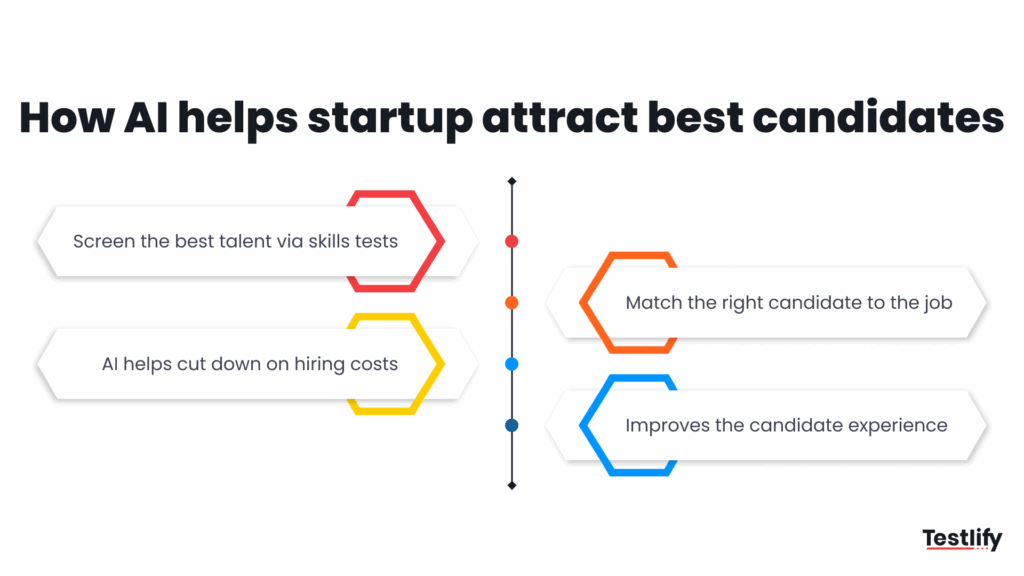
Screen top talent via skills tests
The first step where AI recruiting for startups helps is by using skills tests or skills assessments. These pre-employment tests are incredibly helpful in assessing candidates who actually have the skills and knowledge.
Instead of relying on experience or pedigree, skills tests evaluate talents based on their hard and soft skills. Startups can combine technical and non-technical skills tests to get a 360-degree valuation of candidates.
Pairing skills tests with AI-powered interviews can significantly reduce the time and resources required by startup recruiters.
Pro tip: Use Testlify, an AI-powered skills assessment and interviewing platform with over 3,000 pre-built tests.
Candidates can take online typing tests, engage in chat simulations, and participate in video and audio interviews. Testlify also utilizes AI to administer psychometric tests that accurately assess candidates’ aptitude, personality traits, and cognitive abilities.
Additionally, one of the most impressive features of AI hiring is its multilingual capabilities. Whether you’re hiring someone from Germany, Spain, or Japan, you can communicate with them efficiently via AI-created assessments.
Match the right candidate to the job
One of the most significant ways AI can help busy startup founders is by reducing the time they would otherwise spend researching individual candidates to determine whether they are the right match for the job.
Candidates must be skilled and experienced enough to take a startup to the next level and possess values and qualities that align with the startup’s culture.
Recruiters can utilize AI to automate candidate sourcing by scanning online platforms and identifying potential hires, including those who may not be actively seeking new opportunities (passive candidates).
Such AI tools analyze thousands of data points, considering hard and soft skills to find optimal matches. Large companies, such as Unilever, have implemented AI technologies, resulting in shorter hiring timelines and improved employee retention rates. Startups can copy the same framework.
AI helps make job matching more accurate and fair, enabling startups and larger businesses to attract a broader range of talent and boost job satisfaction.
AI helps cut down on hiring costs
Cut hiring costs by letting AI resume screeners reduce 75% of your admin time, according to a Deloitte report, saving roughly 23 recruiter-hours per open role.
AI automation also minimizes hiring costs across the board by automating interview scheduling (eliminating back-and-forth emails), auto-sending pre-screen chatbots that answer candidate FAQs 24/7, and auto-parsing LinkedIn profiles to build shortlists without requiring recruiter hours. While AI-powered skills tests, such as coding challenges, sales-call simulations, or design tasks, deliver unbiased, real-world scores that surface only qualified applicants, cutting bad-hire rates by up to 40% (LinkedIn Talent Insights, 2024), and sparing the $ 15,000 average cost of replacing a single mis-hire.
Furthermore, Testlify’s study finds that using AI-powered talent assessments reduces time to hire by 55%.
Improves the candidate experience
One of the most valuable features of AI for startups is its ability to interview hundreds (or more) candidates without wasting the management’s time.
AI-powered chatbots can be used in the early stages of interviews to engage with candidates in real-time, answer their queries, and provide detailed information about the company and the role they are interested in.
It’s an excellent way for candidates to ask questions openly before they meet management. AI can enhance job candidates’ experience in another powerful way: by providing startups with insights into candidates’ behaviors and preferences so that managers can tailor their approach and communication style.
Additionally, by utilizing AI-powered skills assessment, recruiters and hiring managers can make data-driven hiring decisions rather than relying on intuition or resumes. Such a standardized hiring practice leads to more concrete decision-making, reducing the chances of a bad hire.
How can you use AI for startup retention?
Once the offer is signed, switch AI from “recruiter-mode” to “retention-mode.” Cut first-month churn by 25 %: feed every new hire into an AI onboarding bot that auto-schedules 30-, 60-, 90-day check-ins and pulses employee net promoter score (eNPS) after week 4, set it once, runs forever.
Try our free eNPS calculator and see how engaged your team really is
Stop burnout before it starts: plug time-tracking data into an AI workload balancer that flags anyone trending over 45 hours per week and auto-suggests a compensation day, keeping your team in the 90th percentile for work-life balance without requiring manager babysitting.
Pay smarter, not just more: run quarterly AI market-pay reports to benchmark equity + cash against Series A-B peers; adjust comp the same week to beat the “better pay” exit trigger that drives 63% of departures.
Ending note
As AI tools continue to advance, startups have more opportunities than ever to find and attract their next top talent.
This doesn’t mean chasing “purple squirrels”, those mythical perfect candidates who rarely exist, but rather using AI to identify skilled, diverse, and value-aligned people who can truly move the company forward.
Ultimately, it’s not just about filling roles quickly; it’s about building a team that shares your vision and helps your startup scale sustainably.
Try a basic skills assessment and save 70% of hiring costs. Try Testlify for free or watch a quick demo to see how it works.
Frequently asked questions (FAQs)

Wordpress Developer
Yash Patel is a Wordpress and SEO Specialist at Testlify with 3+ years of experience in technical SEO, on-page optimization, and content strategy. He works on improving Testlify's organic presence and produces content focused on hiring, talent assessment, and HR technology.
LinkedInRelated resources
View all
Hiring Guide
Building a strong employer brand with visual storytelling

Hiring Guide
5 Go-to strategies for aligning product development with customer feedback

Hiring Guide
The employer’s guide to hiring seasonal international workers
![Grey collar jobs: what they are, examples, and how to hire [2026]](/api/media/file/What-are-grey-collar-jobs-2.png?dpl=dpl_6Z8Gzi5dgny5ePrnCfPbRPCRYCA7)
Hiring Guide
Grey collar jobs: what they are, examples, and how to hire [2026]

Hiring Guide
6 Stages of the performance management cycle

Hiring Guide
Recruitment vs talent acquisition: Key differences
Get started.
Hire on proof, not resumes.
Run your first skills-based assessment free — no credit card required.