
A recruiter’s guide to Employee Net Promoter Score (eNPS)
Learn all about Employee Net Promoter Score (eNPS), how to measure it, calculate benchmarks, and improve employee satisfaction.

One of the best ways to measure the satisfaction and engagement of employees is through Employee Net Promoter Score (eNPS). For recruiters, knowledge of eNPS is crucial because it affects your organization’s capacity to attract and retain the best talent.
Here, we have broken down everything you need to know about eNPS, from what it is to how to measure and improve it.
 ChatGPT
 Gemini
 Claude
 Grok
Grok Perplexity
What is the employee net promoter score (eNPS)?
The Employee Net Promoter Score, or eNPS is a simple yet powerful metric used to gauge how likely employees are to recommend their workplace to others. It’s an adaptation of the Net Promoter Score in measuring customer loyalty; this time, it’s focused on employees instead of customers.
As a core, its foundation is built around one question:
“On a scale of 0 to 10, how likely are you to recommend our company as a great workplace?”
This single question reveals employee sentiment and helps organizations identify areas for improvement.

Why should you measure eNPS?
Here are the key reasons for measuring eNPS and how it benefits the organization overall.
1. It reflects employee engagement
Any engaged employee in a company is highly likely to stay with your organization, perform better, and work more effectively. This makes eNPS give you an instant read on employee satisfaction. It enables you to know the level of engagement in your workforce.
2. It impacts employer branding
A high eNPS score signals job seekers that your organization is a great place to work. This helps build your employer brand and attracts top talent. In contrast, a low eNPS score may keep them away.
3. It helps identify issues early
By eNPS, you can measure how things are going wrong at the workplace and rectify them before they go out of control. It gives you insight into where employee satisfaction is lagging, thus improving the situation proactively.
4. It supports retention
Recruiters not only attract new employees but also retain the current ones. A high score on eNPS reflects a positive work environment, which plays a great role in employee retention.
How do you measure eNPS?
In measuring eNPS, one simple question is asked of employees: The question is: “On a scale of 0 to 10, how likely are you to recommend this company to a friend or colleague?” From there, responses are categorized into three groups.
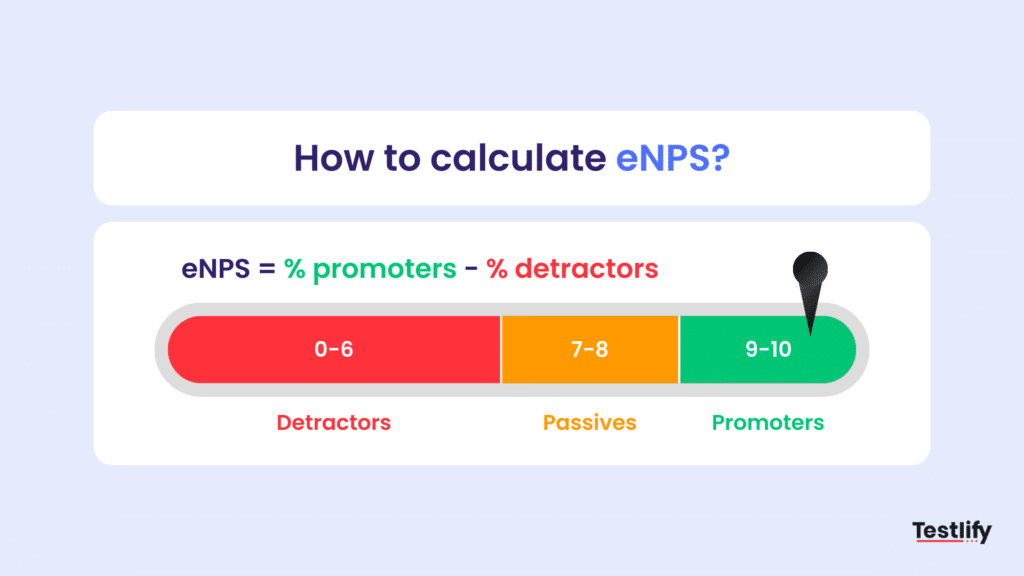
- Promoters (score 9-10): These people are contented and loyal. They are most likely to recommend the company to other people.
- Passives (score 7-8): These employees are satisfied but not overly enthusiastic. They won’t actively promote the company but are unlikely to leave unless offered a better opportunity.
- Detractors (0 – 6): These employees are dissatisfied with their experience and would not likely recommend the company.
Then, after categorizing responses, you calculate the eNPS by subtracting the percentage of Detractors from the percentage of Promoters. The result can range between -100 to +100.
What can HR leaders do to implement eNPS effectively?
Here are a few best practices you can follow to implement eNPS effectively at your workplace:
1. Communicate the purpose of eNPS
Employees need to know why eNPS is being measured, what it means, and how their feedback will be used and integrated into improvements. This should include communicating the survey’s intent and reassuring employees that their responses will lead to better change.
2. Make it a regular process
eNPS should not be a one-time survey. HR leaders can make it a regular process so that the engagement levels among employees in the company can be tracked over time. If eNPS surveys are done quarterly or bi-annually, then shifts in employee sentiment can be caught early.
3. Act on feedback
The most important step after gathering eNPS data is to take action. When employees share concerns or feedback, HR leaders must act on it. It may be improving workplace conditions, revising policies, or conveying concerns to the right leadership. Employees feel heard.
4. Close the feedback loop
Follow up with employees after collecting their eNPS responses. Share the results and explain what the organization plans to do about the feedback. It aids in building trust and generally makes everyone feel that their opinions matter to the organization.
How does eNPS improve company culture?
eNPS represents one simple but effective way to measure and improve company culture. It allows for identifying who would promote and detract from the workforce, knowing what is valued and what needs improvement.
For example, if advocates like the company’s career development programs, HR can expand on these programs to further support employee satisfaction. Conversely, if the critical views complained of poor communication or management problems, that is an open issue for improvement.
Essentially, eNPS provides you with all the information you need to foster a positive and vibrant company culture, improve morale in your organization, and increase retention.
Employee net promoter score calculation
The calculation for eNPS is straightforward:
- Categorize employees into three groups: Promoters, Passives, and Detractors.
- Calculate the percentage of Promoters and Detractors.
- Subtract the percentage of Detractors from the percentage of Promoters.
For example, if 60% of employees are Promoters and 20% are Detractors, the eNPS would be:
eNPS = 60% (Promoters) – 20% (Detractors) = +40
This score provides a snapshot of employee satisfaction. Scores can range from -100 to +100, with higher scores indicating stronger employee loyalty.
Examples of employee net promoter score
Here are a few examples to illustrate how eNPS works in different organizations:
- Example 1:Promoters: 70%Passives: 20%Detractors: 10%
- eNPS = 70% – 10% = +60
A score of +60 indicates a highly engaged and satisfied workforce, with the majority of employees likely to recommend the company to others. - Example 2:Promoters: 50%Passives: 30%Detractors: 20%
- eNPS = 50% – 20% = +30
While a score of +30 is still positive, it suggests areas for improvement, especially among the Detractors.
What is a good employee net promoter score?
A “good” eNPS score can vary depending on your industry, company size, and goals. However, in general:
- Scores above 0 are considered positive, indicating more promoters than detractors.
- Scores above 30 are excellent, showing a high level of employee satisfaction.
- Scores above 50 are outstanding, indicating a very loyal and engaged workforce.
However, it’s essential to remember that eNPS should be tracked over time to identify trends and areas of improvement rather than simply aiming for a specific score.
Employee net promoter score benchmarks
eNPS benchmarks can vary depending on the industry, but here are some general guidelines:
- Tech industry: +30 to +50 is typical for tech companies, where employees value innovation and career development opportunities.
- Healthcare: +20 to +40, as healthcare workers often have high expectations for work-life balance and workplace safety.
- Retail and service industries: +10 to +30, as these industries may experience higher turnover rates and more varied employee experiences.
Be sure to compare your company’s eNPS with industry standards to gauge how your organization stacks up.
How to improve employee net promoter score
Don’t worry if your eNPS score isn’t where you want it to be. These are some strategies that can help improve your score:
1. Increase employee recognition
Employees who feel recognized in their work engage more. Develop a recognition culture that ensures achievements are brought to light regularly.
2. Enhance career development opportunities
Engage training programs, mentorship, and definable career paths will make employees more invested in the role and the company.
3. Address employee concerns promptly
Respond to employee concerns within the shortest time possible and with transparency. Verify their feedback and engage toward a solution.
4. Promote work-life balance
Encourage a healthy work-life balance by offering flexible working hours, telecommuting options, and making time off more accessible.
5. Improve internal communication
Communicate clearly and openly with the employees, ensuring management is transparent. Hold regular updates, feedback sessions, and town hall meetings to keep employees informed and engaged.
Employee net promoter score (eNPS) Questions
While the core question for eNPS is straightforward, additional questions can provide more insight into specific areas of employee experience. Here are some examples:
- “What do you like most about working here?”
- “What areas do you think we can improve upon?”
- “What motivates you to stay with the company?”
- “How can we make this a better place to work?”
These follow-up questions can help identify the drivers behind your eNPS score and give you actionable feedback.
What are the benefits of eNPS?
Key benefits of using eNPS include:
Improved employee retention: By understanding employee satisfaction, you can make appropriate changes to boost morale and minimize turnover.
Strong employer brand: A good eNPS helps build a good reputation for the employer and can attract talented workers.
Actionable insights: eNPS provides data that can be used to improve company culture, policies, and employee experience.
Employee engagement: Regularly measuring eNPS keeps employees engaged and shows them that their opinions matter.
Tips for successfully using eNPS
To maximize the benefits of eNPS, follow these tips:
- Be transparent with results: Share eNPS results with your employees and explain what actions will be taken based on their feedback.
- Track changes over time: Don’t treat eNPS as a one-time event. Regularly track scores to monitor trends.
- Encourage honest feedback: Ensure employees feel comfortable giving honest responses and reassure them that their answers are confidential.
- Act on the feedback: Use the results to make real improvements in the workplace. If employees suggest changes, try to implement them as soon as possible.
NPS vs. eNPS: What’s the difference?
While both NPS and eNPS are based on the same concept, they differ in their application:
- NPS (Net Promoter Score) measures customer loyalty by asking customers how likely they are to recommend a product or service.
- eNPS (Employee Net Promoter Score) measures employee engagement by asking employees how likely they are to recommend the company as a place to work.
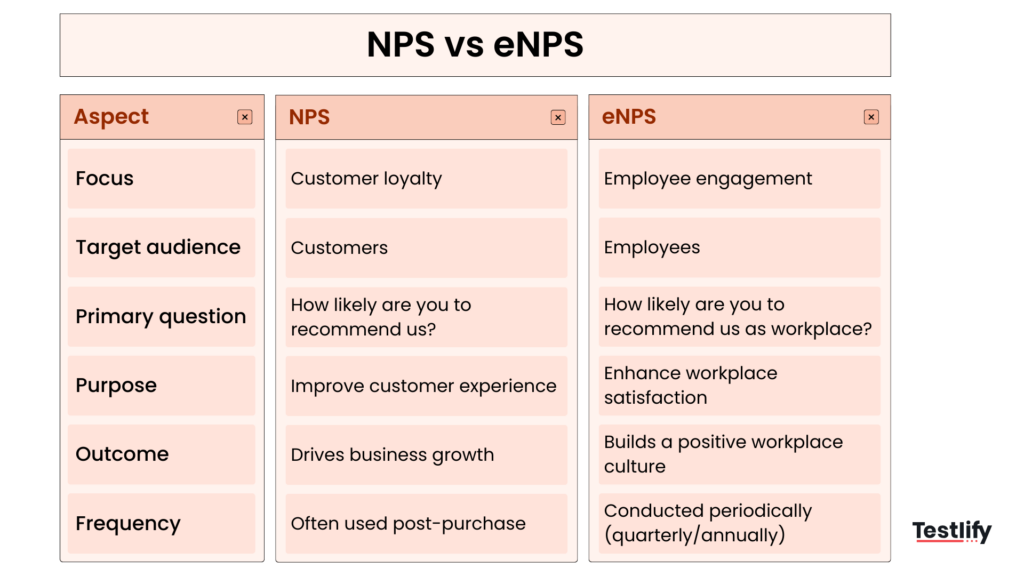
While NPS helps businesses gauge customer satisfaction, eNPS helps organizations assess employee sentiment and loyalty, making it a valuable tool for recruiters and HR leaders.
Conclusion
This is how incorporating eNPS in the recruitment strategy allows you to understand your organization’s culture or where you stand concerning employee satisfaction levels. Whether improving the employer brand, attracting talent, or reducing turnover, eNPS is a tool that offers you everything. It only takes regular, proactive measurements and actions on eNPS to make your company an employer of choice in today’s competitive job market.
Remember, if the employee experience is positive, so are the outcomes for your existing workforce and future recruits. So start measuring eNPS today and watch how that transforms your recruitment strategy!
For further reading, explore Promoter.
Frequently asked questions (FAQs)

Content Writer
Yashika Khandelwal is a Content Writer with 3+ years of experience creating research-backed content on hiring, talent assessment, and HR technology. She is a registered Organizational Psychologist and subject matter expert who combines behavioral science with practical recruitment insights to produce accurate, evidence-based content.
LinkedInRelated resources
View all
HR & recruitment
Spans and Layers: How to Right-Size Your Org Structure

HR & recruitment
Workforce Reduction: Steps, Alternatives, and Best Practices

HR & recruitment
7 ways to start your talent search and sourcing strategy

HR & recruitment
HR Benchmarking: Types, benefits and challenges

HR & recruitment
Agile recruitment: Step-by-step process and benefits

HR & recruitment
Job Crafting: Types, Examples, and How to Do It (2026)
Get started.
Hire on proof, not resumes.
Run your first skills-based assessment free — no credit card required.