
Global employment: Legal standards, cost, and hiring strategies
Learn about global employment covering legal standards, costs, and smart strategies for building and managing international teams.

Remote collaboration, digital work tools, and changing global markets have created huge possibilities for organizations to access talent pools beyond borders.
But, global employment isn’t as simple as listing a job posting and hiring professionals from different countries. There are legal infrastructures, cultural norms, tax implications, and cost factors that HR professionals need to consider.
If you’re an HR professional, chances are you already understand that something that can work in the United States can be a compliance issue in Germany, or that employment in India has entirely different paycheck rules than Brazil.
This blog is your solution to finding your way around global employment, from knowing legal norms to controlling costs and developing effective recruitment strategies.
 ChatGPT
 Gemini
 Claude
 Grok
Grok Perplexity
What is global employment?
Global employment is the process of recruiting and employing workers who reside and work in nations other than where a business has its headquarters. It allows companies to access global talent pools, create diverse teams, and enter new markets without being geographically constrained.
With the emergence of remote work and online collaboration platforms, global employment has never been easier. But although it brings a lot of possibilities, it is also filled with a maze of legal, financial, and cultural implications that need to be carefully navigated by organizations.
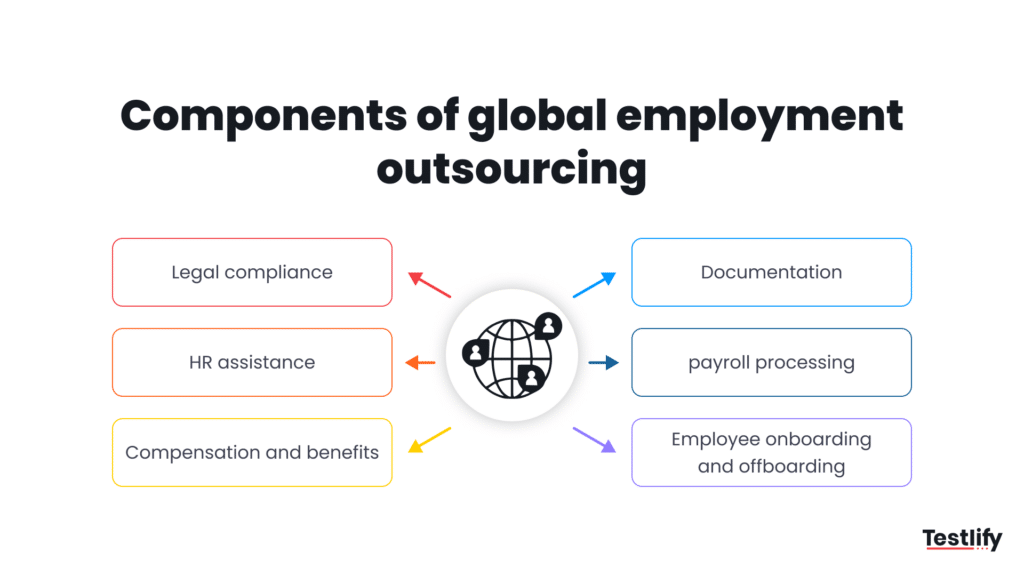

Why is global employment on the rise?
Businesses no longer have geographical boundaries in terms of identifying talent. Global employment is has now become convenient and easy with remote work technology.
Here’s why:
Access to global talent pools: You’re not limited to your city or country. Want a top developer in Poland or a marketing pro in Argentina? Go for it.
Cost savings: Hiring in countries with lower cost-of-living can reduce overhead.
Diverse teams: Diversity drives innovation, and international teams bring unique perspectives to the table.
But before you jump in, you need to understand the legalities involved.
Advantages and disadvantages of global employment
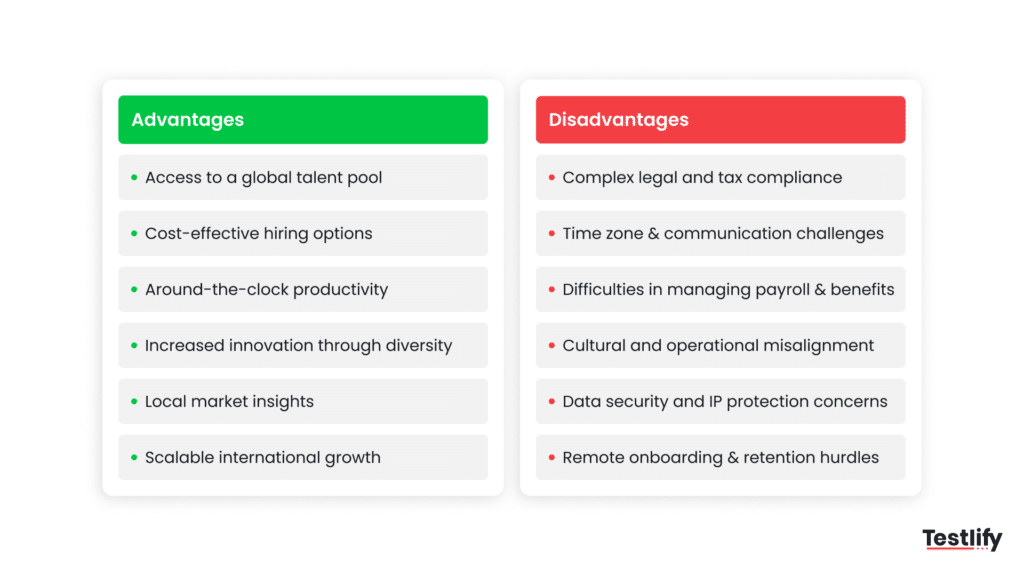
But before you jump in, you need to understand the legalities involved.
Understanding legal standards across borders
Hiring someone in another country isn’t as simple as emailing them an offer letter. Legal compliance is critical and it’s often complex.
Employment laws vary widely
Each country has its own labor laws, and they affect everything from:
- Working hours
- Employee classification (contractor vs. full-time)
- Termination policies
- Paid time off
- Minimum wage and overtime
- Data privacy and workplace safety
For example, in France, a 35-hour workweek is standard, and terminating an employee is a legally intricate process. In contrast, U.S. employers can often terminate employment at will.
Misclassification risks
One of the most common mistakes in global employment is misclassifying employees as independent contractors. While this may seem like a simpler, cheaper way to engage international workers, it can lead to heavy fines and legal consequences if the classification doesn’t meet the local legal definition.
How to stay compliant?
Here are a few ways HR can manage this complexity:
Partner with local legal experts: Even if you only hire one person in a country, consult a local labor lawyer.
Use Employer of Record (EOR) services:Employer of Record Services can hire on your behalf, ensuring compliance with local laws.
Stay updated: Employment laws change. Keep up with changes in key global employment regions.
True costs of global employment
When planning a global hire, salary is just the starting point. HR needs to think about:
Direct costs
Payroll administration
Managing payroll for international employees involves more than just transferring money. You’ll need to navigate local tax systems, comply with labor laws, and process payments in different currencies. This often requires local expertise or specialized payroll providers, adding to operational costs and complexity especially when employing workers in multiple countries.
Tax compliance
Tax regulations differ significantly between jurisdictions. Employers are required to withhold and pay proper income taxes, report wages correctly, and frequently manage social tax filings. Non compliance can result in penalties or audits. HR must collaborate with local specialists or international payroll services to remain current on changing tax requirements in every country.
Onboarding and training costs
Global workers need customized onboarding procedures, such as country-specific legal documents, company policies, and compliance training. Moreover, training remote workers usually means developing custom digital content, scheduling time zones, and providing extended onboarding timelines to align, all of which contribute to the cost and resource investment HR must make.
Technology setup (Laptops, tools, licenses)
Arming global hires with the appropriate technology is essential to productivity. This involves issuing laptops, collaboration software, cybersecurity tools, and project management or industry-specific platform licenses. Buying and shipping equipment overseas can be expensive and logistically challenging, particularly when considering import duties, shipping delays, or device replacement.
Indirect costs
Currency fluctuations
While paying workers in foreign currencies, exchange rates can affect your payroll cost. A sharp devaluation or a local currency spike can make it costly to hire from that area suddenly. Hedging techniques or the establishment of salary buffers should be considered by HR departments to guard against sustained currency volatility.
Exchange and banking fees
International payroll payments tend to have extra banking or wire transfer charges, particularly when making payment through intermediary banks. The charges may appear minor on their own but become considerable over time, particularly with many employees or on a monthly basis. Opting for effective global payroll vendors or bulk payment alternatives can assist in minimizing these charges.
Time zone coordination
Working in time zones can produce communication and cooperation inefficiencies. It might incur costs in buying asynchronous tools, adaptable work timings, or other project management facilities to maintain teamwork coordination. Indirect cost from time-consuming decision-making and coordination difficulties must be accounted for within the total expense of managing the global workforce.
Global hiring strategies that work
After grasping the legal and financial implications of global employment, the selection of the appropriate global employment approach follows. HR groups need to balance business objectives, staffing plans, and compliance requirements to determine whether third-party services, direct hiring, or contractor assistance is best, all while maintaining cultural integration and efficient communication.
1. Skills assessments
Skills assessments help ensure candidates have the required competencies, regardless of where they’re located. Especially in global employment, where educational standards and job titles vary across countries, standardized tests offer a fair and objective way to compare talent. These can include:
- Technical or coding tests
- Language proficiency assessments
- Role-specific scenario-based exercises
- Soft skills evaluations (e.g., problem-solving, communication)
Using skills assessments early in the hiring process helps reduce bias and ensures you’re hiring based on ability, not just credentials.
2. Video Interviews
Video interviews streamline global employment by bridging time zones and reducing logistical hurdles. Employers can conduct live interviews for real-time conversations or use one-way, pre-recorded formats to review responses on their own schedule.
These tools provide insight into a candidate’s communication style, professionalism, and cultural fit. Video interviews also speed up the hiring process, make it easier to involve multiple stakeholders, and allow for more consistent, scalable interview experiences across international teams.
3. Applicant Tracking Systems (ATS)
An Applicant Tracking System (ATS) helps manage the entire hiring process in one centralized platform. It streamlines job postings, candidate communication, interview scheduling, and evaluation making it essential for global employment.
ATS platforms ensure consistency across regions, support compliance with local hiring laws, and reduce manual admin. Many also integrate with video interview tools and skills assessments, providing a seamless experience for both recruiters and candidates while improving hiring efficiency and decision-making.
4. Use Employer of Record (EOR) services
Employer of Record services is a quick, low-risk method to recruit talent worldwide. The EOR is the employer of record, handling payroll, tax returns, contracts, and benefits for you. This allows businesses to move into new markets without establishing a local entity perfect for early-stage global employment or piloting new markets before scaling up.
5. Build in-house international teams
Building an in-house team by establishing a legal entity provides more control over employee experience, culture, and compliance. Although this path demands a higher initial investment and continued administrative effort, it is worthwhile for firms with a long-term presence in one country and seeking more in-depth integration and lower per-employee costs in the long run.
6. Use contractors strategically
Employing independent contractors is a low-cost and flexible way to accomplish short-term or project work. Misclassifying contractors, though, can cause legal problems. HR needs to have proper contracts, be respectful of local classification laws, and not treat contractors as employees. This approach will work best if legal regulations are obeyed and the scope of work is kept well defined.
Make sure you:
- Have a solid contractor agreement
- Understand local classification laws
- Avoid providing equipment or direction that mimics employment
7. Focus on cultural fit and communication
Assembling a global team isn’t only about conformance to law; it’s about constructing a unified work culture beyond borders. HR must facilitate cultural understanding, encourage open communication, and plan wisely across time zones. Investment in tools and training that encourage understanding and teamwork assists global workers in feeling connected and committed regardless of location.
To manage that:
- Offer cross-cultural training
- Use clear, consistent communication tools
- Be timezone-conscious in meeting planning
Best practices for managing global teams
1. Standardize onboarding (With local tweaks)
Establish a standardized onboarding process that welcomes all new employees to your company’s purpose, tools, and expectations. Next, adapt specific aspects such as legal documents, benefits, and cultural expectations to comply with local regulations. This way, every team member begins on an equal footing without sacrificing compliance or sensitivity to regional nuances.
2. Invest in tools that support remote work
Arm your remote team with trusty communication, project management, and knowledge-sharing software such as Slack, Zoom, Notion, or Jira. These tools bridge time zones, keep everyone productive, and stay aligned regardless of where they work. A well-suited tech stack provides a more streamlined, connected remote experience for distributed teams.
Don’t overlook a fast, secure VPN/proxy in your stack. It encrypts connections to company resources, protects logins on public Wi‑Fi, and preserves reliable access across regions. For distributed teams and traveling employees, a lightweight, high‑speed service simplifies access to region‑restricted SaaS and training portals, and can be used to get around geo-blocks when necessary, without compromising security or governance.
3. Prioritize employee engagement
Remote workers may get isolated if special efforts are not made to integrate them. Cultivate engagement with frequent check-ins, virtual team-building, and rewards programs. Encourage two-way communication and share successes collectively. An effective engagement strategy raises morale, retention, and productivity even when your team is located on different continents.
When should you set up a legal entity?
A legal entity is a formally registered organization in a given country (e.g., subsidiary, branch office, or representative office). It allows you to:
- Hire employees directly
- Open local bank accounts
- Register for tax and social security
- Operate as a local business
Determining when to form a foreign legal entity is one of the most strategic and usually difficult choices HR and leadership teams must make when going global. The timing of making this decision relies on various considerations, such as your headcount strategy, long-term business objectives, compliance requirements, and cost-effectiveness priorities.
Hiring 1–2 employees? A quicker and less risk-prone alternative is utilizing an Employer of Record (EOR). EORs enable you to legally hire and compensate foreign workers without establishing a bricks-and-mortar presence within their country.
Hiring 5+ employees in the same country? It is certainly worth considering having your own legal entity. Although it does mean more initial investment and time, it can be more controllable, have less long-term cost per-employee, and can have greater branding in the regional market.
Setting up a legal entity requires:
- Registration with local authorities
- Hiring legal, tax, and payroll experts
- Maintaining compliance with labor and corporate laws
Final thoughts: Think global, hire smart
Global employment brings a world of opportunity but it’s not without its challenges. For HR professionals, the trick is to balance growth with compliance, and agility with cost-efficiency.
Here’s a quick checklist for global employment success:
For further reading, explore Global Mindset Test.
- Understand local labor laws
- Choose the right hiring method (EOR vs. direct vs. contractor)
- Factor in total cost not just salary
- Use the right tools to manage remote teams
- Invest in global employment and engagement
- Stay curious and adaptable
Frequently asked questions (FAQs)

Content Writer
Yashika Khandelwal is a Content Writer with 3+ years of experience creating research-backed content on hiring, talent assessment, and HR technology. She is a registered Organizational Psychologist and subject matter expert who combines behavioral science with practical recruitment insights to produce accurate, evidence-based content.
LinkedInRelated resources
View all
HR & recruitment
Strategic talent acquisition in E-commerce: success in the digital era

HR & recruitment
Improving candidate experience through intelligent conversations and smart assessments

HR & recruitment
How Pre-Employment Assessments Redefined Skill-Based Hiring

HR & recruitment
Understanding HR Recruitment: Step-By-Step Guide To Recruit The Perfect Employees

HR & recruitment
How Recruitment Platforms Can Benefit from Cloud Storage Solutions

HR & recruitment
Internship offer email: 13 templates that get a yes
Get started.
Hire on proof, not resumes.
Run your first skills-based assessment free — no credit card required.