
Speed vs accuracy in enterprise hiring funnel
Optimize your enterprise hiring funnel with smart strategies that balance speed and accuracy. Discover tools, metrics, and insights to hire better and faster.

Every enterprise wants to hire quickly. But hiring quickly without hiring the right candidate is a risk most companies can’t afford.
The pressure to quickly fill roles often clashes with the need to make thoughtful decisions. This trade-off between speed and accuracy is at the core of many broken hiring funnels.
In large organizations, delayed hiring leads to business disruptions, while rushed hiring leads to mismatched candidates. Either way, the result is lost time, wasted resources, and poor employee retention.
When not optimized, the enterprise hiring funnel becomes a bottleneck. This blog explores how enterprises can fix this imbalance.
 ChatGPT
 Gemini
 Claude
 Grok
Grok Perplexity
What is an enterprise hiring funnel?
An enterprise hiring funnel is a structured, multi-stage recruitment model designed to manage high-volume, cross-functional hiring efficiently and consistently.
Hiring isn’t linear at the corporate level. Multiple departments hire simultaneously. Roles range from entry-level to executive. Different evaluation criteria are required for each job role.
The funnel serves as a scalable system for managing all these moving components while maintaining speed and candidate quality.
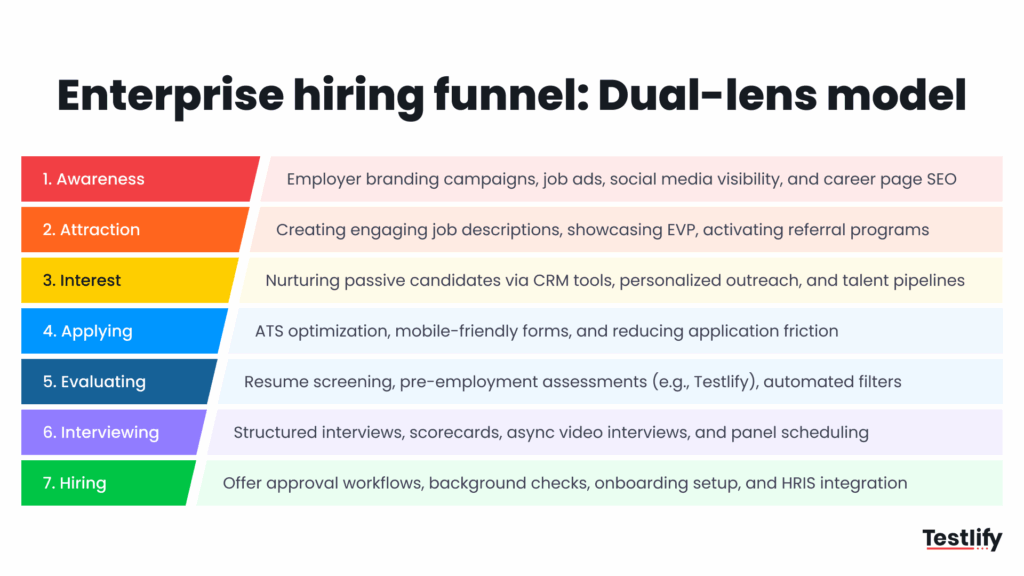
The hiring funnel is composed of seven core stages:
- Awareness: This is the moment potential candidates first discover your company. It could be through LinkedIn, Glassdoor, word of mouth, or employee advocacy. At an enterprise level, the responsibility for brand awareness is often shared between HR and marketing.
- Attraction: Employer brand strength plays a crucial role here. Candidates are evaluating whether they want to engage further.
- Interest: Candidates begin to explore job roles and company values more deeply. This is where intent starts to build.
- Applying: This is the point where the funnel becomes measurable. Applications flow in; drop-offs from clunky ATS systems or long forms can be costly.
- Evaluating: This is the most resource-intensive stage. Recruiters now filter through applicants and assess their qualifications.
- Interviewing: Only a small percentage of applicants reach this point. The process must be fast, fair, and data-driven.
- Hiring: The final decision is made, and an offer is extended. But enterprise hiring doesn’t stop there.
Why this funnel matters more in enterprises
To truly optimize hiring at an enterprise level, an enterprise recruiter needs to understand two perspectives happening in parallel:
In enterprise environments, hiring is rarely a one-person job. Each open role may involve multiple stakeholders, compliance checks, role-specific evaluations, and regional coordination.
According to the 2025 Recruiting Benchmarks Report, hiring teams conducted 42% more interviews per hire than in 2024, leading to a 24% increase in the average time to hire (from 33 to 41 days).
When your hiring funnel lacks structure or speed, top talent drops out, and average candidates slip through. This inefficiency multiplies quickly for enterprise hiring teams managing hundreds or thousands of monthly applications.
Also Read: The evolving role of enterprise recruiters.

Speed vs accuracy: The ongoing tug of war
Every enterprise recruiter faces the same question: Should we hire fast or hire right?
At scale, this isn’t a philosophical debate; it’s a measurable business trade-off with real impact on performance, cost, and retention.
When speed becomes the priority
Speed is often driven by business pressure. Unfilled positions may cause current teams to become overworked or delay client deliverables.
Enterprise hiring teams are expected to meet quarterly headcount targets, shorten the time to hire, and close positions quickly. It’s not uncommon for large organizations to track “hiring velocity” as a key performance metric.
But here’s the risk: Fast hiring can sacrifice candidate evaluation depth. To meet internal deadlines, recruiters may push underqualified candidates forward, rely too much on resumes, or forego structured assessments in their haste to fill positions.
Result?
- Higher attrition within 90 days
- Increased onboarding costs
- Negative impact on team performance
- Repeated cycles of backfilling roles
Check Out: Use our Time to Hire Calculator to align your enterprise hiring funnel with hiring goals.
When accuracy takes over
On the other hand, some teams go deep on precision. They invest time in multi-stage interviews, case studies, reference checks, and cultural fit assessments. These steps improve quality-of-hire and reduce the risk of misalignment.
In fact, SHRM research shows that a bad hire can cost up to 30% of the employee’s annual salary, making accuracy a financially wise choice.
But here, too, there’s a price. Lengthy hiring processes can frustrate candidates, lead to drop-offs, and open the door for competitors.
A SHRM study reported that 60% of candidates abandon applications if the process takes too long or lacks transparency. In a competitive talent market, slow is often seen as disinterest.
Striking the right balance
The truth is, enterprises don’t have to choose between speed and accuracy.
Modern hiring tools, automation, and structured processes make it possible to achieve both.
That’s where platforms like Testlify come in.
- Testlify helps reduce manual screening by using automated pre-employment assessments, cutting days from the evaluation phase.
- It enables asynchronous candidate testing, allowing candidates to complete tests on their own time, while recruiters review results instantly.
- With built-in analytics and benchmarking, recruiters can make faster, smarter, and more consistent decisions.
This kind of system doesn’t just speed up hiring, it also improves accuracy without adding complexity.
Why enterprises struggle to balance both
Balancing speed and accuracy in hiring, especially for enterprises, is easier said than done.
Large organizations are working across silos, systems, and stakeholders, whereas smaller businesses can often tweak their processes quickly. That complexity is precisely what creates the gap.
Fragmented hiring processes
Different departments or regions in many enterprises operate with their own hiring methods. Marketing might use different screening criteria than engineering. Sales might skip assessments entirely, while tech insists on live coding tests.
Without a standardized enterprise hiring funnel, inconsistencies creep in, making it hard to optimize for either speed or accuracy.
Manual screening slows everything down
Also Read: Hiring Funnel Bottlenecks: How to Stop Candidate Ghosting
Enterprises often receive hundreds or even thousands of applications per open role. Without automation, recruiters spend hours manually reviewing resumes. This bottleneck inflates the time to hire and limits the focus on the quality-of-hire.
Too many stakeholders, too many delays
The average enterprise hiring decision involves 3–5 stakeholders. Valuable time is lost between scheduling interviews, collecting feedback, and aligning on who to move forward with.
In high-volume roles, this can stall hiring for weeks. The result? Either speed is sacrificed for alignment, or accuracy is compromised to close quickly.
Poor tech integration
Many enterprises rely on legacy applicant tracking systems (ATS), HRIS platforms, or recruitment CRMs that don’t “talk” to each other. This leads to repetitive data entry and lost candidate insights.
Fear of missing out on top talent
In trying to be thorough, many hiring teams hold out for the “perfect” candidate. But in today’s competitive market, the best candidates are off the market in 10–14 days. The longer you take, the more likely another company will move faster.
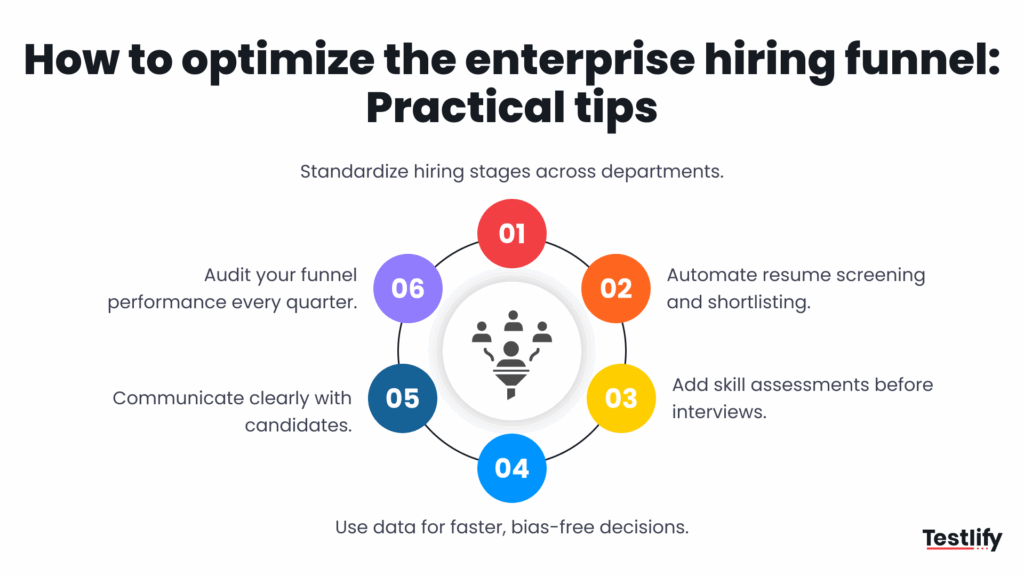
The real challenge isn’t choosing speed or accuracy; it’s building a hiring infrastructure that supports both. Without automation, structured evaluation, and better team alignment, that balance will always be out of reach.
Check Out: Testlify’s quality of hire calculator to measure how effective your hiring really is.
Tools and technology to accelerate accuracy
In enterprise hiring, achieving both speed and accuracy requires the right technological tools. Here’s how Testlify addresses this challenge:
AI-powered skill assessments
Testlify offers a comprehensive test library of over 3,500+ pre-built assessments across various domains, including technical, cognitive, and behavioral skills.
These assessments are designed to accurately and efficiently evaluate candidates’ abilities, reducing reliance on resumes and subjective judgments.
AI-driven video interviewing
Testlify’s AI-powered video interviewing tool allows candidates to record responses to predefined questions. The platform analyzes these videos to assess communication skills, confidence, and other soft skills, providing a deeper insight into candidate suitability.
Seamless ATS integration
Testlify integrates with over 100+ Applicant Tracking Systems (ATS), enabling smooth data flow and streamlined recruitment processes. This integration ensures that assessment results are easily accessible within existing recruitment workflows.
Real-time analytics and reporting
The platform provides real-time analytics and detailed reports, allowing recruiters to make informed decisions quickly. These insights help identify top candidates and understand assessment performance trends.
Customizable assessments
Testlify allows recruitment teams to create custom assessments tailored to specific job roles and requirements. This flexibility ensures that the evaluations are relevant and aligned with organizational requirements.
Metrics that matter: Tracking progress
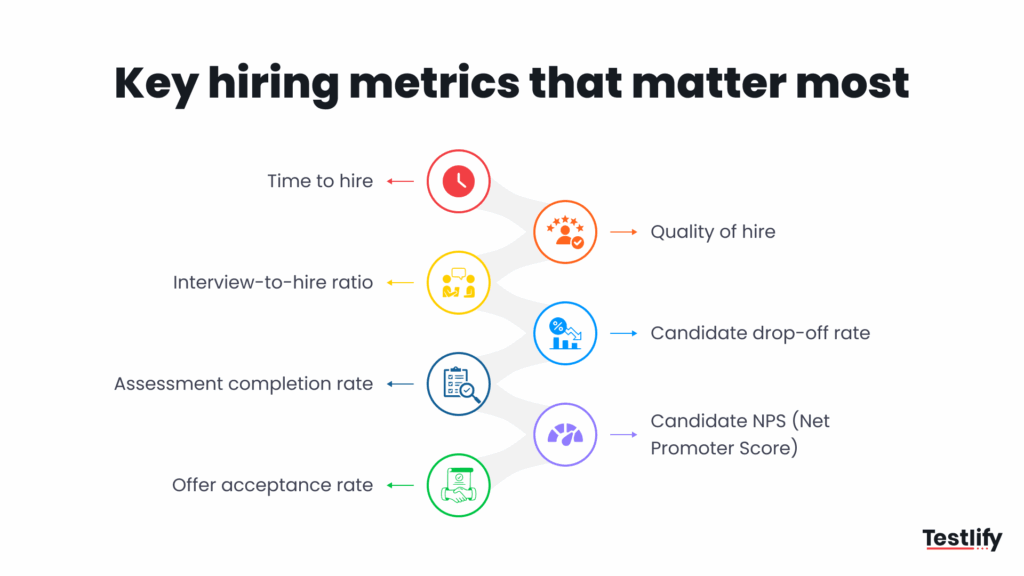
You can’t improve what you don’t measure. For enterprise hiring teams, tracking performance across the funnel is essential for making more accurate hiring decisions. The right metrics highlight inefficiencies and help validate what’s working.
Also Read: Interview to hire ratio: A complete guide for hiring teams
Case insight: What top companies are doing right?
While many enterprises struggle with the speed vs. accuracy challenge, top-performing companies don’t settle for one over the other. Instead, they build intelligent hiring systems that scale —and let data, not urgency, drive decisions.
Let’s look at how leading organizations optimize their enterprise hiring funnels.
Google: Structured interviews + data-backed hiring
Google is known for its rigorous hiring process, but that doesn’t mean it is slow. They use structured interviews with pre-defined rubrics and scorecards to reduce bias and improve evaluation consistency. Multiple data points back each hire.
Accenture: High-volume hiring with pre-assessment filters
Accenture hires thousands of candidates yearly across multiple geographies. They use online assessments early in the funnel to filter candidates based on job-relevant skills to streamline this at scale.
Amazon: Fast funnel, high bar
Amazon’s “bar raiser” program ensures hiring decisions are made quickly, but never at the cost of quality. They embed independent evaluators into the hiring team to maintain consistent standards.
Final thoughts: Speed and accuracy aren’t enemies
Enterprises no longer have to choose between speed and accuracy. The real solution is building a structured hiring funnel with the right tools and data.
Platforms like Testlify simplify this shift, with async assessments, AI video interviews, and built-in analytics to streamline every stage. Optimize the funnel, and the results will follow.
For further reading, explore Enterprise Architect.
Frequently asked questions (FAQs)

B2B SaaS Content Writer
Rishav Kumar is a B2B SaaS content writer with 4 years of experience. He loves crafting engaging content. Always exploring fresh ideas, he's passionate about helping businesses grow through impactful writing.
LinkedInRelated resources
View all
HR & recruitment
How to build a recruitment tech stack that works at enterprise scale

HR & recruitment
How to hire startup web app development company

HR & recruitment
How small businesses can use scheduling software to attract top talent

HR & recruitment
Key hiring metrics every large organization should monitor

HR & recruitment
Global hiring insights: Key strategies for success

HR & recruitment
How to operationalize DEI in the enterprise recruitment funnel
Get started.
Hire on proof, not resumes.
Run your first skills-based assessment free — no credit card required.