
Skills based hiring best practices: how to implement them in 2026
Ten skills based hiring best practices, a 90-day rollout plan and the metrics that show whether hiring for skills works in your team.

Skills based hiring best practices are the habits that make hiring for ability work day to day: a short list of must-have skills per role, job ads written around those skills, a job-like test before anyone reads a resume, one scoring rubric for every candidate, trained interviewers and a quarterly review against real outcomes. Most employers now say they hire for skills. Far fewer have changed how candidates are actually screened, scored and chosen, and that gap is what this playbook closes.
If you need the definition and the case for the approach first, start with our explainer on skills-based hiring. This page is for TA leaders, recruiting ops managers and HR business partners who have already decided to make the shift and now need to make it stick.
TL;DR:
- The core practices: define 5 to 7 must-have skills per role, test them before the resume screen, score every candidate on one rubric and review results each quarter.
- Adoption is broad but shallow. 70% of employers in NACE's Job Outlook 2026 use skills-based methods for entry-level hires, yet a Harvard Business School study found the shift changed fewer than 1 in 700 hires.
- Dropping a degree line from the job ad is not a practice. About 45% of firms that did so changed hiring in name only.
- Never rank candidates on self-rated skills. The US federal government stopped using self-assessment questionnaires for ranking in 2025.
- Start with 2 to 3 pilot roles, set a baseline for time-to-hire and quality of hire, and scale only after one full review cycle.
- A skills test should replace a resume screen, not add a stage, or candidate drop-off rises.
 ChatGPT
 Gemini
 Claude
 Grok
 Perplexity
What are the most important skills based hiring best practices?
Skills based hiring best practices come down to ten habits, run in order on a few roles before the whole company. Each one removes a point where degrees, job titles or gut feel used to decide who moved forward. Adoption is already wide: NACE's Job Outlook 2026 survey found 70% of employers use skills-based methods for entry-level hires, most often in interviews (87%), job descriptions (81%) and screening (65%).
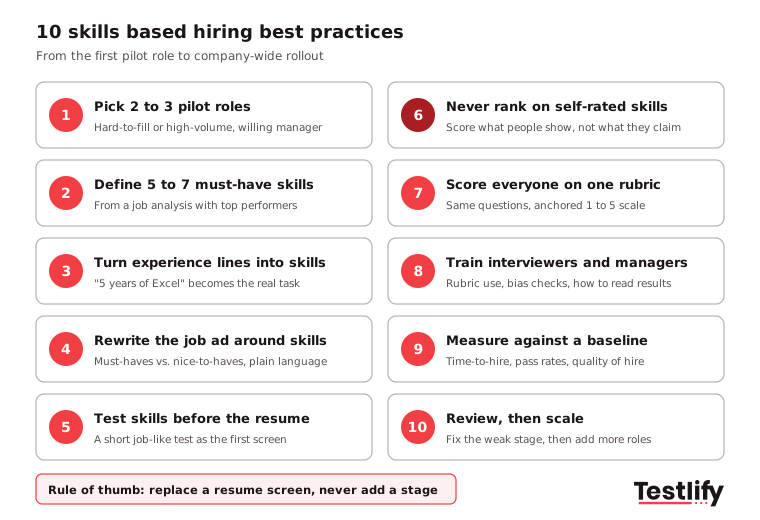
- Pick pilot roles: Choose 2 to 3 roles that are hard to fill or hired in volume, with a manager who wants to try it.
- Define must-have skills: Agree on 5 to 7 skills per role from a job analysis.
- Translate experience lines: Turn "5 years of X" into the task those years were meant to prove.
- Rewrite the job ad: Lead with skills and outcomes, split must-haves from nice-to-haves.
- Test early: Put a short, job-like assessment before the resume screen.
- Ban self-rated skills from scoring: Rank on what candidates show, not what they claim.
- Use one rubric: Same questions and the same anchored scale for every candidate.
- Train the people deciding: Recruiters and hiring managers learn the rubric and how to read results.
- Measure against a baseline: Track time-to-hire, pass rates, quality of hire and early exits.
- Review, then scale: Fix the weakest stage, then add the next set of roles.

Why do so many skills-first hiring efforts stall?
Skills-first hiring efforts stall because companies change the job ad but not the decision. A February 2024 report by Harvard Business School's Project on Managing the Future of Work and the Burning Glass Institute found that about 45% of firms that removed degree requirements made the change in name only, and the overall shift touched fewer than 1 in 700 hires.
The pull back toward old habits is visible in job postings too. Indeed Hiring Lab's January 2026 analysis shows 51% of postings list no formal education requirement, but the share asking for a bachelor's degree or higher rose to 19.3% in November 2025, from 16.6% two years earlier.
Three patterns sit behind most stalled programs:
- No way to see skills: If the only evidence in front of a recruiter is a resume, the recruiter falls back on degrees and brand-name employers.
- Inconsistent teams: One hiring manager uses the new rubric, the next ignores it, and the data never adds up to a decision.
- Speed pressure: A new stage that adds days gets skipped the first time a role is urgent.
The good news from the same report: at the firms that followed through, non-degree hires stayed at a rate 10 percentage points higher than their degree-holding peers.
How do you develop a skills based hiring strategy?
A skills based hiring strategy is a short written plan that names the goal, the pilot roles, the owners and the metrics before any process changes. Writing it down first keeps the effort from becoming a job-ad rewrite with no change in who gets hired.
Cover five points on one page:
- The problem you are solving: Slow time-to-fill, poor quality of hire, a narrow candidate pool or bias concerns. Pick one primary goal.
- Pilot roles: Two or three, ideally one high-volume role and one hard-to-fill role.
- Owners: A TA lead who owns the process, a hiring manager per role and someone from HR ops or people analytics who owns the data.
- Baseline numbers: Current time-to-hire, offer acceptance, 90-day attrition and hiring manager satisfaction for the pilot roles.
- Decision rule: What result after one quarter means you scale, adjust or stop.
Buy-in matters more than tooling. The SHRM skills-first research found 86% of HR professionals using skills-first hiring hit hurdles, led by reliance on degree requirements (29%), lack of tools to assess skills (29%) and inconsistent practices across teams (25%). Your strategy should name how you will handle each of those three before launch.
Key takeaway: Treat the first quarter as an experiment with a decision rule, not a company-wide policy change.
How do you put skills based hiring practices in place, step by step?
Skills based hiring practices go in through five stages: define the skills, rewrite the job ad, assess before the resume, decide with a structured interview and review the results. Run all five on the pilot roles before adding more. If you are working out how to implement skills-based hiring across a large organization, the order matters more than the tools: skills first, evidence second, decisions third.
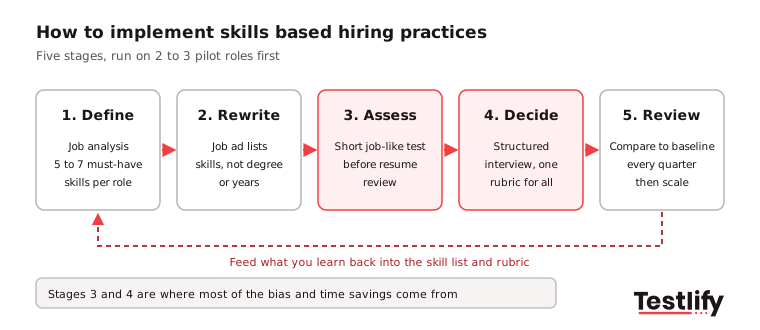
1. Define the skills each role needs
Run a short job analysis with the hiring manager and two or three top performers in the role. List the tasks that fill most of the week, then the skills each task needs. Cut the list to 5 to 7 must-haves. Everything else is a nice-to-have or something you can teach in the first 90 days. A shared skills taxonomy keeps the same skill from being described five different ways across teams.
2. Rewrite the job ad around skills
Lead with what the person will do and the skills that work requires. Move degrees to "nice to have" or drop them where the job does not legally need one. Use plain language and keep the must-have list short, because long requirement lists put off qualified people who do not tick every box.
3. Assess skills before the resume screen
Send a short, job-like assessment as the first step, so every applicant gets the same chance to show ability before anyone reads a job history. Keep it to 30 to 45 minutes for most roles. This is the practice that most often separates real programs from name-only ones, because it puts evidence of skill in front of the recruiter at the moment the shortlist is made.
4. Stop scoring self-rated skills
Self-ratings tell you how confident a candidate is, not how skilled. Under the OPM Merit Hiring Plan, US federal agencies had to stop using self-assessment questionnaires to rate and rank applicants by September 30, 2025, and add at least one technical assessment such as a work sample or structured interview. Private employers can apply the same rule: questionnaires can check eligibility, but scores come from what candidates do.
5. Decide with a structured interview and one rubric
Ask every finalist the same job-related questions and score answers on an anchored 1 to 5 scale, with a written note for each score. A structured interview and a shared interview scorecard turn interviews into evidence that can be compared across interviewers.
6. Train recruiters and hiring managers
Run a 60 to 90 minute session per hiring team: how to use the rubric, how to read assessment results, and the common biases that creep back in (similarity, halo, first impressions). Calibrate by having two interviewers score the same recorded answer and discuss the gap.
7. Reduce noise that is not skill
Hide names, photos and schools during early review where your tools allow it. Blind hiring works best as a support to skills evidence, not a replacement for it.
8. Close the loop with candidates
Tell candidates up front what the assessment covers and how long it takes, and share results or feedback where you can. Clear expectations keep completion rates up.
Pro tip: Put the assessment where the resume screen used to be, not after it. Adding a test on top of every existing stage makes the process longer and gives candidates a reason to drop out.
How do you turn experience requirements into skills?
Experience requirements turn into skills when you ask what the years were supposed to prove and then test that directly. "Five years of experience" usually stands in for a handful of tasks the person can do without supervision.
Old requirement | What it was meant to prove | Skills-based version |
|---|---|---|
Bachelor's degree in finance | Can build and read financial models | Builds a three-statement model from raw data in a timed Excel task |
5+ years in customer support | Handles upset customers calmly and resolves issues | Resolves three written tickets and one chat simulation to a set quality bar |
3 years as a Java developer | Writes clean, working code without hand-holding | Completes a 60-minute coding task with tests in the language used on the team |
Experience managing a team | Gives feedback and sets priorities | Answers situational judgment questions and a structured interview on real team scenarios |
Strong communication skills | Writes clearly for customers and colleagues | Writes a short customer email from a brief, scored on a rubric |
Run this exercise with the hiring manager for every pilot role. Disagreement about the middle column is a sign the role itself is not clearly defined yet.
Which assessment methods fit which skills?
Assessment methods should match the skill you want to see: knowledge tests for what people know, work samples for what they can do and structured interviews for how they think through situations. Most roles need two or three methods, not one.
Skill type | Best-fit method | Example |
|---|---|---|
Technical or job knowledge | Role-specific knowledge test | Accounting principles, networking basics |
Hands-on tool skills | Simulation or practical task | Excel model, coding task, CRM data entry |
Problem solving | Cognitive ability test or case task | Data interpretation, prioritising a backlog |
Judgment and behaviour | Situational judgment test plus structured interview | Handling a missed deadline or a customer complaint |
Communication | Written task or one-way video answer | Customer email, short explainer on video |
Language | CEFR-based language test | English B2 for a support role |
Project-based assessments are worth the effort. SHRM's 2026 research links them to lower turnover (46% of organizations using them versus 34% without), yet 53% of HR professionals have not used or considered them.
What does a 90-day rollout plan look like?
A 90-day rollout plan moves from design to a first review in three blocks of about a month each. The aim is one full hiring cycle on the pilot roles with clean before-and-after data.
Days | Focus | Output |
|---|---|---|
1 to 30 | Strategy, job analysis, skills list, rewritten job ads, assessment built and tested on current employees | Signed-off skills list and assessment per pilot role |
31 to 60 | Live hiring with the new flow, interviewer training, weekly check on completion and pass rates | First hires made on skills evidence |
61 to 90 | Compare with the baseline, interview hiring managers and candidates, fix the weakest stage | Go, adjust or stop decision and the next set of roles |
Test new assessments on a few current strong performers before going live. If your best people fail it, the test is measuring the wrong thing.
Which metrics show the practices are working?
Metrics that show skills based hiring practices are working compare the pilot roles with their own baseline, not with a company average. Track a small set every month and review it each quarter.
- Time-to-hire: Days from opening to accepted offer.
- Assessment completion rate: Share of invited candidates who finish. A sharp drop usually means the test is too long.
- Pass-through by stage: How many candidates move from assessment to interview to offer, and whether the mix of backgrounds changes.
- Quality of hire: Manager rating and performance at 90 and 180 days. Our guide on how to improve quality of hire covers how to set this up.
- Early attrition: Exits within the first 90 days.
- Hiring manager satisfaction: A two-question survey after each hire.
Looking for wider industry numbers to build the business case? See our roundup of skills-first hiring statistics.
Where do skills-first methods need extra care?
Skills-first methods need extra care in roles with legal licensing rules, very senior roles and roles where speed matters more than anything else. The approach still applies, but the design changes.
- Licensed roles: Nurses, pharmacists, electricians and lawyers need the license by law. Test skills on top of the credential, not instead of it.
- Senior and executive roles: Skills like strategy and stakeholder management are hard to test in 45 minutes. Lean on structured interviews, case discussions and references scored against a rubric.
- High-volume roles: Keep the assessment short and mobile-friendly, and use score thresholds to move strong candidates forward the same day.
- Internal moves: Use the same skills list to assess current employees. Skills data from hiring is just as useful for internal mobility.
How does Testlify support skills based hiring best practices?
Testlify supports skills based hiring best practices by putting a scored, job-relevant assessment at the front of the funnel and keeping every candidate on the same scale through to the interview.
- Assessments built from the job description: The AI test builder creates a custom assessment from a job description in under a minute, or you can pick from 3,500+ tests in the test library covering role-specific, coding, cognitive, situational judgment, language and personality.
- Structured interviews: One-way video and audio interviews and two-way AI interviews ask every candidate the same questions and score each answer.
- Fair, comparable scores: Automated scoring, weighted scoring by skill and benchmarking, with AI candidate insights that break results down by skill and list pros and cons for each candidate.
- Integrity: 20+ anti-cheating and proctoring checks, including tab and copy-paste tracking, to protect the result.
- Fits your stack: 100+ ATS and HRIS integrations, including Workday, Greenhouse and SAP SuccessFactors, so results sit next to the candidate record.
Start with one role this quarter
Pick the role that hurts most right now, list its 5 to 7 must-have skills and build one assessment around them. Browse the Testlify test library or start a 7-day free trial, no credit card needed, and run your first skills-first shortlist this month.
Frequently asked questions (FAQs)

Content Writer
Yashika Khandelwal is a Content Writer with 3+ years of experience creating research-backed content on hiring, talent assessment, and HR technology. She is a registered Organizational Psychologist and subject matter expert who combines behavioral science with practical recruitment insights to produce accurate, evidence-based content.
LinkedInRelated resources
View all
HR & recruitment
What is skills-based hiring? Importance & how to get started

HR & recruitment
Recruitment Software for Small Businesses: The 2026 Buyer’s Guide

HR & recruitment
How to use recruitment technology to improve your hiring process

HR & recruitment
Top 10 recruitment technology trends for 2026

HR & recruitment
Employee engagement case studies

HR & recruitment
How to use recruitment technology to onboard new employees?
Get started.
Hire on proof, not resumes.
Run your first skills-based assessment free — no credit card required.