
Why are soft skills the new hard skills?
Learn why soft skills drive performance today and how Testlify’s assessments help HR measure them accurately, fairly, and at scale.

Soft skills used to be the thing managers sighed about at performance review time: “He’s brilliant technically but lacks communication.” Today, that “but” is the main event.
As automation and AI take over routine tasks, what separates high-performing teams and resilient organizations is less about who can write the tightest algorithm and more about who can collaborate, adapt, influence, and learn.
In short, soft skills are no longer “soft.” They’re strategic, measurable, and, crucially, assessable.
This article explains why soft skills are now the hard skills, what evidence supports that shift, and how HR teams can measure and operationalize them using modern assessment platforms like Testlify.
 ChatGPT
 Gemini
 Claude
 Grok
Grok Perplexity
Why do soft skills now carry the business weight?
Two forces accelerated the rise of soft skills:
Technology displaces routine hard skills. Automation, low-code/no-code, and AI are taking over many technical tasks that used to require heavy training. That raises the bar on uniquely human capabilities, communication, judgment, empathy, and complex problem solving.
Work changed in structure. Hybrid and distributed work, cross-functional teams, and faster product cycles mean success hinges on teamwork, adaptability, and clarity of communication more than siloed technical mastery.
A Harvard Business Review analysis highlights that foundational human skills, collaboration, adaptability, communication are strong predictors of career advancement and wages.

What does “assessing soft skills” actually mean?
Before you invest in tools, be clear on what the assessment should achieve.
Assessment goals that matter
- Predict on-the-job performance. You want assessments that predict behavior in role situations (teamwork, client interactions, stakeholder influence), not just self-reported personality traits.
- Reduce bias where possible. Structured assessments and simulations reduce interviewer subjectivity and create fairer hiring decisions.
- Be actionable. Results should map to development plans or interview guides, not sit in a dashboard as interesting but unusable data.
- Scale reliably. For high-volume hiring, you need automated, validated tools; for senior roles, you may want richer simulations and assessor scoring.
What assessment is not
- Not just personality tests. Personality inventories give context but often fail to predict behavior concretely. They’re best paired with situational judgment tests (SJTs) or work simulations.
- Not an excuse to ditch interviews. Rather than replacing human judgment, good assessments provide structured signals that make interviews more precise and fair.
- Not one-size-fits-all. Different roles require different soft-skill mixes. Sales needs persuasion and resilience; product managers need stakeholder management and strategic thinking.
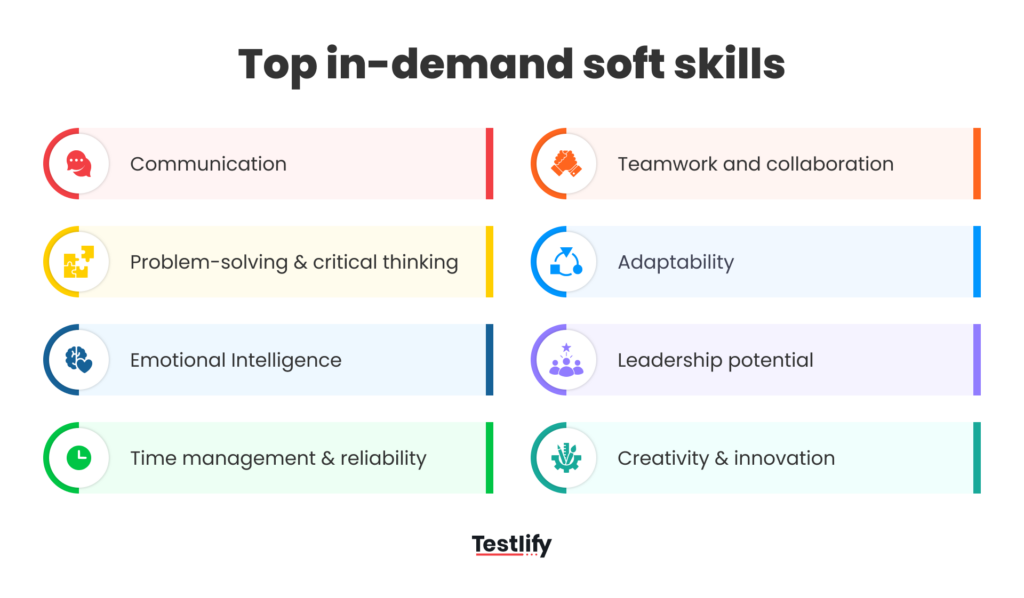
Which soft skills drive business impact?
Different roles emphasize different skills, but some human skills consistently show up as high-impact across functions:
- Clear, concise, and context-sensitive communication reduces rework and conflict.
- Collaboration and teamwork, cooperation across silos speed delivery and improve quality.
- Adaptability and learning agility, the ability to learn quickly and change direction with minimal friction in uncertain environments.
- Problem-solving and critical thinking, combining structured thinking with judgment to move projects forward.
- Emotional intelligence and empathy, critical for leadership, customer success, and people managers.
- Accountability and resilience, follow-through and the capacity to handle setbacks without derailing teams.
When HR prioritizes and measures these competencies, you get better predictors of retention, promotion success, and team outcomes.
How to assess soft skills properly?
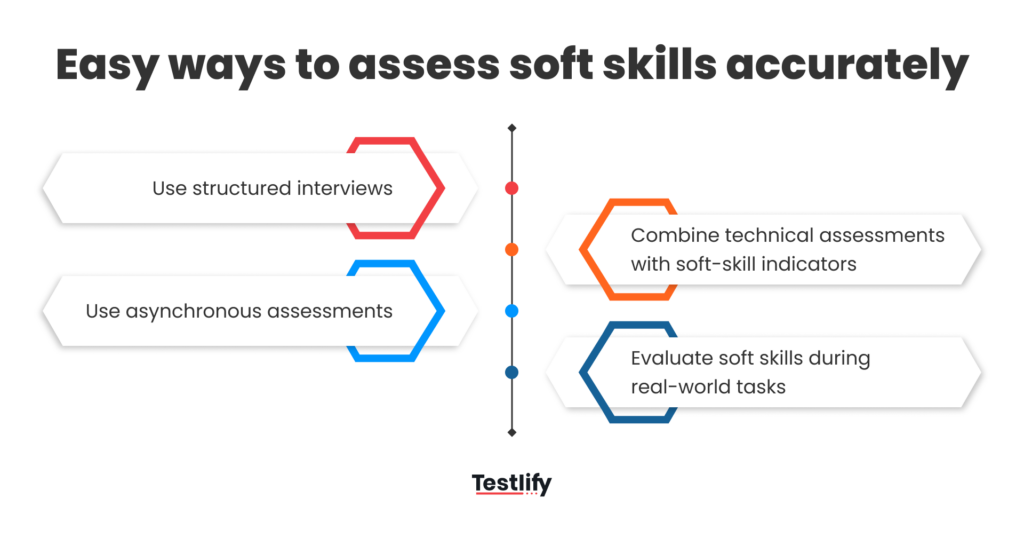
Here are validated, practical methods HR teams can use. The best programs combine several for a multi-signal approach.
Situational Judgment Tests (SJTs)
SJTs place candidates in realistic workplace scenarios and ask them to rank or select the best responses. Because they mimic actual role challenges, they provide strong insight into judgment, communication, and interpersonal skills. They’re scalable, objective, and offer high predictive validity, making them ideal for both early screening and deeper evaluation across many job families.
Work simulations and role plays
Work simulations recreate critical job tasks, like handling a difficult client call or resolving a team conflict, to observe real-time behavior. They reveal how candidates think, communicate, and respond under pressure. When combined with structured scoring rubrics and trained assessors, simulations provide highly reliable insights, especially for mid- to senior-level roles where nuance matters.
Behavioral and competency interviews
Structured interviews use standardized, evidence-based questions tied to role-specific competencies. They require candidates to share past behaviors that demonstrate key soft skills. With clear scoring rubrics and anchor examples for each rating level, these interviews significantly reduce bias, ensure consistency across interviewers, and improve the accuracy of hiring decisions.
Peer or manager assessments
For internal promotions or mobility, peer and manager assessments offer valuable context about how employees collaborate, lead, and contribute. Tools like calibrated performance ratings or 360° feedback help identify behavioral strengths and gaps. This method is particularly effective for succession planning and leadership development, where day-to-day behavior matters as much as technical expertise.
How HR can design an assessment program with Testlify?
Below is a practical, step-by-step plan HR can implement in 8–10 weeks to start assessing soft skills in a defensible, high-impact way.
Align on outcomes
Start by bringing together hiring managers, LandD, and talent acquisition to clarify success criteria for each role. Identify 6–8 core competencies for every role family based on real job demands. Use a proper job analysis to map tasks, behaviors, and performance expectations so assessments are aligned with what truly matters on the job.
Select assessment mix
Choose assessment formats based on role complexity. Use short SJTs or micro-simulations for early screening, deeper SJTs plus structured simulations for mid-level roles, and in-depth, assessor-scored simulations for senior positions. This layered approach gives you multiple signals, improves predictive accuracy, and ensures candidates are evaluated at the right depth for their level.
Build or choose assessments
Use Testlify’s validated library or design custom SJTs and simulations tailored to your roles. Every test item should map directly to the competencies you identified earlier. Create clear, structured scoring rubrics so assessors evaluate behavior consistently. This alignment ensures your assessments are job-relevant, fair, and capable of predicting real workplace performance.
Pilot
Test your assessments with a small hiring cohort of 10–40 candidates to gather practical insights. Collect feedback from assessors, monitor candidate experience, and analyze scoring patterns. Use this stage to calibrate assessors, refine rubrics, and adjust assessment difficulty or clarity before rolling out the program at scale.
Validate and baseline
Validate assessments by checking how well scores correlate with early performance indicators like onboarding success or manager ratings. Establish baseline metrics for future comparison. Analyze subgroup performance to identify and address any adverse impact. This ensures your assessments are both predictive and fair across different candidate groups.
Scale
Once validated, integrate assessments into your ATS to streamline workflows and reduce manual work. Train hiring managers to interpret assessment scores and use structured interview guides based on competencies. This ensures consistent decision-making across teams and makes the assessment process a seamless part of your hiring funnel.
Monitor and improve
Review predictive validity, fairness metrics, and score distributions quarterly to keep assessments accurate and inclusive. Use insights to refine test items, update rubrics, and adjust competency priorities as roles evolve. Feed assessment data into LandD and leadership development programs to close skill gaps and strengthen internal talent pipelines.
This phased, data-driven approach reduces risk, builds stakeholder trust, and delivers measurable wins quickly.
Conclusion
Soft skills have graduated from the margins to the center of talent strategy. The evidence is clear: these capabilities correlate with performance, career mobility, team productivity, and organizational growth. For HR leaders, that means three things:
- Measure them with rigor: Use validated SJTs, simulations, and structured rubrics.
- Operationalize the data: Use assessment outputs to guide hiring, onboarding, and LandD.
- Build systems, not one-offs: Integrate assessments into talent processes, monitor fairness, and iterate based on outcomes.
Testlify and platforms like it make this practical: they provide job-aligned assessments, validated item libraries, scorer workflows, and analytics that connect assessment signals to business outcomes. When HR treats soft skills as measurable, trainable, and decisive, you stop guessing and start hiring and developing people who actually drive results.
Frequently asked questions (FAQs)

B2B SaaS Content Writer
Rishav Kumar is a B2B SaaS content writer with 4 years of experience. He loves crafting engaging content. Always exploring fresh ideas, he's passionate about helping businesses grow through impactful writing.
LinkedInRelated resources
View all
Hiring Guide
How to build a bias-free hiring process in 2026

Hiring Guide
ROI of Smarter Hiring: Cut Cost and Lift Quality of Hire
Hiring Guide
How to future-proof recruitment process with AI in hiring?

Hiring Guide
How does Testlify prevent cheating in AI pre-hire assessments?
Hiring Guide
Why are hiring and training employees essential in 2026?
Hiring Guide
Internships in Talent Acquisition: A 2026 Strategy Guide
Get started.
Hire on proof, not resumes.
Run your first skills-based assessment free — no credit card required.