
How AI interviews work for candidate screening
AI interviews are changing how companies hire—faster, fairer, and smarter. See how it works and why more teams are switching to Testlify’s platform.
Recruiters are stretched thin: the average practitioner now juggles 56% more open requisitions and 42 % more interviews per hire than in 2021, marking average time-to-hire to 41 days. During those extra weeks, almost 80 % of applicants abandon the process.
That’s the bottleneck AI interviews were built to break. Companies using AI video interviewing software report time-to-hire drops of more than 50 % and far fewer drop-offs.
That speed comes from letting an AI video interview platform handle the heavy task. By the end, you’ll know exactly how to plug AI interviews for candidate screening into your stack and why it’s quickly becoming the standard for modern hiring.
 ChatGPT
 Gemini
 Claude
 Grok
Grok Perplexity
What is an AI interview?
AI interviews are an evaluation method that uses AI technology during the process. These interviews come in two primary forms: AI-assisted interviews and AI-conducted (Automated) Interviews.
- AI-assisted interviews: In these interviews, an AI tool assists a human interviewer. The AI may help with note-taking, sentiment analysis, facial expression analysis, scoring answers, or generating insights based on candidate responses, but a human is still present and leads the conversation.
- AI-conducted (automated) interviews: In this format, the AI acts as the primary interviewer. The candidate responds to pre-set questions (often via video or audio), and the AI analyzes responses. There’s no human present during the initial interaction; the AI screens, scores, and shortlists candidates, sometimes even giving real-time feedback.
An AI interview platform is more than a webcam and a timer. It’s a layered system that captures rich data and turns those insights into a single, reliable score. Let’s have a peek inside the engine room in the next section.
Recommended reading: How AI interviewers are reducing time-to-hire across industries

How AI interviews work for candidate screening
Modern AI–enabled interviews transform every candidate response into structured evidence that talent teams can search, score, and compare, eliminating the scheduling bottlenecks of live calls.
AI recruiter like Scouty, by Sintra AI, complements AI interviews by handling repetitive recruitment tasks such as outreach, resume screening, interview planning, and onboarding.
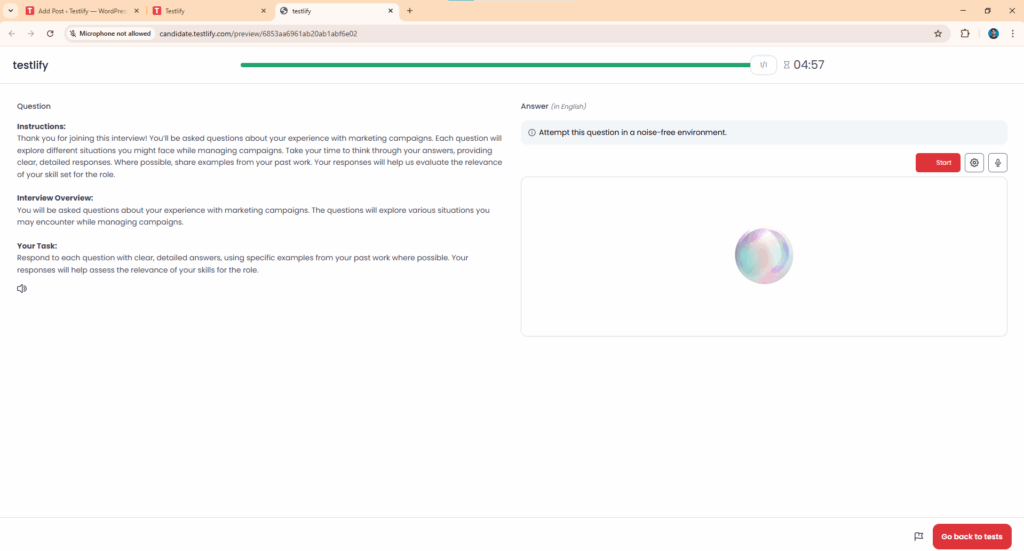
When an invitation is sent, the system detects the applicant’s device and connection speed, then offers a camera-on video path or a lightweight audio-only alternative.
That device flexibility keeps completion rates high even in low-bandwidth regions while still capturing the raw speech that AI needs for downstream analysis.
Before recording starts, recruiters choose a proctoring level. Under the hood, those settings switch modules such as face-presence checks, tab-switch alerts, copy-paste locks, or dual-camera monitoring on or off.
This creates a security envelope that matches each role’s risk profile. Granular control matters: too little oversight invites malpractice, while too much can harm candidate experience.
During the interview, automated speech recognition transcribes the answers in real-time. Natural-language models parse vocabulary depth, topic coverage, and sentiment.
While computer-vision layers (if video is enabled) read posture and micro-expression cues to enrich the signal set, those hundreds of data points are weighted against a competency rubric and scored in seconds.
Finally, ranked shortlists, full transcripts, and proctoring logs sync to the ATS or CRM. Recruiters review a curated pool instead of trawling first-round recordings, cutting time-to-hire while maintaining an auditable security trail. In a nutshell:
- Flexible capture = higher completion: video or audio paths adapt to each candidate.
- Selectable proctoring= right-sized security: teams dial oversight up or down per role.
- Multilayer analytics = richer talent signals: NLP and (optional) computer vision score responses objectively.
- Built-in bias checks = safer decisions: Automated audits surface red-flag disparities before offers go out.
The tech stack that powers AI interviews
Layer | What happens | Why it matters |
|---|---|---|
Data-capture layer | Browser-based video and audio are recorded at source, with an adaptive bitrate so even candidates on 3G can participate. | Wider reach = lower candidate drop-off. |
Speech-to-text & NLP | Real-time transcription converts every word. Natural-language processing checks vocabulary richness, jargon fit, filler-word frequency, and sentiment. | Gives objective, automated interview scoring on communication skills. |
Computer-vision engine | Frame-by-frame analysis of eye focus, facial muscle activity, and speaking pace, tuned to ignore factors that could disadvantage neurodiverse talent. | Adds a calibrated confidence-and-poise signal without introducing bias. |
Dynamic dialogue generator | A large language model reviews each answer and asks a follow-up question if depth or clarity is missing. | Mimics a sharp human interviewer, keeps the conversation natural, and surfaces deeper evidence of skill. |
Predictive scoring & bias dashboard | Models benchmark answers against success profiles, then run fairness checks across gender, ethnicity, and accent. | Fast, defensible decisions and bias-free hiring. |
Compliance + integration layer | GDPR consent screens, EEOC audit logs, and webhook pushes straight into your ATS or Slack. | Keeps legal teams happy and workflows seamless. |
Step-by-step: Candidate journey in an AI interview
Invite lands in the inbox
A branded email from your AI interview platform, with role name, deadline, and a one-click privacy consent, arrives seconds after the application is screened. No scheduling back-and-forth, so response rates stay high.
Device & bandwidth check
A lightweight script calibrates the webcam, mic, and connection. Candidates who pass this gate are 40 % less likely to abandon.
AI avatar greeting
On screen, an avatar greets the candidate by name and outlines the interview flow. This sets a professional tone without the awkwardness of blank screens often associated with one-way video tools.
Here’s where the magic happens.
- NLP transcribes every word.
- A large language model crafts personalised follow-ups (“Can you unpack that metric for me?”).
- Computer-vision tracks eye focus and pace to generate a confidence signal.
- The candidate sees a progress bar, no surprises, no stress.
Auto-submit & instant score
The recording uploads, an AI video interview scoring engine benchmarks answers against your success profile, and a bias dashboard checks pass-rate parity across demographics. Scores push straight to your ATS.
See an AI interview in Action: Watch our 2-minute demo of Testlify AI Interview features.
Deep dive: Why Testlify’s AI interview outperforms the legacy crowd
Most “AI video interviewing software” still feels like a souped-up one-way recorder: candidates talk to a blinking light, then wait days for feedback.
Testlify rebuilt the experience from the ground up, adding real-time intelligence and a candidate-first design that legacy vendors struggle to match.
AI audio interviews: Voice-first screening without the camera
Video isn’t always practical. Poor bandwidth, camera-shy candidates, or phone-only sales reps can slip through a video-only net. Testlify’s AI Audio Interview mode addresses this by allowing applicants to answer structured voice questions on the web or via phone.
- Pronunciation Insights baked in: The same engine that scores articulation in video now analyses phoneme clarity, stress, and intonation in pure audio. Perfect for roles where tone matters more than face time.
- Dynamic follow-ups, just voice: The LLM still probes deeper (“Can you walk me through that objection-handling example?”), keeping the conversation natural.
- Low-data success: Adaptive bitrate drops requirements to 48 kbps; completion rates rise sharply in regions with spotty 3G.
- Bias-safe: Audio-only mode removes any chance of look-based discrimination while retaining rich communication signals.
Feature | Testlify advantage | What competitors still miss / Why it matters |
|---|---|---|
Dynamic follow-up | LLM tailors the following question in real time. | Static prompt lists: Provide minimal understanding. |
Pronunciation Insights | Scores phoneme clarity, stress & rate. | No automated articulation check, critical for voice-based roles. |
Multilingual ASR | Accurate speech-to-text across 50+ accents. | English-only transcripts; heavy manual review. |
Voice AI (audio-only) | Web or phone answers, dynamic follow-ups & Pronunciation Insights | Video-only tools force webcam access, excluding deskless workers |
Bulk screening engine | Auto-starts thousands of video / audio interviews in parallel; scores hit ATS in real time | Legacy tools queue uploads; recruiters wait hours to see first results |
Adaptive proctoring (Standard / Strict / Custom) | Toggle tab-switch, face detection, AI-assist alerts, dual-cam, copy-paste tracking per assessment | One fixed “on” or “off” setting; either overkill or loopholes |
Soft-Skill Heatmap | Visual read-outs for confidence, empathy, and adaptability. | Gut-feel notes; no objective soft-skill metric. |
Instant ATS hand-off | Scores, videos, and transcripts push to Workday, Greenhouse, and Lever in seconds. | PDF exports you re-upload manually. |
Adaptive Difficulty | Questions level up or down on the fly. | Same eight questions for every candidate—poor signal. |
Mobile-first UX | PWA loads < 2s on 3G; zero downloads: lower candidate drop-off. | Desktop plug-ins: 10% higher abandonment. |
Accessibility Mode | Captions, sign-language avatar, high-contrast toggle. | Limited WCAG support: Shrinks the talent pool and raises legal risk. |
Transparent scoring rubric | Shows the weight of grammar, vocabulary, fluency, and confidence. | Black-box grades recruiters can’t defend. |
Pronunciation-driven follow-ups | Avatar requests clarification when key terms are misspelled. | No feedback loop, mispronunciations pass unnoticed. |
Handling Bulk Screening at Enterprise Scale
High-growth teams don’t trickle in resumes—they receive them in waves. Testlify’s distributed compute layer spins up parallel scoring jobs, allowing 2,000 marketing-rep applications to be interviewed, transcribed, scored, and pushed to your ATS in under an hour.
- Auto-invites in batches or drip campaigns, feed a CSV or zap in candidates from Greenhouse; Testlify fires out branded links instantly.
- The real-time queue dashboard lets recruiters see who is recording, who has submitted, and who might need a nudge.
- Score-based auto-shortlists move only the top percentile to human review, significantly reducing manual triage time when requisitions surge.
Built-in proctoring: Security that fits your risk level
Whether you need light oversight or exam-grade lockdown, Testlify ships three ready presets — Standard, Strict, and Custom — so you can dial in just the proper control for every role.
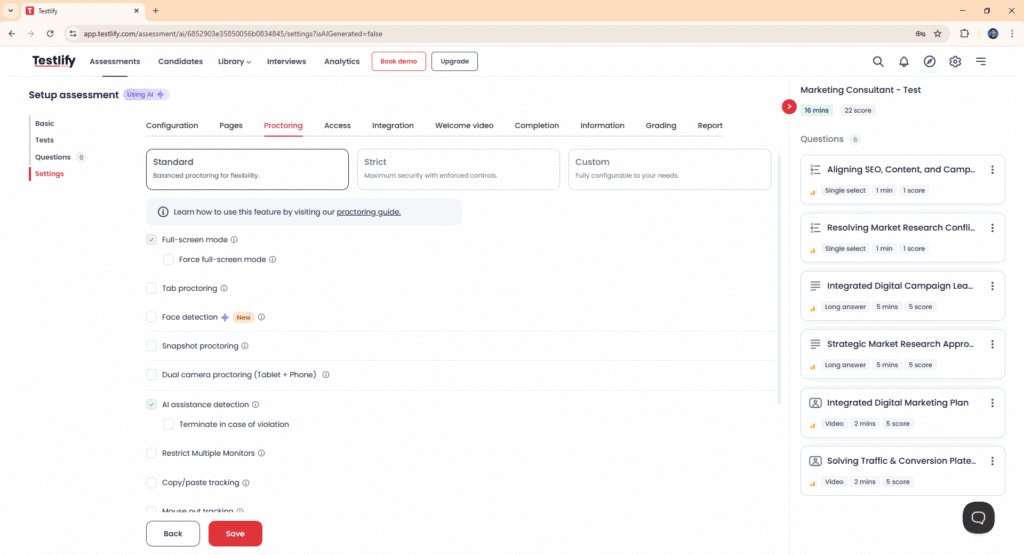
Level | Default Controls | Typical Use Cases |
|---|---|---|
Standard | Full-screen, AI-assisted detection | Campus recruiting, early-career roles |
Strict | + Tab proctoring, forced full-screen, copy-paste lock | Pre-hire coding tasks, regulated industries |
Custom | Pick from all options, incl. dual-camera and mouse-out tracking | Exec assessments or localisation variants |
Clients report 50% faster time-to-hire and a 23 % reduction in candidate drop-off when switching from first-generation AI interview platforms to Testlify.
Those gains compound at volume, especially in sales and customer-facing roles, where communication skills make or break performance.
ROI & compliance
1. The speed that shows on the balance sheet
Hirebee’s 2025 trend audit pegs the average at exactly half the calendar days needed for traditional screens.
A Berlin startup, quoted by LinkedIn, reduced its response time from 27 days to 7 days after switching from phone screens to automated video Q&A. This change saves every day, trimming vacancy costs and allowing revenue roles to start billing sooner.
2. Recruiter hours are not equal to overhead
AI handles the repetitive first pass, so your team can focus on closing offers. Recruiters who adopted intelligent automation reported a 60% reduction in manual workload while maintaining or even improving candidate quality.
That translates to fewer contractors, lower agency spend, and faster requisition throughput in peak seasons.
3. Happier candidates, lower drop-off
On-demand scheduling enables applicants to interview at their convenience, including after hours, and on mobile devices; data shows a 23% reduction in abandonment compared to legacy one-way video.
Shorter queues also mean faster feedback loops, a reason often cited for why top talent stays engaged.
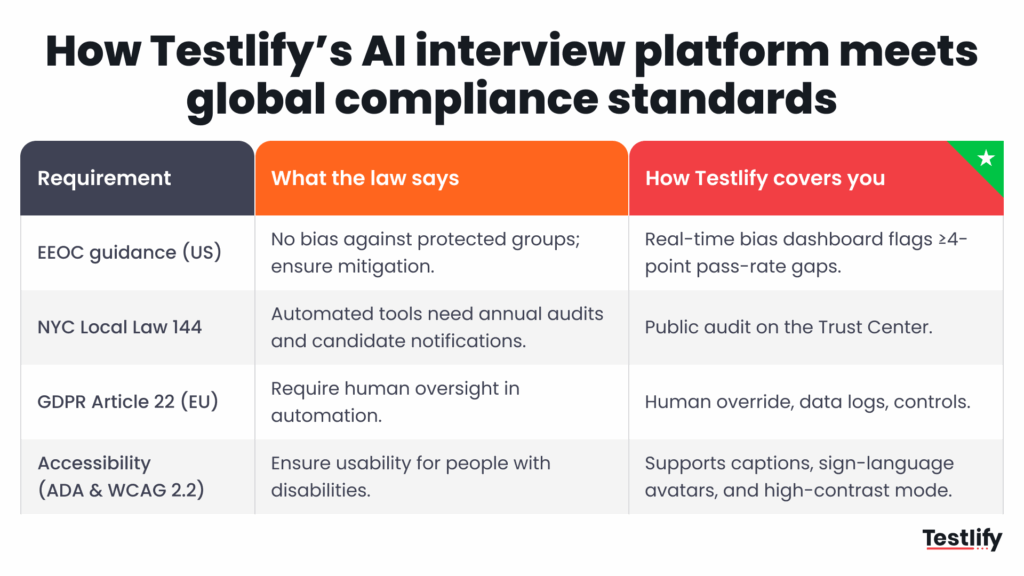
4. Built-in fairness & audit-ready compliance
How should you roll out AI interviews
Start with one high-volume role.
Sales development representatives and customer support agents are among the positions where effective communication skills make or break success. A tight pilot lets you benchmark completion rates and time-to-hire before expanding.
Customize the question bank, don’t copy and paste.
Feed the AI interview platform with scenarios that mirror day-one tasks (“Handle an angry caller wanting a refund”). Dynamic follow-ups only shine when seed questions are job-relevant. Include at least one competency, one value, and one situational prompt.
Set a scoring rubric that your managers trust.
Agree up-front on weightings for grammar, vocabulary, fluency, confidence, and Pronunciation Insights. Transparency beats black-box scepticism.
Integrate, don’t duplicate.
Push scores, transcripts, and recordings straight to your ATS or Slack via webhook. Recruiters skim the AI Insight Card, make a keep/kill decision, and move on.
Communicate clearly with candidates.
The invitation email must clearly explain why an AI video interview is being used, how data is stored, and who will review the results. Transparency enhances participation and ensures compliance with GDPR Article 22.
Schedule a 30-day retrospective.
Measure:
- Completion rate vs. old phone-screen flow
- Time-to-shortlist in hours
- Drop-off by device (mobile vs. desktop)
- Any bias flags triggered
Use those numbers to tweak question difficulty, time limits, or accessibility settings before scaling.
Roll out in waves.
Move from the pilot team to a new department every sprint. This phased approach enables recruiters to coach hiring managers and share quick wins.
Final thoughts
Traditional phone screens and one-way video tools simply can’t keep up. AI interviews bring structure, intelligence, and objectivity into early-stage screening, making hiring more data-driven and less biased.
Platforms like Testlify go a step further:
- They listen and probe like a skilled interviewer using dynamic follow-ups.
- They analyze every word and facial cue, scoring not just what was said, but how it was delivered.
- They cut screening time in half, reduce candidate drop-off, and offer built-in compliance for GDPR, EEOC, and ADA, making them enterprise-ready from day one.
With features like pronunciation insights, soft-skill heatmaps, and AI insight cards, Testlify doesn’t just record answers—it understands them.
And when your AI interviewer is this sharp, recruiters spend less time screening and more time closing.
Ready to see it in action? Watch our AI demo or try a live assessment now.
Frequently asked questions (FAQs)

B2B SaaS Content Writer
Rishav Kumar is a B2B SaaS content writer with 4 years of experience. He loves crafting engaging content. Always exploring fresh ideas, he's passionate about helping businesses grow through impactful writing.
LinkedInRelated resources
View all
HR & recruitment
Rethinking talent validation in a skills-based hiring world
HR & recruitment
How to streamline the interview process with AI
HR & recruitment
7 Mobile tools to simplify HR Tasks

HR & recruitment
How to incorporate gamification in corporate training
HR & recruitment
How enterprises save 80% of screening time and cut resume fatigue?
HR & recruitment
Why legacy ATS tools fail enterprise hiring teams?
Get started.
Hire on proof, not resumes.
Run your first skills-based assessment free — no credit card required.