
How to build a bias-free hiring process in 2026
Discover how Testlify enables bias free hiring with data-driven assessments, promoting diversity and inclusion for a more equitable workplace.
A hiring manager forms an opinion on a resume in about six seconds. In that gap, a name, a school, or an accent can decide who gets the callback long before anyone reads what the candidate can actually do.
When researchers sent more than 83,000 fake job applications to 108 large US employers, resumes with distinctively Black names got called back 2.1 percentage points less often than identical white-named resumes with matching skills and experience (NBER). That gap came from a process with no structure built in to catch it, not from one biased recruiter.
This guide covers where bias creeps into your funnel, why it costs you strong hires, and the five-move Testlify BLIND Framework for building it out. It also shows where skills assessments, the slice Testlify owns, fit into that chain.
TL;DR
- Bias-free hiring is a process, not a personality trait. Standardize the steps, and you shrink the bias.
- Bias is measurable. Identical resumes still get different callback rates based on the name at the top.
- The biggest levers are structure and skills: blind screening, skills tests scored before a name is seen, structured interviews, and a quick funnel audit.
- Skills-first hiring also widens the pool, lifting the share of women in candidate pools by 24% more than men in roles where women are underrepresented.
- Testlify covers the assessment slice (blind, standardized skills tests). It is not an ATS and won’t fix sourcing or interviews on its own.
 ChatGPT
 Gemini
 Claude
 Grok
Grok Perplexity
What is bias-free hiring?
Bias-free hiring is a recruitment process built to remove the influence of things that have nothing to do with the job: gender, race, age, accent, or which university someone attended. Instead of trying to make people less biased, it changes the process itself, so the same questions, the same scoring, and the same skills checks apply to everyone.
Honest framing: bias-free is a direction, not a finish line you cross once. The realistic target is bias-reduced and bias-aware.
Start by eliminating the easiest sources of bias, such as identifiable candidate information and subjective scoring. Then audit your hiring data regularly. At Testlify, we’ve seen that teams relying on a one-time policy often regress within a year, while quarterly audits help preserve fair hiring practices over time.
Bias-free hiring vs. blind hiring
People often use blind hiring and bias-free hiring as if they mean the same thing. They do not, and the difference matters for what you build next.
Blind hiring | Bias-free hiring | |
|---|---|---|
Scope | First screen only | Full funnel: screen, interview, decision, offer |
What it fixes | Name, school, and photo bias at intake | Affinity bias, gut-feel scoring, panel groupthink, funnel drop-off |
What it misses | Interview scoring, referral pipelines, final decisions | Nothing by design, though execution still needs auditing |
Example | Anonymized resume screening | Testlify BLIND Framework: screening, structured interviews, and audits |

Where does hiring bias actually creep in?
Bias rarely shows up as someone being openly unfair. It hides in small, routine decisions, like whose resume gets a second look, who feels like a culture fit, and how loosely you score a strong talker, and most of it happens in the first ten seconds of a screen or in an unstructured interview.
Job descriptions and coded language
Masculine-coded words like assertive, dominant, or competitive quietly narrow your applicant pool before anyone applies. Swap them for skill-based, job-specific language that names the actual outcome the role owns instead of the personality type you assume will deliver it.
Resume screening
A name, a postcode, or a school triggers a snap judgment before a reviewer reads a single skill. Anonymizing that first pass forces the decision back onto what is actually on the page.
Affinity bias in interviews
Interviewers rate people who remind them of themselves more warmly, often without noticing it happen. A shared alma mater or hobby can outweigh a stronger answer from a less familiar candidate.
Referral pipelines
Hiring from your own network tends to reproduce the team you already have, not the team you need. Referrals are not the problem; running them as your only channel is.
Unstructured scoring
With no rubric, a confident answer beats a correct one, and memory quietly fills the gaps after the call ends. Two interviewers can walk away from the same conversation with opposite impressions, and neither one is wrong by their own logic.
Why does bias-free hiring matter?
Bias-free hiring matters for two reasons. It is the right thing to do, and it is how you stop losing strong hires to noise instead of signal.
The business case for fairer hiring
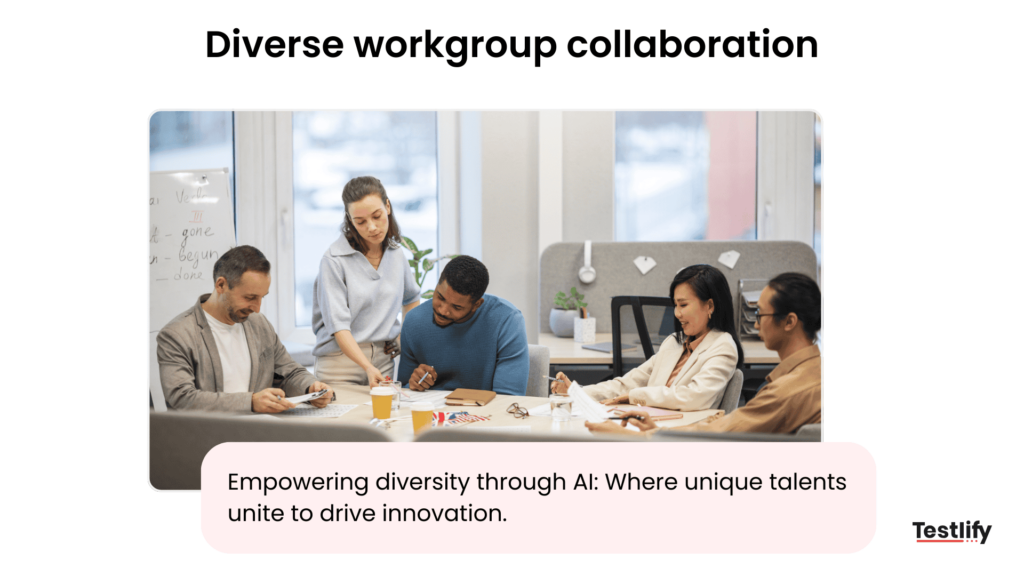
When a process rewards the loudest or most familiar candidate over the most capable one, you pay for it twice: in worse hires and in a narrower team. Fairer screening opens up a far larger pool of genuinely qualified people.
Most people already buy the business logic. A 2025 Bentley-Gallup survey found 61% of Americans say businesses with a diverse workforce are more profitable, and 64% say they innovate better.
The catch the cheerleading skips is that representation without inclusion underdelivers. Hiring diverse people into a process that still scores them unfairly just moves the bias one stage later, so the hiring fix and the culture fix have to travel together.
The pool argument is the most concrete of the three. LinkedIn’s Skills-First research found that focusing on skills over pedigree lifts the share of women in candidate pools by 24% more than men in roles where women are underrepresented, and grows the pool of capable people without a bachelor’s degree by 9%.
You are not lowering the bar by doing this. You are looking in places pedigree filters were quietly hiding.
The legal exposure behind biased hiring
Adverse impact is not a theory. Under the EEOC’s four-fifths rule, if one group’s selection rate falls below 80% of the highest-scoring group’s rate at any stage, regulators treat that as evidence worth investigating, whether or not anyone intended to discriminate.
This is the same threshold we flagged in our breakdown of adverse impact in cognitive ability testing, and it applies to any stage of your funnel, not just testing. A funnel audit is what catches a four-fifths violation before a regulator or a plaintiff’s attorney does.
How do you build a bias-free hiring process?
Reduce bias by removing identity from the early stages of your funnel and adding structure to the late ones. We call this sequence the Testlify BLIND Framework, five moves that each shrink a different kind of bias.
B: Benchmark objective criteria before you post the role
Write the must-have skills and evaluation criteria before you open the requisition, not after resumes start arriving. A benchmark set in advance is one less place for a hiring manager’s shifting gut feeling to creep back in.
L: Limit what reviewers see at the first screen
Strip names, photos, and schools so the first cut runs on skills, not signals; this is also the cheapest of the five moves to make. Build the screen from a shared assessment approach for the role, so a weak resume from a strong candidate still gets through.
See how it compares to traditional resume screening in our guide on CVs vs. online assessments. A scored work sample ranks candidates on how they perform the job, not on how well their resume is written.
I: Interview with a structured, shared scorecard
Ask every candidate the same questions in the same order, scored against the same interview scorecard, before the panel compares notes. Structured interviews are the strongest validated predictor of job performance, with a mean operational validity of 0.42 in Sackett and colleagues’ review, well ahead of a free-flowing chat.
N: Normalize diverse, calibrated panels
A single trusted gatekeeper carries a single set of blind spots into every decision. A small, mixed panel that calibrates on the scorecard together before interviews start cancels out more of those blind spots than any one rater’s good intentions.
D: Data-audit the funnel every quarter
Track pass rates by group at every stage: applied, screened, interviewed, offered, hired. The data shows you the leak your policy alone will never find; see our guide to a more inclusive recruitment strategy for the full workflow.
Pro tip: Don’t roll out all five BLIND moves at once. Start with the L step: anonymized screening paired with a skills test before the first interview. Those two changes reduce the most bias with the least process overhead, while giving you clear before-and-after data to support the rest.
Which bias-reduction methods work best?
Some bias-reduction methods have a much bigger impact than others. The most effective ones change the hiring process itself rather than relying on individual judgment.
Methods that move the needle
The strongest bias-reduction strategies prevent bias before it influences a hiring decision. Each method addresses a different point in the hiring funnel, so they work best when used together rather than in isolation.
Anonymized screening
Remove names, photos, schools, addresses, and other identifying details during the first round of screening. This keeps reviewers focused on skills and experience instead of background, reducing affinity and name bias before first impressions form.
Skills assessments
Evaluate candidates on job-related tasks before reviewing their resumes. A structured skills assessment shifts attention from credentials to demonstrated ability, making it easier to identify high performers regardless of where they studied or worked.
Structured interviews
Ask every candidate the same core questions and score each answer against predefined criteria. Consistent interviews reduce gut-feeling decisions and make it easier to compare candidates using evidence rather than memory.
Diverse interview panels
Include interviewers with different backgrounds, experiences, and perspectives. A mixed panel helps balance individual blind spots and encourages more objective hiring discussions than relying on a single decision-maker.
Funnel audits
Track pass rates across every hiring stage by demographic group, role, and recruiter. Regular audits reveal where candidates are disproportionately screened out, allowing you to fix hidden bias before it becomes a long-term hiring pattern.
Structure and audits catch what slips through after that. Here is how the common methods compare.
Method | What it does | Bias it targets | Effort |
|---|---|---|---|
Anonymized screening | Hides name, photo, school, and address on the first pass | Affinity and name bias at the top of the funnel | Low |
Skills assessments | Scores what a candidate can do, before identity is known | Pedigree bias (degrees, brand-name employers) | Low to medium |
Structured interviews | Same questions and same scorecard for every candidate | Similarity bias and gut-feel scoring | Medium |
Diverse interview panel | Multiple raters from different backgrounds | Single-rater blind spots | Medium |
Funnel audits | Tracks pass rates by group at each stage | Hidden drop-off you cannot see otherwise | Ongoing |
Key takeaway: Willpower-based fixes (“try to be objective”) fade fast. Process-based fixes (“the reviewer never sees the name”) hold, because they don’t depend on anyone remembering to be fair on a busy day.
Methods that sound good but underdeliver
Not every bias-reduction initiative delivers meaningful results. The methods that tend to fall short rely on people changing their behavior rather than changing the hiring process itself.
Unconscious bias training
Unconscious bias training raises awareness, but awareness alone rarely changes what happens the next time someone reviews a resume. The SHRM research on curbing unconscious bias is blunt: training works best alongside structural changes, not as a replacement for them.
Diversity hiring targets
Representation goals can improve workforce diversity, but they do little to reduce bias if hiring decisions still depend on subjective resume reviews and unstructured interviews. Better outcomes come when targets are paired with evidence-based selection methods.
Generic interview guidelines
Providing interview tips or best practices is rarely enough. Without standardized questions, clear scoring criteria, and interviewer calibration, different candidates are still judged by different standards.
DEI policies and statements
Written policies demonstrate commitment, but they do not change hiring outcomes on their own. They need to be supported by structured hiring practices, accountability, and regular audits.
One-time hiring workshops
A single workshop may increase awareness for a few weeks, but its impact usually fades as hiring teams return to familiar habits. Lasting improvement requires continuous measurement and process changes, not one-off training sessions.
The methods that consistently reduce hiring bias are the ones that redesign the hiring process itself. Skills assessments, anonymized screening, structured interviews, and regular audits reduce opportunities for bias instead of relying on people to overcome it through awareness alone.
How does Testlify support bias-free hiring?
Testlify supports the part of the funnel where most early bias lives: the screen. It runs blind, standardized skills assessments and scores them before a reviewer sees who the candidate is, so the shortlist is built on demonstrated ability rather than a name or a school. Being precise about scope matters here, because no single tool fixes the whole chain.
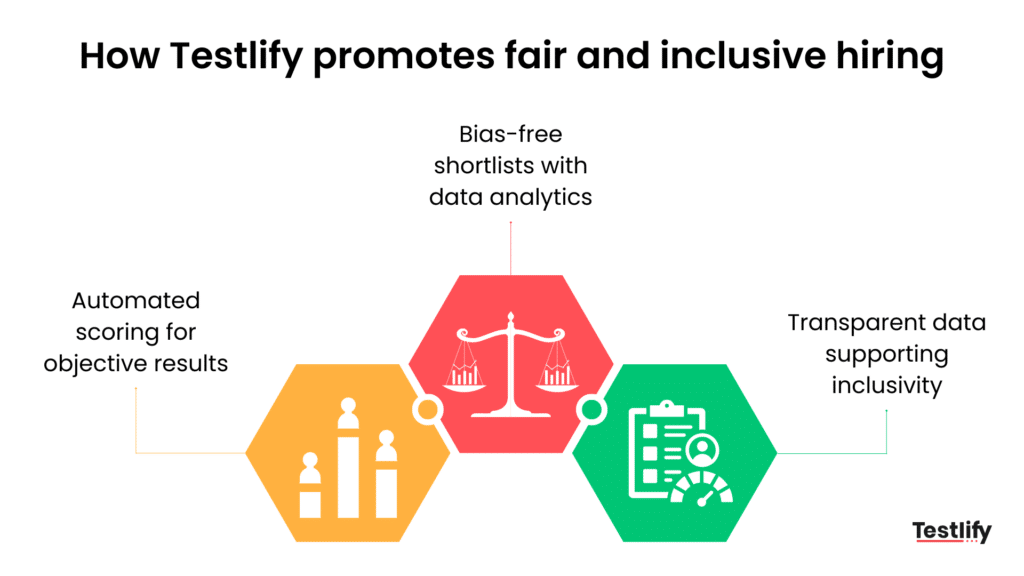
Skills-first tests measure competence
The tests measure the competencies a role actually needs, not a candidate’s degree or previous employer. You can tailor them per role from the assessment library.
Automated scoring applies one rubric to everyone
The same automated scoring rubric applies to every submission, so a confident answer never outscores a correct one. This is also where a lot of AI screening quietly loses fairness ground: a model without a fixed rubric scores confident phrasing over correct substance, the same failure mode as an untrained human reviewer.
Structure matters more than the AI label attached to a tool. HR teams using inclusion-focused AI design hired disabled candidates 70.2% of the time, compared with 36.2% for teams using standard, unstructured AI screening.
The gap is the rubric, not the algorithm, which is exactly why Testlify scores every submission against the same standardized benchmark before a name is attached.
Standardized benchmarks
Standardized benchmarks let you compare candidates against a consistent bar instead of against each other in the moment. That single change removes the recency and contrast effects that quietly skew back-to-back interview scoring.
Where Testlify stops
Testlify is a pre-hire assessment platform, not an applicant tracking system or a sourcing tool. It will not anonymize your whole pipeline and help you source candidates directly from job boards.
For real diversity and inclusion results, pair Testlify’s role-specific tests with structured interviews and a funnel audit. Picture a 500-person company hiring 30 support reps a quarter: scoring a short skills test before the first call lets the team build a shortlist on ability, then spend interview time only on candidates who can already do the work.
How do you measure whether your hiring is actually bias-free?
You measure it by tracking pass-through rates by group at every funnel stage, not by asking managers if the process felt fair. A gap that clears the EEOC’s 80% threshold at any single stage is your signal to dig into that stage specifically.
Metrics to track by funnel stage
Funnel stage | What to track | Red flag |
|---|---|---|
Applied | Source and demographic mix of applicants | One channel drives 80%+ of applicants |
Screened | Pass rate by group vs. the highest-scoring group | Below 80% of the top group’s rate (four-fifths rule) |
Interviewed | Interview-to-offer rate by group and by interviewer | Large spread between interviewers scoring the same rubric |
Offered | Offer acceptance rate and starting comp by group | Consistent comp gap at the same level |
Hired | 90-day performance and retention by source and group | Retention gap tied to hiring channel, not role |
Link metrics to a KPI you already track
Fold these pass-through rates into the same dashboard as your other recruitment KPIs, such as time-to-fill and quality-of-hire, instead of running them as a separate compliance exercise. A metric nobody looks at alongside the numbers everyone already tracks gets fixed a lot slower than one sitting next to time-to-fill on the same screen.
Build a fairer hiring process
Pick the one stage where you lose the most good candidates, and remove identity from it this quarter. For most teams, that is the first screen, exactly where a blind skills test earns its keep.
Start free with Testlify to score candidates on skills before names, or book a demo to see the blind-screening workflow on your own roles.
Frequently asked questions

Head of Assessments
Usha brings a rare depth of expertise to Testlify’s assessment function, over 40 years of multidisciplinary experience spanning banking, insurance, healthcare, automotive, IT services, manufacturing, pharmaceuticals, and enterprise software. At Testlify, she ensures that every assessment, scoring methodology, and competency structure meets the highest standards of enterprise-grade transparency, fairness, and consistency, the kind that holds up under audit and earns the trust of the world’s most rigorous hiring teams.
LinkedInRelated resources
View all
Hiring Guide
ROI of Smarter Hiring: Cut Cost and Lift Quality of Hire
Hiring Guide
How to future-proof recruitment process with AI in hiring?

Hiring Guide
How does Testlify prevent cheating in AI pre-hire assessments?
Hiring Guide
Why are hiring and training employees essential in 2026?
Hiring Guide
Internships in Talent Acquisition: A 2026 Strategy Guide
Hiring Guide
Top 9 people management skills and how to assess them
Get started.
Hire on proof, not resumes.
Run your first skills-based assessment free — no credit card required.