
What is affinity bias and how to avoid it in 2026?
Learn affinity bias and how to avoid it in 2025. Discover practical examples to create fairer, more inclusive hiring practices.
Affinity bias is the unconscious pull toward people who remind you of yourself. Same university, same hometown, or just the same way of telling a story, and a candidate starts to read as "a good fit" before anyone has checked whether they can do the job. In hiring, that pull quietly narrows the shortlist to people who already resemble the team.
TL;DR
- Affinity bias is the tendency to favor people who feel familiar, and it works before you notice it working.
- It shows up as "culture fit" language, warm small talk in one interview and clipped questions in the next, and a shortlist where everyone went to the same kind of school.
- Names alone move outcomes. Identical resumes sent with white-sounding names drew 50 percent more callbacks than the same resumes sent with Black-sounding names.
- Awareness on its own does not fix it. Process does: the same questions in the same order, scored the same way, with skills evidence collected before the interview.
- The honest test of any hiring decision is whether you can answer "what evidence changed your mind?" without saying the word "vibe".
 ChatGPT
 Gemini
 Claude
 Grok
Grok Perplexity
What is affinity bias?
Affinity bias is the tendency to favor people who share your background, interests, or manner. It is a form of unconscious bias, which means the preference forms on its own, ahead of any deliberate judgment. In hiring it pushes interviewers toward candidates who feel familiar and away from equally qualified candidates who do not.
The word "unconscious" is doing real work in that sentence. Nobody sits down planning to hire their own reflection. The preference arrives as a feeling, usually a good one, and the reasons get assembled afterwards. That is why affinity bias survives in teams who genuinely care about fair hiring, and why it is so often defended in the language of instinct: she just clicked with us.
Affinity bias definition and meaning
The short definition: affinity bias is an automatic preference for people similar to yourself. Its other common name is similarity bias, sometimes called the "similar to me" effect. The meaning that matters at work is narrower than the psychology textbook version. It is the moment a shared detail, a hometown or a former employer, starts doing the job that evidence is supposed to do.

What causes affinity bias?
Affinity bias comes from two ordinary things happening at once: people form impressions fast, and sameness feels safe. Similarity gives the brain a shortcut, the conversation flows, and fluency gets mistaken for suitability. Nothing about the process announces itself as a judgment.
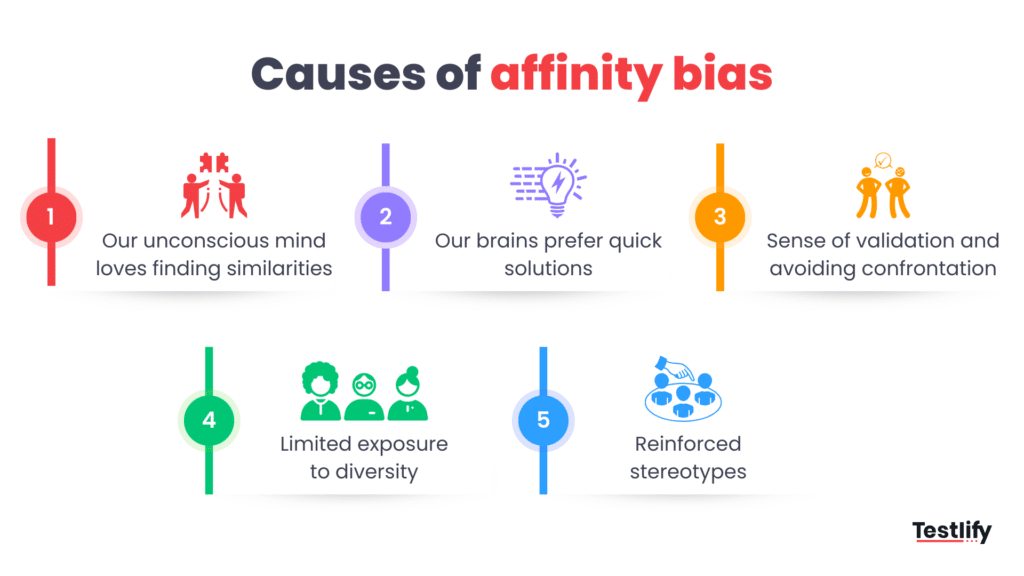
Four mechanisms do most of the damage:
- In-group preference. People extend more trust and more benefit of the doubt to those they read as "one of us". A shared employer or accent is enough to trigger it.
- Familiarity and fluency. An easy conversation feels like a good interview. It usually just means the two of you communicate the same way.
- The halo effect. One shared positive (same alma mater) spreads a general glow over unrelated qualities like judgment or reliability.
- Confirmation bias. Once the interviewer likes someone, the remaining questions tend to look for reasons to keep liking them, and the harder probe quietly goes to somebody else. In a field study of real employment interviews, interviewers' early impressions were related to how they ran the rest of the interview, including their question style and how they behaved toward the candidate.
How strong is the effect on real decisions? Strong enough that a name on a page changes them. In a field experiment published in the American Economic Review, researchers sent otherwise identical resumes to real job ads and varied only the names. Resumes with white-sounding names received 50 percent more callbacks than the same resumes carrying Black-sounding names. No interview, no conversation, no culture fit discussion. Just a name at the top of a page, read by human screeners.
That study describes human screening, not software, and it is the cleanest available picture of the baseline everyone is working against.
Affinity bias examples: one example at each stage
Affinity bias is easier to catch when you stop looking for prejudice and start looking for comfort. Here is where it tends to sit in a normal hiring process, and what it sounds like out loud.
Hiring stage | What affinity bias sounds like | What it actually costs |
|---|---|---|
Resume screen | "I know that company, they train people well." | Candidates from unfamiliar employers get a shorter read |
Phone screen | "Really easy conversation, good energy." | Communication style gets scored as capability |
Interview | "We both did the same degree, so we got into the weeds." | One candidate gets a rehearsal, another gets an interrogation |
Debrief | "I can just see him in the team." | The loudest gut feel becomes the group decision |
Offer | "She reminds me of Priya when she started." | Last year's hire becomes this year's spec |
A concrete example. Two candidates apply for a senior account role at a 60-person marketing agency. One spent six years at agencies the hiring manager knows by name. The other ran the same function in-house at a retailer, managing a bigger budget with a smaller team. The agency candidate gets forty minutes of shop talk about clients they both remember. The in-house candidate gets a tidy set of competency questions and finishes eight minutes early. Both are scored "good". Only one of them was given room to be impressive.
That is affinity bias with nobody behaving badly. The interviewer was warmer because the conversation was easier, and the conversation was easier because the backgrounds matched.
Why is affinity bias a problem in hiring?
Affinity bias is a problem because it degrades the quality of the decision and creates legal exposure at the same time. It narrows the range of experience on a team, it makes hiring outcomes harder to defend, and because it feels like good judgment rather than bias, it goes uncorrected for years.
Start with the legal edge, because it is the one with a number attached. Under the Uniform Guidelines on Employee Selection Procedures, US enforcement agencies apply a rule of thumb: a selection rate for any race, sex, or ethnic group that is less than four-fifths, or 80 percent, of the rate for the highest-selected group is treated as a substantially different rate of selection. Affinity bias does not need intent to push a selection rate under that line. It only needs a few interviewers hiring people who feel familiar, repeated across a year of requisitions.
Then the performance edge. McKinsey's fourth Diversity Matters study, covering 1,265 companies across 23 countries, found companies in the top quartile for board gender diversity were 27 percent more likely to outperform financially than those in the bottom quartile, with a 13 percent gap on ethnically diverse boards. Those are correlations at board level, not a promise about any single hire, and they are worth reading as a signal rather than a formula.
Alex Alonso of SHRM put the cultural cost plainly: stick to sameness and "you contribute to an organizationwide sameness that causes cultures to become stale, stagnant, and problematic in the long run." The teams that get hit hardest are the ones hiring fastest, because every new hire is modelled on the last one.
How do you avoid affinity bias at work?
You avoid affinity bias by changing the process, not by trying harder to be fair. Decide what good looks like before you meet anyone, ask every candidate the same questions, score against the same scale, and collect evidence of the actual skill before the conversation that makes you like somebody.
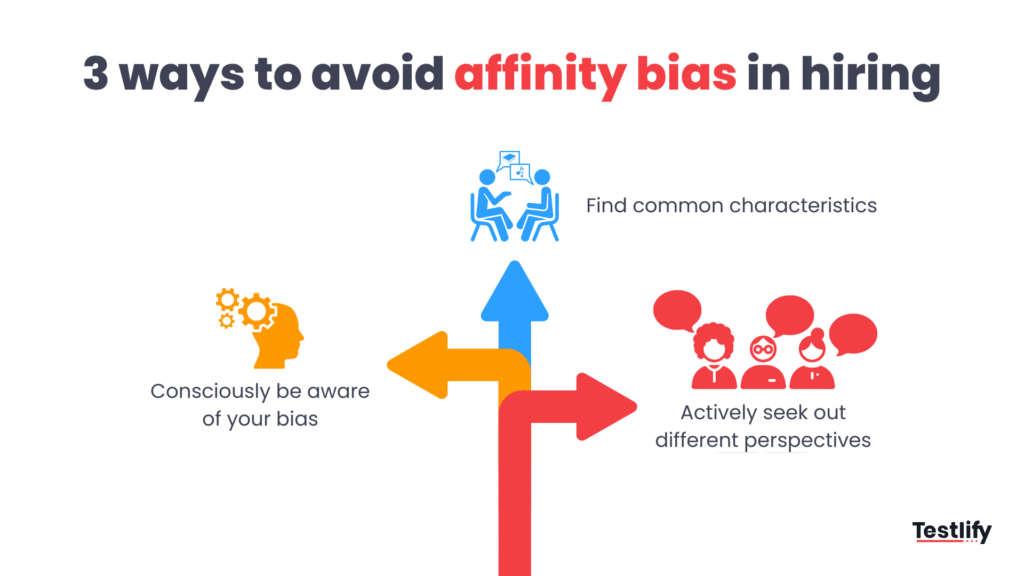
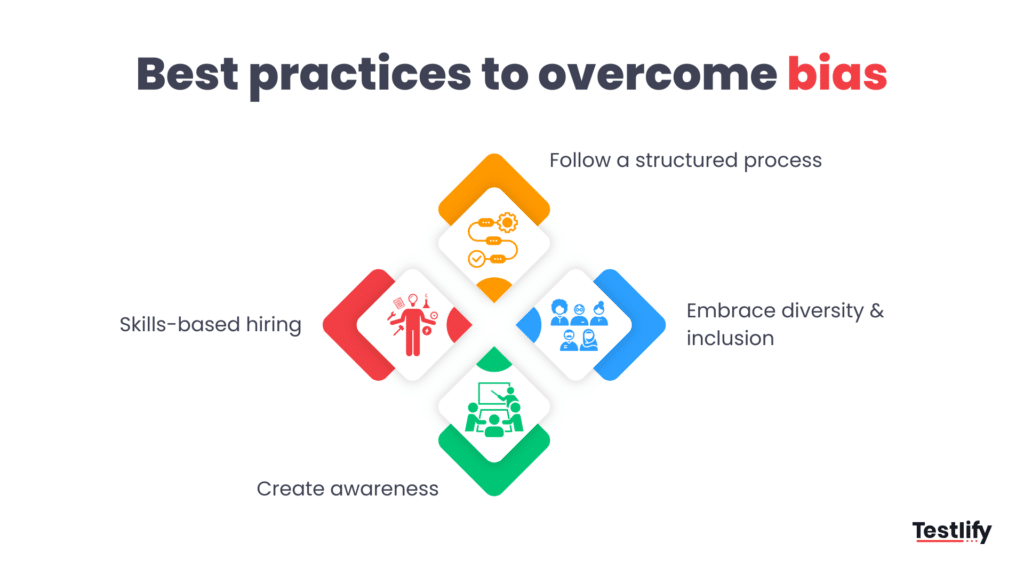
Awareness training is where most teams start and where most teams stop. It is useful for naming the problem. It is weak at changing a decision made in the ninth minute of a friendly interview, because the bias is not waiting for permission. Controls work better than good intentions:
- Write the scorecard before the job goes live. Four or five competencies, each with what a weak, adequate and strong answer looks like. Once the bar is written down, "not quite a fit" has to be converted into a rating, and that conversion is where the vague objection usually dies.
- Put skills evidence before the interview. A work sample or role-based assessment completed before anyone meets is the single cleanest way to stop a warm conversation from setting the ranking. The case for skills-based hiring rests on exactly this ordering.
- Use structured interviews. The same questions, in the same order, rated on the same scale. The US Office of Personnel Management notes that structured interviews limit the discretion an interviewer is allowed and raise agreement between interviewers on their overall evaluations. Discretion is the room affinity bias lives in. The difference between structured and unstructured formats is the difference between a measurement and a chat.
- Score independently, then discuss. Every interviewer submits their rating before the debrief. Otherwise the first confident voice sets the anchor and the rest of the room calibrates to it.
- Retire "culture fit" as a criterion. Replace it with the two or three behaviours the role genuinely needs. "Fit" is where affinity bias goes to hide with a respectable name on.
On the evidence for the third point: a major 2022 reanalysis of selection-method validity by Sackett and colleagues in the Journal of Applied Psychology placed structured interviews among the strongest predictors of job performance, while years of education and general years of experience sat among the weaker ones. The exact coefficients in that literature are still argued over in print. The ranking of structured over unstructured is the part that survives every reanalysis, and it is the part that matters here.
Overcoming affinity bias in the hiring process
Overcoming affinity bias in the hiring process means building evidence the decision has to answer to. The Testlify Human-Led Decision Scorecard turns candidate evidence into a structured hiring decision: assessment results, AI-generated strengths and gaps, reviewer ratings, interview responses and reference feedback are brought together, and the final judgment stays with the hiring team.
The point of the scorecard is sequencing, not paperwork. When several reviewers rate the same evidence against the same weights, a single warm impression stops being the deciding input. Testlify lets each test in an assessment carry a weight from x0 to x5, so the competencies that actually predict performance count for more than the ones that are merely easy to observe. Reviewer scores are aggregated and comparable, and candidates can be ranked by percentile against other candidates and against other reviewers, which makes an outlier rating visible instead of persuasive.
Where AI is involved, keep it advisory. Testlify ships the disclaimer in the product itself: AI scores and insights are for guidance only, and human judgment makes the final call. Whether AI scores are shown to a reviewer, and whether they count toward the final average, are both toggles a hiring team controls. That matters for affinity bias specifically, because an automated score that nobody can switch off or argue with just relocates the problem.
Pro tip: run the scorecard on your last five hires before you run it on a live role. Teams usually discover that two competencies did all the deciding and the rest were decoration. That is a cheaper lesson to learn on closed requisitions than on an open one.
A few more controls worth adding, in rough order of payoff: hide names and schools at the resume-screen stage; rotate who runs the first interview so one person's taste does not filter the pipeline; and write the debrief note before the meeting, not during it. Our guide to avoiding bias in employment testing covers the assessment-design half of this in more detail.
The caveat, honestly stated: structure costs time up front, and it makes hiring feel less pleasant for the interviewer. A structured interview is a worse conversation than an unstructured one. That is the trade. You are buying comparability, and comparability is the only thing that lets you defend a decision six months later.
Is affinity bias the same as unconscious bias?
No. Unconscious bias is the whole category of automatic judgments; affinity bias is one specific bias inside it, the one driven by similarity. Affinity bias is also closely related to similarity bias (usually treated as the same thing), and often confused with the halo effect and confirmation bias, which behave differently.
Bias | What triggers it | How it shows up in an interview |
|---|---|---|
Affinity bias | Similarity to the decision-maker | "We just clicked" ranks above the scorecard |
Unconscious bias | Any automatic association, similarity or not | The umbrella category; affinity bias is one branch |
Similarity bias | Similarity to the decision-maker | Another name for affinity bias, used interchangeably |
Halo effect | One strong positive trait or credential | A known employer makes unrelated skills look proven |
Confirmation bias | An impression already formed | Later questions hunt for support, not for holes |
Affect heuristic | Current mood of the interviewer | The 9am candidate and the 5pm candidate get different rooms |
The practical reason to keep them separate: they need different fixes. Affinity bias responds to structure and blind evidence. Confirmation bias responds to independent scoring before discussion. Treating them as one blob is how teams end up running a single training session and calling it solved. For a wider view of the category, our overview of unconscious bias in the hiring process maps the rest of them.
Hire on evidence, not on familiarity
If the last three hires on a team all came from similar backgrounds, that is not proof of affinity bias, but it is a good reason to look at how the decisions were made. Start with one role. Write the scorecard first, put a skills assessment before the first conversation, and have every interviewer score before anyone talks. Testlify's skills assessments are built to sit at that point in the process. Book a demo and bring a live requisition; the useful conversation is about where the evidence currently enters your funnel, and how late that is.
Key takeaways
- Affinity bias is a decision-quality problem, not only a fairness problem. It swaps evidence for comfort, which means the team loses information about who can actually do the job. Treat it as a defect in the hiring process rather than a character flaw in interviewers, because that is the version you can fix.
- It operates before anyone notices. The preference forms early and the justification arrives later, dressed as instinct. Any control that depends on people catching themselves in the moment will underperform, which is why "be more aware" has such a poor track record as a remedy.
- Names alone shift real outcomes. Identical resumes drew 50 percent more callbacks with white-sounding names. If a name can do that before any human contact, an hour of friendly conversation can certainly do it, so the screening stage deserves as much structure as the interview.
- Structure beats intention. Same questions, same order, same scale, scored independently before the debrief. This is the intervention with actual evidence behind it, and it works because it shrinks the discretion that bias needs in order to operate.
- Sequence the evidence before the conversation. A skills assessment completed before the first call gives the debrief something objective to argue with. Once a warm interview has set the ranking, later evidence tends to get read as confirmation rather than correction.
- "Culture fit" is the phrase to watch. It is where affinity bias most often hides behind a respectable label. Replace it with the two or three behaviours the role genuinely requires, and make each one rateable.
- Accept the trade-off. Structured hiring is slower to set up and less enjoyable to run. What you buy is a decision you can explain, compare and defend, which matters most exactly when a hire goes wrong.
FAQs

Related resources
View all
Hiring Guide
HR checklist for 2026: Key steps you can’t miss
Hiring Guide
White Collar vs Blue Collar Jobs: Key Differences (2026)
Hiring Guide
Practical tips for HR to optimize working days
Hiring Guide
What is involuntary turnover? Formula, types, best practices
Hiring Guide
What is talent optimization and what are its 4 key phases?
Hiring Guide
A guide on how digital adoption is revolutionizing employee recruitment
Get started.
Hire on proof, not resumes.
Run your first skills-based assessment free — no credit card required.