
What HR teams can do during a hiring freeze: a week-by-week plan
A practical HR plan for a pause in hiring: scope it, tell staff and candidates, protect your team, fill skill gaps and prepare the restart.

What HR teams can do during a hiring freeze comes down to five jobs: set the exact scope of the pause, tell employees and candidates what it means, protect the people who absorb the extra work, close skill gaps with the talent you already have, and get every process ready so hiring restarts fast. The freeze stops new headcount. It does not stop HR.
Freezes are common again. A Careerminds survey of 600 US HR managers, published in September 2025, found that two-thirds of employers had paused hiring: 22% across all roles and 44% in specific departments or positions. The hiring freeze strategies for HR below are ordered the way the work actually lands, from the first week to the day the budget opens again.
TL;DR / Key Takeaways
- HR teams should spend the first week of a freeze confirming its scope: which roles, which exemptions, whether backfills and contractors count, and when it will be reviewed.
- Tell employees early and plainly that a freeze is not a layoff. Silence is what starts the layoff rumors.
- Candidates already in process should hear from a person, not an automated email, with an honest timeline and a way to stay in touch.
- The biggest risk is burnout in the teams covering open roles. Cut or delay work before you ask people to absorb it.
- Fill skill gaps internally first: map current skills, test internal candidates for the role, cross-train, and use contractors only for short, urgent gaps.
- Track regretted attrition, overtime and the internal fill rate, so leadership sees when the freeze costs more than it saves.
- Use the quiet months to build the restart kit: ranked roles, ready assessments, interview scorecards and a warm list of past finalists.
 ChatGPT
 Gemini
 Claude
 Grok
 Perplexity
What can HR teams do while hiring is frozen?
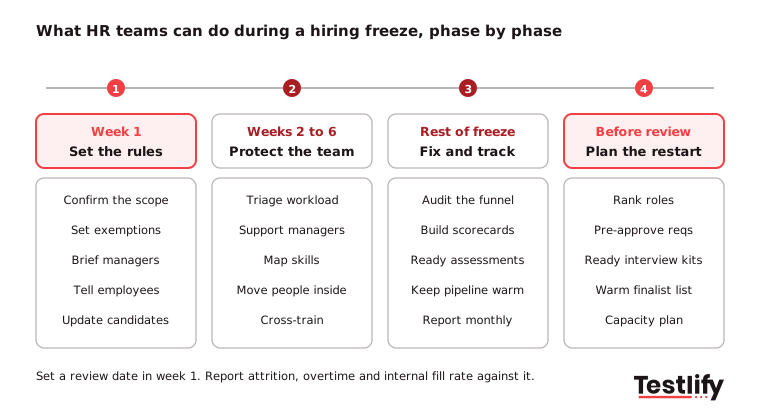
HR teams can use a pause in hiring to protect current staff, redeploy existing talent and fix the hiring process before demand returns. In practice that means ten moves, spread over the length of the freeze, owned mostly by HR leadership and talent acquisition, with managers carrying the team-level work.
Move | What it covers | Owner | When |
|---|---|---|---|
1. Confirm the scope | Roles, exemptions, backfills, contractors, review date | HR lead + finance | Week 1 |
2. Brief managers | A short script, an exemption process, a contact person | HRBPs | Week 1 |
3. Tell employees | What the freeze is, what it is not, when the next update comes | HR lead + leadership | Week 1 |
4. Contact candidates in process | Personal update by stage, honest timeline | Recruiters | Week 1 |
5. Triage workload | Drop, delay or share work in teams with open roles | Managers + HRBPs | Weeks 2 to 6 |
6. Map skills and move people | Skills inventory, internal moves, cross-training | HR + team leads | Weeks 2 to 6 |
7. Fix the hiring process | Funnel audit, scorecards, assessments, job descriptions | TA ops | Ongoing |
8. Keep the pipeline warm | Past finalists, talent pools, employer brand content | Recruiters | Ongoing |
9. Track the cost of the freeze | Attrition, overtime, engagement, internal fill rate | People analytics | Monthly |
10. Build the restart kit | Ranked roles, ready assessments, interview kits | TA lead | Before the review date |

What should HR do in the first week of a freeze?
HR should use the first week to turn the announcement into rules people can follow. Most freezes are partial, so a vague memo leaves every manager guessing whether their backfill, intern or contractor is still allowed. Agree on these points with finance and leadership before anyone outside the leadership team hears about it:
- Scope: Which departments, levels and locations are frozen. The Careerminds survey found 36% of employers had paused all entry-level hiring while keeping some senior roles open, so spell out the levels.
- Exemptions: Which roles stay open (revenue, safety, compliance, critical backfills) and who signs off on a new exception.
- Backfills and contractors: Whether a leaver can be replaced, and whether contractors, temps and agency staff count against the freeze.
- Offers already out: Whether signed offers are honored. Pulling an accepted offer damages the employer brand far more than pausing a search.
- Review date: When the freeze will be reviewed. Without a date, a three-month pause quietly becomes a year.
Then close the loop on the outside world: take frozen roles off the careers page and job boards, stop paid job ads, and give agencies a short, approved statement so they stop sending candidates.
How should HR talk to employees and candidates about the pause?
HR should tell employees early, in plain words, what the freeze is and what it is not. People hear "hiring freeze" and assume layoffs are next, so say clearly whether jobs are at risk, which plans are paused (promotions, internal moves) and when the next update will come. Give managers the same short script so every team hears one message. If job cuts are on the table, handle the layoff as a separate process with its own communication plan instead of letting the freeze message carry it.
Candidates need a message matched to how far they got:
- Applied but not screened: A short, honest note that the role is paused, with an option to join the talent pool.
- In interviews: A call or personal email from the recruiter, the reason in one line, and a realistic timeline.
- Final stage or verbal offer: A call from the hiring manager. These people are the first ones you will want back.
Pro tip: Log every paused candidate in your ATS with a tag and the date you promised to follow up. That one field is what turns a frozen search into a warm restart.
How can HR support the team that carries the extra work?
HR support for a team during a hiring freeze starts with removing work, not with wellness perks. When a role stays empty, its tasks land on the people next to it, and the people most likely to leave are often the strong performers who absorb the most. Ask managers in teams with open roles to list the work and decide, task by task, to drop it, delay it, automate it or share it.
Manager support matters more than ever. Gallup's State of the Global Workplace report found global employee engagement fell to 20% in 2025, and manager engagement dropped from 27% to 22% in a single year. Managers are the people who have to explain the freeze and carry the workload, so check in with them first.
Low-cost ways to support the team:
- Workload check-ins: A standing one-to-one question about workload, not just project status.
- Recognition that names the extra effort: Thank people specifically for covering a vacant role.
- Flexibility: Flexible hours and encouragement to take leave already earned.
- Clear growth paths: Stretch work on an open role counts toward a promotion case once the freeze ends.
- Early warning signs: Watch overtime, sick days and exit-interview themes in the teams carrying vacancies.
How can HR fill skill gaps without new headcount?
HR can fill most skill gaps during a freeze by moving work to people who already have the skills or can learn them quickly. Start with a skills inventory so you know who can do what, then decide gap by gap whether to move someone, train someone or bring in short-term help.
The common answer to a hiring freeze is to fill roles with current employees, through internal moves, stretch assignments and temporary cover. The hard part is matching people to roles fairly. LinkedIn's 2024 Workplace Learning Report found that 33% of employers have internal mobility programs, yet only 1 in 5 employees has strong confidence in making an internal move. Publish the open internal roles, then use the same skills test for every internal applicant so moves are based on evidence, not on who knows the hiring manager.
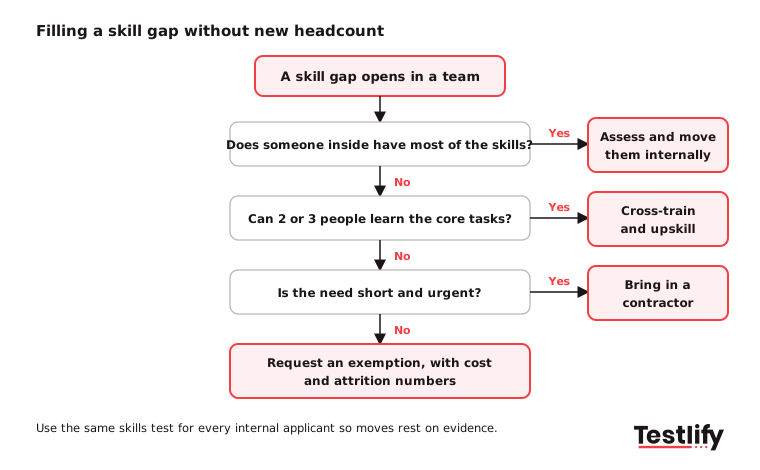
Three options cover most gaps:
- Internal move: Someone already has most of the skills. Assess them for the role and move them, with a plan for their old work. Our guide to internal mobility covers how to run it.
- Cross-training: Two or three people learn the core tasks of the vacant role, so the work does not rest on one person. See how to set up cross-training for employees.
- Upskilling: For skills the business will need after the freeze, start a short upskilling and reskilling plan now. The Careerminds survey found 43% of employers in a freeze were already upskilling their workforce.
If a gap is urgent, short and no one inside can cover it, a contractor is cheaper than burning out a team. If the gap is permanent and business-critical, take it to the exemption process with numbers.
Which hiring processes should HR fix while hiring is paused?
The hiring processes worth fixing during a pause are the ones that slowed you down or produced weak hires last year. With no live searches, TA ops finally has time to look at the data instead of the queue.
- Audit the funnel: For the last 12 months, check where candidates dropped out, how long each stage took, and which sources produced the hires who stayed.
- Cut stages: Remove interview rounds that repeat the same questions. Every extra round costs candidates.
- Write scorecards: Agree on the skills each core role needs and how to score them. Use structured interviews so every candidate answers the same questions.
- Prepare skills assessments: Build the tests for your most-hired roles now, so screening starts on day one of the restart.
- Refresh job descriptions: Rewrite them around skills and outcomes, not a list of degrees and years.
- Clean the ATS: Close stale requisitions, merge duplicate profiles and tag past finalists.
- Train hiring managers: Run short sessions on scorecards and fair interviewing while they have the time.
How do you keep the talent pipeline warm?
Keeping the talent pipeline warm means staying in honest, low-effort contact with people you will want to hire later. Start with the people who already know you: past finalists, candidates paused mid-process and former employees who left on good terms. Segment them by role family and skill, so outreach is relevant.
- Be honest: Say there is no open role today. People respect a recruiter who does not dangle jobs that do not exist.
- Give something useful: A quarterly update, an invitation to an event or a piece of content about the team works better than "just checking in".
- Build an employer brand backlog: Record employee stories, team photos and role explainers now, ready to publish when roles reopen.
- Keep campus and partner ties alive: Universities and communities remember who disappeared.
A talent pipeline kept warm through the freeze is the fastest source of hires when roles reopen.
Which metrics should HR track while hiring is paused?
HR should track the metrics that show the hidden cost of the freeze, so leadership can judge whether it still pays off. Context helps: the US Bureau of Labor Statistics JOLTS release for September 2026 put the hires rate at 3.4% and the quits rate at 2.1%, so many employers are hiring slowly while their people stay put. A freeze can hide problems in that kind of market until a strong performer leaves.
Metric | Why it matters | Warning sign |
|---|---|---|
Regretted attrition | Losing people you would rehire costs more than the saved salary | Rising in teams with open roles |
Overtime and absence | Early sign of burnout where work was absorbed | Up two months in a row |
Engagement pulse | Shows whether the freeze message landed | Drops after the announcement |
Internal fill rate | Share of open work covered by internal moves | Flat, while gaps stay open |
Exemption requests | Shows where demand is real | Same team asking every month |
Warm pipeline size | Readiness for the restart | Shrinking past finalist list |
Time-to-fill (exempt roles) | Whether critical roles still get filled | Longer than before the freeze |
Report these monthly against the review date. Numbers turn "the team is stretched" into a decision leadership can make.
How should HR get ready for hiring to restart?
HR gets ready for the restart by building a kit that lets recruiting move on the first day the budget opens. Across the teams we talk to, the first month after a freeze is often lost to re-approvals, rewritten job descriptions and cold sourcing. A workforce planning review during the freeze avoids most of that.
The restart kit:
- A ranked list of roles: Which ones open first, agreed with leadership and finance in advance.
- Pre-approved requisitions: Paperwork ready to submit, not drafted after the announcement.
- Ready assessments and interview kits: One per priority role, with scorecards.
- A warm candidate list: Past finalists and paused candidates, tagged and contactable.
- Agency terms: Agreed rates and briefs, if you use agencies.
- A capacity plan: How many hires recruiters can handle per month, so the restart does not swamp the team.
Key takeaway: A freeze ends faster for teams that planned the restart while it was on. The work done in the quiet months shows up as weeks saved later.
What mistakes should HR avoid while hiring is on hold?
The mistakes that hurt most during a pause are the ones that damage trust or quietly overload people:
- Silence: Not telling employees what the freeze means, so rumors fill the gap.
- Ghosting candidates: Letting paused candidates hear nothing for months.
- Pulling signed offers without a call: If it must happen, do it early, directly and with care.
- No review date: Letting a short pause drift on with no decision point.
- Stacking work on top performers: Covering every gap with the same few reliable people.
- Unfair internal moves: Filling roles by who is visible rather than who has the skills.
Get ready for the restart with Testlify
Testlify helps HR teams use a freeze well. Assess internal candidates for open roles with the same role-based tests you would use for external hires, using Testlify for internal mobility. Pick from 3,500+ tests in the Testlify test library or generate a custom assessment from a job description in under a minute, so your assessments are ready before hiring restarts. Start a 7-day free trial with no credit card, or book a demo to plan your restart.
Frequently asked questions
Related resources
View all
HR & recruitment
9 Outbound recruiting strategies to hire faster

HR & recruitment
How to onboard and train blue-collar workers

HR & recruitment
How to measure and improve blue-collar worker productivity and engagement

HR & recruitment
5 common HR compliance landmines and how to avoid them

HR & recruitment
Campus Hiring for Talent Pipeline Development

HR & recruitment
The role of HR tools in remote work environment
Get started.
Hire on proof, not resumes.
Run your first skills-based assessment free — no credit card required.