
10 Essential soft skills to assess while hiring developers
Discover essential soft skills to assess when hiring developers. Improve hiring accuracy, team performance, and project outcomes.

Hiring developers has never been harder. Technical skills still matter, of course, but they’re no longer enough. With distributed teams, complex products, rapid releases, and cross-functional collaboration becoming the norm, soft skills have quietly become the real differentiator between good developers and great ones.
A strong screening process helps you find the best candidates quickly and efficiently. See also How To Screen Candidates For Ruby On Rails Developers for more techniques.
A report by Harvard Business Review found that 85% of job success comes from soft skills, while only 15% comes from technical skills.
This creates a clear mandate, if you want developers who not only build products but also help your organization scale, assessing soft skills must become a core part of your hiring strategy.
This blog breaks down the 10 essential soft skills every HR team should evaluate when hiring developers, along with practical ways to assess each one.
 ChatGPT
 Gemini
 Claude
 Grok
Grok Perplexity
Why soft skills matter more than ever in developer hiring?
Developers today do far more than write code. They collaborate with designers, product managers, QA testers, business leaders, and even customers. The modern development workflow demands:
- Rapid communication
- Clear decision-making
- Adaptability
- Creative problem-solving
- Collaboration across time zones and functions
- Comfort with ambiguity
- Ownership of work and outcomes
Yet, according to LinkedIn’s Global Talent Trends Report, 89% of recruiters say bad hires usually lack soft skills, not technical ability. Soft skills are now a competitive advantage for engineering teams.

Top 10 soft skills to assess while hiring developers
Below are the soft skills that consistently separate high-performing developers from the rest. HR teams that intentionally assess for these skills will improve hiring accuracy, reduce turnover, and build healthier engineering culture.
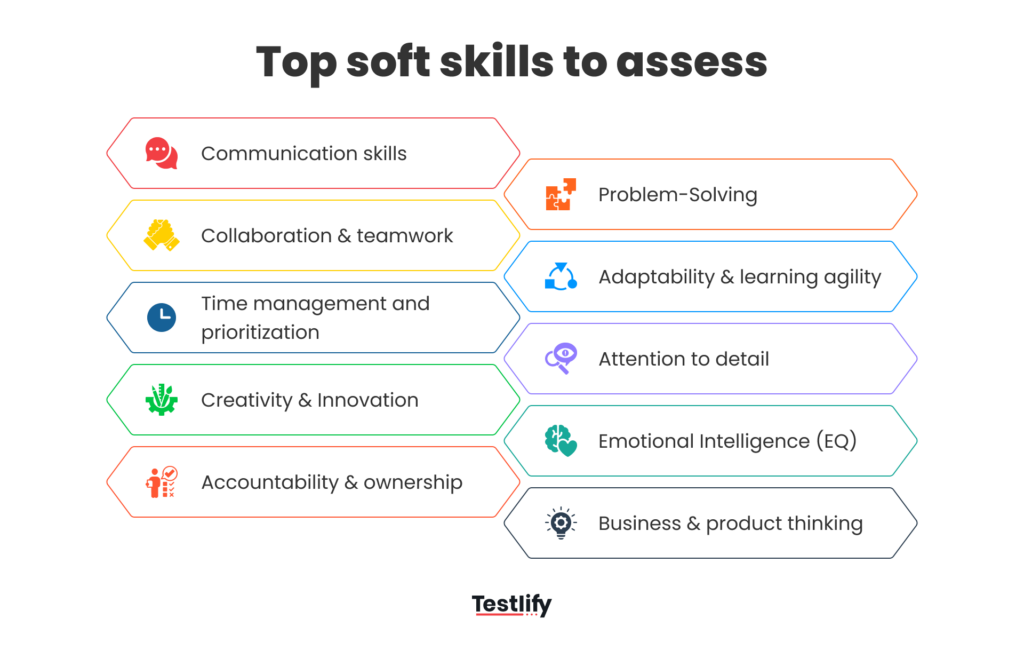
1. Communication skills
Communication is the backbone of software development. Developers must explain technical concepts to non-technical stakeholders, write clear documentation, give feedback in code reviews, and collaborate with teammates.
Why it matters
- Prevents misunderstandings and costly rework
- Improves sprint efficiency
- Reduces dependency on “knowledge silos”
- Enhances cross-team collaboration
According to SHRM, poor communication costs companies an average of $62.4 million per year.
How to assess it
- Ask candidates to explain a complex technical concept to a non-technical audience
- Evaluate clarity during pair-programming sessions
- Use asynchronous tasks to check documentation skills
2. Problem-Solving
Good developers solve problems. Great developers solve the right problems. This requires analytical thinking, systematic reasoning, and creativity, especially when product goals are ambiguous.
Why it matters
- Reduces bottlenecks during development
- Leads to better architectural decisions
- Prevents technical debt
How to assess it
- Use scenario-based problem-solving tasks (not just algorithm puzzles)
- Ask how they approached and resolved previous project challenges
- Evaluate thought process, not just the final solution
3. Collaboration and teamwork
Software is built by teams, not individuals. Developers must work smoothly with product managers, QA, designers, DevOps, and business teams.
Why it matters
- Directly influences team velocity
- Strengthens engineering culture
- Supports knowledge-sharing and mentorship
How to assess it
- Use pair programming or group exercises
- Ask about previous teamwork challenges
- Look for empathy and humility in responses
4. Adaptability and learning agility
Tools, frameworks, and languages evolve fast. Developers must be comfortable with constant change and willing to continuously upskill.
Why it matters
- Future-proofs your engineering team
- Reduces dependency on outdated practices
- Increases resilience during shifting business needs
How to assess it
- Ask about the most recent new skill or tool they learned
- Present changing project requirements during assessments
- Look for curiosity and willingness to experiment
5. Time management and prioritization
Developers often juggle multiple tasks, features, bug fixes, sprint deadlines, documentation, code reviews, and meetings.
Why it matters
- Ensures timely delivery
- Improves capacity planning
- Reduces burnout
How to assess it
- Use situational questions involving deadline conflicts
- Ask how they break down large tasks
- Check how they estimate work during technical tasks
6. Attention to detail
Small mistakes in code lead to large problems, bugs, outages, security vulnerabilities, and performance issues. Detail orientation is crucial.
Why it matters
- Prevents regression issues
- Improves product reliability
- Reduces QA cycles
How to assess it
- Review their code for naming conventions, documentation, and structure
- Use debugging-based tasks
- Give incomplete instructions and check how they clarify requirements
7. Creativity and Innovation
Contrary to stereotypes, software development is deeply creative. Developers innovate daily, whether designing user flows, architecting systems, or troubleshooting complex errors.
Why it matters
- Leads to better product experiences
- Helps teams find elegant solutions
- Encourages experimentation
How to assess it
- Use open-ended challenges with multiple possible solutions
- Evaluate ideas and originality during technical tasks
- Ask for examples of creative workarounds or innovations
8. Emotional Intelligence (EQ)
EQ affects how developers handle stress, resolve conflicts, give feedback, and stay motivated through setbacks.
Why it matters
- Reduces friction in teams
- Enhances leadership potential
- Helps developers stay resilient
How to assess it
- Use behavioural questions focused on conflict resolution
- Observe reactions to feedback during live tasks
- Assess self-awareness and empathy through reflective questions
9. Accountability and ownership
Great developers don’t just complete tasks, they take ownership of outcomes. They’re proactive, responsible, and committed to delivering quality work.
Why it matters
- Reduces micromanagement
- Builds trust in remote and hybrid teams
- Improves product stability
How to assess it
- Ask about a time they made a mistake and how they handled it
- Observe how they justify decisions during technical tasks
- Look for proactive mindset and initiative
10. Business and product thinking
Top developers understand the “why” behind features, not just the “how.” They consider user impact, business value, and long-term product implications.
Why it matters
- Builds alignment between engineering and product teams
- Reduces unnecessary work
- Drives better decision-making
How to assess it
- Ask candidates to prioritize features based on user value
- Present trade-off scenarios (speed vs quality, cost vs innovation)
- Evaluate if they ask business-driven clarifying questions
How to assess soft skills without adding friction to hiring?
Assessing soft skills doesn’t mean adding more interviews or lengthy tasks. Instead, integrate soft-skill assessment into existing steps.
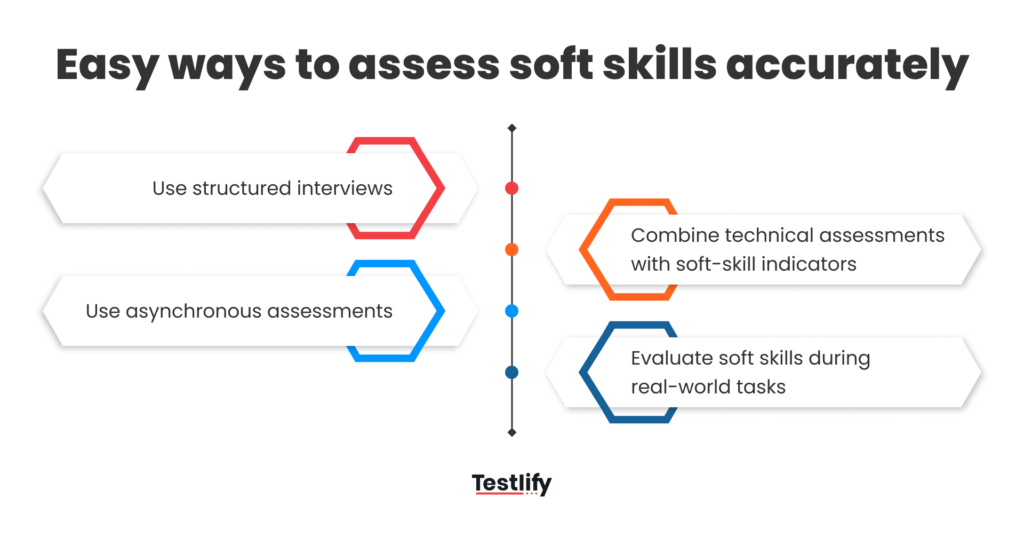
1. Use structured interviews
Unstructured interviews are subjective. Structured interviews improve predictive accuracy by nearly 26% (Harvard Business Review).
Include consistent behavioural questions like:
- “Tell me about a time you had conflicting priorities. How did you manage them?”
- “Describe a situation where you disagreed with a teammate. What happened?”
2. Combine technical assessments with soft-skill indicators
Skills tests can reveal soft skills such as:
- Thought process
- Communication
- Collaboration
- Detail orientation
- Problem-solving
For example:
- Pair programming reveals communication and teamwork
- Architecture design tasks reveal reasoning and prioritization
- Debugging challenges reveal attention to detail
3. Use asynchronous assessments
Tools like Testlify help evaluate:
- Communication clarity
- Documentation habits
- Ability to follow instructions
- Critical thinking
This also reduces interviewer bias.
4. Evaluate soft skills during real-world tasks
Instead of hypothetical puzzles:
- Give candidates mini case studies
- Use product-oriented tasks
- Assess how they collaborate, justify decisions, and adapt
Common soft skill red flags to look out for
Even strong technical candidates may show soft-skill risks. Watch for:
Struggles to explain their thinking
When a developer can’t clearly articulate their reasoning, decisions, or thought process, it becomes difficult for teams to collaborate, review code, or resolve issues quickly. Poor communication often leads to misunderstandings, rework, and dependency on that individual. This is a key red flag, especially in cross-functional, fast-moving environments.
Blaming others for past issues
Candidates who frequently blame teammates, managers, or “the company” for past problems often lack self-awareness and accountability. This pattern typically leads to conflict, defensiveness, and poor collaboration. In team-based engineering environments, blame-oriented individuals can create friction, break trust, and weaken psychological safety.
Dismissive attitude during feedback
If a candidate reacts defensively to suggestions or seems resistant to input, it’s a warning sign. Developers regularly work through reviews, QA feedback, and stakeholder comments. A dismissive attitude slows improvement, damages team dynamics, and signals low emotional intelligence, making it hard for them to thrive in iterative, collaborative workflows.
Rigid thinking and unwillingness to consider alternatives
Developers who cling rigidly to their preferred approaches often struggle in dynamic environments where requirements evolve. Inflexibility prevents healthy debate, limits innovation, and makes collaboration difficult. Strong engineers evaluate trade-offs, explore alternatives, and adapt their solutions, not shut down new ideas or operate with a “my way is best” mindset.
Poor time awareness during tasks
If a candidate consistently underestimates effort, gets lost in details, or shows little awareness of deadlines, it will impact sprint velocity and delivery timelines. Developers need to balance quality with speed. Weak time awareness often results in schedule slips, missed commitments, and difficulty working within Agile or structured project frameworks.
Lack of curiosity or questions
Curiosity is a key soft skill in tech. When candidates don’t ask clarifying questions or show genuine interest in understanding the problem deeply, it signals low initiative and weak learning agility. Developers who accept incomplete information without probing tend to deliver shallow solutions and struggle with complex or ambiguous requirements.
Hiring someone with these red flags often leads to downstream issues like conflict, siloed work, missed deadlines, and quality problems.
The ROI of hiring developers with strong soft skills
Soft skills directly impact team performance, and ultimately business outcomes.
Here’s what research shows:
Higher productivity
Teams with strong soft-skill alignment communicate better, collaborate efficiently, and resolve roadblocks faster, directly improving productivity. McKinsey reports that such teams can outperform others by up to 25%. When developers understand each other’s perspectives and work styles, they deliver faster, avoid rework, and keep projects moving smoothly.
Lower turnover
Developers with strong communication, empathy, and collaboration skills integrate into teams more quickly and feel connected to their work. This reduces misunderstandings, conflicts, and disengagement, major drivers of attrition. When soft skills are strong, teams feel easier to work in, and developers are more likely to stay long-term, lowering hiring and training costs.
Better innovation
Teams with psychological safety, often fostered by soft skills like openness, listening, and humility, produce more creative ideas and experiment more freely. Collaborative communication accelerates problem-solving and helps teams explore new technical approaches. As a result, innovation cycles shorten, and teams consistently deliver better, more user-centered product solutions.
Better project delivery
Developers with high emotional intelligence and adaptability manage shifting requirements, feedback loops, and uncertainties with more resilience. They communicate early, align expectations, and adjust quickly when priorities change. This reduces bottlenecks and delays, enabling smoother sprints, fewer last-minute surprises, and more predictable project delivery across the engineering pipeline.
Stronger culture
Soft skills shape the everyday interactions that define team culture. Developers with strong interpersonal skills support each other, give constructive feedback, mentor junior members, and help create an environment of trust. This reduces conflict, boosts morale, and contributes to a healthier engineering culture where people feel motivated, valued, and engaged.
Hiring for soft skills is not just “nice to have”, It’s a strategic advantage for any organization scaling engineering teams.
Conclusion
Technical skills get developers through the door. Soft skills determine whether they succeed, grow, and meaningfully contribute to your engineering culture.
In today’s fast-moving tech landscape, where teams are distributed, products are complex, and collaboration is essential, hiring developers with strong soft skills is non-negotiable.
For HR leaders, this is a powerful opportunity: By intentionally assessing the 10 essential soft skills outlined in this guide, communication, problem-solving, teamwork, adaptability, time management, attention to detail, creativity, emotional intelligence, ownership, and business thinking, you’ll hire developers who don’t just code. They elevate your entire organization.
Soft-skill-driven hiring is not the future. It’s the present, and the companies that embrace it will build stronger, smarter, more resilient tech teams.
Frequently asked questions (FAQs)

Director of Marketing
Akash Patange is the Director of Marketing at Testlify, where he works closely with HR leaders and recruiters to help organizations improve hiring outcomes. He writes about talent assessment, recruitment technology, and data-driven hiring practices.
LinkedInRelated resources
View all
Candidate assessment
10 Mistakes to avoid while hiring remotely

Candidate assessment
How to Write Rejection Emails to Unsuccessful Candidates: 7 Free Templates (2026)

Candidate assessment
The art and science of hiring software developers

Candidate assessment
The importance of evaluating attention to detail in the hiring process

Candidate assessment
Comprehensive guide to skill testing: all you need to understand

Candidate assessment
A guide to hiring candidates with excellent time management skills
Get started.
Hire on proof, not resumes.
Run your first skills-based assessment free — no credit card required.