
What is skills intelligence: Components, benefits and tips
Learn what percentile scores are, how they work, and their role in HR for hiring, performance reviews, and employee development.

We’re all too familiar with the pressure to stay ahead of the curve in today’s fast-paced business environment. You have to not only manage talent properly but also make sure that your teams have the proper skills to take the company ahead.
The question is: How do you go about making a decision about which skills can best drive organizational success?
Skills intelligence is an evidence-based practice of understanding, managing, and developing the skills in your workforce. It’s all about knowing what skills your people have, what skills they need, and how to close any gaps in an efficient way. It’s not a trend, but a key strategy for the future of work.
If you have been wondering how to implement skills intelligence, why it is crucial, and how it can impact your company’s bottom line, then this blog will walk you through everything.
 ChatGPT
 Gemini
 Claude
 Grok
Grok Perplexity
What is skills intelligence?
Skills intelligence is the capacity to gather, analyze, and act on data regarding the skills within your workforce.
This means not just listing what your employees can do but the depth of those skills, how they are aligned with the company’s goals, and how they can be developed to fit future demands.
It is a GPS for talent, a tool that helps you travel through complex capabilities landscapes and guides the people through to where they need to be, and it is a big deal.
A LinkedIn report pointed out that talent shortages are regarded as a major hindrance in reaching business objectives for 70% of hiring managers. It would be highly difficult for you to reach your strategic objectives if skills were not well maintained in the workplace.
The role of skills intelligence here becomes significant because it gives you clear insight into capabilities you have versus where you must grow.

Key components of skills intelligence
Skills intelligence isn’t just one thing—it’s a collection of activities that, when combined, create a holistic view of your organization’s skill landscape. Here’s a breakdown of the main components:
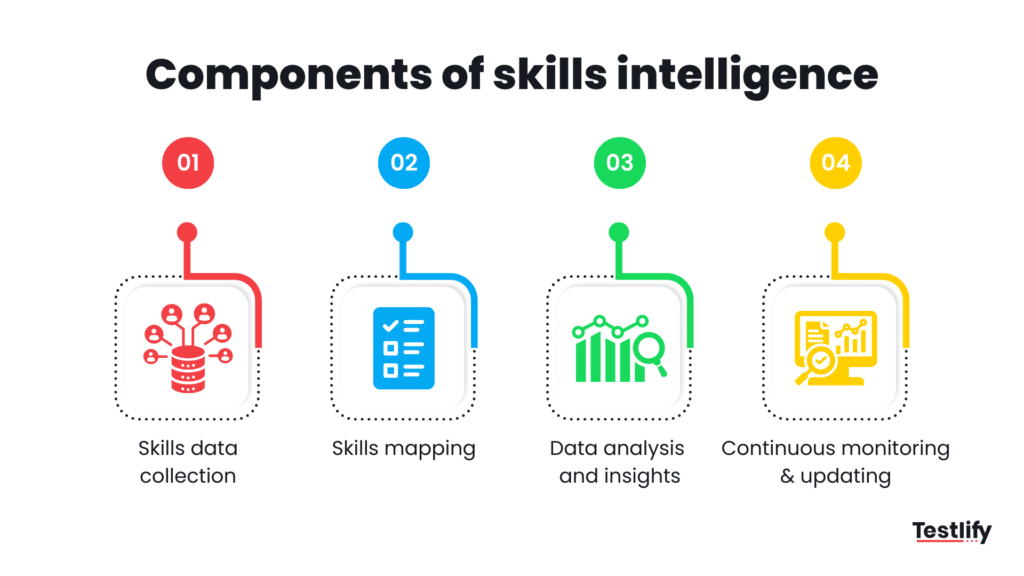
1. Skills data collection
The foundation of skills intelligence is data. But where does this data come from?
You’ll need to gather skills-related data from multiple sources, such as:
Skills assessments: These can be self-assessments, peer reviews, or specialized testing. Platforms like Testlify can help you efficiently evaluate both soft and hard skills across your team. Testlify enables you to conduct tailored, role-specific assessments to gain a clear understanding of employee capabilities.
Employee profiles: Resumes, performance reviews, and internal assessments give insights into the skills your employees possess.
Learning platforms: With more companies adopting eLearning, platforms like LinkedIn Learning or Coursera offer a wealth of data on what skills employees are developing.
Data collection is the first step in building a comprehensive picture of your workforce’s capabilities.
2. Skills mapping
Once you have the data, it’s time to organize it. Skills mapping involves identifying the key skills required for each role and aligning them with your employees’ skill sets.
This process helps you visualize where your organization excels and where you’re lacking. It’s like a skills audit, but with a focus on how those skills contribute to your company’s strategic objectives.
A report from McKinsey found that 87% of executives believe their organizations have skill gaps. By performing regular skills mapping exercises, you can prevent these gaps from widening.
3. Data analysis and insights
Now, we move into the real magic of skills intelligence: data analysis. It’s not enough to simply collect data—you need to extract actionable insights from it.
You’ll need to perform:
Skill gap analysis: This helps identify which skills your employees are missing. Are you seeing a trend where certain departments are lacking digital skills? Are soft skills like communication falling behind?
Trend analysis: What skills are becoming more relevant in your industry? According to World Economic Forum, 65% of children entering primary school today will eventually work in jobs that don’t even exist yet. Tracking trends in skills helps HR stay proactive and future-ready.
Predictive analytics: Using historical data, HR can predict the skills needed in the future. For example, the rise of AI and automation may require a future focus on data science and robotics.
4. Continuous monitoring and updating
Skills intelligence isn’t a one-off process—it’s ongoing. To stay relevant, you need to continually monitor and refresh your data. Industry shifts, company direction, and employee development all change over time, so your skills data should evolve with them.
According to Deloitte, 80% of executives say that workforce strategy is vital to organizational success, but only 28% have a clear plan for closing skills gaps. Continuous monitoring ensures that HR stays ahead of the curve and adapts to new challenges.
Benefits of skills intelligence for HR
Implementing skills intelligence in your HR strategy brings a lot of benefits, not only for your department but also for the company. Here are some of the key advantages:
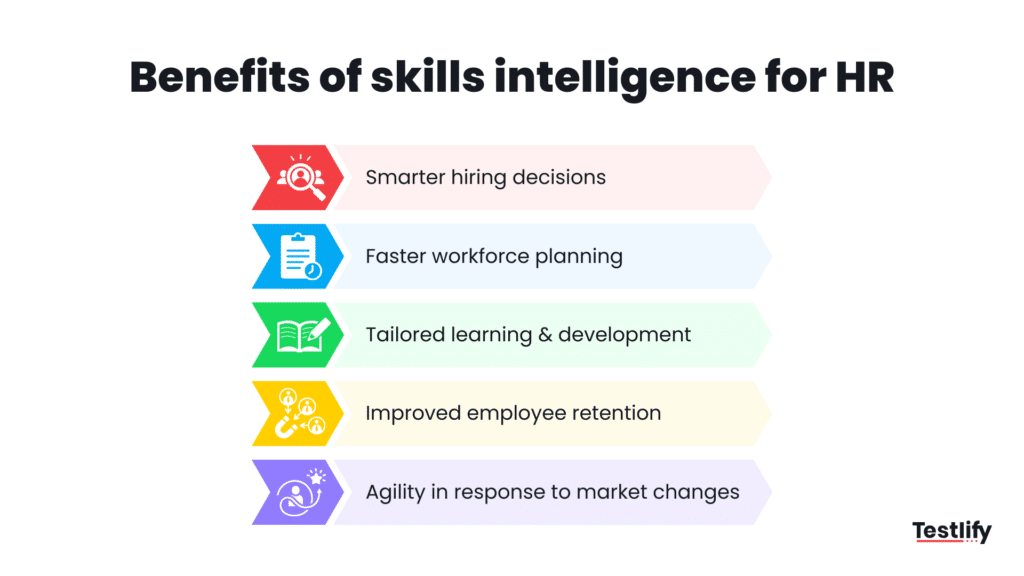
1. Smarter hiring decisions
When you have a clear understanding of the skills required for each role, you can make better hiring decisions. You won’t be relying solely on resumes and interviews, which often fail to provide the full picture.
In fact, according to a survey by Glassdoor, 58% of recruiters say that making the hiring process better is their biggest priority. Skills intelligence will enable you to adjust your recruitment to focus on what matters most for your company’s success: those skills that, when hired for, will be making an impact right away.
Testlify can significantly streamline this process by providing standardized, data-backed assessments for candidates, so you can ensure the professional you hire truly matches the skills required for the role. This helps reduce the risk of hiring mismatches and improves long-term employee retention.
2. Faster workforce planning
Skills intelligence allows for predicting future requirements of skills and, hence, proper preparation in anticipation of the situation.
For example, if I am aware of the fact that a new technology is going to be implemented over the next years, I know in advance whose skills need enhancement or upskill.
This strategy will reduce your stress and disruption you will face otherwise with last moment hiring.
3. Tailored learning & development
Skills intelligence allows you to create development plans for every employee that are unique to them. For instance, if you discover that a particular employee has strong leadership potential but lacks emotional intelligence, you can send them to appropriate training.
Gallup reports that 71% of employees say they would feel more engaged if their employer invested in their development. With the right tools, you can turn this data into an actionable plan that increases employee satisfaction and retention.
4. Improved employee retention
Employees tend to stay longer at companies that invest in their skills development. The more HR can identify growth opportunities that align with both the company’s needs and the employee’s aspirations, the more likely employees are to stay engaged and loyal.
In fact, LinkedIn’s 2023 Workplace Learning Report revealed that 94% of employees would stay at a company longer if it invested in their learning and development.
5. Agility in response to market changes
Agility is very key in the fast-changing world of business, and skills intelligence allows HR to identify and resolve skill shortages faster so that a company can make the necessary shift quickly when presented with new challenges or opportunities.
How to implement skills intelligence in your organization
Ready to apply this skills intelligence into action? Well, here’s step-by-step as to how one can apply that:
1. Choose the right tools
You will need the correct technology for acquiring and processing such data. Sometimes, it might require an employee’s skills database all the way through a holistic Talent Management system, and then Workday, Degreed, and SAP Success Factors can all have a place as well. Managing skills data also provides you insights.
Additionally, Testlify can provide you with easy-to-implement skills assessments that integrate directly into your recruitment process, helping you evaluate the specific competencies of your workforce and new candidates.
2. Conduct a skills inventory
Create a comprehensive list of the skills required for each role and compare it against the skills your employees currently possess. This process will help you identify gaps and prioritize development efforts.
3. Align skills to business strategy
Ensure that the skills you’re tracking align with your company’s long-term goals. What are the strategic initiatives for the next few years, and what skills will be required to meet those goals? This alignment is key to the effectiveness of your skills intelligence efforts.
4. Offer tailored learning opportunities
Once you’ve identified skill gaps, offer targeted learning and development opportunities. This could include formal training, online courses, mentorship programs, or stretch assignments. Using Testlify, you can track progress through assessments and ensure that employees are meeting their development goals effectively.
5. Monitor and adapt
Skills intelligence is not a one-time initiative. To keep your workforce future-ready, continuously track skills and reassess your strategies.
Conclusion
Skills intelligence is not just a buzzword, it’s a capability for modern HR departments. Through data, it’s possible to understand and manage the skills within your workforce better, which would mean smarter decisions regarding hiring, training, and development. This means an agile, engaged, and high-performing workforce.
With 58% of HR leaders naming skills shortages as the biggest challenge they are currently facing, skills intelligence can no longer be considered an optional addition but is rather a strategic necessity to propel the business forward.
Testlify can significantly help by providing streamlined, role-specific assessments that give HR teams the insights they need to make more effective decisions about talent management.
So, what’s the next step? Start mapping out your current skills, identify gaps, and create a plan to close them. By doing so, you’ll be setting up your company and your employees for success today and in the future.
Frequently asked questions (FAQs)

Content Writer
Yashika Khandelwal is a Content Writer with 3+ years of experience creating research-backed content on hiring, talent assessment, and HR technology. She is a registered Organizational Psychologist and subject matter expert who combines behavioral science with practical recruitment insights to produce accurate, evidence-based content.
LinkedInRelated resources
View all
HR & recruitment
30 virtual team building activities for remote teams
HR & recruitment
What is a job requisition & position: A guide for hiring managers

HR & recruitment
Top HR programs every organization should have
HR & recruitment
Gamified assessments: types, examples and benefits
HR & recruitment
HR KPIs: What are they? Examples & formulas
HR & recruitment
A complete guide to human proctoring vs AI proctoring
Get started.
Hire on proof, not resumes.
Run your first skills-based assessment free — no credit card required.