
How to conduct a skills audit?
Learn how to conduct a skills audit in your organization, identify skill gaps, and align talent with business goals for improved performance.

As businesses change dramatically, keeping an eye on what your workforce brings to the table becomes a priority. The key drivers of organizational success and change reside in ensuring your employees have both the skills today and tomorrow. One of the best ways of evaluating and enriching your staff’s capabilities is through a skills audit.
This refers to an inventory of the skills, knowledge, and abilities found within your team. By looking at both areas of strength and gaps, this gives HR professionals the insights to optimize talent management strategies. To be an effective HR leader or manager, understand the importance of a skills audit, how you can conduct it, and utilize the results for building a more agile, capable workforce.
 ChatGPT
 Gemini
 Claude
 Grok
Grok Perplexity
What is a skills audit?
A skills audit is a systematic review of the skills and competencies of employees in an organization. Its purpose is to assess the current skill levels, identify any areas that might require employee development, and present potential skill gaps that may influence performance.
The World Economic Forum report shows that 94% of business leaders expect employees to learn new skills on the job. A skills audit helps ensure that employees are equipped with the right knowledge and expertise, not just for their current roles but for the company’s evolving needs.
Platforms like Testlify make this process even smoother by offering a range of tailored assessments designed to map out an employee’s current skill set.
Why do companies need a skills audit?
So, why should your organization conduct a skills audit? What are the tangible benefits it provides? Let’s dive into the advantages of doing so.
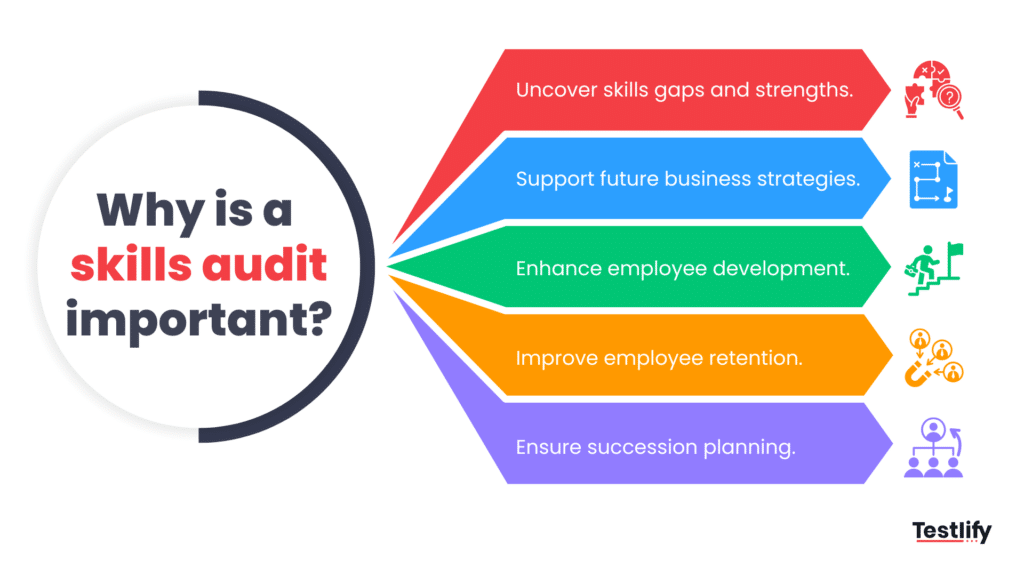
1. Identifying skills gaps
The most apparent reasons for conducting a skills audit include the identification of skill gaps within your team. A rapidly changing business environment can lead to the deprecation of some skills while introducing newer ones that might be crucial to success in the near future.
According to a PwC study, 74% of CEOs feel concerned about the availability of key skills in the workforce.
Conducting a skills audit can be used to identify gaps in skills that can potentially hamper your business operations and prepare ahead of time. It might mean upskilling the current employees or hiring new talent with the appropriate skills. Tools like Testlify help pinpoint these gaps with precision by using targeted assessments.
2. Aligning talent with business strategy
A skills audit is also an excellent way to align your workforce’s capabilities with the strategic goals of your business. Let’s say your company is moving into a new market, adopting a new technology, or launching a new product line. These initiatives will require a certain set of skills to succeed.
For example, if your company plans to implement AI tools, you’ll need employees who are proficient in machine learning, data analytics, and AI programming. A skills audit helps you assess if you have these competencies internally or if you need to focus on hiring or training.
3. Employee development and career growth
Employees today seek more than just a paycheck. They want to grow and develop their skills, and they expect companies to invest in their professional development. In fact, according to Gallup, 87% of millennials say that development opportunities are a top factor when choosing an employer.
By conducting a skills audit, you can uncover training needs and create personalized development plans. You can also offer employees opportunities for lateral moves or new challenges within the company, keeping them engaged and motivated.
Testlify, with skills assessments also provide detailed reports that make it easier to design development plans.
4. Improving employee retention
It’s well known that the cost of employee turnover can be staggering. A study by SHRM found that the average cost to replace an employee can be as high as 6-9 months of their salary. A skills audit can help you identify high-potential employees who might be looking for more growth opportunities.
By matching employees’ skills and career aspirations with relevant training or new roles within the organization, you can keep them satisfied and reduce turnover. It’s a win-win for both your team and the organization as a whole.
5. Supporting succession planning
Succession planning is another critical area where a skills audit can help. By understanding the skills within your workforce, HR can identify employees who are ready to step into leadership roles or take on more responsibility. This also ensures that when key employees leave, you have internal candidates prepared to fill those positions.
A Gartner survey found that 65% of organizations are struggling to fill leadership positions, which makes having a strong internal talent pool all the more important.

How to conduct a skills audit: A step-by-step guide
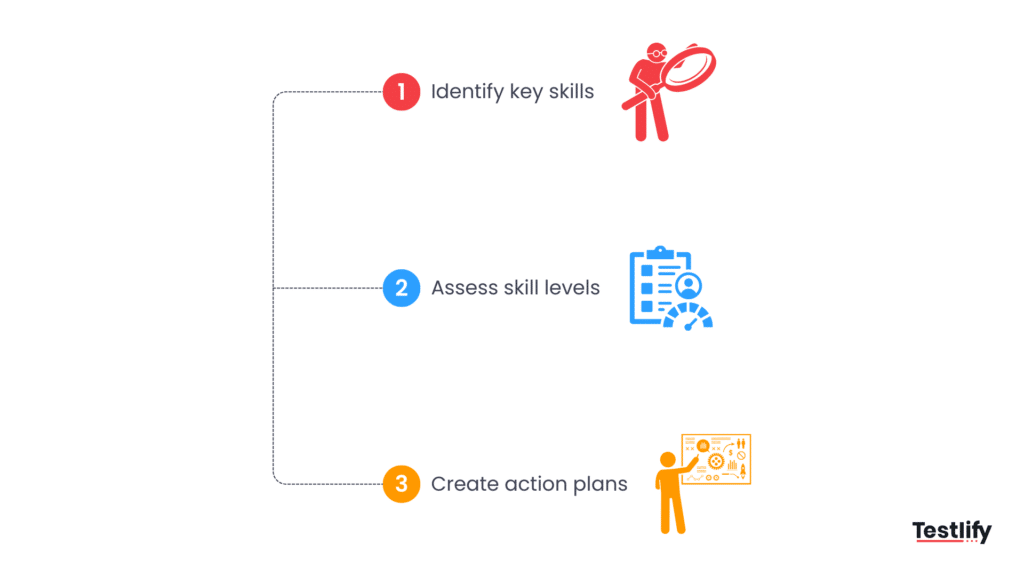
A skills audit doesn’t have to be complicated, but it does require careful planning and execution. Here’s a step-by-step guide to help you carry out a successful skills audit:
1. Define the purpose and scope
Start by clarifying the purpose of the audit. What do you hope to achieve? Are you focused on improving employee development, identifying training needs, or aligning skills with future business strategies?
You should also decide the scope of your audit. Are you going to assess all employees, or focus on specific teams, departments, or job roles? Defining the scope will ensure that your audit is focused and efficient.
2. Identify key skills for the organization
To assess skills, you first need to determine what skills are important for your organization. These can be broken down into two main categories:
- Hard skills: Technical competencies related to specific tasks (e.g., coding, data analysis, financial modeling).
- Soft skills: Interpersonal skills like leadership, communication, and collaboration, which are just as crucial to a company’s success.
Working with managers and team leaders is vital to understand which skills are needed for current and future business needs. A report from LinkedIn reveals that 92% of talent professionals believe that soft skills are equally or more important than technical skills. As such, a skills audit should assess both.
3. Gather data on employees’ skills
There are several ways to gather information about your employees’ skills. Here are some methods to consider:
- Self-assessments: Employees can evaluate their own skills. This can help you gauge their perception of their abilities and areas for improvement.
- Manager assessments: Managers can provide valuable insights into their team members’ strengths and weaknesses.
- Surveys and questionnaires: Conducting company-wide surveys can help you gather more data on a broader scale.
Ensure that the assessment tools are clear and easy to use. If you have a large workforce, consider using automated tools or platforms that can facilitate this process.
4. Evaluate skill levels
Once you’ve gathered the data, the next step is to assess skill levels. A simple way to do this is by categorizing skills into three levels:
- Beginner: The employee has basic knowledge but requires guidance.
- Intermediate: The employee is competent but may need occasional support.
- Advanced: The employee has mastered the skill and can apply it independently.
This will allow you to see where employees excel and where additional training is needed.
5. Analyze the results
Now that you’ve gathered and evaluated the data, it’s time to analyze the results. This is where the magic happens—by looking at the patterns, you can make informed hiring decisions about where to focus your attention.
Here are a few things to look for:
- Skills gaps: Are there specific skills that are lacking across teams or departments?
- Overlapping skills: Do multiple employees have the same skills, or is there an imbalance?
- Skills that support future goals: Are there emerging skills needed for future business strategies that are currently underrepresented?
6. Create action plans
Once you’ve identified gaps and strengths, it’s time to create action plans. This could include:
- Training and development programs to address gaps and upskill employees.
- Recruitment strategies to bring in external talent for critical skills that cannot be developed internally.
- Leadership development programs for employees who show potential for higher-level roles.
Make sure that each action plan is specific, measurable, achievable, relevant, and time-bound (SMART) so that progress can be tracked.
7. Communicate findings and next steps
Share the results of the audit with the relevant stakeholders—managers, employees, and leadership. Transparency is key to gaining buy-in and making the process feel inclusive. Make sure everyone understands how the findings will impact decisions like training, promotions, or even hiring.
8. Review and follow-up
A skills audit isn’t a one-time process. As business needs evolve and new skills emerge, you’ll need to regularly review and update your skills inventory. Scheduling periodic follow-ups will help ensure that you’re staying on top of skills development and adjusting to changes in the business landscape.
Best practices for conducting a skills audit
To make the most out of your skills audit, keep these best practices in mind:
1. Involve employees early on
For a skills audit to be successful, it’s essential to get employees’ buy-in. Be transparent about the purpose of the audit and how it will benefit them personally (e.g., by opening up opportunities for career growth).
2. Use technology to streamline the process
Using HR software and digital tools can simplify the skills audit process, especially in larger organizations. Many platforms allow employees to self-assess their skills and track their learning progress, making it easier for HR to analyze data and identify trends.
3. Take a holistic approach
Don’t just focus on hard skills; soft skills like communication, collaboration, and problem-solving are equally critical. A well-rounded workforce is essential for both short-term performance and long-term success.
4. Track progress over time
A skills audit should be part of an ongoing development cycle. Make sure you track the progress of your action plans and revisit the audit results regularly to assess whether your workforce is developing the necessary skills to meet business needs.
Conclusion
A skills audit is one of the most effective ways for HR professionals to ensure that their team is ready to meet the challenges of the future. By identifying gaps, recognizing strengths, and aligning employee skills with business goals, you can create a more agile, capable, and engaged workforce.
Given that 84% of organizations plan to increase their investment in employee training over the next few years, conducting regular skills audits will position your company as a leader in talent development, helping you stay competitive.
By integrating a talent assessment platform like Testlify into your process, you can make skills audits more efficient, accurate, and actionable.
Frequently asked questions (FAQs)

Content Writer
Yashika Khandelwal is a Content Writer with 3+ years of experience creating research-backed content on hiring, talent assessment, and HR technology. She is a registered Organizational Psychologist and subject matter expert who combines behavioral science with practical recruitment insights to produce accurate, evidence-based content.
LinkedInRelated resources
View all
HR & recruitment
What is regretted attrition and how to reduce it?

HR & recruitment
16 HR skills every professional need

HR & recruitment
5 Essential HR goals and objectives for a thriving 2026

HR & recruitment
101 guide to using the 9-box matrix

HR & recruitment
Modern recruitment hacks and pitfalls to avoid in 2026

HR & recruitment
7 innovative HR initiatives you must know in 2026
Get started.
Hire on proof, not resumes.
Run your first skills-based assessment free — no credit card required.