
How to succeed at recruiting generation Z employees?
Discover effective strategies for recruiting and retaining Generation Z employees. Learn how to attract this dynamic, purpose-driven generation to your team.

Are you trying to win over the most tech-savvy, socially conscious, and ambitious generation ever to enter the workforce? Yes, generation Z!
That’s an excellent challenge for employers! For Gen Z, a job is not just about a paycheck. They want meaningful work that aligns with their values.
They also want the flexibility to balance personal and professional priorities, as well as an employer that genuinely cares about diversity, equity, and inclusion (DEI). Speed, transparency, and authenticity are non-negotiables.
However, it gets even more interesting in recruiting Generation Z: traditional recruitment strategies often fail to resonate with this generation.
Employers relying on outdated methods are missing out on top talent and alienating the very people who could bring fresh perspectives.
Did you know that74% of Gen Z employees prefer to leave their jobs within three years? It’s a stark reminder that attracting this generation is only half the battle; keeping them is the actual test.
So, how do you win their trust, loyalty, and enthusiasm? This guide goes deep into the world of recruiting Generation Z, offering practical strategies, real-world examples, and inspiring insights to help you succeed.
 ChatGPT
 Gemini
 Claude
 Grok
Grok Perplexity
Who is generation Z?
Generation Z refers to people born between 1997 and 2012. They have grown amid dramatic changes, including the rise of social media, the global recession, the climate crisis, and a worldwide pandemic. These experiences have developed resilience and a strong desire for meaningful engagement in their lives.
Key traits of Gen Z
- Digital natives: Unlike any generation before them, Gen Z doesn’t remember a world without smartphones. Their technological fluency is not just a skill but second nature.
- Socially conscious: This generation is the most diverse in history. They expect their employers to promote Diversity and Inclusion (DEI) actively. Additionally, they expect their employers to tackle social and environmental challenges head-on.
- Practical yet ambitious: Gen Z values stability but refuses to settle. They seek meaningful work that aligns with their values. Also, they are not afraid to switch jobs. Most of them prefer to leave their roles within a few years without any hesitation.
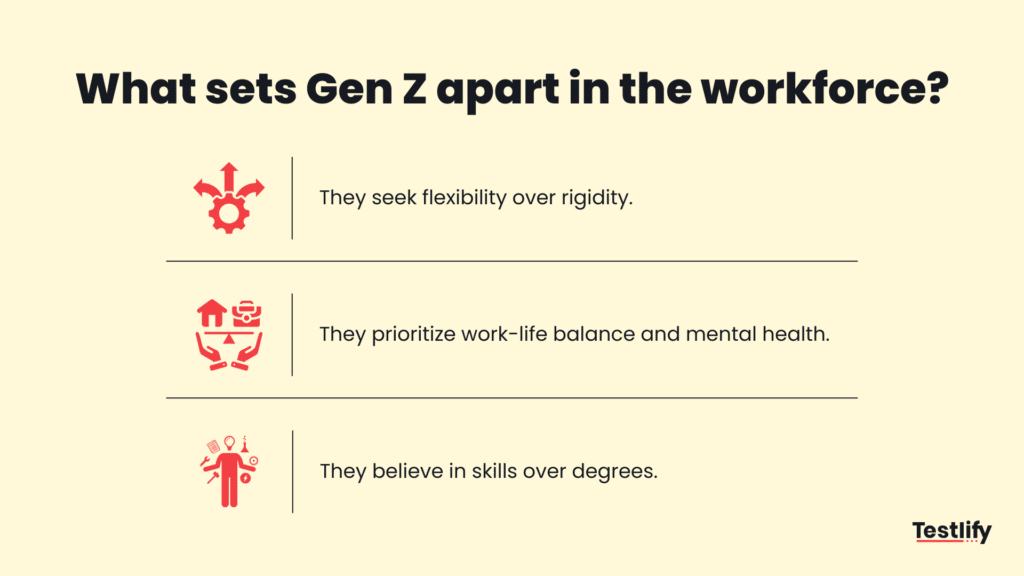
Generation Z does not want to be an employee but rather an agent of change. What do they want? An inclusive, transparent, and impactful workplace. For businesses willing to adapt, the rewards are immense.

Challenges employers face in recruiting generation Z
Recruiting Generation Z is redefining the talent acquisition playbook. As a generation driven by purpose, technology, and flexibility, they challenge employers to rethink traditional hiring methods. Here’s where businesses often stumble:
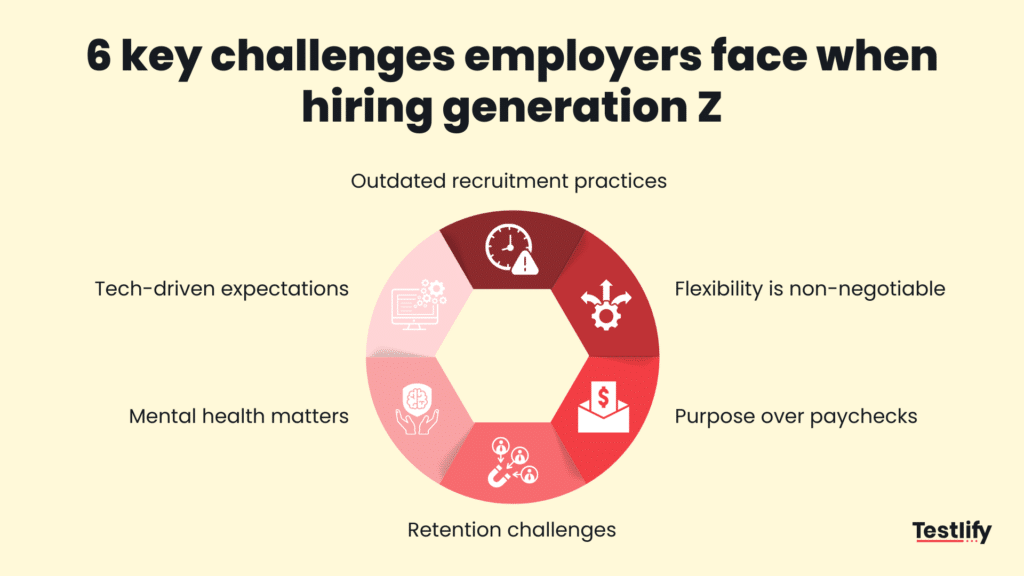
1. Outdated recruitment practices
Gen Z lives in an on-demand world: 75 % abandon applications that feel clunky, and 71 % quit when they don’t hear back quickly. The fix? Strip friction, keep the form mobile-first, and communicate within hours, not days.
2. The flexibility dilemma
For Gen Z, work-life balance isn’t negotiable. They expect options to work from home or in a hybrid model, as well as flexibility to structure their day. 72% of Gen Z workers are willing to quit their jobs if they don’t offer flexibility.
3. Value-driven career choices
Monster’s April 2025 study found that 44% of Gen Z grads walk away if a salary isn’t transparent, 33% require visible diversity in leadership, and fully 75% refuse to work for companies misaligned with their social values.
4. Retention risks
A fast-paced approach characterizes Gen Z’s career perspective. They are more likely to change jobs within a couple of years in search of constant growth and new challenges. Those employers who get stuck in the traditional career progression models risk losing them to competitors who offer clear development paths.
5. Mental health expectations
A 2024 Mental Health America poll shows 71 % of Gen Z employees rate their work health as “unhealthy,” and 34 % have considered quitting over mental-health strain. They want visible well-being programs, stigma-free check-ins, and psychologically safe workloads.
6. Technology shortfalls
Gen Z isn’t impressed by legacy ATS screens. Deloitte’s 2025 survey reports that 74% of respondents expect GenAI to reshape their workflow within a year, while 33% of all candidates abandon one-way video tasks they deem pointless.
Your tech stack must feel as progressive as the roles you’re hiring for.
These challenges aren’t obstacles—they’re opportunities. Employers who adapt to Gen Z’s expectations can unlock an innovative and socially conscious workforce.
What is the next step? Crafting recruitment strategies that not only attract Gen Z talent but also create environments where they thrive.
Recruiting strategies to attract gen Z
To recruit Generation Z, you must think beyond conventional hiring tactics. This is a generation that values authenticity, innovation, and purpose over flashy perks. Here are proven strategies to attract top Gen Z talent:
1. Meet them where they are: Utilize social media
Gen Z spends a significant amount of time on platforms like Instagram, TikTok, and YouTube. Use short, engaging videos, employee stories, and behind-the-scenes glimpses to showcase your company culture.
2. Prioritize skills over pedigrees, with conversational assessments
Gen Z trusts proof of skill, not paper credentials. Tools like Testlify’s gamified skills tests, real-time coding sandboxes, and the new Conversational AI Audio Interview let candidates demonstrate competence while keeping the experience lively and bias-free.
3. Personalize the candidate’s experience
Gen Z wants to feel valued from the start. Personalize communication by addressing candidates by name and referencing their unique skills or interests. While hiring, provide real-time updates and use video messaging to add a human touch.
You can also send a personalized welcome email or a small care package after the interview to leave a lasting impression.
4. Adapt flexibility and transparency
Flexibility is a priority for Gen Z. Offer remote work options, hybrid models, or flexible hours that align with their need for work-life balance.
Additionally, be transparent about salary ranges and opportunities for growth. You can also show candidates what their career trajectory might look like in your company.
By aligning your recruitment practices with the values that resonate with Gen Z, you can establish your company as a leading choice for this progressive generation.
Leveraging Testlify’s voice-and-video stack gives you the speed Gen Z craves and the fairness regulators expect. It’s a powerful combination for any U.S. or global hiring team.
Retention strategies for generation Z employees
Retaining Generation Z talent requires employers to create a positive work environment. In simpler terms, an environment where growth, flexibility, and purpose thrive. Start by offering clear career paths and continuous learning opportunities.
Unlike previous generations, Gen Z views skill-building as a lifelong journey. Offer customized career development plans and access to diverse projects that allow them to expand their expertise.
Flexibility is essential. Gen Z values autonomy and expects workplaces to offer roles tailored to their needs. This could mean offering compressed workweeks or project-based schedules that prioritize outcomes over hours.
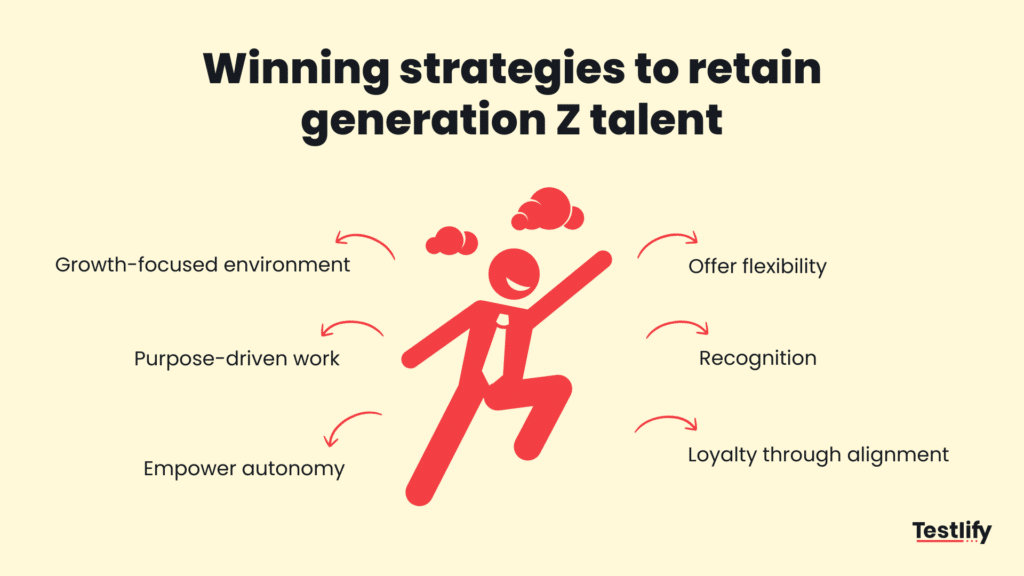
But it doesn’t stop there. This generation thrives on purpose. Tie their work to the bigger picture. Organizations must clearly communicate how their contributions impact the company, community, or environment. Additionally, highlight initiatives that align with social responsibility.
Lastly, don’t overlook the power of recognition. Gen Z thrives on the meaningful acknowledgment of their efforts. Whether through micro-bonuses or public shoutouts, use the power of recognition. This can reinforce their sense of belonging and value within the organization.
Employers who align their retention strategies with these priorities are more likely to cultivate a loyal, high-performing workforce. Retaining Gen Z is about nurturing a generation that will redefine the future of work.
Real-life examples of success
Understanding Generation Z is one thing, and successfully engaging and retaining them is another. Let’s examine how forward-thinking companies are adapting their strategies to meet the expectations of Gen Z.
Cisco
Cisco actively engages employees in building its employer brand through social media. Employees are featured in Instagram posts where they share experiences at Pride parades. The authenticity and transparency resonate with Gen Z, who prefer real stories over corporate messaging.
Microsoft
Microsoft has adopted skills-based hiring to break down barriers for Gen Z candidates. It replaced degree requirements with skills-based assessments.
It also opens up opportunities for diverse talent. This shift not only appealed to Gen Z’s preference for meritocracy but also strengthened the talent pipeline of Microsoft.
Final thoughts
Generation Z is a force of change. Their emphasis on authenticity, purpose, and innovation challenges employers to rethink traditional approaches. They seek workplaces that inspire growth, prioritize inclusivity, and offer meaningful work.
Success lies in embracing their needs. Whether it’s skills-based hiring or showcasing real commitments to work-life balance, your willingness to adapt will define your ability to attract and retain top talent.
The message is clear: Meet Gen Z on their terms, and you’ll unlock trailblazers who will drive your organization forward.
Frequently asked questions (FAQs)

B2B SaaS Content Writer
Rishav Kumar is a B2B SaaS content writer with 4 years of experience. He loves crafting engaging content. Always exploring fresh ideas, he's passionate about helping businesses grow through impactful writing.
LinkedInRelated resources
View all
Hiring Guide
Heuristic Bias in Hiring: Types and How to Reduce It

Hiring Guide
5 high volume recruitment strategies to adopt in 2026

Hiring Guide
Talent matching: what it is and how it works

Hiring Guide
What is interview scheduling and how to do it?

Hiring Guide
What is affinity bias and how to avoid it in 2026?
Hiring Guide
HR checklist for 2026: Key steps you can’t miss
Get started.
Hire on proof, not resumes.
Run your first skills-based assessment free — no credit card required.