
Pre-hire assessments for marketing and advertising industry roles in 2026
Which tests to use for each marketing and advertising role, how to design a fair work sample, and how to run assessments candidates finish.

A portfolio can show a great campaign, but it cannot show who built it. Titles drift, channels change every year and interviews reward strong presenters, which is what marketers are.
Pre-hire assessments for marketing and advertising industry roles are short, job-related tests that show whether a candidate can do the work. They score every candidate on the same tasks, such as reading campaign data, writing copy or planning a media budget.
TL;DR:
- Pre-hire assessments for marketing and advertising roles combine a role skills test, a reasoning test and a short work sample, scored on the same criteria for every candidate.
- Marketing is a large, competitive hiring market: the US alone has about 36,300 openings a year for advertising, promotions and marketing managers, at a median pay of $165,780.
- Match the test mix to the role. Analysts need numerical reasoning and analytics tests, creatives need a timed brief, and agency account roles need situational judgment and client communication tasks.
- Keep the whole assessment under 60 minutes and never ask for free spec work. Long or unpaid tasks push the best candidates to drop out.
- Score work samples with a written rubric agreed before the first candidate applies, and use proctoring on take-home tasks where AI tools could do the work.
- Put assessments right after the application, before interviews, so interviewers spend time only on candidates who have shown the skills.
 ChatGPT
 Gemini
 Claude
 Grok
 Perplexity
What are pre-hire assessments for marketing and advertising industry roles?
Pre-hire assessments for marketing and advertising industry roles are standardized tests and tasks given to candidates before interviews to measure the skills a marketing job needs. A typical set combines a role skills test (SEO, paid media, content, analytics), a reasoning test and a short work sample, all scored automatically or against one rubric.
The difference from a generic aptitude test is focus. A marketing aptitude test checks how a candidate reasons with numbers and words.
A marketing skills assessment checks whether they know the channel, the tool and the trade: how bidding works in paid search, what a healthy email click rate looks like, how to brief a designer. Most teams need both, plus one task that looks like the real job.
These assessments apply across in-house brand teams, performance marketing teams, e-commerce and SaaS growth teams, and agencies hiring for creative, media and account roles.

Why do marketing and advertising teams need skills-based screening?
Marketing and advertising teams need skills-based screening because job titles and portfolios say little about what a candidate did personally, and the channels change faster than resumes. A "digital marketing manager" at one company runs paid social budgets; at another, the same title means email and events.
The market is large and competitive. The US Bureau of Labor Statistics occupational outlook for advertising, promotions and marketing managers reports 454,800 jobs in 2025, a median pay of $165,780 and about 36,300 openings a year, with 6% growth projected from 2025 to 2035. Hiring the wrong person at that pay level is expensive, and finding the right one quickly matters.
Skills-based screening also widens the pool. According to LinkedIn Economic Graph's Skills-Based Hiring 2025 report, hiring on skills rather than past job titles could expand talent pools by 6.1x globally. For marketing, that means a strong analyst from finance or a copywriter from journalism gets a fair look instead of being filtered out for a missing title.
Three problems skills tests solve for marketing hiring:
- Portfolio ambiguity: A campaign in a portfolio was usually a team effort. A timed task shows what the candidate does alone.
- Channel drift: Platforms, bidding rules and AI tools change every year. A current skills test checks today's knowledge, not what someone learned five years ago.
- Interview polish: Marketers are good presenters by trade. Scored tests keep charisma from deciding the shortlist.
Which skills should a marketing assessment measure?
A marketing assessment should measure five skill groups: analytical skills, channel and tool skills, creative and writing skills, commercial and client skills, and work behaviors such as prioritization and collaboration. The weight of each group depends on the role, but almost every marketing job needs some of all five.
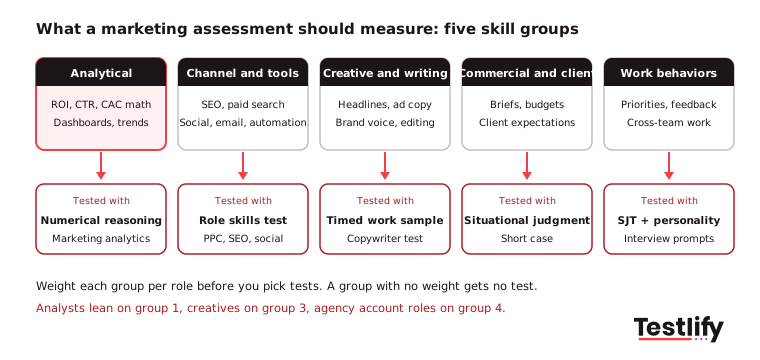
- Analytical skills: Reading dashboards, calculating ROI, cost per click, conversion rate and customer acquisition cost, spotting a real trend versus noise. Tested with a numerical reasoning test and a marketing analytics test.
- Channel and tool skills: SEO, paid search, paid social, email, marketing automation, web analytics and the platforms behind them. The Digital Marketing Institute lists 12 skill areas in its own benchmark, from content and SEO to programmatic advertising and AI, which is a useful checklist for scoping a role.
- Creative and writing skills: Headlines, ad copy, landing page structure, tone for a brand, editing someone else's draft. Tested with a copy or design work sample.
- Commercial and client skills: Understanding a business goal, writing a brief, managing budgets and client expectations. Tested with situational judgment questions and a short case.
- Work behaviors: Handling competing deadlines, taking feedback, working with design, sales and product. Tested with situational judgment and personality questionnaires used as interview prompts, not as pass or fail filters.
Pro tip: Write the five groups on one page for each open role and give each a weight before you pick tests. If a skill has no weight, leave its test out, because shorter assessments get finished.
Which pre-hire assessments for marketing and advertising industry roles work best?
The pre-hire assessments that work best for marketing and advertising industry roles pair one role-specific skills test with one reasoning test and, for mid-level and senior roles, one short work sample. The table below shows a practical mix for the most common role families, based on what each job spends its week doing.
Role family | Role skills test | Reasoning and behavior | Work sample (15 to 30 min) |
|---|---|---|---|
Digital and performance marketing | Digital marketing, PPC, Google Ads, paid social | Numerical reasoning | Diagnose a campaign report and reallocate budget |
SEO and content | SEO specialist, content writer, SEO copywriting | Verbal reasoning | Outline a page for a target query and fix a weak intro |
Social media and community | Social media manager, social media marketing | Situational judgment | Plan a week of posts and answer a negative comment |
Copy and creative | Copywriter, creative copywriter, graphic designer | Critical thinking | Write three ad headlines and one landing hero from a brief |
Marketing analytics and research | Marketing analytics, Google Analytics, Excel | Numerical reasoning | Read a dataset and write a three-line recommendation |
Brand and product marketing | Brand management, product marketing manager | Critical thinking, situational judgment | Draft positioning for a product launch |
Agency account and client service | Account executive, PR strategy | Situational judgment, personality | Reply to a client asking for a scope change |
Marketing leadership | Marketing manager, head of marketing | Critical thinking, personality | 90-day plan with budget split, discussed in interview |
For analyst and research roles, demand is growing even faster than for managers: the BLS outlook for market research analysts projects 7% growth from 2025 to 2035 and about 82,000 openings a year. Numerical and analytics tests carry the most weight there.
Testlify's library covers each row. Start with the general marketing assessment test for broad roles, then add role tests such as the digital marketing test, PPC manager test, SEO specialist test, social media manager test, copywriter test and brand management test.
How do you build a fair work sample for creative roles?
A fair work sample for creative roles is short, timed, based on a fictional or public brief, and scored against a rubric written before anyone applies. Creative candidates judge an employer by the task.
A tight 20 to 30 minute brief earns respect; a weekend "test campaign" for your real client reads as free work and drives strong people away.
How to design one:
- Use a fictional or public brief: Never a live client or an upcoming campaign. Candidates should not wonder whether their ideas will be used without pay.
- Time box it: Twenty to thirty minutes for juniors, up to forty-five for seniors. Say the time limit up front.
- Ask for a few small outputs: Three headlines, one social post and a two-line rationale tell you more than one polished concept.
- Score with a rubric: Four criteria on a 1 to 5 scale, such as fit to brief, clarity, brand voice and the strength of the rationale. Two reviewers score separately, then compare.
- Review blind where possible: Remove names and photos from the submission so the work is judged on its own.
A job simulation follows the same logic for non-creative roles: a realistic slice of the job, short enough to finish in one sitting. For the wider picture of team design, see this guide on how to build a successful marketing team.
Key takeaway: Judge creatives on thinking and fit to the brief, not on production polish. Polish comes from tools and time; the thinking is what you are hiring.
How should agencies assess account and media talent?
Agencies should assess account and media talent on client judgment, numbers and written communication, because those three skills decide whether an account grows or churns. Creative skill matters less in these roles than the ability to manage expectations, defend a budget and explain results in plain language.
- Account managers and executives: Situational judgment questions on scope creep, missed deadlines and unhappy clients, plus a written reply to a client email. The account executive test adds a commercial skills check.
- Media planners and buyers: Numerical reasoning and a budget allocation task: split a fixed budget across channels for a stated goal and justify it in three lines.
- PR and communications roles: A short press statement or crisis reply, scored for accuracy, tone and speed. The public relations strategy test covers the planning side.
- Creative directors and senior creatives: A portfolio review in interview, plus a critique task: give written feedback on a weak ad. Feedback quality shows how they will lead a team.
Agencies often hire in bursts after a new account win. Ready-made role tests let a small HR team screen a large applicant pool quickly, then spend interview time only on the strongest candidates.
How do you add assessments to your marketing hiring process?
Adding assessments to a marketing hiring process takes six steps: define the skills, pick the tests, invite candidates right after they apply, review scores, run structured interviews on the shortlist, and check results against early job performance.
The order matters. Testing after interviews wastes the time testing is meant to save.
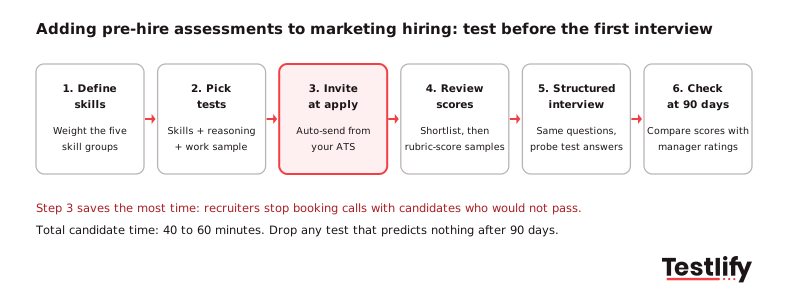
- Define the skills: Use the five skill groups and weight them for the role with the hiring manager.
- Pick the tests: One role skills test, one reasoning test, and a work sample for mid-level roles and up. Aim for 40 to 60 minutes in total.
- Invite at application: Send the assessment link automatically from your ATS once a candidate applies or passes a basic screen.
- Review scores and samples: Shortlist on test scores, then score work samples with the rubric.
- Run structured interviews: Ask every shortlisted candidate the same questions, including follow-ups on their test answers. This guide to structured interviews shows how.
- Check against performance: After 90 days, compare test scores with the hiring manager's rating. Drop tests that predict nothing for your roles.
Across the teams we work with, the biggest time saving comes from step 3: when testing happens before the first call, recruiters stop scheduling interviews with candidates who would not pass.
How do you keep marketing assessments fair and cheat-resistant?
Marketing assessments stay fair and cheat-resistant when every candidate gets the same job-related tasks, the same time limits and the same scoring, and when take-home work is either proctored or followed up live. AI writing tools make this more urgent for marketing than for most fields, because copy and content tasks are exactly what those tools do.
Fairness and integrity checks to build in:
- Job-related content only: Every question should map to a skill in the role profile. Drop trivia and culture-fit questions with no link to the job.
- Accommodations: Offer extra time or alternative formats on request, and say so in the invite.
- Clear rules on AI: Decide whether AI tools are allowed for a task. If they are, ask candidates to show their prompt and edits. If not, use timed tasks with proctoring.
- Proctoring on unsupervised tests: Tab switching alerts, copy and paste blocking, webcam snapshots and AI assistance detection flag suspicious sessions for review rather than rejecting automatically. Testlify includes 20+ proctoring checks for this.
- Live follow-up: Ask candidates to talk through their work sample in the interview. People who did the work explain it easily.
- Bias monitoring: Compare pass rates across candidate groups each quarter. Where AI scoring is used, check local rules such as NYC Local Law 144. Testlify publishes its NYC bias audit.
HR teams are adopting AI quickly, which raises the bar for transparency. The SHRM 2025 Talent Trends research found that AI use in HR tasks rose to 43% in 2025 from 26% in 2024, and that 69% of organizations still struggle to recruit for full-time roles.
Telling candidates what is tested, how it is scored and where a person reviews the result keeps trust high.
What mistakes do teams make when testing marketers?
Teams testing marketers most often make five mistakes: tests that are too long, unpaid spec work, generic tests that ignore the channel, pass marks set without data, and treating personality results as a filter. Each one either loses good candidates or keeps the wrong ones.
- Too long: A 2-hour battery for a junior social role invites drop-off. Keep it under an hour and explain why each part is there.
- Spec work: Asking for a full campaign for a real client damages your employer brand in a small, connected industry.
- Wrong test for the role: A general marketing test for a paid search specialist misses bidding, match types and conversion tracking. Use the role test.
- Arbitrary cut-offs: Set pass marks after reviewing the first group of scores against interview results, not before.
- Personality as a gate: Use personality results to shape interview questions, not to reject candidates.
How does Testlify support marketing and advertising hiring?
Testlify supports marketing and advertising hiring with ready-made role tests, custom tasks for creative and agency roles, and automated scoring that ranks candidates on the same criteria. Hiring teams can run the whole screening stage from one platform and send results back to their ATS.
- Marketing test library: 3,500+ tests in total, including more than 70 marketing tests for roles from marketing intern to chief marketing officer, plus SEO, paid media, email, social, analytics, copywriting and brand tests. Browse the test library.
- Custom work samples: 25+ question types, including file upload, video, audio and practical tasks, so a copy brief or a campaign diagnosis can sit next to the skills test.
- AI test builder: Generate a custom assessment from your job description, then edit the questions and scoring criteria.
- Integrity: 20+ proctoring checks, including AI assistance detection and copy and paste blocking, for take-home copy and content tasks.
- ATS sync: Two-way sync with 100+ ATS and HRIS tools, including Greenhouse, Lever, Workday and SmartRecruiters. See integrations.
- Global hiring: Tests in 15+ languages for teams hiring marketers across regions.
Hiring for digital roles first? This guide on how to use a digital marketing test to screen candidates walks through one role in detail.
Ready to hire marketers on proof?
Pick one open marketing or advertising role, add a role skills test and a short work sample, and see how the shortlist changes. Start a 7-day free trial of Testlify, no credit card required, or book a demo to see marketing tests built for your roles.
Frequently asked questions

Director of Marketing
Akash Patange is the Director of Marketing at Testlify, where he works closely with HR leaders and recruiters to help organizations improve hiring outcomes. He writes about talent assessment, recruitment technology, and data-driven hiring practices.
LinkedInRelated resources
View all
Candidate assessment
Pre-hire assessments for telecommunications industry

Candidate assessment
Pre-hire assessments for legal industry

Candidate assessment
Pre-hire assessments for consulting industry

Candidate assessment
Leadership skills assessment: a hiring guide for 2026

Candidate assessment
Importance of assessing analytical skills in recruitment

Candidate assessment
Recruitment Decision Making: Assess Decision-Making Skills
Get started.
Hire on proof, not resumes.
Run your first skills-based assessment free — no credit card required.