
Job offer email template: 12 free samples for 2026
12 job offer email templates to copy, from the verbal-offer recap to the acceptance reply, with subject lines and what each email needs.

You made the hire and the candidate said yes on the call. Then the offer email sits in drafts for three days, and a strong candidate starts listening to other employers.
A job offer email template fixes this by putting the role, pay, start date, conditions and reply deadline in one clear message. Below are 12 free templates for every email in the offer stage, plus the rules that keep accepted offers from falling through.
TL;DR:
- A job offer email confirms the offer in writing: job title, pay, start date, location, manager, conditions, the reply deadline and one named contact.
- Call the candidate first, then send the offer email within 24 hours while the conversation is fresh.
- Keep the email short and put the full terms in the attached letter; every figure in the email must match the letter exactly.
- Gartner found 35% of candidates backed out after accepting an offer in 1Q25, so the emails after the yes matter as much as the offer.
- Set a real reply date, usually 3 to 5 business days, and send one polite follow-up after 2 to 3 business days of silence.
- If the offer depends on a background check, say so in the email and follow the FTC rules before you withdraw any offer.
 ChatGPT
 Gemini
 Claude
 Grok
 Perplexity
What is a job offer email template?
A job offer email template is a reusable message that turns a hiring decision into a written offer. The email is the cover note: it names the role and the headline terms, invites questions and sets a deadline.
The formal offer letter is usually attached and carries the full terms the candidate signs.
The split matters because candidates read the email on a phone in a few seconds, while the letter is the record both sides keep. If you need the document itself, use our job offer letter templates or the free offer letter generator.
What it does | Job offer email | Formal offer letter |
|---|---|---|
Purpose | Delivers the offer and starts the conversation | Records the terms of employment |
Length | 100 to 250 words | One to three pages |
Contents | Role, headline pay, start date, deadline, contact | Full pay, benefits, conditions, policies, signature lines |
Format | Email body | Attached PDF or e-signature link |
Reply | "Yes", questions or a counter | Signed copy |

Why does the job offer email matter so much?
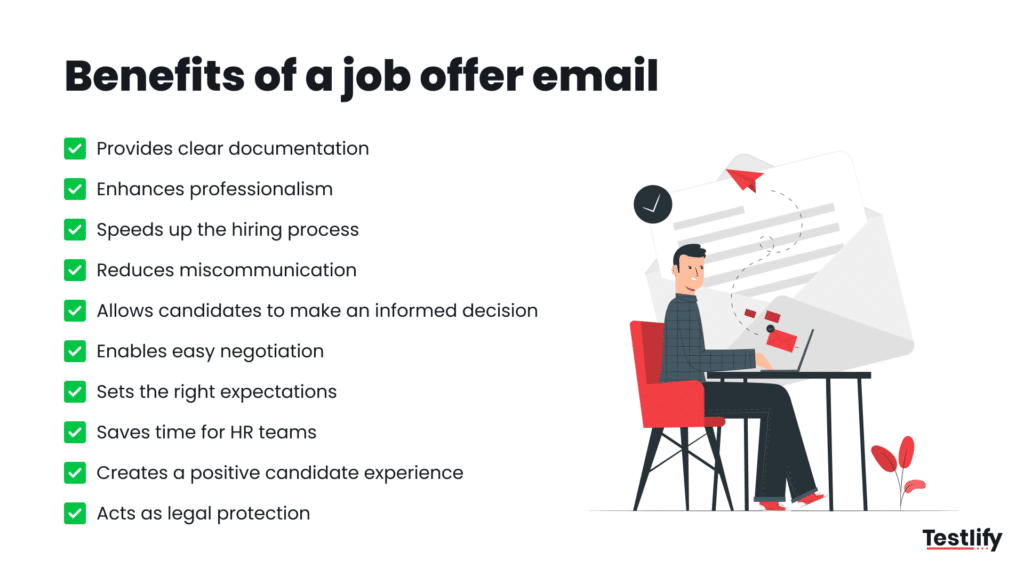
The job offer email matters because it is the moment a candidate decides whether the role is real, fair and worth leaving a current job for. A slow, vague or wrong email gives a strong candidate a reason to wait for another offer.
Candidates still compare offers. According to Gartner's 2025 candidate survey, 44% received multiple job offers in 1Q25, and 35% backed out after accepting one.
HR Dive's report of the same research adds that 53% of candidates named pay as the main reason to accept. A clear email with the right numbers, sent fast, is the cheapest way to protect your offer acceptance rate.
What should a job offer email include?
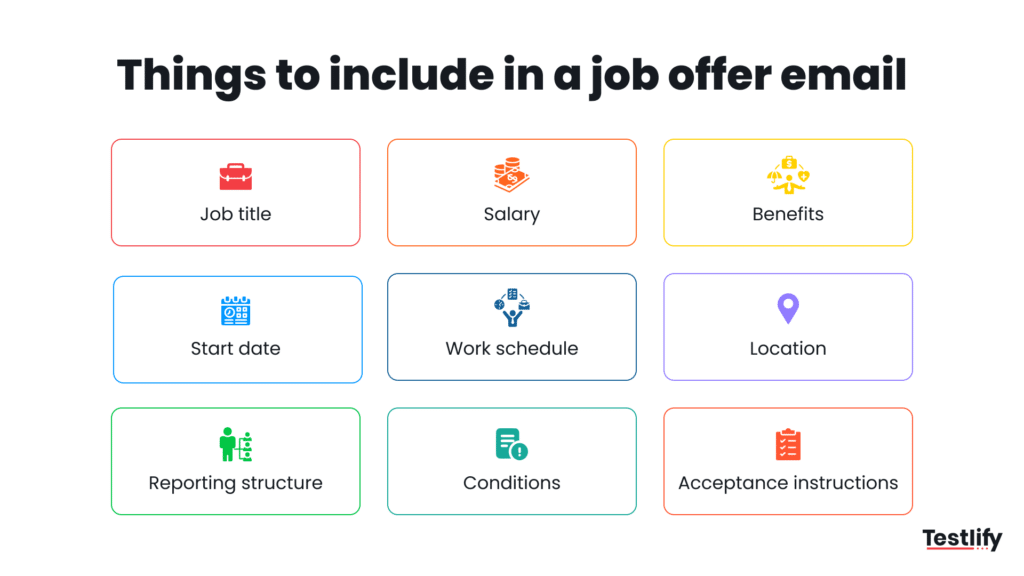
A job offer email should include the job title, base pay and pay frequency, start date, work location or remote setup, the manager the person reports to, any conditions such as a background check, the attached offer letter, a specific reply deadline, and the name and phone number of the person to contact with questions.
Use this checklist before you press send:
- Job title and team: The exact title from the requisition, plus the team or department.
- Pay: Base salary or hourly rate, pay frequency, and any bonus, commission or equity in one line each.
- Benefits headline: One sentence on the main benefits; the letter carries the detail.
- Start date and schedule: Full-time, part-time or contract, and the working hours if they are fixed.
- Location: Office address, hybrid pattern or fully remote, and any travel.
- Reporting line: The manager's name and title.
- Conditions: Background check, references, right-to-work documents or a licence check.
- Attachment: The offer letter or e-signature link, named clearly.
- Deadline: A real date and time zone, not "soon".
- Contact: One named person, with email and phone.
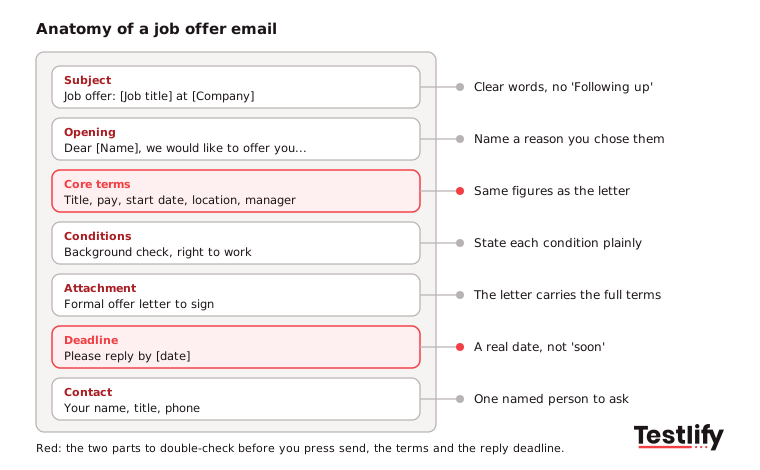
Pro tip: Copy every figure into the email from the signed-off letter, never from memory or an old draft. A salary that differs by one digit between the email and the letter is the fastest way to lose trust at the finish line.
Which subject lines work for a job offer email?
Subject lines that work for a job offer email name the company and the word "offer", so the candidate spots it in a full inbox. Vague subjects such as "Following up" or "Next steps" get opened late or missed.
Subject line | |
|---|---|
Verbal offer recap | Your offer from [Company]: summary of our call |
Standard offer | Job offer: [Job title] at [Company] |
Remote offer | Remote job offer: [Job title] at [Company] |
Contingent offer | Conditional job offer: [Job title] at [Company] |
Internal move | Your new role at [Company]: [Job title] |
No-reply follow-up | Checking in on your [Company] offer |
Revised offer | Updated offer: [Job title] at [Company] |
Acceptance confirmation | Welcome to [Company], [First name] |
Decline acknowledgment | Thank you, [First name] |
When should you send a job offer email?
A job offer email should go out after the hiring decision is approved and you have called the candidate with the verbal offer, ideally within 24 hours of that call. The call lets you hear their reaction and answer questions; the email puts the same terms in writing.
Speed matters. SHRM's 2026 recruiting benchmarking puts median time to fill at 39 calendar days for nonexecutive roles, measured up to the moment a candidate accepts.
Every day between the decision and the written offer adds to that number and gives competing employers time to move.
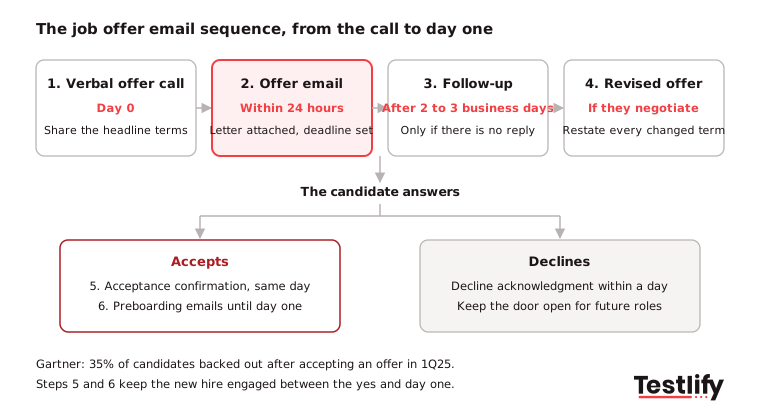
The offer stage is a sequence, not one email:
- Day 0, verbal offer call: Share the role, pay and start date, then tell them the email is coming.
- Within 24 hours, offer email: Letter attached, deadline set.
- After 2 to 3 business days of silence, follow-up: One short, friendly check-in.
- If they negotiate, revised offer: Restate every changed term in writing.
- Same day as the yes, acceptance confirmation: Next steps and the first-day plan.
- Until day one, preboarding: Regular contact so the new hire does not go quiet. Our onboarding email templates cover this stretch.
Which job offer email templates can you copy?
The 12 job offer email templates below cover each email in the sequence. Replace every bracket, keep the tone of your company, and attach the letter where the template says so.
1. Verbal offer recap email
Subject: Your offer from [Company]: summary of our call
Hi [First name],
Thank you for your time on the phone today. As promised, here is a short summary of the offer we discussed for the [Job title] role:
- Base salary: [Amount] per [year/hour], paid [frequency]
- Start date: [Date]
- Location: [Office/Hybrid/Remote]
- Reporting to: [Manager name, title]
The formal offer letter will follow within 24 hours. In the meantime, reply here or call me on [phone] with any questions.
Best, [Your name], [Title], [Company]
2. Standard job offer email with the letter attached
Subject: Job offer: [Job title] at [Company]
Dear [First name],
On behalf of [Company], I am happy to offer you the role of [Job title] in our [Team] team. Your [specific strength from the interviews] stood out to everyone you met.
Your offer letter is attached. The headline terms are a base salary of [Amount] per year, a start date of [Date], and [main benefits].
You will report to [Manager name], [Title].
Please review the letter and reply by [Date, time, time zone]. If anything is unclear, I am happy to talk it through on a call.
We would love to have you on the team.
Kind regards, [Your name], [Title], [Company], [Phone]
3. Job offer email with the offer in the body
Use this when you do not attach a letter, for example for short contracts in countries where a separate contract follows.
Subject: Job offer: [Job title] at [Company]
Dear [First name],
We would like to offer you the position of [Job title] at [Company]. The details of the offer are:
- Employment type: [Full-time/Part-time/Fixed-term until date]
- Pay: [Amount] per [period], paid [frequency]
- Benefits: [List]
- Hours: [Schedule]
- Location: [Address or remote]
- Start date: [Date]
- Conditions: [For example, satisfactory references]
To accept, reply "I accept" to this email by [Date]. Your employment contract will follow for signature.
Best regards, [Your name], [Title], [Company]
4. Remote job offer email
Subject: Remote job offer: [Job title] at [Company]
Hi [First name],
We are happy to offer you the fully remote role of [Job title] at [Company]. You will work from [country/state] and collaborate with the team across [time zones], with core hours of [hours].
Your salary is [Amount] per year. We will send a laptop and [equipment] before your start date of [Date], and you will receive a [home office stipend, if any].
The attached letter covers the full terms, including the location you are hired to work from.
Please reply by [Date]. I am glad to set up a video call with [Manager name] if you would like to talk through how the team works.
Best, [Your name], [Title], [Company]
5. Contingent job offer email
Subject: Conditional job offer: [Job title] at [Company]
Dear [First name],
We are happy to offer you the role of [Job title] at [Company], subject to [a background check / reference checks / proof of right to work / a valid licence].
You will receive a separate email from [provider or team] asking for your permission to run the check. Once it is complete, we will confirm your start date of [Date].
The attached letter sets out the full terms and the conditions of the offer.
Please reply by [Date] to let us know whether you accept.
Kind regards, [Your name], [Title], [Company]
6. Senior hire offer email with a signing bonus or relocation
Subject: Job offer: [Job title] at [Company]
Dear [First name],
Following your conversations with [CEO/Hiring manager], I am happy to share our offer for the role of [Job title].
The package includes a base salary of [Amount], a target bonus of [percent or amount], a signing bonus of [Amount] and relocation support of up to [Amount] for your move to [City]. Equity and the repayment terms for the signing bonus are set out in the attached letter.
Senior offers often need a conversation, so please take until [Date] and tell me what questions you have. [Hiring manager] would also be glad to speak with you this week.
Best regards, [Your name], [Title], [Company]
7. Internal move or promotion offer email
Subject: Your new role at [Company]: [Job title]
Hi [First name],
Congratulations: we would like to offer you the role of [New job title] in [Team], starting [Effective date].
Your new base salary will be [Amount], and you will report to [Manager name]. Your benefits and service date stay the same.
[Current manager] and [New manager] will agree a handover plan with you over the next two weeks.
The attached letter confirms the changes. Please reply by [Date] if you accept.
Best, [Your name], [Title]
8. Part-time or contract offer email
Subject: Job offer: [Part-time/Contract] [Job title] at [Company]
Dear [First name],
We would like to offer you a [part-time/fixed-term contract] role as [Job title] at [Company], from [Start date] to [End date, if fixed].
You will work [hours per week / schedule] at a rate of [Amount] per [hour/month], paid [frequency]. [State benefits eligibility, or that the role is not eligible for benefits.]
The attached [letter/contract] gives the full terms.
Please reply by [Date] to accept.
Kind regards, [Your name], [Title], [Company]
Hiring students? Use our internship offer email templates instead.
9. Follow-up email when the candidate has not replied
Subject: Checking in on your [Company] offer
Hi [First name],
I wanted to check that our offer for the [Job title] role reached you, sent on [Date]. If you have questions about the pay, the team or the start date, I am happy to answer them on a quick call.
As a reminder, we would love to hear from you by [Deadline]. If you need a few more days, just let me know.
Best, [Your name], [Phone]
10. Revised offer email after negotiation
Subject: Updated offer: [Job title] at [Company]
Dear [First name],
Thank you for the open conversation about the offer. We have updated it as follows:
- Base salary: [New amount] (was [Old amount])
- [Other changed term]: [New value]
Everything else in the original offer stays the same. The updated letter is attached and replaces the earlier version.
Please reply by [Date] to confirm.
Kind regards, [Your name], [Title], [Company]
11. Acceptance confirmation email
Subject: Welcome to [Company], [First name]
Hi [First name],
Thank you for accepting our offer. Everyone on the [Team] team is looking forward to working with you.
Here is what happens next:
- [Date]: You will receive your new hire paperwork from [system].
- [Date]: [Manager name] will call to plan your first week.
- [Start date, time]: Your first day at [address or video link]. Please bring [documents].
If anything comes up before then, I am your contact on [phone].
See you soon, [Your name], [Title]
12. Decline acknowledgment email
Subject: Thank you, [First name]
Hi [First name],
Thank you for letting us know, and for the time you gave our team during the process. We respect your decision.
We would be glad to stay in touch, and we will reach out if a role comes up that fits your experience. If you are open to it, a one-line reply on what tipped your decision would help us improve.
All the best in your next role, [Your name], [Company]
For candidates who were not chosen, use our candidate rejection email templates.
How do you write a job offer email step by step?
A job offer email is easy to write when you follow a fixed order. Most mistakes happen because someone skips a step, such as the call or the final check against the letter. Work through these six steps each time, and the email will be clear, accurate and ready to send.
- Confirm the approved terms: Get sign-off on pay, title, start date and any bonus before anyone speaks to the candidate.
- Call first: Make the verbal offer and listen for concerns you can answer in writing.
- Pick the template: Standard, remote, contingent, internal or contract; do not stretch one template over every case.
- Personalise the opening: Name one specific reason the team chose them, taken from the interview or assessment results.
- Check every figure: Pay, dates and titles must match the letter word for word.
- Set the deadline and contact: A date with a time zone, and one person who answers questions fast.
Key takeaway: A good job offer email is short, specific and consistent with the letter. The template does the structure; the personal line and correct numbers do the persuading.
What legal points should a job offer email cover?
Legal points a job offer email should cover are the conditions of the offer, the status of the email next to the formal letter, and, in the US, the at-will nature of employment where it applies. Wording that promises job security or fixed future raises can be read as a commitment, so keep it in the reviewed letter.
- Conditions: If the offer depends on a background check, references or right-to-work documents, say so in the email.
- Background checks: The FTC guidance for employers requires a stand-alone written notice and written permission before you get a background report, and a pre-adverse action notice with a copy of the report before you withdraw an offer based on it. Read more on background checks.
- Consistency: The email should point to the letter for full terms rather than restate them differently.
- Local rules: Pay transparency, notice periods and contract rules differ by state and country. Have your legal team review your templates once, then reuse them.
This is general guidance, not legal advice.
What mistakes make candidates turn down an offer?
Mistakes that make candidates turn down an offer are usually about speed, clarity and silence, not the template itself.
- Waiting days after the decision: The candidate keeps interviewing elsewhere.
- Numbers that do not match: The email says one salary, the letter another.
- No deadline: The offer drifts while the candidate waits on a competitor.
- A generic message: Nothing in the email shows the team knows who they hired.
- Going quiet after the yes: Silence between acceptance and day one is where candidate ghosting happens.
- Emails that look like a scam: Offer scams are common, so send from your company domain, name a real contact, and never ask the candidate to pay for equipment or training.
For the wider process, see our offer management tips.
Ready to make offers you are confident in?
A job offer email is only as strong as the hiring decision behind it. Testlify helps you decide on evidence, with 3,500+ validated tests and Video AI, Voice AI and Chat AI interviews.
Book a demo to see how Testlify fits your hiring process, or browse the Testlify test library. You can also start a 7-day free trial, no credit card needed.
Frequently asked questions (FAQs)

People and Talent Partner
Arushi Shah runs day-to-day talent acquisition and candidate experience at Testlify. She writes on interviewing, structured hiring, and giving candidates a fair, fast process.
LinkedInRelated resources
View all
HR & recruitment
University partnerships: a 2026 hiring playbook for employers

HR & recruitment
Smarter ways to identify top talent: How AI is transforming hiring practices

HR & recruitment
Decoding the impact of ISTP personality type in workplaces

HR & recruitment
Concurrent Validity: Definition, Examples, and Uses (2026)

HR & recruitment
Adjacent skills: what they are and how to map them for hiring

HR & recruitment
Implicit vs explicit bias: Difference and impact in workplace
Get started.
Hire on proof, not resumes.
Run your first skills-based assessment free — no credit card required.