
What is a job aggregator? A recruiter’s guide
Discover how job aggregators simplify recruitment by centralizing millions of job listings. Learn their benefits, challenges, and tips for effective use in hiring.

A job aggregator is a search engine for job ads. It crawls job boards, company career pages and recruiter feeds, then pulls every listing it finds into one searchable index. Candidates search once instead of twenty times. Recruiters get reach they never bought.
That reach is the whole pitch, and it is also the problem. Aggregators are very good at getting a job in front of people. They do nothing to tell you which of those people can do the work. The U.S. Bureau of Labor Statistics counted 7.4 million open jobs against 5.3 million hires in June 2026. Openings are not the bottleneck. Sorting is.
 ChatGPT
 Gemini
 Claude
 Grok
Grok Perplexity
TL;DR
- A job aggregator indexes job ads from other sites. A job board hosts ads posted directly by employers. Aggregators pull, boards receive.
- Aggregators solve discovery. They do not solve selection, and confusing the two is why teams drown in applications.
- Entry-level roles are where the volume lands: 46% of U.S. postings are entry-level, so aggregator traffic skews toward the roles that already attract the most applicants.
- Free listings get you indexed. Sponsored slots get you seen. Neither improves who applies.
- Write the ad for the crawler and the candidate at once: plain job title, real salary, accurate location.
- Put a skills check between the aggregator and your shortlist, or you are just reading resumes faster.

What is a job aggregator?
A job aggregator collects job postings from many sources and makes them searchable in one place. It does not own the listings. It indexes them, the way a web search engine indexes pages it did not write.
The practical difference for a recruiter is where the ad starts life. You post a role on your careers page or a job board. An aggregator's crawler finds it, copies the title, description, location and company, and adds it to a pool that candidates search. You did not submit anything to the aggregator. It came to you.
That is also why recruiters sometimes find their own roles listed on sites they have never heard of, occasionally with a stale salary or a location that got mangled in translation.
How do job aggregators work?
Job aggregators run four steps: crawl, clean, index, rank. A crawler pulls listings from boards and career pages, the raw data gets deduplicated and standardized, the cleaned listings go into a search index, and a ranking algorithm decides what a candidate sees first. Paid placement usually overrides organic ranking.
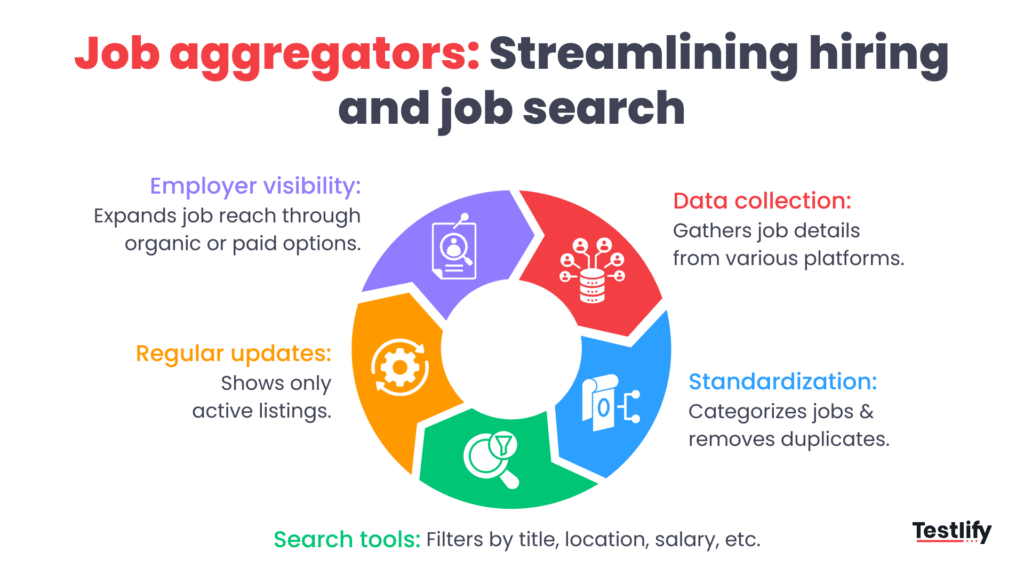
1. Crawling and data collection
Crawlers scan job boards, careers pages and applicant tracking system feeds on a schedule. They extract the title, description, location, company and salary where it is published. Most large aggregators also accept a direct XML feed, which is faster and far more accurate than letting a crawler guess at your page structure.
2. Cleaning and standardization
Raw job data is messy. The same role posted to four boards arrives as four records. Titles vary, locations arrive in six formats, and half the ads have no salary. Aggregators deduplicate, map job titles to standard categories, and normalize locations so a search for one city returns everything in it. This step is where your ad either gets categorized correctly or disappears into the wrong bucket.
3. Indexing and search
Cleaned listings enter a search index with filters for title, location, remote status, salary band and employment type. Candidates rarely browse. They filter, and they filter hard.
4. Ranking and sponsorship
Organic ranking rewards freshness, relevance and click behavior. Sponsored placement buys position outright. An unsponsored ad in a crowded category can sink out of view within days, which is why recruiters who treat aggregators as free reach are often disappointed by week two.
Job aggregator vs job board: what's the difference?
A job board is a destination where employers post ads directly and pay for the placement. A job aggregator is an index that collects ads from those boards and everywhere else. Boards curate a smaller, cleaner pool. Aggregators cover far more ground with messier data.
Aspect | Job aggregator | Job board |
|---|---|---|
How listings arrive | Crawled or fed in from other sites | Posted directly by the employer |
Who controls the listing | The original source, not the aggregator | The employer, inside the board |
Reach | Very broad, across thousands of sources | Narrower, tied to that board's audience |
Data quality | Duplicates and stale ads are common | Curated, usually accurate |
Cost model | Free to be indexed, pay to be promoted | Pay per post or per duration |
Candidate mix | High volume, wide range of fit | Lower volume, closer to the niche |
Best used for | Maximum visibility on a role | Targeting a specific industry or region |
Most hiring teams end up using both, and the reason is not strategy. It is that the aggregator indexes the board anyway, so posting to a good board gets you aggregator reach for free.
Top job boards vs job aggregator sites
The names get used interchangeably, and even the platforms blur the line. Several started as one and became the other. Here is the honest split as it stands in 2026.
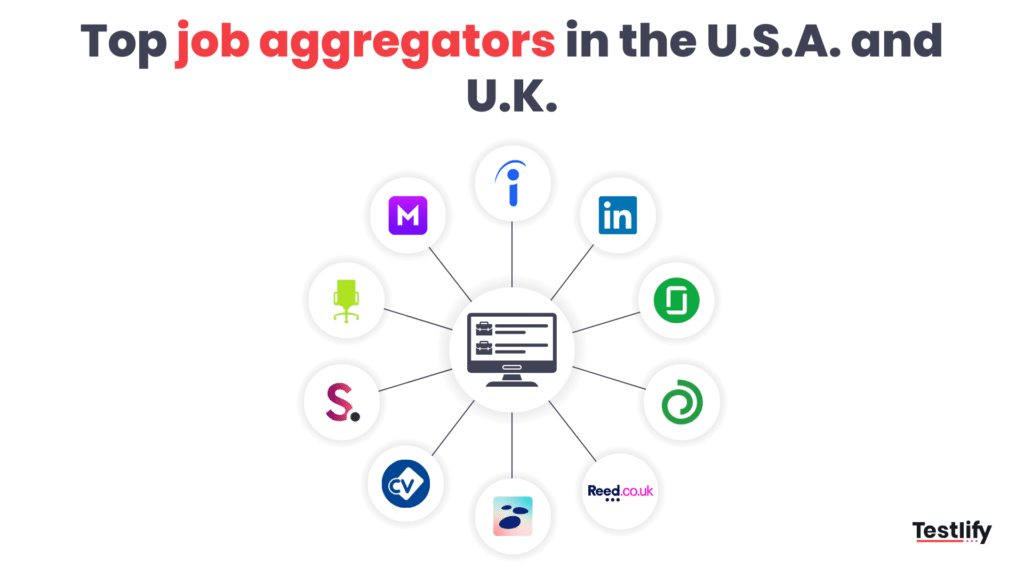
Sites that work primarily as aggregators: Indeed, SimplyHired, Adzuna, Jooble, Careerjet and Google for Jobs all index listings from elsewhere. Google for Jobs is the purest case, since it has no listings of its own at all and surfaces structured job data straight in search results.
Sites that work primarily as boards: Reed, Totaljobs and CV-Library in the UK, and Monster and ZipRecruiter in the US, host ads employers place with them directly. Several of them also pull in third-party listings, which is where the categories start to leak.
Sites that are neither, exactly: LinkedIn runs a job board inside a professional network, so its listings sit alongside a candidate graph no aggregator can match. Glassdoor combines listings with salary and review data.
The board side is covered separately, sector by sector, in a full rundown of job boards worth knowing.
Where to find jobs: aggregators, boards, or both?
If you are hiring, the answer is both, in that order:
- Post the role to one or two boards that match its sector.
- Make sure your own careers page is crawlable, so the ad can be found at source.
- Let the aggregators index what you already published, and check where the organic listing actually lands.
Paying an aggregator for sponsorship makes sense once you know the organic listing is not getting seen, not before.
If you are job hunting, start with an aggregator to map what exists, then go to the board or company page to apply. Applying through the original source usually means fewer broken forms and a faster route into the real pipeline.
What do recruiters actually gain from aggregators?
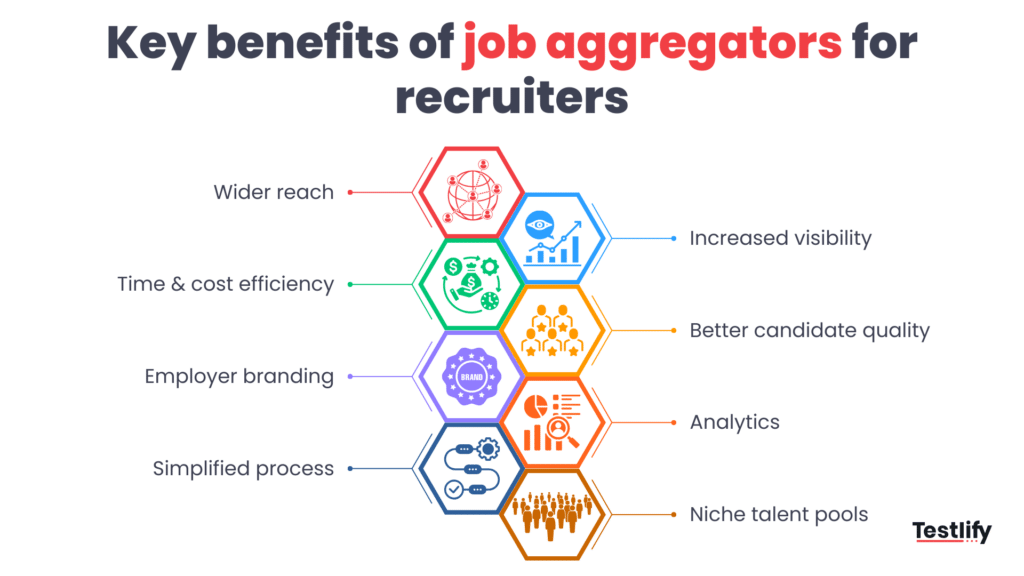
- Reach you did not pay for. A crawled listing costs nothing. For a role with a broad candidate pool, organic aggregator traffic can carry the entire top of funnel.
- Speed to market. A feed-connected ad appears within hours of going live on your careers page, with no separate posting workflow.
- Search demand data. Aggregator analytics show how often your title is searched and clicked. If a job gets impressions but no clicks, the title or the salary is the problem, not the market.
- A wider candidate pool. Aggregators reach people who are not signed up to any one board, which helps when you need to reach beyond your usual talent pool.
- Coverage for hard-to-fill locations. For a site in a small labor market, the aggregator may be the only channel that reaches commutable candidates at all.
None of that is small. Just be clear about what you bought: attention, not assessment.
What are the real limits of job aggregators?
Aggregators have five structural weaknesses, and every recruiter who has used one seriously has hit most of them.
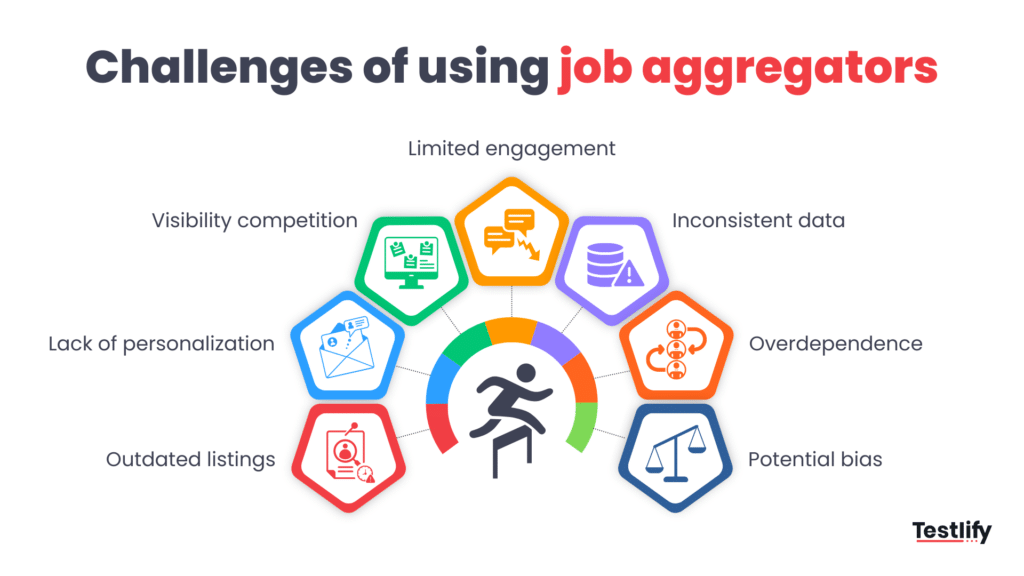
- Volume without filtering. An aggregator optimizes for applications, because applications are what it sells. It has no view on whether an applicant can do the job. That cost lands entirely on your team.
- Concentration at entry level. Indeed's Hiring Lab found that 46% of US postings are entry-level while only about 14% are senior, with entry-level postings down 7.5% year over year as of May 2026 and senior postings up 14.7%. Fewer entry roles competing for the same wide audience means more applications per opening, exactly where screening is already hardest.
- Data drift. Crawled listings go stale. A filled role can sit live for days, and duplicates from four boards fragment your click data so the analytics stop being trustworthy.
- Ranking you do not control. Organic position depends on an algorithm you cannot see and cannot appeal. The remedy on offer is always the same one: pay.
- No relationship. Aggregators are discovery tools. Nurturing a pipeline, running a talent pool, following up with a strong candidate who was second choice, none of that lives here. That work still needs an applicant tracking system and a human.
The honest read: aggregators are a distribution channel, not a hiring strategy. Teams that get burned are the ones that treated volume as progress. Pairing them with a working referral scheme and direct sourcing keeps you from depending on a channel whose rules can change without notice.
How do you build a job aggregator?
Aggregator ranking rewards the same things candidates want: a clear title, honest pay, a real location. Write for both and you rank without buying position.
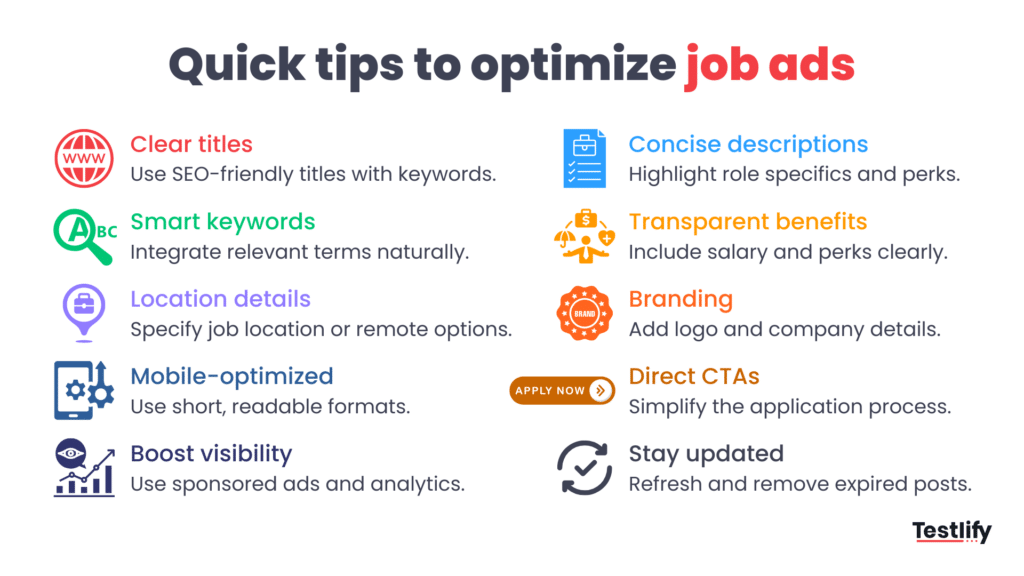
Use the job title people search for
"Marketing Manager" gets found. "Marketing Ninja" does not. Aggregators map titles to standard categories, and an invented title fails the mapping, so the ad lands in no category and surfaces for nobody. Skip internal grade codes too. "Analyst II" means nothing outside your company.
Publish the salary
Salary is the most-used filter on most aggregators. An ad with no salary is invisible to anyone filtering by pay, which is a large share of active searchers. A range is fine. Silence is not.
Get the location right
Use a real city and region in a standard format. For remote roles, state the countries or states a candidate must live in. "Remote" with no boundary generates applications from people you legally cannot hire, and you will read every one of them.
Write the first 200 words for a human
Crawlers read the whole ad. Candidates read the top of it on a phone. Lead with what the person will actually do, not three paragraphs of company history. The mechanics of writing a job post people finish reading matter more here than any keyword trick.
Feed the aggregator directly where you can
An XML feed or a native integration beats crawling. You control the fields, updates propagate quickly, and closed roles come down when you close them. This is also the cleanest fix for duplicate listings.
Keep it fresh, and take it down
Freshness feeds ranking. A role reposted every few weeks holds position better than one left untouched for three months. Just as important: pull filled roles. Stale ads waste candidate time and quietly damage your employer brand. The wider mechanics of search-friendly job advertising apply to aggregator ranking almost unchanged.
How should recruiters screen aggregator applicants?
This is the part the aggregator does not do, and it is where the hiring outcome is actually decided. If several hundred people apply and you read every resume by hand, the channel has not helped you. It has just moved the workload.
The problem with resume-first screening on aggregator traffic is that the resume is the weakest available signal, and it is getting weaker. The World Economic Forum's Future of Jobs Report found employers expect 39% of workers' core skills to change by 2030, down from 44% in 2023. The same research projects 170 million new roles created and 92 million displaced by 2030. A history of job titles tells you less each year about what someone can do next year.
The Testlify Multi-Signal Talent Evaluation Model is built for exactly this shape of problem. Instead of advancing a candidate on one strong-looking resume, it combines several role-relevant signals, including a skills assessment, a work simulation, structured interview feedback and reviewer scoring, and moves people forward when the signals agree. One signal is fragile. Several pointing the same way is a decision you can defend.
In practice that means putting a short skills check immediately after the aggregator application, before any human reads anything. The screen does the sorting; your team spends its hours on the shortlist.
A worked example, hypothetical but ordinary. A regional logistics operator hiring 40 warehouse associates before peak season posts to two boards and lets the aggregators index the ads. Roughly 900 applications arrive in eleven days, which is unsurprising for an entry-level role in a market where entry-level postings make up 46% of the total. Reading those manually at four minutes each is 60 hours of recruiter time before a single interview. Routing every applicant through a 15-minute assessment covering safety judgment, numeracy and attention to detail instead produces a ranked shortlist automatically, and the team interviews the top 50. The volume did not change. What changed is who reads what.
Pro tip: send the assessment invitation automatically on application, not after a resume review. The moment a candidate applies is the moment they are most likely to complete it, and completion rate drops sharply once a few days pass. It also means the resume never becomes the gate, which is the point.
One caveat, because this is not free. A screening step adds friction, and some strong candidates will not finish it. Keep the assessment short, tell people up front how long it takes and why it exists, and never use it for a role where the skill genuinely is not testable. For senior and specialist hires, where the aggregator sends you a handful of applicants rather than hundreds, direct sourcing and specialist recruiting support usually beat any volume channel.
Hire on evidence, not application volume
Aggregators will keep filling your inbox. The question is what happens next. Testlify puts a skills assessment between the application and the shortlist, so the ranking is done on what candidates can do rather than how their resume reads. You can book a demo to see how it fits your current posting workflow.
Key takeaways
- An aggregator indexes, a board hosts. The distinction decides where you post and who controls the listing. Post to a board, keep your careers page crawlable, and the aggregator picks you up for free. Paying an aggregator before you have checked the organic listing is money spent on a problem you have not diagnosed.
- Reach is not the constraint. With 7.4 million US openings against 5.3 million hires, the market is not short of advertised jobs. It is short of a reliable way to tell who fits. Any channel sold on reach alone is answering a question you did not have.
- Volume lands hardest at entry level. With 46% of US postings entry-level and that share shrinking year over year, aggregator traffic concentrates exactly where application counts are already highest. Plan screening capacity for the role type, not the headcount.
- Ad hygiene beats ad spend. A searchable title, a published salary and an accurate location move organic ranking more than sponsorship does, and they improve who applies rather than just how many. Sponsorship amplifies whatever the ad already is, including a bad one.
- The resume is the weakest signal you have. With 39% of core skills expected to change by 2030, past job titles predict less every year. Screening on evidence of skill is the part that actually protects quality of hire.
- Screen before you read, not after. Automating a short assessment at the point of application turns an unsorted pile into a ranked shortlist, and keeps recruiter hours on the candidates worth the time.
- Treat it as one channel, not the strategy. Referrals, direct sourcing and specialist boards cover what aggregators structurally cannot, particularly for senior and niche roles.
Frequently asked questions (FAQs)

B2B SaaS Content Writer
Rishav Kumar is a B2B SaaS content writer with 4 years of experience. He loves crafting engaging content. Always exploring fresh ideas, he's passionate about helping businesses grow through impactful writing.
LinkedInRelated resources
View all
HR & recruitment
Candidate persona: A complete guide for recruiters

HR & recruitment
Why and how to choose the right recruitment CRM?

HR & recruitment
Compassionate leave: A guide for HR and employees

HR & recruitment
What is E-Recruitment? Pros, cons, strategies for 2026

HR & recruitment
11 core HR functions every recruiter should know in 2026

HR & recruitment
Interview to hire ratio: A complete guide for hiring teams
Get started.
Hire on proof, not resumes.
Run your first skills-based assessment free — no credit card required.