
How to attract diverse candidates: 9 steps that work
Nine practical steps to attract diverse candidates, from inclusive job ads and wider sourcing to skills-first screening and funnel metrics.

Knowing how to attract diverse candidates comes down to removing the filters that quietly narrow your pool before anyone is assessed. Write job ads around skills, show the pay range and flexibility, post beyond your usual boards, make the application accessible, and screen every applicant on the same skills test before resumes. Then track each funnel stage, so you can see where candidates drop out and fix that step.
TL;DR:
- To attract diverse candidates, change the process, not just the message: skills-based job ads, visible pay, wider channels, an accessible application and the same skills test for everyone.
- Start by finding where candidates drop out. A pool that is diverse at application but not at interview points to screening, not sourcing.
- A skills-based approach could expand talent pools by 6.1x globally, according to LinkedIn's 2025 Economic Graph research.
- Cut "required" lists to what the job truly needs, use plain gender-neutral wording, and publish the pay range. The EU Pay Transparency Directive makes pay ranges for applicants the rule from June 2026.
- Attract broadly, select on skills. The EEOC's 2025 guidance treats slates, pools or interview picks based on protected traits as discrimination.
- Measure selection rates at every stage with the four-fifths rule, and review any stage where one group's rate falls below 80% of the highest.
 ChatGPT
 Gemini
 Claude
 Grok
 Perplexity
What does it mean to attract diverse candidates?
Attracting diverse candidates means designing your job ads, sourcing and application process so that qualified people from every background hear about the role, want to apply and can apply without barriers. The goal is a wider, fairer pool, with every candidate then judged on the same job-related criteria.
Diversity covers more than gender, race and ethnicity. Age, disability, socioeconomic background, veteran status, neurodiversity and career path all shape who sees and applies for a job. A diverse candidate is simply someone whose background differs from the groups your current pipeline already reaches.
Diversity and inclusion are linked but not the same. Diversity is about who is in the room. Inclusion is about whether those people are heard and can progress. Recruitment diversity work that only chases headcount, without fixing the process behind it, rarely lasts.
Diversity recruiting is also not about lowering the bar or hiring on identity. Done well, it removes barriers to entry and keeps the decision firmly on performance.

Why does knowing how to attract diverse candidates matter in 2026?
Knowing how to attract diverse candidates matters because the pool you attract sets the ceiling on who you can hire. Wider pools give you more qualified people for hard-to-fill roles, teams with fewer shared blind spots, and a hiring process you can defend when it is audited or challenged.
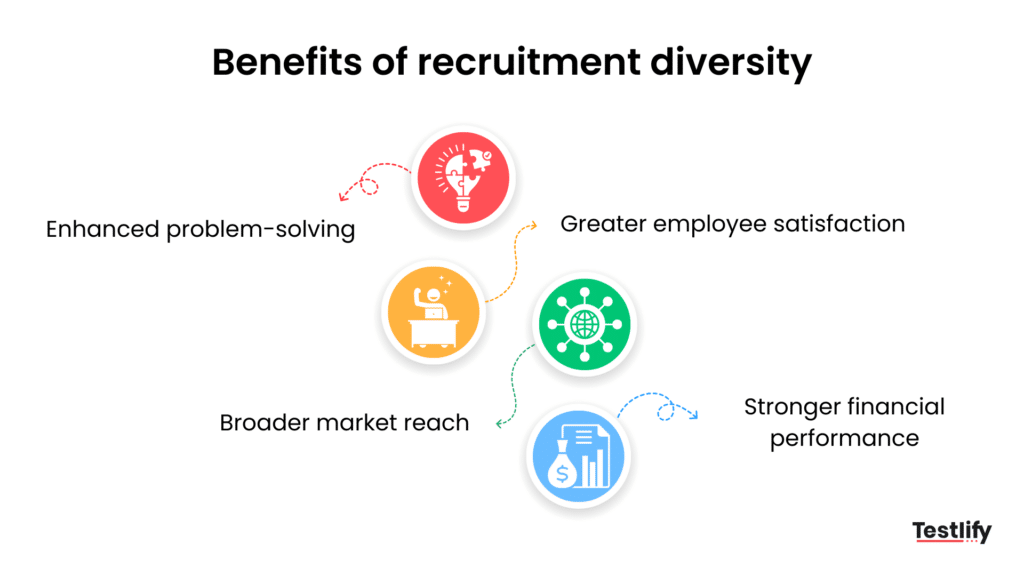
The case rests on four practical gains:
- A bigger talent pool: Dropping filters that do not predict performance, such as degree or exact title requirements, brings in people who have the skills but took a different path.
- Better decisions: Teams with varied backgrounds and experience approach problems from more angles and are less likely to miss the same risk.
- Employer brand: Candidates check whether your stated values show up in practice, from the job ad to who interviews them.
- Defensible hiring: A consistent, documented process makes compliance reviews easier and reduces the risk of disparate impact claims.
Candidate views are also more mixed than they were. Pew Research Center found in late 2024 that 52% of US workers say focusing on DEI at work is mainly a good thing, down from 56% in 2023, while 21% say it is a bad thing. That split is a reason to talk about fairness and opportunity for everyone, backed by visible practice, rather than slogans.
Where do diverse candidates drop out of your hiring funnel?
Diverse candidates usually drop out at five points: they never see the ad, the ad tells them they do not fit, the application is hard to complete, resume screening filters them out, or unstructured interviews favor people who resemble the panel. Find your leak before you spend more on sourcing.
Funnel stage | Sign of a leak | Likely cause | First fix |
|---|---|---|---|
Reach | Few applicants from outside your usual networks | Same boards, same schools, referral-heavy sourcing | Add new channels and track source of hire |
Job ad | Many views, few applies from some groups | Long "required" lists, coded wording, no pay or flexibility | Rewrite the ad around skills and outcomes |
Application | High drop-off before submit | Long forms, no accessibility, timed tasks without accommodations | Shorten the form and offer adjustments |
Screening | Diverse at application, not at shortlist | Resume filters on school, title or gaps | Same skills test for everyone before resumes |
Interview | Diverse shortlist, homogeneous hires | Unstructured interviews, "culture fit" scoring | Structured interviews with scored rubrics |
If your applicant pool is 40% women but your interview slate is 15% women, the problem sits in screening, not in sourcing. Adding more job boards will not fix it.
How to attract diverse candidates: which 9 steps work?
The nine steps below move from the job ad to the offer. The first six widen who applies. The last three make sure the wider pool is assessed fairly, because candidates notice and talk about a process that looks open but screens them out.
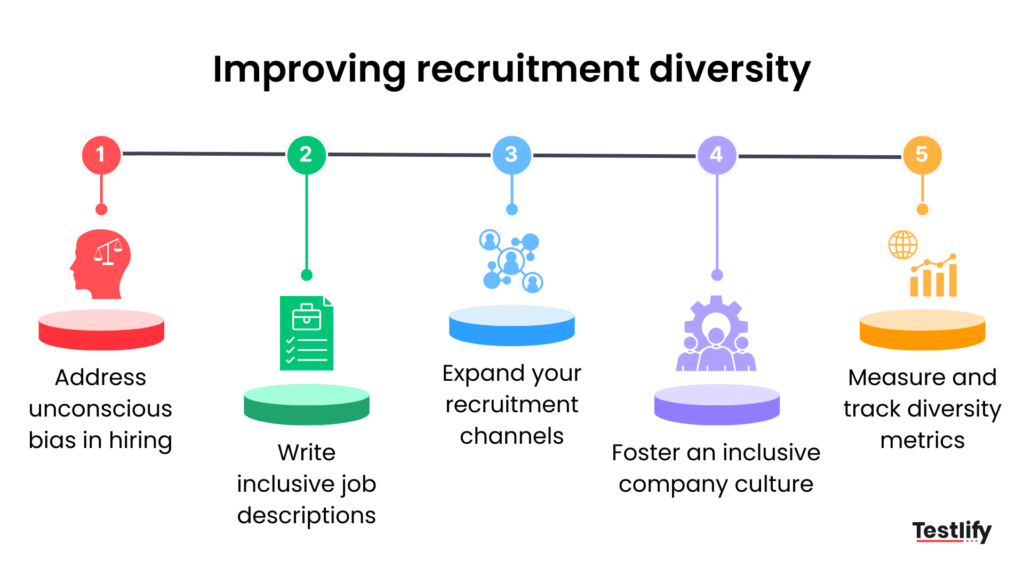
1. Write inclusive job descriptions
Write job descriptions that lead with outcomes and skills, not credentials and tenure. "Can manage cross-functional priorities in a high-volume team" opens the role to more people than "8+ years of project management experience". The first describes the work. The second describes one career path to it.
Separate "required" from "nice to have", and question every degree requirement. Use gender-neutral titles and plain language, and avoid coded words such as "rockstar", "dominant" or "aggressive". Have someone outside the hiring team review each ad before it goes live. Our guide to clear and engaging job postings covers the full structure.
2. Publish the pay range and real flexibility
Publishing the pay range removes a guessing game that tends to put off people who are less likely to negotiate or who lack insider networks. Many US states already require pay ranges in job ads, and EU employers must give applicants the starting pay or range before the interview once the Pay Transparency Directive is in national law.
Flexibility widens the pool just as much. Remote or hybrid options, flexible hours and part-time paths bring in carers, people with disabilities and candidates outside commuting distance. State the arrangement in the ad, not in the final interview.
3. Widen your sourcing channels
Relying on the same job boards, alumni networks and referrals reproduces the workforce you already have. Add channels where under-represented talent is active: diversity-focused job boards, professional associations (women in tech, Black HR and Hispanic professional groups), disability employment networks, veteran transition programs, community organizations, and HBCU and HSI campus partnerships.
On LinkedIn and other sourcing tools, widen the search itself. Drop location filters for remote roles, add similar job titles and search on skills rather than past employers. Our talent sourcing strategies guide lists more channels.
4. Balance your referral program
Referrals are fast and often produce strong hires, but they mirror the networks of your current staff. Keep referrals, and balance them: ask employees to refer from beyond their immediate circle, reward referrals for hard-to-reach talent, and put every referred candidate through the same assessment as everyone else. See how to design a successful employee referral program.
5. Show your culture with real stories
Candidates research diversity claims before they apply. Show the practice behind the statement: employee resource groups, mentoring, flexible policies and the people who actually do the job. Short employee stories, team photos (never stock images of your "team") and a careers page that names concrete programs work better than a generic diversity statement.
Take part in diversity-focused job fairs, networking events and campus clubs, and send people from across the business, not only recruiters. Read more on building a strong employer brand.
6. Make the application accessible
An application that a screen reader cannot use, or that times out halfway, quietly removes candidates with disabilities and anyone on a slow connection or a phone. Keep forms short, let candidates apply on mobile, offer adjustments for tests and interviews, and allow flexible interview times and formats.
7. Screen on skills before resumes
Skills-first screening is the most reliable way to keep a wider pool wide. Give every applicant the same job-related skills test before anyone reads a resume, so names, schools and career gaps do not decide who moves on. Pair it with blind hiring for any resume review that remains.
The upside is large. LinkedIn's Economic Graph report "Skills-Based Hiring: Increasing Access to Opportunity" (March 2025) found that a skills-based approach could expand talent pools by 6.1x globally, raise the share of women in AI-role talent pools by up to 24%, and give workers without a bachelor's degree a 6% greater increase than degree holders. See how to implement skills-based hiring.
Pro tip: Run the skills test as the first step, not after a recruiter screen. The earlier the same criteria apply to everyone, the fewer chances bias has to shape the shortlist.
8. Use structured interviews and diverse panels
Structured interviews ask every candidate the same questions in the same order and score answers against the same rubric. That removes the drift toward candidates who are "easy to talk to", which is often a proxy for similarity to the interviewer.
Build panels with varied backgrounds and roles, train interviewers on unconscious bias and affinity bias, and ask them to score before the debrief. Replace "culture fit" with "culture add" and define what it means for the role.
9. Build pipelines that are open to everyone
Internships, apprenticeships, returnships for people coming back after a career break, and mentoring programs bring in talent that traditional hiring misses. Keep eligibility open to all applicants and promote these programs in the communities where you want to be better known. Mentoring new hires also helps them stay, which protects the gains you made at the offer stage.
Finally, ask for feedback. Survey candidates, new hires and recruiters about the process, and use what they say to adjust the ad, the channels and the steps that cause drop-off.
What should an inclusive job posting include?
An inclusive job posting includes a gender-neutral title, a short summary of the work, outcomes and skills instead of long credential lists, a clear "required" versus "nice to have" split, the pay range, the work arrangement, a short inclusion statement backed by real programs, and an invitation to ask for adjustments.
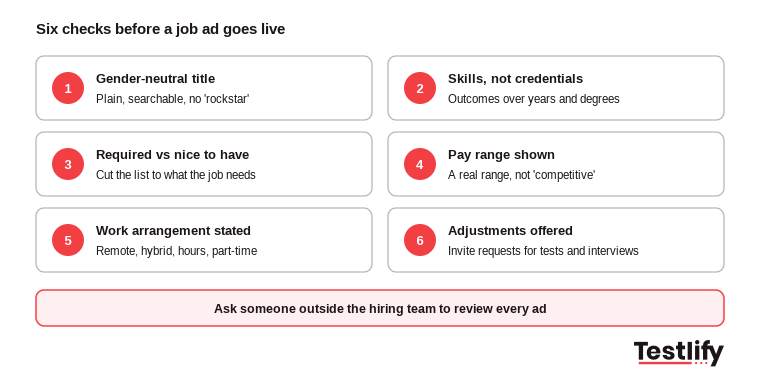
Job ads also shape how candidates see the company. A poorly written ad with errors suggests a chaotic workplace, while a clear one shows care for detail. Under the EU's Pay Transparency Directive (EU) 2023/970, job vacancy notices and titles must be gender-neutral and employers cannot ask applicants about pay history.
Is diversity recruiting legal in 2026?
Diversity recruiting is legal when it widens outreach to everyone and then selects on job-related criteria. What carries legal risk is treating candidates differently because of a protected trait, for example building interview slates or shortlists by race or sex, or limiting a program to one group.
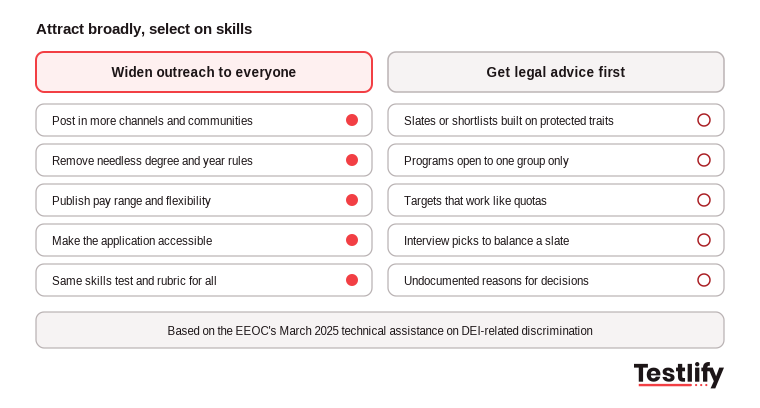
In March 2025 the EEOC's technical assistance on DEI-related discrimination listed "selection for interviews" and "placement or exclusion from a candidate 'slate' or pool" based on protected traits as unlawful disparate treatment.
It also covers internships, fellowships, mentoring and training programs, and it reminds employers they can be liable for the actions of recruiters and staffing agencies.
That shapes the practical line for hiring teams:
- Safe to do: Post in more places, partner with community groups, remove needless requirements, publish pay, make the process accessible, and use the same skills test and rubric for everyone.
- Get legal advice first: Slate rules tied to protected traits, programs limited to one group, or hiring targets that act like quotas.
- Keep records: Document job-related criteria, scores and reasons for every decision, so the process can be explained later.
AI tools add a further rule in some places. New York City's Local Law 144 requires a yearly bias audit and candidate notice before an automated employment decision tool is used.
How do you measure diversity recruiting results?
Measuring diversity recruiting means tracking the share of each group at every funnel stage, then checking whether any stage selects one group at a much lower rate than another. Measuring only at hire tells you what happened, not where. Six metrics cover most needs.
Metric | What it shows | Act when |
|---|---|---|
Pipeline mix by stage | Who applies, passes screening, is interviewed and hired | The mix shifts sharply between two stages |
Selection rate ratio | Whether a stage has adverse impact | A group's rate is under 80% of the highest group's |
Source of hire by group | Which channels bring candidates who get hired | A channel brings applicants but no hires |
Assessment score spread | Whether a test scores groups differently for the same role | Gaps persist across hiring rounds |
Time to hire by group | Where some candidates wait longer | One group sits longer at a stage |
12-month retention by cohort | Whether hires stay | Diverse hires leave faster than average |
The four-fifths rule comes from the Uniform Guidelines on Employee Selection Procedures: a selection rate below 80% of the highest group's rate is generally treated as evidence of adverse impact. A worked example: 60 of 200 applicants from group A pass screening (30%), and 30 of 150 from group B pass (20%). The ratio is 20 / 30 = 0.67, below 0.8, so that screening step needs a review.
Set clear goals for the process, such as more channels or a smaller drop-off at screening, and give the leaders who own the hiring funnel responsibility for them.
Key takeaway: Programs that attract diverse candidates combine four things: inclusive ads and channels, an accessible application, the same skills test and structured interview for everyone, and stage-by-stage measurement. Any one of them alone produces limited results.
What are the common mistakes when hiring diverse candidates?
The most common mistakes when hiring diverse candidates are fixing one stage and ignoring the rest, relying on referrals and familiar channels, judging people on "fit", and measuring only at the offer. Each one lets bias back in at a stage nobody is watching.
- Unconscious bias in screening: Name, school and career-path shortcuts shape decisions without anyone noticing. Same criteria for everyone is the fix.
- Narrow channels: The same boards and campuses keep producing the same pool, however good the job ad is.
- An inaccessible process: Forms and tests that fail with assistive technology lock out candidates with disabilities. The W3C's WCAG 2.2 guidelines at level AA are a practical bar for careers sites and application forms.
- A homogeneous leadership team: Programs led by one group at the top tend to lose momentum and funding.
- Resistance to change: Managers who see new practices as box-ticking will skip them. Show them the funnel data and the time saved by structured steps.
- Promises without practice: A diversity statement with no programs, pay range or flexible options behind it reads as empty and costs trust.
How does Testlify help hiring teams attract and assess diverse candidates?
Testlify helps hiring teams keep a wider pool wide by scoring every candidate on the same job-related skills before resumes or interviews. Teams build a role-specific assessment from the job description, run structured AI interviews, and compare candidates on results rather than on background.
- Skills first: 3,500+ validated tests across role-specific, cognitive ability, situational judgment, language and coding skills. Browse the test library.
- Same questions for everyone: Video AI, Voice AI and Chat AI interviews ask role-based questions and score every answer against the same criteria, with human review.
- Accessible to more candidates: Assessments run in 15+ languages, with candidate-side question translation. See multilingual assessments.
- Audited and fair: Testlify's matching model completed a third-party bias audit under NYC Local Law 144 on June 16, 2023. Read the NYC bias audit.
- Fits your stack: Results sync with 100+ ATS and HRIS tools, so the same data follows each candidate through the funnel.
Ready to build a fairer shortlist?
Put the same skills test in front of every applicant and see who rises when background stops being the filter. Start a 7-day free trial of Testlify, no credit card required, and build your first assessment from your own job description.
Frequently asked questions (FAQs)

Human Resources Lead
Snehi Parmar leads People at Testlify, owning hiring, culture, performance, and retention for a 90-person team. She writes on practical HR strategy and building people processes that scale.
Related resources
View all
HR & recruitment
How to Adapt to Changing Market Trends and Talent Demands

HR & recruitment
How to handle negative Glassdoor reviews in 2026

HR & recruitment
How to Reduce Early Attrition and Keep New Hires

HR & recruitment
How to Gauge Candidate Motivation and Long-Term Commitment

HR & recruitment
How to hire top talent using Python test

HR & recruitment
Logical reasoning test for hiring: a 2026 guide for TA teams
Get started.
Hire on proof, not resumes.
Run your first skills-based assessment free — no credit card required.