
Leadership skills assessment: a hiring guide for 2026
How to assess leadership skills when you hire or promote: which skills to test, the assessment types to use and a sample scorecard.

A leadership skills assessment is a structured way to measure how well a person can lead: how they communicate, make decisions, handle people and pressure, and set direction. Hiring teams use it to compare candidates for manager and leadership roles on the same job-related evidence, instead of relying on a resume, a title or a good conversation.
TL;DR / Key Takeaways
- A leadership skills assessment combines tests, a structured interview and a work simulation to show how a candidate leads before you hire or promote them.
- Assess four to six skills tied to the role. Communication, decision making, emotional intelligence, adaptability, developing people and integrity cover most manager jobs.
- Situational judgment tests, personality questionnaires, structured interviews and simulations suit hiring. 360-degree feedback and self-assessments suit internal development only.
- The need is real: Gallup found manager engagement fell from 31% in 2022 to 22% in 2025, and only 20% of HR teams in DDI's 2025 survey trusted their leadership bench.
- Score every candidate against the same rubric with written anchors, and combine at least two methods before you decide.
- Keep it fair: test only job-related skills, offer accommodations, give candidates notice and keep a person in charge of every decision.
 ChatGPT
 Gemini
 Claude
 Grok
 Perplexity
What is a leadership skills assessment?
A leadership skills assessment is a set of tests, exercises and structured questions that shows how a person behaves when they lead others. Instead of asking "Have you managed a team?", it puts the candidate in leadership situations and scores what they do, so every candidate is judged on the same criteria.
A good assessment looks at a range of skills, not one trait. It covers how a person communicates, solves problems and makes decisions, but also how they work with others, cope with stress and adapt when plans change. Hiring teams use the results to choose external hires for manager roles, to decide internal promotions and to spot employees with leadership potential early.
The assessment is a complement to your usual hiring steps, not a replacement. Resumes and interviews show a candidate's background. The assessment adds evidence about how they lead today.

Why does assessing leadership skills matter in hiring?
Assessing leadership skills matters because a weak manager hire costs far more than one salary. Managers shape how engaged, productive and likely to stay their teams are, so the wrong pick affects every person who reports to them. A leadership skills assessment lowers that risk by testing the skills before the offer, not after.
The data shows the gap is growing. Gallup's State of the Global Workplace report found that manager engagement fell from 31% in 2022 to 22% in 2025, the steepest drop of any group, while global employee engagement fell to 20%. Gallup estimates low engagement costs the world economy about $10 trillion in lost productivity.
Leadership pipelines are thin too. According to DDI's Global Leadership Forecast 2025, a survey of 10,796 leaders and 2,185 HR professionals, only 20% of HR professionals felt confident in their leadership bench, and only 40% of leaders rated leadership quality in their company as high.
Assessing leadership skills during hiring brings these benefits:
- Better leadership hires: You pick people who show the skills the role needs, not only the ones with the longest titles.
- Stronger team performance: Leaders who set clear goals, give feedback and resolve conflict get more from their teams.
- Lower turnover risk: People who fit the role and the company's values are more likely to succeed and stay, and so are the people they manage.
- A healthier culture: Leaders who share the company's values shape how everyone else works.
- Better decisions across the business: Hiring for judgment and problem solving improves the calls made every day.
- A ready pipeline: The same data helps with succession planning and shows where future leaders need development.
Which leadership skills should you assess?
The leadership skills worth assessing are the ones the role actually needs. For most people manager roles, six skills carry the weight: communication, decision making, emotional intelligence, adaptability, developing people and integrity. Pick four to six, define each in plain words, and test each one with at least one method.
1. Communication: Explains goals and decisions clearly, listens actively and adapts the message to the audience. Strong communicators build understanding and keep teams aligned.
2. Decision making and problem solving: Weighs options and risks, decides on time with incomplete information and owns the result. A decision-making test shows how a candidate reasons through trade-offs.
3. Emotional intelligence: Reads and manages their own emotions and other people's, shows empathy and resolves conflict without damaging trust. An emotional intelligence test measures this directly.
4. Adaptability and resilience: Stays effective when priorities shift, learns from setbacks and helps the team adjust.
5. Strategic thinking and vision: Sets direction, links team goals to company goals and explains why the work matters.
6. Developing people and building teams: Delegates well, gives useful feedback, coaches and creates a team where people want to contribute.
7. Integrity and accountability: Acts ethically, keeps promises and takes responsibility when things go wrong. Leaders with integrity earn the trust that every other skill depends on.
8. Initiative and drive: Takes ownership, spots problems before they grow and acts without waiting to be asked.
Leaders themselves say some of these are hardest to find. In DDI's 2025 survey, 64% of leaders called setting strategy essential but only 37% had been trained in it, and 60% called decision making critical while only 39% had received training. Those gaps are good places to focus your assessment.
How do leadership skills change by level?
Leadership skills change by level because the job changes. A first-time manager mostly leads tasks and people they used to work beside. A senior leader sets strategy and leads other managers. Adjust the skills you weight, the scenarios you use and the length of the assessment to the level you are hiring for.
Level | Typical roles | Skills to weight most | Best assessment mix |
|---|---|---|---|
First-time manager | Team lead, supervisor, shift manager | Communication, giving feedback, delegating, handling conflict | Situational judgment test, structured interview |
Mid-level manager | Department manager, senior manager | Decision making, developing people, managing change, cross-team work | Situational judgment test, personality questionnaire, case or role-play |
Senior leader | Director, VP, head of function | Strategy, managing change, building leaders, judgment under ambiguity | Cognitive test, structured interview, business simulation with a panel |
Pro tip: For first-time managers, test what they will do in their first 90 days: running a one-to-one, handling an underperformer, giving feedback to a former peer. Those moments decide whether a promotion works.
What are the main types of leadership skills assessments?
The main types of leadership skills assessments are situational judgment tests, personality questionnaires, cognitive ability tests, structured interviews, simulations and work samples, 360-degree feedback and self-assessments. Each type shows something different, and each suits a different purpose. The most useful question is what you will decide with the result.
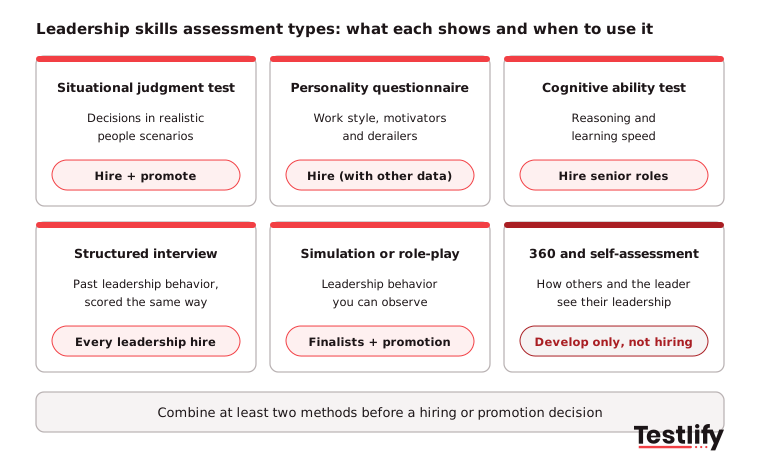
Two of these need a warning. 360-degree feedback depends on colleagues who have worked with the person, so it cannot be used for external candidates. Self-assessments only show how people see themselves, so they belong in development, not selection. Situational judgment tests are often the best first step because they scale to many candidates and test choices in context; see how to run managerial hiring with situational judgment tests.
Assessment centers combine several of these exercises in one session: group discussions, role-plays, case studies and in-tray tasks, observed by trained assessors. They give a rich picture but cost the most, so most teams keep them for senior roles. For the trait side, Testlify's guide to psychometric tests explains the personality and ability options.
How do you assess leadership skills during hiring?
Hiring teams assess leadership skills in six steps: define the leadership profile, choose methods for each skill, screen with short online tests, run a structured interview, test finalists in a simulation, then combine the evidence and decide. Each step narrows the pool, so the most expensive exercises go only to the strongest candidates.
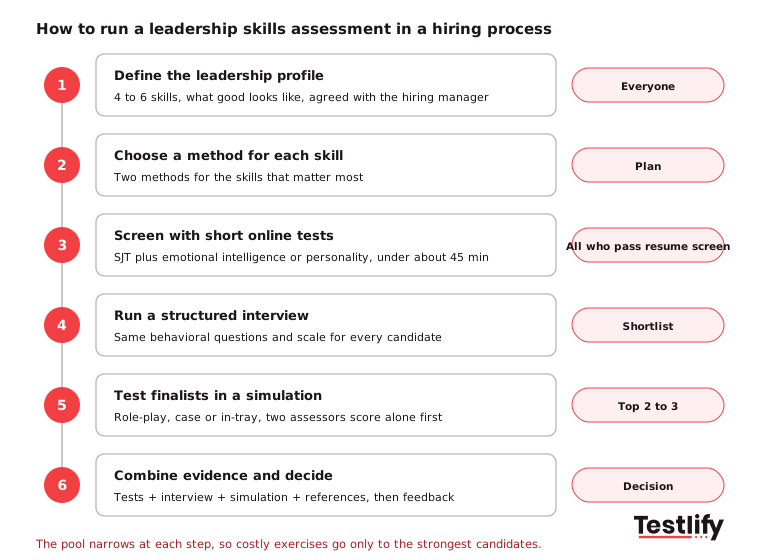
- Define the leadership profile: Agree with the hiring manager and senior leaders on the four to six skills the role needs, what good looks like for each, and how they link to company values and goals. Write this down before you see a single candidate.
- Choose a method for each skill: Map every skill to at least one method from the table above. Use two methods for the skills that matter most, so one result can confirm the other.
- Screen with short online tests: Send an SJT plus an emotional intelligence or personality test to everyone who passes the resume screen. Keep this stage under about 45 minutes so strong candidates do not drop out, and tell candidates what it covers and why.
- Run a structured interview: Ask every candidate the same behavioral questions, linked to the profile, and score answers on a shared scale. The guide to the structured interview shows how to build one.
- Test finalists with a simulation: Give the last two or three candidates a role-play, case or in-tray exercise. Have at least two trained assessors score it on their own before they compare notes.
- Combine the evidence and decide: Bring test scores, interview ratings, the simulation and reference checks together. Read results in the context of the role: a lower score on one skill may matter little if the role rarely needs it. Then give every candidate short, useful feedback.
Leadership assessments also save time. Testing the whole shortlist early means interviewers spend their hours on people who already showed the skills, rather than on many first-round conversations.
What does a scored leadership exercise look like?
A scored leadership exercise gives the candidate a realistic situation, asks what they would do, and rates the answer against written anchors that every reviewer uses. The anchors are what make scores comparable. Here is a sample situational judgment item for a first-time manager and the rubric a reviewer would apply.
Scenario: You were promoted to lead your former team two weeks ago. A teammate who also applied for the role has started missing deadlines and makes sarcastic comments in team meetings. Two other team members have mentioned it to you. What do you do first?
- A. Raise it in the next team meeting so everyone hears the expectations.
- B. Ask for a private one-to-one, describe the specific behavior and its effect, and ask how they see it.
- C. Wait a few more weeks, since the change is recent and may settle down.
- D. Escalate to your own manager and ask them to handle it.
Option B is the strongest answer: it is private, specific and opens a two-way conversation. Option D is acceptable later if the behavior continues. Options A and C damage trust or let the problem grow.
Score | Anchor for "handles conflict and gives feedback" |
|---|---|
5 | Acts quickly and privately, names the specific behavior and its impact, listens, agrees next steps and a follow-up date |
4 | Acts privately and specifically, but leaves next steps vague |
3 | Addresses it, but in general terms or after a long delay |
2 | Avoids the conversation or hands it to someone else straight away |
1 | Addresses it publicly or in a way that blames or embarrasses the person |
Key takeaway: Write the anchors before anyone scores. Without them, two reviewers can watch the same answer and give it a 2 and a 5.
How do you choose a leadership skills assessment tool?
The right leadership skills assessment tool measures the skills in your leadership profile, gives consistent results, fits your hiring process and is fair to every candidate. Start from the decision you need to make (hire, promote or develop), then judge tools on evidence, candidate experience, scale and how you will use the results.
Use these criteria to compare options:
- Fit with the role and your culture: Some assessments test general leadership skills. Others are built for an industry, level or company structure. Choose one that reflects the situations your leaders actually face, or one you can customize.
- Evidence that it works: Ask the vendor how the test was built, who reviewed it and what evidence shows it measures what it claims and gives consistent results. A long list of past test takers is not evidence.
- Flexibility: You should be able to combine test types, change weights by role and add your own questions or scenarios.
- Candidate experience: Clear instructions, mobile-friendly tests and a sensible total time keep strong candidates in the process.
- Scale and integration: For volume or global hiring, check that the tool connects to your ATS and supports the languages your candidates speak.
- Fairness and compliance: Ask for the vendor's bias testing. If an AI tool helps score or rank candidates for jobs in New York City, NYC's automated employment decision tool rules require a bias audit within the past year and notice to candidates.
- A plan for the results: Decide before launch who sees the scores, how they feed the hiring decision and what happens next for the person hired.
Technology now does much of the heavy lifting. Online platforms run tests at scale, score answers instantly and simulate real situations, and AI can summarize results and suggest follow-up questions. Keep a person reviewing every decision; AI is there to organize the evidence, not to make the hire.
How do you use leadership assessments to find potential leaders inside the company?
Companies use leadership assessments to find potential leaders inside the business by combining performance data with tests of leadership skills and potential. High performers are not always potential leaders: a top individual contributor may excel at the work but not at leading others. An assessment separates the two before you promote.
Look for these signs of leadership potential: a clear sense of direction, communication that brings others along, adaptability after setbacks, emotional intelligence, initiative beyond the job description and a habit of helping teammates succeed.
To identify and assess potential leaders:
- Use performance reviews and 360-degree feedback: Look for people who exceed goals and already show leadership behaviors, and gather feedback from peers, reports and managers.
- Run a talent identification program: Combine leadership assessments, competency reviews and talent reviews by senior leaders and HR. A leadership potential test adds consistent data to these reviews.
- Watch for informal leadership: Notice who handles hard situations well, who others go to for help and who takes the lead on projects without being asked.
- Map people on a potential matrix: Plot performance against potential and readiness to see who is ready now, who is ready soon and who needs more development.
- Link it to succession planning: Name potential successors for key roles and give them targeted development. The succession planning process shows how.
Once you know who your future leaders are, develop them. Give each person an individual development plan, a mentor or coach, stretch assignments and special projects outside their comfort zone, and regular feedback. Reassess after six to twelve months to see what changed. A full leadership development plan covers each step. DDI's 2025 research found that organizations with strong leadership benches were 2.9 times more likely to have a high success rate filling leadership roles internally.
How do you keep a leadership skills assessment fair?
A fair leadership skills assessment tests only job-related skills, treats every candidate the same way, offers accommodations and keeps people accountable for the decision. Fairness is also a legal duty: tests that screen out protected groups must be clearly tied to the job.
The EEOC's guidance on employment tests states that a test must be job-related and its results appropriate for the employer's purpose, that employers remain responsible even when a vendor supplies the test, and that reasonable accommodations must be offered in how tests are given.
Use this checklist:
- Link every skill to the job: Base the leadership profile on what the role really requires, and keep a short record of why each skill is there.
- Use the same criteria for everyone: Standard tests, the same interview questions and shared scoring rubrics stop first impressions from deciding the outcome. Testlify's guide to overcoming unconscious bias in hiring covers more tactics.
- Train your assessors: Make sure interviewers and simulation assessors know the criteria and the anchors, and score on their own before they discuss.
- Check results by group: Review pass rates by gender, ethnicity and age. If one group is screened out more often, find out why and look for a fairer method.
- Offer accommodations: Make extended time, screen-reader support and other adjustments easy to request.
- Be open with candidates: Tell them what the assessment covers, how long it takes and how it is used, and respect their privacy.
- Review and update regularly: Roles and company needs change. Refresh scenarios and weights at least once a year.
Done well, a structured leadership skills assessment supports diversity: candidates from non-traditional backgrounds get the same chance to show how they lead, rather than being filtered out by titles they never had.
What mistakes should you avoid when assessing leadership skills?
The most common mistakes in assessing leadership skills are testing too many skills, relying on one method and choosing tools for convenience rather than fit. Each one makes results less useful or less fair. These are the mistakes to watch for:
- Promoting the best individual contributor by default: Great work in a role does not show the ability to lead people. Test leadership skills before you promote.
- Using one method only: A single test or a single interview gives a narrow view. Combine at least two.
- Measuring everything: Ten skills at once makes a long assessment and blurred results. Focus on four to six.
- Using development tools to hire: 360 feedback and self-assessments are for growth, not for choosing between external candidates.
- Scoring without anchors: Without written descriptions of each score, ratings depend on who is scoring.
- Collecting data with no plan: Decide before launch how results feed the decision and the new leader's first development plan.
- Ignoring candidate experience: Long, unexplained tests push the best candidates to drop out.
Can leaders use a leadership skills self-assessment?
Leaders can use a leadership skills self-assessment to reflect on their strengths and gaps, but it is a development tool, not a hiring tool. A self-assessment shows how people see themselves. The useful part comes from comparing it with how others see them, for example through 360-degree feedback.
A simple self-assessment asks a leader to rate statements such as "I give specific feedback within a week of the event" or "I explain the reasons behind my decisions" on a scale of 1 to 5, then pick one or two areas to practice. Ask the leader to repeat it after a few months to see what changed. For a broader view of the full process, see these tips to evaluate leadership skills.
Expect leadership assessment to keep moving in three directions: more continuous assessment over time instead of a single test, more weight on emotional intelligence and inclusive leadership, and more AI help in scoring and summarizing results with people making the final call.
How can Testlify help you assess leadership skills?
Testlify helps hiring teams assess leadership skills with ready-made tests, interviews and scoring in one platform. The leadership test library is part of a catalog of 3,500+ tests that includes situational judgment, personality (Big Five, DISC), cognitive ability and emotional intelligence tests, so you can build the screening stage for any leadership level.
- Build an assessment from the job description: Testlify's AI test builder suggests tests and competencies for the role, and you can add your own scenarios with 25+ question types, including video and open-ended answers.
- Run structured interviews at scale: One-way video interviews and AI interviews ask every candidate the same questions and score answers against the same criteria.
- Compare candidates on evidence: Weighted scoring, per-skill breakdowns and AI candidate insights show where each candidate is strong and where to probe in the final interview.
- Keep it fair and secure: 20+ proctoring checks protect results, and Testlify completed a third-party NYC Local Law 144 bias audit of its matching model.
- Fit your stack: 100+ ATS and HRIS integrations keep results in the system your recruiters already use.
Ready to see how your next manager leads before you hire them? Browse the leadership tests in the Testlify test library and start a 7-day free trial, no credit card needed.
Frequently asked questions

Content Writer
Yashika Khandelwal is a Content Writer with 3+ years of experience creating research-backed content on hiring, talent assessment, and HR technology. She is a registered Organizational Psychologist and subject matter expert who combines behavioral science with practical recruitment insights to produce accurate, evidence-based content.
LinkedInRelated resources
View all
Candidate assessment
Importance of assessing analytical skills in recruitment

Candidate assessment
Recruitment Decision Making: Assess Decision-Making Skills

Candidate assessment
Importance of critical thinking skills in hiring: why it matters and how to test it

Candidate assessment
Engineering Assessment: How to Hire Better Engineers

Candidate assessment
Pre-hire assessments for HR and recruitment industry

Candidate assessment
Pre-hire assessments for construction industry
Get started.
Hire on proof, not resumes.
Run your first skills-based assessment free — no credit card required.